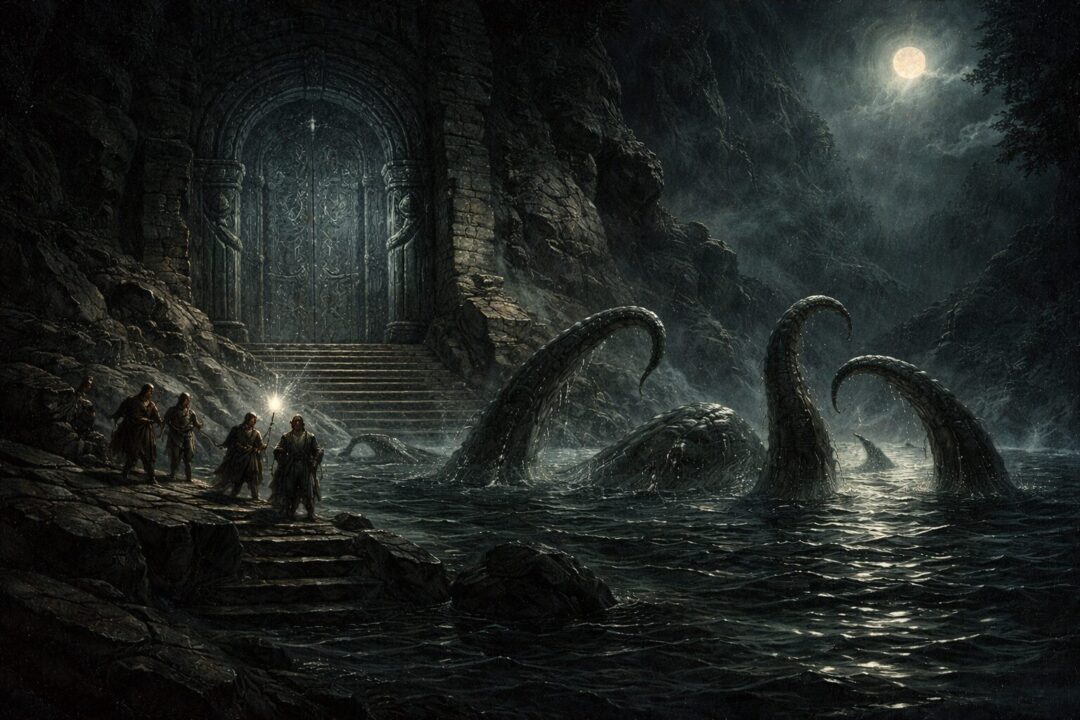
During the War of the Ring, Middle-earth does not merely struggle against a single, unified threat.
It stirs.
Long-buried powers surface. Forgotten terrors re-enter the world. Creatures older than kingdoms—and in some cases older than memory—awaken from centuries, even millennia, of silence. The earth itself seems to remember things it once tried to forget.
And yet the greatest watcher of all does not respond.
Sauron, whose will stretches across vast distances and whose attention bends the fate of nations, never appears to notice these events. There is no sign that the emergence of a Balrog in Moria, or the stirring of other ancient evils, alters his plans in the slightest. His strategies remain fixed. His attention remains locked forward.
This is not because Sauron is weak.
It is because his power is focused in a very specific—and very limited—way.
The Illusion of Total Awareness
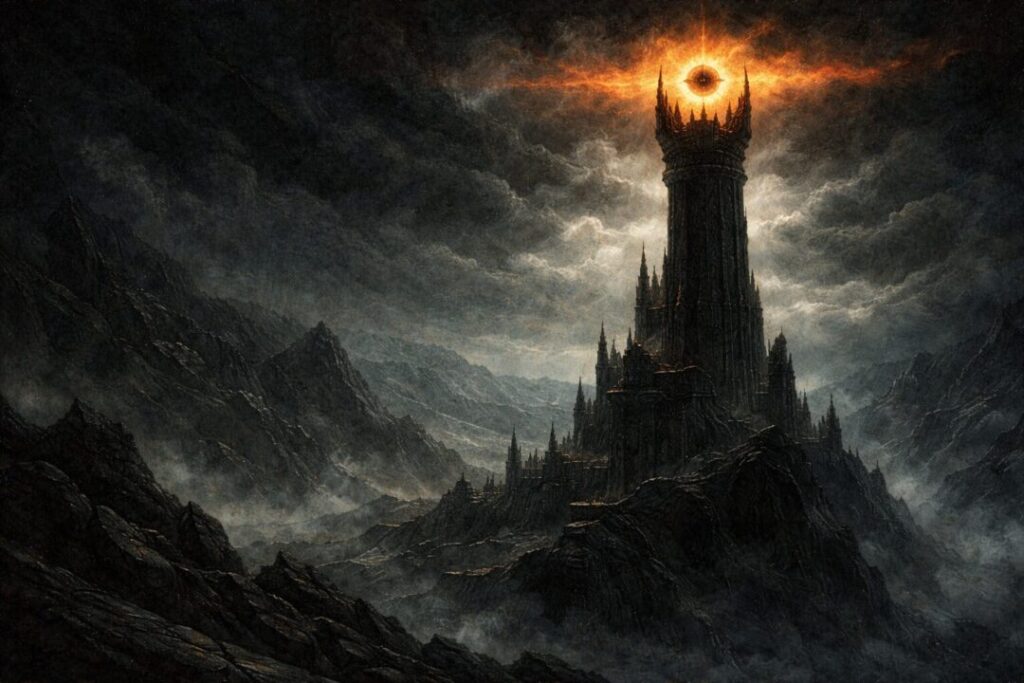
Sauron is often imagined as all-seeing. The Eye, the palantíri, the Nazgûl—everything about him suggests omnipresent surveillance. His shadow seems to fall across the whole of Middle-earth.
But this impression is misleading.
Sauron does not perceive everything.
He perceives what he is attuned to.
His awareness is strongest where power is organized, claimed, or contested. Kings, armies, rings of power, fortified realms—these form the structure of his attention. He watches Gondor because it resists him. He monitors Rohan once it begins to stir. He hunts relentlessly for the One Ring because it threatens his dominion in a direct and absolute way.
What Sauron watches is ambition.
Movement toward authority.
Defiance of his order.
Claims of rule that rival his own.
Ancient evils do not operate within this framework.
They do not seek thrones.
They do not build empires.
They do not issue challenges.
They simply exist.
And to Sauron, existence without ambition is nearly invisible.
The Balrog of Moria: A Power Outside the Game
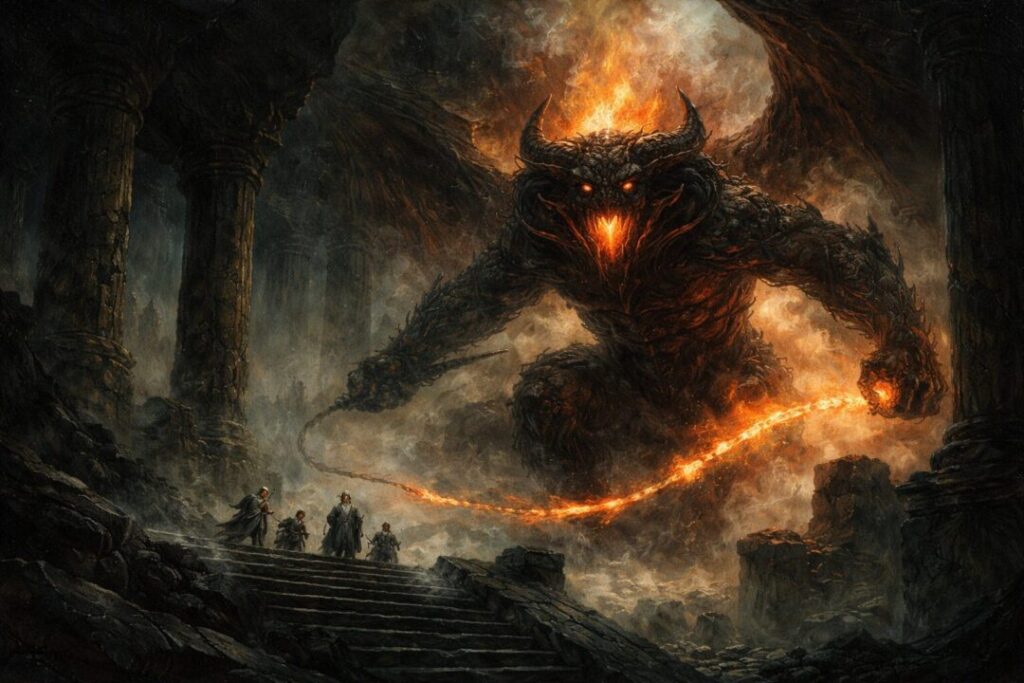
The clearest example is the Balrog beneath Khazad-dûm.
Balrog is not a servant awaiting orders. It is a remnant of an earlier world—one that predates Sauron’s current ambitions. Though they once served the same master in the ancient past, they do not answer to each other.
The Balrog has no interest in conquest.
It does not spread influence.
It does not rebuild a fallen dominion.
It hides.
For centuries after the fall of Khazad-dûm, it remains dormant, content to rule a silence beneath the mountains. Even when awakened by the Dwarves, it does not march forth. It does not proclaim itself. It does not reshape the world.
When the Fellowship encounters it, the Balrog acts only in immediate response—pursuing intruders, defending its domain, then falling into ruin.
From Sauron’s perspective, this is not a developing threat.
It is a static danger.
Contained. Localized. Predictable.
Sauron watches motion.
He watches intent.
The Balrog has neither.
A power that does not move toward domination does not register as meaningful within Sauron’s worldview.
The Watcher in the Water and the Problem of Nameless Things
Outside the West-gate of Moria, something else stirs.
Watcher in the Water is never named, never classified, never explained. Gandalf himself suggests that it belongs to a category of beings that even Sauron does not govern—creatures older than the Dark Lord’s rise, shaped by the deep places of the world rather than by deliberate will.
These are often referred to, cautiously, as nameless things.
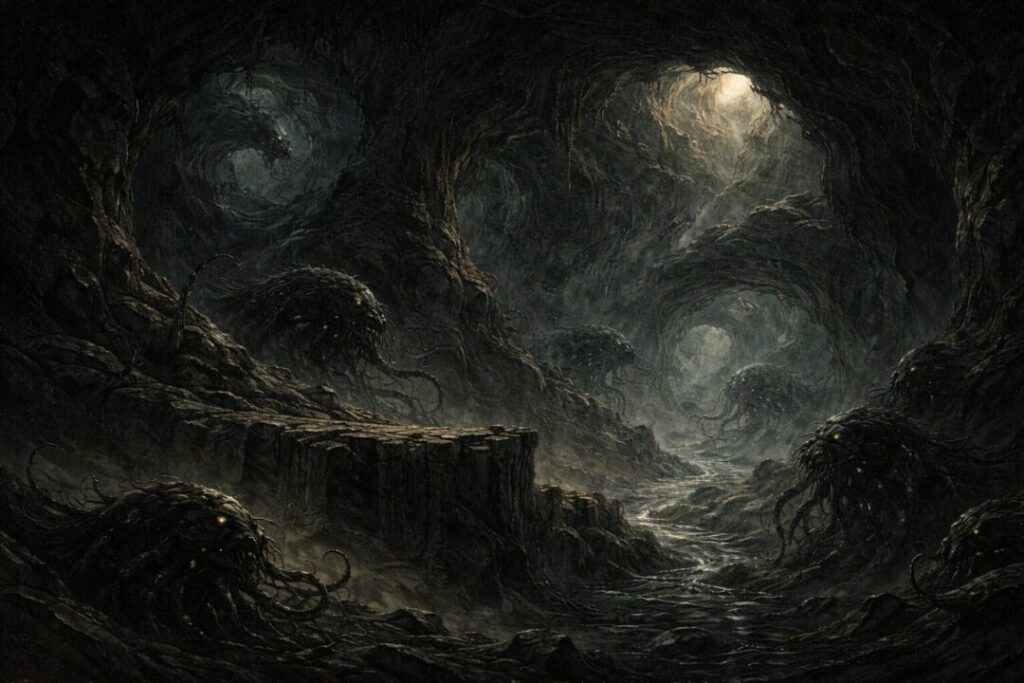
They dwell beneath the world.
They burrow, endure, and wait.
They do not serve causes.
Such beings fall completely outside Sauron’s perception—not because they are hidden, but because they are irrelevant to his framework of power.
Sauron’s evil is structured. It is hierarchical, deliberate, and ordered. He builds systems. He delegates authority. His cruelty is methodical, almost industrial.
The nameless things are the opposite.
They are chaotic.
Stagnant.
Uninterested in dominion.
They do not threaten him in the way he understands threat, because they do not seek to replace him. They do not challenge his rule. They do not imagine a world shaped in their image.
To Sauron, that makes them unimportant.
Power Versus Possession
One of the most important distinctions in Middle-earth is the difference between having power and seeking power.
Sauron seeks power relentlessly. He defines himself by acquisition and control. Everything he notices is filtered through this obsession. Even resistance matters to him only insofar as it disrupts his claim to authority.
Ancient evils already possess power—but they do nothing with it.
They do not contest him.
They do not resist him.
They do not desire his downfall.
And so they escape his notice.
This is the same blind spot that leads Sauron to misjudge the greatest danger of all.
Not the Balrog.
Not the Watcher.
But Hobbits.
Hobbits, too, do not seek power.
They do not dream of rule.
They do not hunger for domination.
They do not imagine themselves shaping the world.
And because of that, they pass beneath Sauron’s gaze just as surely as the ancient horrors beneath the mountains.
Why Sauron Cannot See What He Cannot Understand
Sauron is not a god. He is not omniscient. His perception is constrained by his own nature.
He cannot imagine action without ambition.
He cannot imagine threat without rivalry.
He cannot imagine significance without dominion.
Anything that does not fit into these categories becomes background noise.
This is why he never considers that the Ring might be destroyed rather than claimed. Why he cannot conceive of a plan that does not culminate in a throne. Why he assumes that anyone who finds the Ring will use it to challenge him directly.
His mind is locked inside a single axis of meaning: power must be taken, wielded, and displayed.
Everything else is invisible.
Thematic Meaning: Why This Blind Spot Matters
Sauron’s failure to notice ancient evils is not a plot hole.
It is a thematic statement.
Evil in Middle-earth is not unified. It does not cooperate by default. Some evils are too old, too indifferent, or too inward-facing to serve larger ambitions. They persist not because they are effective, but because they are patient.
And Sauron, for all his might, cannot see beyond his own desires.
This is why the Ring is destroyed not by a rival power, but by quiet persistence. By chance shaped by mercy. By endurance rather than conquest.
The world is not saved by something stronger than Sauron.
It is saved by something he cannot recognize as meaningful at all.
The Final Failure
Sauron does not fall because he overlooks ancient evils.
He falls because he overlooks everything that does not think like he does.
He cannot see goodness without ambition.
He cannot see danger without defiance.
He cannot see significance without domination.
And so the smallest hands, the quietest wills, and the least ambitious hearts pass through the center of his empire unnoticed.
That blindness—more than any sword, spell, or siege—is what finally ends him.