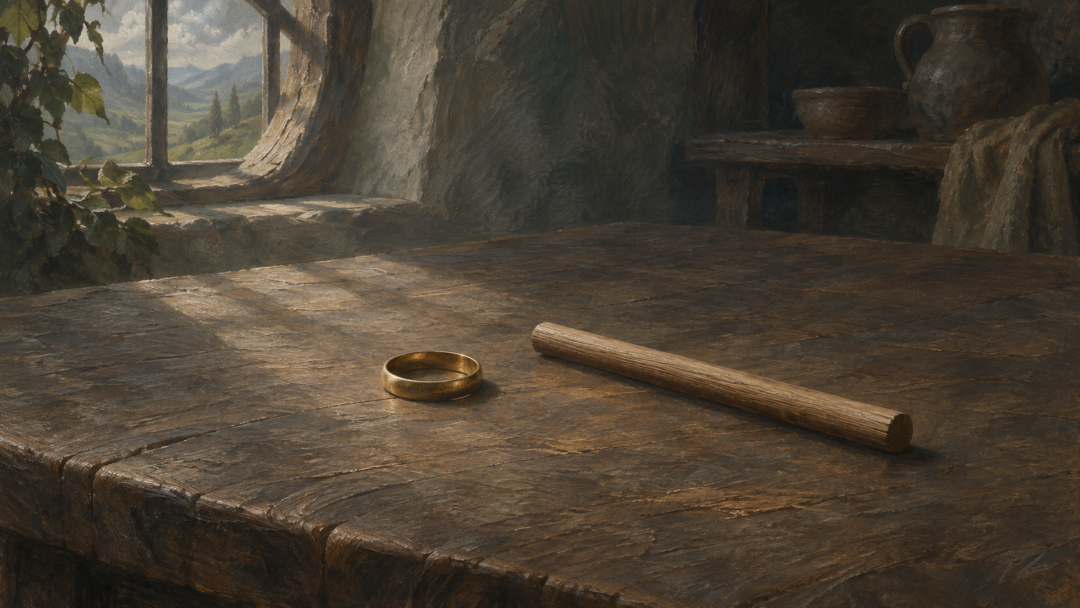
In Rivendell, Frodo wakes to find the One Ring on a new chain around his neck. It is a wonderfully ordinary detail among ancient powers: someone has secured a dangerous little object rather than leave it loose in a pocket. Which raises a practical question. If a chain works, why not fix the Ring to a wooden stick so nobody can slip it onto a finger?
The honest answer is that Tolkien never describes anyone proposing or testing such a device. An attachment might make accidental wearing harder; nothing establishes that every fastening would magically fail. But preventing someone from putting the Ring on by mistake is not the same as preventing the desire to possess it or deciding to destroy it. That is where the apparently simple solution runs out of road.

What Would the Stick Actually Prevent?
Imagine a wooden dowel with the Ring fixed around it rather than dangling freely. If the attachment holds, a finger cannot go through the Ring in that position. This is a physical precaution, not a claim about enchanted wood. It inserts an extra step between an impulse and wearing the Ring. Whether a knot, peg, or fastening would survive the journey is a practical question the narrative never tests.
That extra step could be valuable. The Ring is small, easily handled, and capable of making its wearer invisible. Preventing it from being slipped onto a finger immediately might discourage a hasty action under pressure. A traveller sheaths a sharp blade for a similarly limited reason: the arrangement helps prevent one kind of mishap without guaranteeing its owner will always act wisely.
Making an action inconvenient is different from making it impossible. A removable fastening leaves the bearer the choice to undo it. A permanent fastening could be thrown into the Fire with the Ring, so detaching it need not be part of the plan. But the holder could not make its bearer take that final action. These are questions about a hypothetical design, not hidden rules of Middle-earth. The stick addresses a narrow handling problem, provided its fastening works.
The Book Already Gives Frodo a Precaution
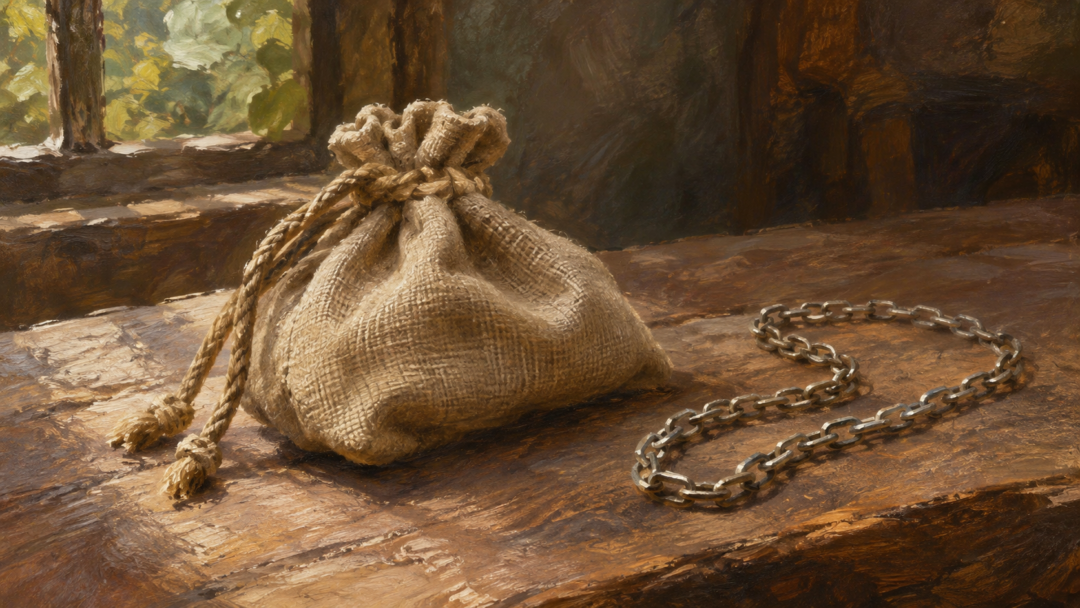
The chain in Rivendell is worth taking seriously. Frodo discovers it after recovering from his journey to the Ford of Bruinen; we are not told who put it there. The Ring has been secured for carrying, and the arrangement is clearly possible. The absence of a wooden dowel does not mean Elves or hobbits were incapable of using simple attachments. They already use one.
Yet the chain has a revealing limitation. At Weathertop, before reaching Rivendell, Frodo draws out the Ring and puts it on as the Black Riders approach. His action is bound up with fear and pressure, not an unguarded ring rolling onto his hand. A different fastening might have delayed that movement, but the story does not tell us whether a delay would have changed his decision.
A chain suits the business of travelling. Frodo must walk, sleep, scramble through difficult places, and avoid losing the object his enemies seek. A stick might be manageable too, but its length, fastening, and concealment would involve trade-offs. We can consider those possibilities without pretending the Council held a workshop and rejected the idea. The evidence is a chain that exists, not a test of every alternative.
Wearing the Ring Is Only One Kind of Danger
Wearing the Ring is a particular act, with particular effects. For a hobbit, invisibility is the most obvious. Carrying it is different: Frodo bears it for much of the journey without wearing it. Claiming it or attempting to wield its power is different again. Treating these acts as interchangeable makes the stick seem more protective than it is, assuming every danger begins when the Ring crosses a knuckle.
Bilbo supplies a more intimate example. Seeing the Ring again in Rivendell, he longs for another look, and Frodo responds with alarming possessiveness. The Ring is on its chain, yet the encounter is troubled by attachment, memory, and reluctance to share. Neither hobbit needs to wear it for the moment to become painful. The chain works as a carrier, but cannot settle what the Ring means to either of them.
Boromir makes the distinction sharper. Near the end of the Fellowship’s journey together, he tries to persuade Frodo to give him the Ring, then attempts to seize it. He believes Gondor could use it against Sauron. The danger is not accidental wearing but an argument for taking possession and employing power. Had Frodo carried the Ring on a stick, Boromir’s proposal would still have required an answer.

The Council Was Choosing an End, Not Just Safe Storage
At the Council of Elrond, the dispute is not how to package the Ring. Boromir urges the Free Peoples to use it against their enemy. Elrond answers that someone powerful enough to overthrow Sauron by mastering it could become another tyrant. His warning is precise: “The very desire of it corrupts the heart.” Desire comes before successful use, so an obstacle to wearing does not answer the temptation to command.
Elrond refuses the Ring for either concealment or wielding, and Gandalf agrees. This does not mean they forbid practical safeguards. They will not make themselves its possessors, trusting their strength or good intentions to make its power safe. Their concern reaches beyond the next moment of contact. Even a securely fastened Ring remains an object that someone might seek to control.
The Council considers hiding the Ring beyond Sauron’s reach. Tom Bombadil is discussed as a guardian, but his lack of interest does not make him reliable. Sending the Ring over the Sea is rejected; casting it into the ocean would not ensure safety forever. These proposals expose a weakness in the stick idea: tidier custody does not end the danger of recovery, theft, or pursuit.
Elrond’s decision turns toward Mordor: “We must send the Ring to the Fire.” The Ring was made in Mount Doom, and no craft available to the Council can unmake it elsewhere. A travel precaution might help get it there, but cannot replace that destination. Their objective is not to keep the Ring off the wrong finger for a few weeks. It is to end the threat of its continued existence.
What the Stick Theory Cannot Tell Us
No scene shows a fastening breaking, a wooden holder changing shape, or the Ring defeating a mechanical restraint. No passage explains how securely it could be tied, pegged, or enclosed. Claims that the Ring would inevitably slip free, move by itself onto a hand, or corrupt the wood would be inventions. So would the promise that a clever fastening could make its bearer immune to temptation.
Even stick conceals different proposals. Is the Ring loose on a rod with ends too wide to pass through? Tied to a short dowel? Attached until it is destroyed? Each version changes how the bearer might pack, retrieve, hide, or hand it over. The books provide no materials test or fastening diagram. There is no definitive engineering verdict to extract from them.
A sensible party might use a pouch, chain, or extra restraint to reduce risks on the road. That would not contradict the Council’s reasoning. The mistake is giving those devices powers the story never grants. A secure container cannot decide what its keeper will do if an ally demands the Ring, an enemy corners them, or an opportunity to use its power appears. Such moments require judgment as well as equipment.

Frodo’s Task Was Still a Choice
After the Council weighs the alternatives, Frodo freely offers to carry the Ring toward Mordor. Elrond does not compel him, and Sam insists Frodo should not go alone. These details get overlooked when the quest becomes a problem of transporting a hazardous object. Its bearer must choose the task, and others must help him survive it. A well-designed holder could assist, but cannot volunteer or remain faithful on anyone’s behalf.
Sam’s time as Ring-bearer gives this further weight. Believing Frodo dead near Shelob’s lair, he takes the Ring, wears it briefly amid danger, and eventually returns it to Frodo in the Tower of Cirith Ungol. Possession passes from one person to another, and returning it is consequential. No fastening supplies the loyalty and restraint on which that exchange depends.
The final approach to Mount Doom is more uncomfortable. Frodo reaches the place where the Ring can be unmade, but claims it instead. Gollum’s struggle with him brings the Ring into the fire. We cannot know whether a hypothetical stick would have changed the event; none figures in it. The ending shows that reaching the right place, with destruction possible, is not the same as being able to choose it.
The appealing thing about the stick idea is its common sense. Even a terrifying object might benefit from a simple precaution, and the story never rules that out. But the decisive image remains a small Ring at the edge of the Fire, where no clasp or chain can make the final choice for the person who carried it there.
Sources & Notes
- Tolkien Gateway, The One Ring — possession, temptation, wearing, and destruction — https://tolkiengateway.net/wiki/The_One_Ring
- Tolkien Gateway, The Council of Elrond — why using, hiding, and sending away the Ring were rejected — https://tolkiengateway.net/wiki/The_Council_of_Elrond
- Tolkien Gateway, Mount Doom (chapter) — Frodo's final claim and the Ring's destruction — https://tolkiengateway.net/wiki/Mount_Doom_(chapter)
Reading references: The Fellowship of the Ring, Many Meetings, The Council of Elrond, and The Breaking of the Fellowship; The Return of the King, The Tower of Cirith Ungol and Mount Doom. No stick or fastening experiment is narrated. Mechanical precautions are distinguished from the Ring's temptation and the choice to destroy it.