In Tolkien’s world, weapons are never just weapons.
A sword carries the intent of its maker.
A blade remembers the hands that shaped it, the battles it survived, and the cause it served.
Steel, in Middle-earth, holds memory.
Because of this, when a weapon passes from its rightful bearer into the hands of an enemy, the act is never neutral. It is never merely practical. It is symbolic, psychological, and deeply bound to how evil operates in Tolkien’s legendarium.
Throughout The Lord of the Rings, we see a recurring and unsettling pattern: enemies who keep the arms of those they defeat—not as scrap, not as raw material, but as objects of meaning. They are collected, displayed, reused, and sometimes deliberately defiled. These are not trophies taken lightly. They are proof of domination.
This behavior is not incidental background detail. It reflects Tolkien’s understanding of evil as something that seeks not only to conquer bodies and lands, but to erase identity, memory, and continuity.
Trophies From the Fallen
At the most basic level, the explanation seems simple. Weapons are taken from those who die. Battlefields are stripped. The dead do not need their arms, and war is costly.
But Tolkien consistently shows that something more deliberate is happening.
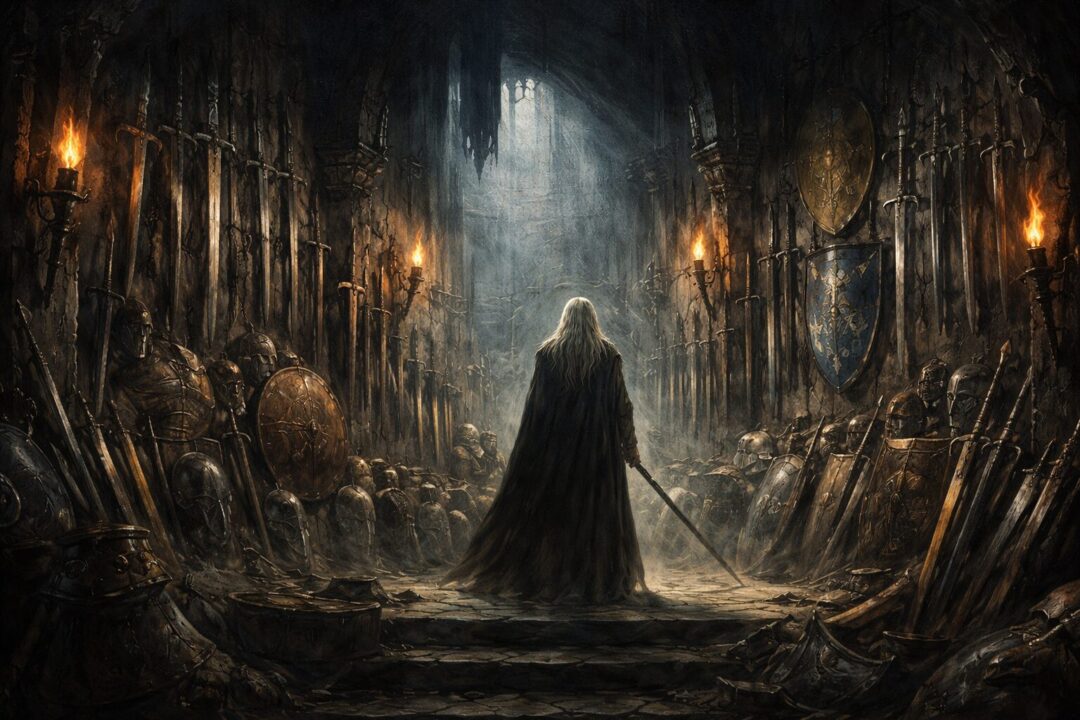
When Saruman turns against the Free Peoples, Orthanc becomes more than a fortress. It becomes a place of accumulation. Shields, blades, tools, and relics from many cultures of Middle-earth are gathered within its walls. These objects are not destroyed. They are not immediately reforged. They are kept.
This is important.
Saruman is not ignorant of symbolism. He is a Maia, a being of deep knowledge, once charged with guiding the peoples of Middle-earth against Sauron. When he collects the weapons of his enemies, he is not acting out of necessity. He is curating evidence. Proof of his own ascendancy and of the decline of those he once claimed to serve.
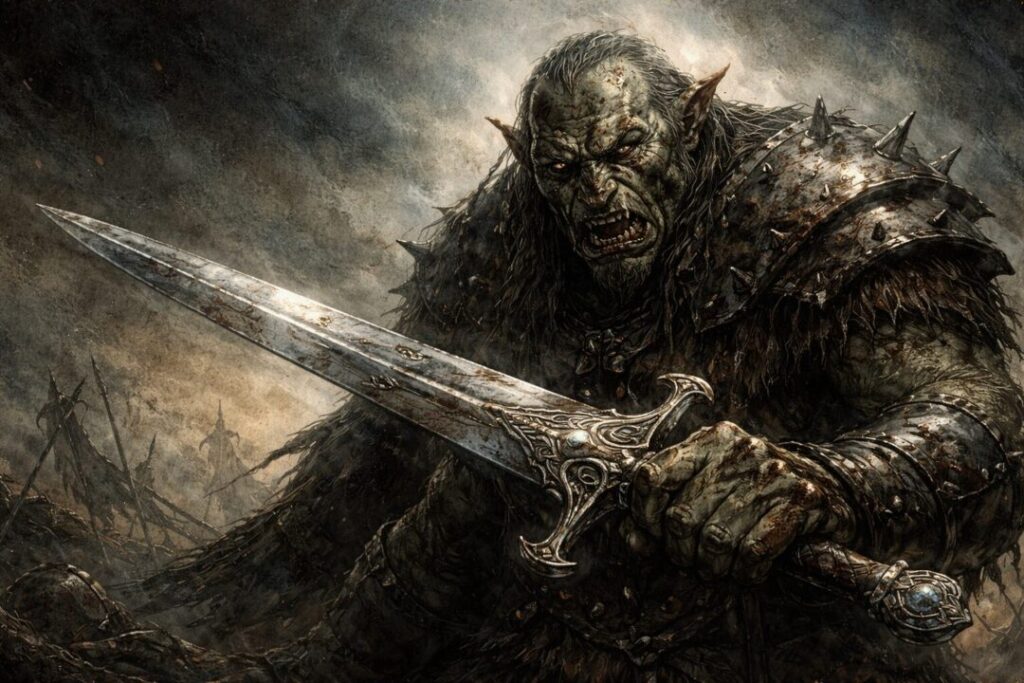
The same pattern appears among the Orcs. Orcs are frequently described wielding stolen elven swords, Númenórean blades, and gear taken from fallen Men. These weapons are often mistreated—chipped, scratched, misused—but they are rarely discarded. To carry such a weapon is a statement: your craft now answers to me.
These are trophies, yes—but trophies with intent.
Why Enemy Weapons Matter
To understand why this matters, we must understand how the Free Peoples relate to weapons in the first place.
In Middle-earth, arms are extensions of identity.
Elven blades are works of art and foresight. Some glow in the presence of evil, not because they are enchanted for spectacle, but because they were forged with awareness of the darkness they would one day face.
Dwarven weapons are tied to lineage and memory. A dwarf’s axe is often bound to clan, inheritance, and honor. It is not simply replaced.
The swords of Men frequently bear names—Andúril, Narsil, Herugrim—names that carry history, prophecy, and responsibility. To wield such a blade is to step into a story larger than oneself.
When an enemy takes such a weapon, they are not merely disarming a foe. They are interrupting a narrative. They are claiming the right to decide how that story ends.
Saruman understands this deeply. His betrayal is not only political or military—it is cultural. By collecting the weapons of his enemies, he is asserting that their traditions, their craftsmanship, and their inherited meanings are finished. He positions himself as the inheritor of a world he believes is passing away.
This is why captured weapons recur so often in the hands of darkness. They are symbols of a future stolen before it can arrive.
Hatred, Corruption, and Imitation
One of Tolkien’s clearest moral principles is that evil cannot truly create. It can only imitate, twist, and corrupt.
The Dark Powers cannot forge beauty equal to the Elves. They cannot produce craftsmanship born of patience, love, and memory. Instead, they steal such creations and remake them into something diminished.
This applies not only to living beings—Orcs themselves are a corrupted mockery—but also to objects.
When an enemy fights with a stolen blade, it is an act of mockery. The weapon still carries echoes of its origin, but it is now used for the opposite purpose. What was forged to defend becomes a tool of oppression.
When many such weapons are kept together, the act becomes ritualistic. A private language of dominance.
Each blade says: I survived you. You did not survive me.
Each blade says: Your past now serves my present.
This is how evil in Middle-earth sustains itself—not through innovation, but through possession.
When the Collection Begins
Notably, these collections do not appear late in a villain’s arc. They begin at the moment of transformation.
Saruman’s descent is not marked first by open war, but by accumulation. He gathers lore, studies rings, stockpiles resources, and collects objects of power. Knowledge becomes possession. Possession becomes justification.
The same pattern appears elsewhere in Tolkien’s work. The moment a figure turns fully toward domination, they begin to keep rather than destroy.
Destroying is impulsive.
Keeping is intentional.
To keep something is to believe it belongs to you—not just materially, but narratively.
Keeping is control.
Keeping is memory rewritten.
Not Practical — Personal
If this practice were about efficiency, these weapons would be immediately melted down. Steel would be reforged. Materials reused.
But that is not what we see.
Instead, weapons remain close.
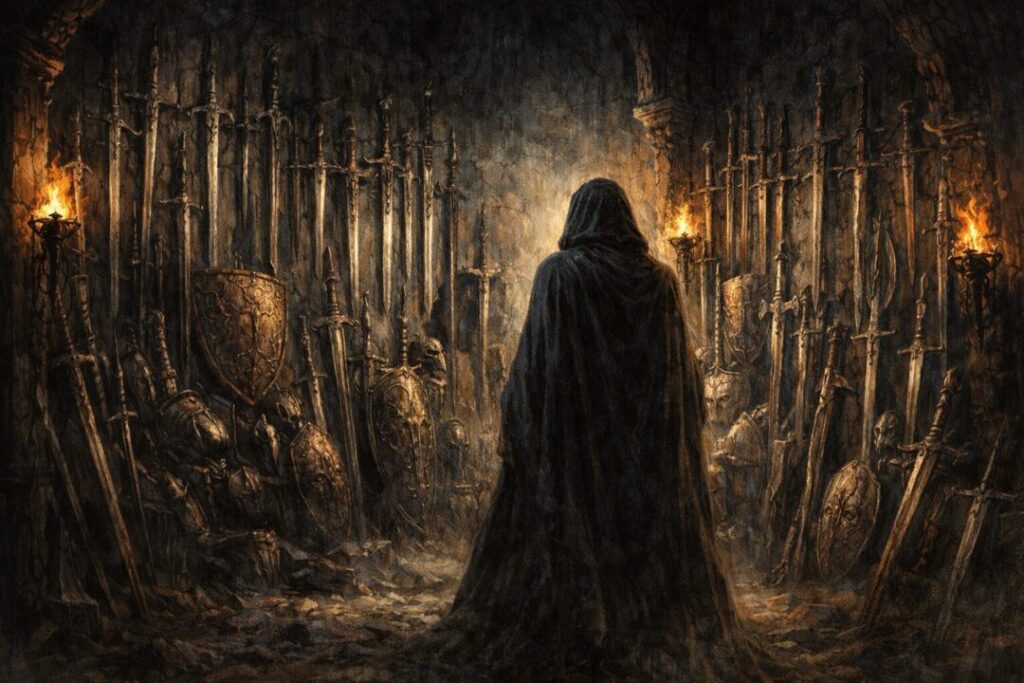
Blades are hung in towers.
Helms are stacked in pits.
Rings are counted, named, remembered.
These are not armories. They are shrines of resentment.
Each object is a reminder of someone defeated, a people diminished, a resistance broken. These collections reassure the enemy that their hatred is justified, that their violence has meaning.
They are souvenirs of grievance.
They reflect not strength, but obsession.
The Psychological Function of the Trophy
From a psychological perspective, collecting weapons serves another purpose: it externalizes blame.
By surrounding themselves with the objects of fallen enemies, villains reinforce a narrative in which they are not aggressors, but survivors. Each trophy becomes evidence that others stood in their way and paid the price.
This is especially important for characters like Saruman, who begin with noble intentions. The trophies help him rewrite his own story. He is no longer a traitor—he is a realist. No longer a servant—he is an inheritor.
Weapons, in this sense, become tools of self-deception.
What These Weapons Represent
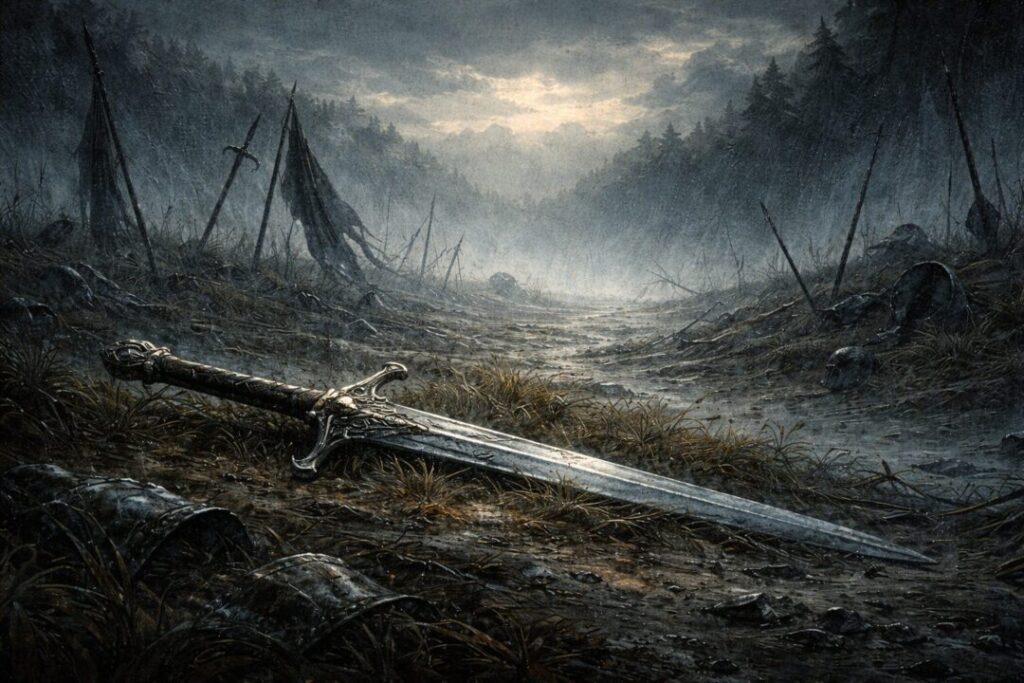
Every collected weapon represents a story cut short.
A blade that will never return home.
A lineage interrupted.
A song unsung.
A future denied.
In Tolkien’s moral universe, this matters profoundly.
Evil does not merely kill bodies. It seeks to kill memory. To make the past feel irrelevant and the future feel predetermined.
That is why moments of reclamation are so powerful in The Lord of the Rings.
When a broken sword is reforged, it is not just repaired steel. It is history restored. When a lost weapon returns to the hands of the Free Peoples, memory itself pushes back against erasure.
Why Reforging Matters
This is why Tolkien places such weight on acts of recovery.
Narsil becoming Andúril is not about upgrading a weapon. It is about continuity. About the refusal to let meaning die simply because power has shifted.
Reclaimed weapons do what evil cannot tolerate: they reconnect the present to the past without distortion.
They say: We remember who we are.
The Deeper Pattern
Ultimately, the enemies of Middle-earth collect the weapons of the fallen because they fear what those weapons represent.
They fear memory.
They fear continuity.
They fear the idea that stories do not end simply because they are interrupted.
By keeping these objects, they attempt to freeze history at the moment of their victory.
But Tolkien’s world does not allow that to last.
Because memory, once reclaimed, is stronger than possession.
And so the story continues.