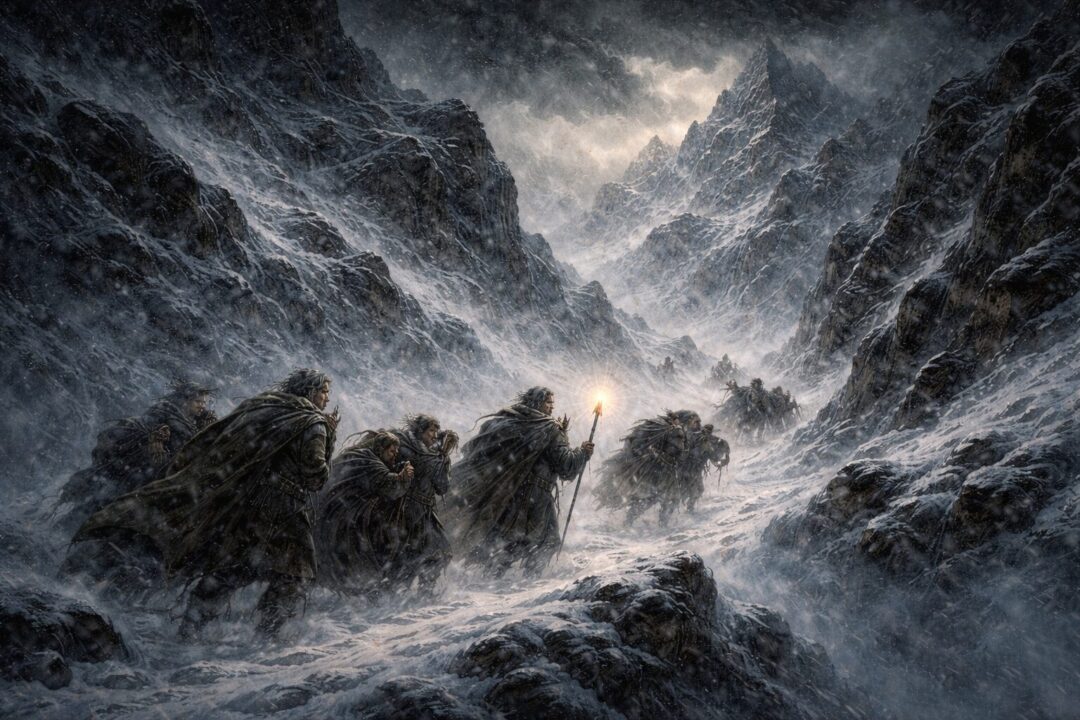
When the Fellowship of the Ring attempts to cross Caradhras, the Redhorn Pass, the journey quickly turns from difficult to outright hostile. Snow falls thick and relentless, the wind scours skin and cloth alike, and the mountain itself seems to resist every step. Stones fall without warning. Paths vanish beneath drifts. Even the strongest among the Company begin to falter.
Yet amid this struggle, something subtle but telling happens.
Bill the Pony—steady, sure-footed, and bred for rough country—fails before the Hobbits truly do.
At first glance, this feels wrong. Bill is a sturdy pony from Bree, accustomed to cold roads and long journeys. The Hobbits—especially Frodo Baggins and Samwise Gamgee—are small, lightly built, and far from the comforts of the Shire. If anyone should collapse first in a blizzard high in the Misty Mountains, surely it would be them.
And yet, as the crossing worsens, it is Bill who struggles most, while the Hobbits press on through the storm.
So why does the pony suffer first?
The answer lies not in weakness, but in burden, labor, and choice—and in the quiet cruelty of Caradhras itself.
Load, Labor, and the Cost of Each Step
Bill is not simply walking across the mountain.
He is working.
From Bree onward, Bill carries the Fellowship’s supplies: food, cooking gear, blankets, and tools needed to survive the road ahead. By the time they reach Caradhras, those packs are heavy, awkward, and soaked through with snow and ice. Every step Bill takes through deep drifts demands far more energy than a step taken by someone unburdened.
Tolkien notes that the snow on Caradhras rises “knee-deep” even for the Men. For a pony, pushing through snow of that depth means lifting legs high with every stride, breaking crusted ice, and fighting resistance that drains strength quickly. The work compounds with each mile.
Movement does generate warmth—but only briefly. When exertion becomes constant, and rest is denied, the body begins to lose heat faster than it can replace it. Muscles burn through energy reserves. Breath shortens. Fatigue sets in.
Bill moves almost continuously, head down, shoulders straining beneath the weight. He cannot stop when he needs to. He cannot lighten his load. He cannot choose a safer pace.
The Hobbits, by contrast, are walking.
Hobbits and the Art of Endurance
Hobbits are often underestimated, both in Middle-earth and by readers who focus too much on their size. Yet Tolkien repeatedly shows that Hobbits possess a quiet, stubborn resilience. They are built for long roads, modest food, and discomfort endured without complaint.
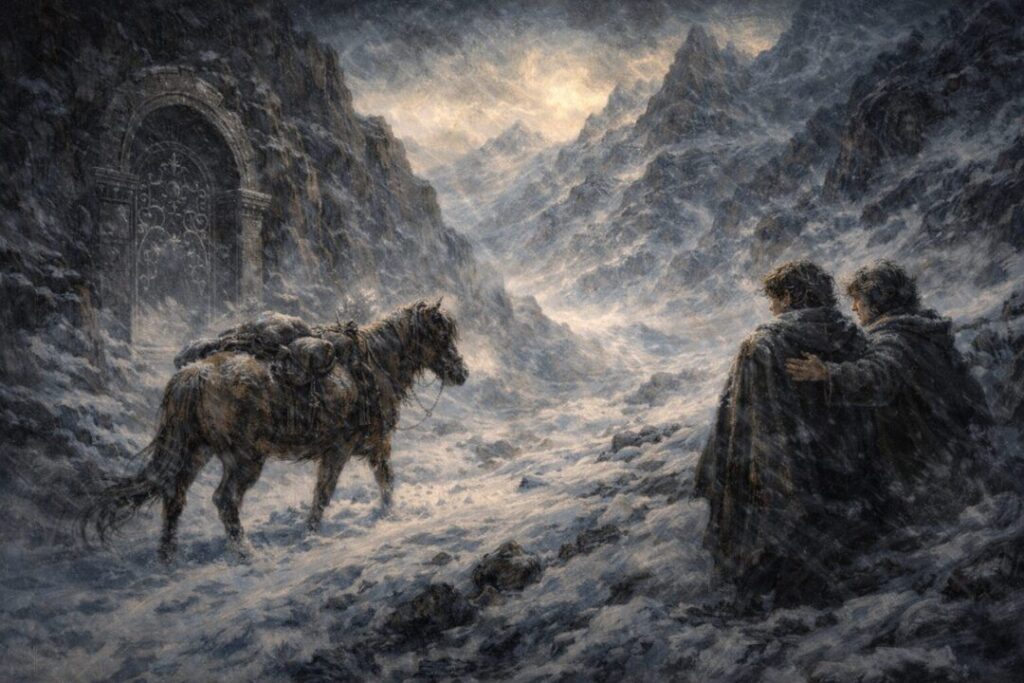
Frodo and Sam are already hardened by weeks of travel before reaching the mountains. They know how to walk steadily for hours, how to keep moving without burning themselves out. When the wind becomes unbearable, they huddle closer. When the cold bites too sharply, they pull cloaks tight and lower their heads.
Even before receiving the Elven cloaks of Lothlórien, the Fellowship shares what protection they can—adjusting packs, redistributing gear, helping one another through drifts. When someone stumbles, another is there to catch them.
Bill has none of this.
He cannot ask for help. He cannot redistribute weight. He cannot slow the march or seek shelter without being told to do so. His role is fixed: carry, move, endure.
That lack of agency matters more than strength ever could.
Exposure Without Choice
Cold alone does not kill quickly. Exposure does.
Bill is exposed in ways the Hobbits are not. Wind scours his flanks. Snow packs into his coat. Ice forms along his legs and belly. He sweats from exertion, and that moisture freezes almost as soon as he pauses, pulling warmth from his body.
The Hobbits, though miserable, are allowed moments of stillness. They can shelter briefly behind rocks. They can tuck hands into sleeves, adjust scarves, and stamp their feet to restore circulation. Even small actions like these make a difference over time.
Bill cannot perform such small acts of self-preservation.
And Caradhras gives him no mercy.
The Will of the Mountain
Caradhras is not merely a high pass with bad weather.
It is hostile.
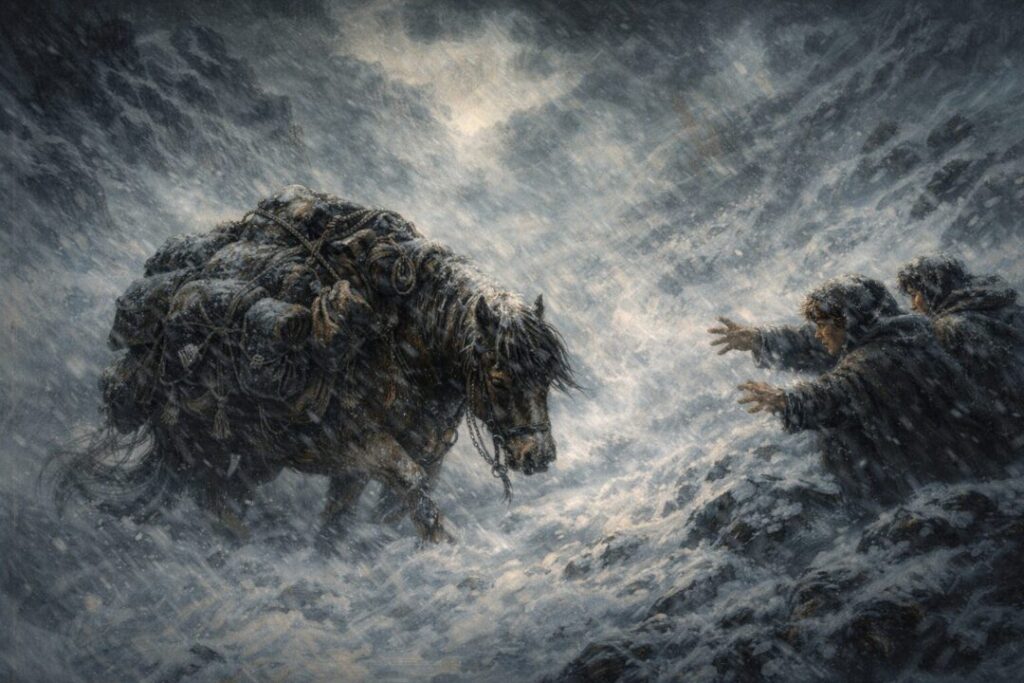
Whether one interprets the storm as a natural fury or as something darker—perhaps stirred by ancient malice—the result is the same. The mountain seems to punish effort itself. Snow falls harder the higher they climb. Stones crash down without warning. Paths that were passable moments before vanish under fresh drifts.
For a laden animal, every delay is dangerous. Every stumble risks injury. Every pause allows cold to sink deeper into muscle and bone.
Eventually, even Gandalf must concede defeat. The mountain will not be crossed. The Fellowship turns back, retreating toward the western side of the range.
By then, Bill is nearly spent.
Why Bill Cannot Go On
When the Company reaches the Doors of Moria, it becomes clear that Bill cannot continue.
The path ahead will lead into darkness, narrow stone ways, and dangers far worse than snow. Even if Bill could physically proceed, the journey would likely kill him.
So the Fellowship makes a quiet, merciful choice.
They release him.
This moment is often overlooked, but it is one of the gentlest decisions made in the entire journey. Bill is not cast aside. He is unburdened. His packs are removed. He is turned loose with the chance to follow his instincts, seek shelter, and move at his own pace.
It is an act of trust as much as mercy.
And Tolkien later rewards that trust.
Bill survives.
After the War of the Ring, he is found alive and well, having made his way back to Bree. In a story filled with sacrifice and loss, Bill’s survival stands as a quiet reminder that not every burden must end in death.
Endurance Is Not About Strength Alone
So why does Bill the Pony collapse on Caradhras before the Hobbits do?
Not because he is weaker.
But because he is carrying more, working harder, and given fewer choices.
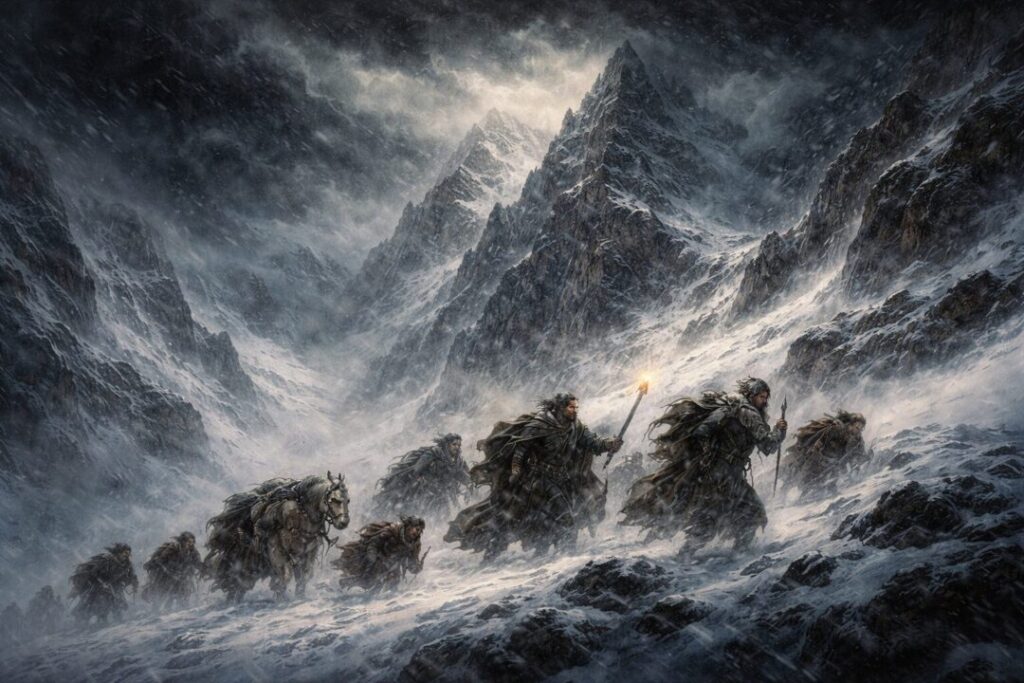
The Hobbits endure because they can adapt. They can share burdens. They can decide when to suffer and when to stop. Bill cannot. His strength is spent not in weakness, but in service.
In Middle-earth, survival is rarely about raw power. It is about patience, mercy, and knowing when to let go.
And sometimes, the kindest act is not to push forward—but to turn back, unburden what you love, and let it live.