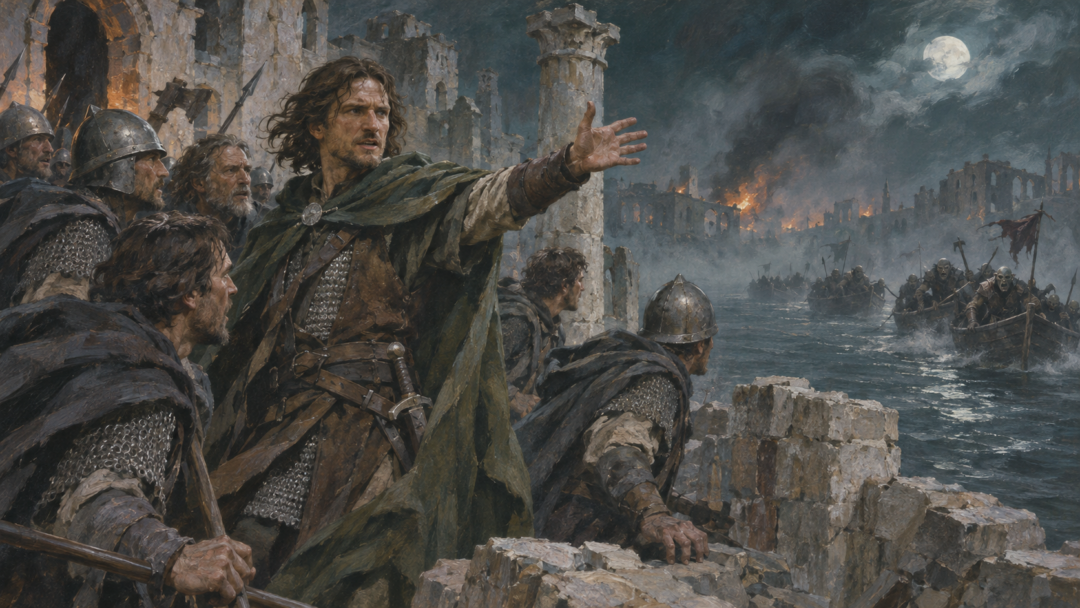
The Anduin is almost still in the darkness. Across it come low boats packed with Orcs, their oars disturbing the water beneath ruined Osgiliath. A Gondorian sentry spots them and is shot. Faramir rallies his men, but instead of lining the bank to strike the crowded vessels, they crouch behind broken pillars. Some attackers reach shore and rush by before the defenders emerge. Why give them that opening?
The film depicts an ambush intended to contest the landing, not a surrender of the shore. Yet its execution invites serious tactical criticism. The filmmakers wanted Faramir to appear brave and overwhelmed by superior numbers; the available production commentary does not explain why his men let the first Orcs get past their cover. The story's explanation for his defeat and the effectiveness of the tactics shown are separate questions.
What happens at the riverbank
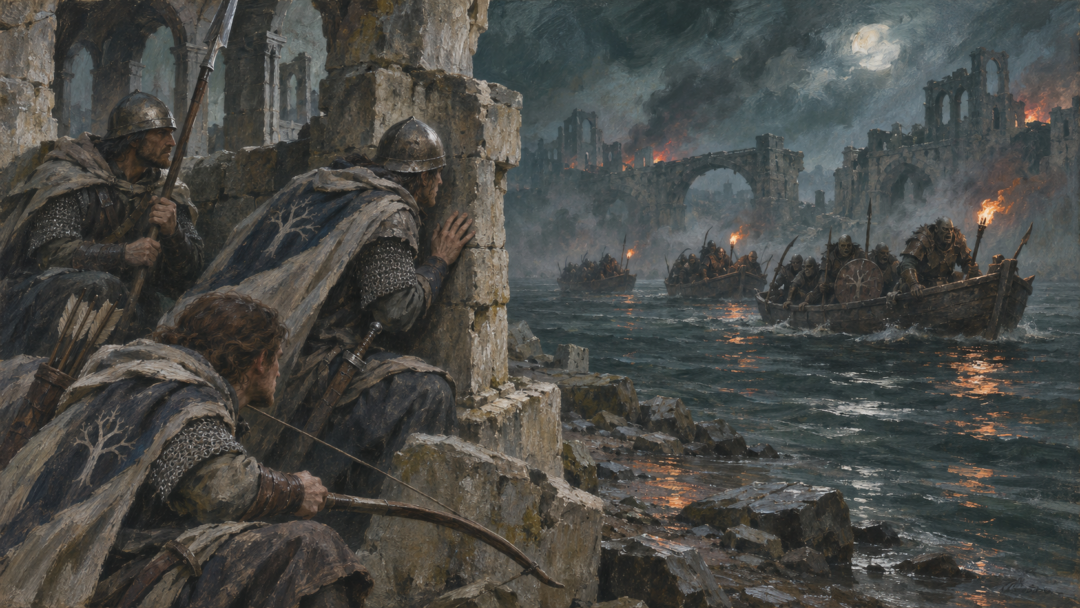
Madril reports an eerie quiet across the river and scouts sent toward Cair Andros, where an attack from the north might be detected. The Orcs instead approach directly across the Anduin under cover of darkness. Once the lookout falls, Faramir recognizes the danger and orders his men to the river. His reaction is immediate. This is no commander refusing to engage an enemy he sees coming.
A transcript of the finished film describes the men gathering behind pillars at the riverbank and attacking as the Orcs arrive ashore. That matters because the criticism can become exaggerated. Faramir does not wait until the whole invasion force marches inland; his soldiers fight at the landing itself. What looks strange is their positioning and timing within those first moments, when the attackers might be most vulnerable.
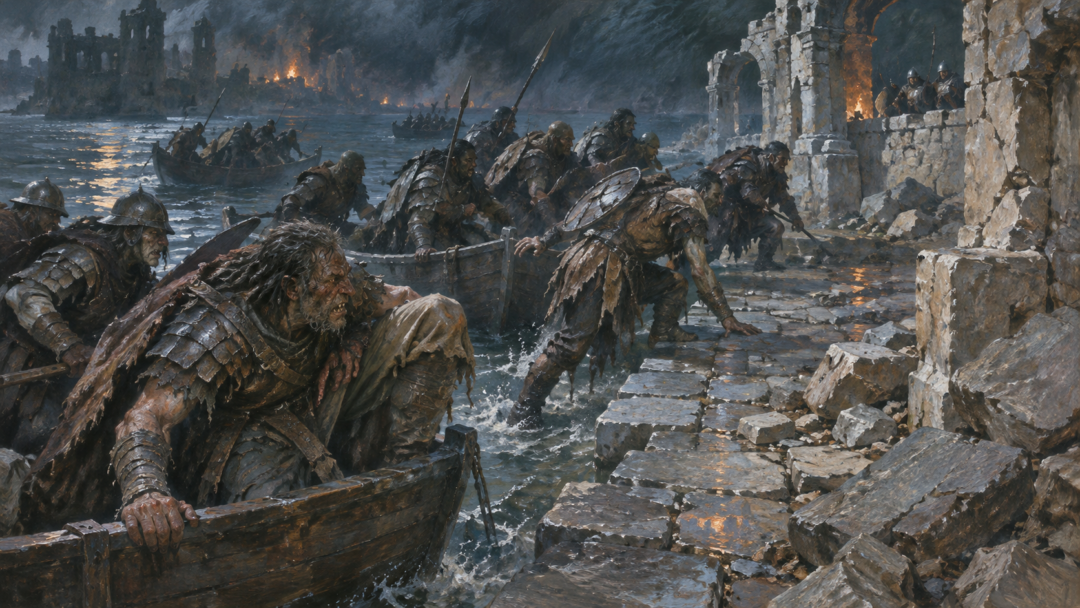
Military historian Bret Devereaux, examining the Siege of Gondor on A Collection of Unmitigated Pedantry, identifies the sharper problem: the defenders allow the first rank of Orcs past before rushing toward the waterline. That may isolate some attackers between Gondorian groups, but it produces a costly, disordered fight. The film offers no reliable count of Orcs slipping through, so the issue is the visible choice of engagement, not a supposed tally of enemies deliberately ignored.
Why an army in boats is especially vulnerable
Crossing a river is not the same as arriving ready for battle. Soldiers packed into boats must make landfall, find footing, clear their companions and form up. Until enough stand together on firm ground, they cannot use their numbers like troops already deployed ashore. A crowded quay or narrow bank makes that transition worse. The opening moments offer defenders a temporary advantage even when the larger battle is hopeless.
That makes missile fire an obvious possibility. The boats are exposed on the water, and the ruins offer elevated or sheltered positions. Archers could potentially disrupt the crossing before Orcs reach land; infantry might meet those who disembark. Devereaux argues for firing from the ruins and using Gondor's shields and spears in a coherent line. This is an assessment of what the equipment and terrain might permit, not proof Faramir had exactly the right troops immediately available.
The Orcs' approach is not inherently absurd. Darkness, mist and surprise help move troops across a defended river, especially if guards are spread through a shattered city. Their advantage diminishes once the lookout is killed and Faramir realizes what is happening, but the crossing is already underway. Nor would an earlier attack automatically stop it. There may be several landing points, the defenders cannot be everywhere, and more landings could overwhelm even a well-positioned unit.
What hiding behind the pillars accomplishes—and risks
Concealment is not foolish by itself. Broken masonry screens troops from view and may protect them from missiles while they wait. If attackers believe the waterfront unguarded, a sudden rush from the ruins can catch them off balance. In a city of blind corners, ambushes are plausible. Yet these Orcs have come armed and expecting to fight. Surprise might disrupt them without preventing an immediate response. The question is whether it is worth missing the chance to attack men still confined to boats.
The pillars also provide cover. Once Orcs move beyond them, however, those hiding places may no longer shield Gondorians from enemies beside or behind them. A line that allows opponents through risks losing its own front. Instead of forcing attackers through a controlled obstacle, defenders can end up fighting in several directions, unable to keep shields and spears working together.
Devereaux acknowledges one potential gain: leading Orcs can become trapped between defenders emerging behind them and those confronting the landing. But trapping some attackers is not stopping the crossing. Gondor must preserve soldiers as well as inflict losses. A sudden melee is fierce resistance, yet it can squander the discipline and defensible ground that help an outnumbered force endure.
The stronger alternative is a delaying defense
It is tempting to imagine Gondor massing at the water, shooting boats to pieces and driving Orcs back into the Anduin. But that assumes too much. We do not know every viable landing point, where Faramir's men were posted or how much warning they could obtain. A thin line stretched across the waterfront might break in several places. The real question is not whether one dramatic stand could save Osgiliath forever.
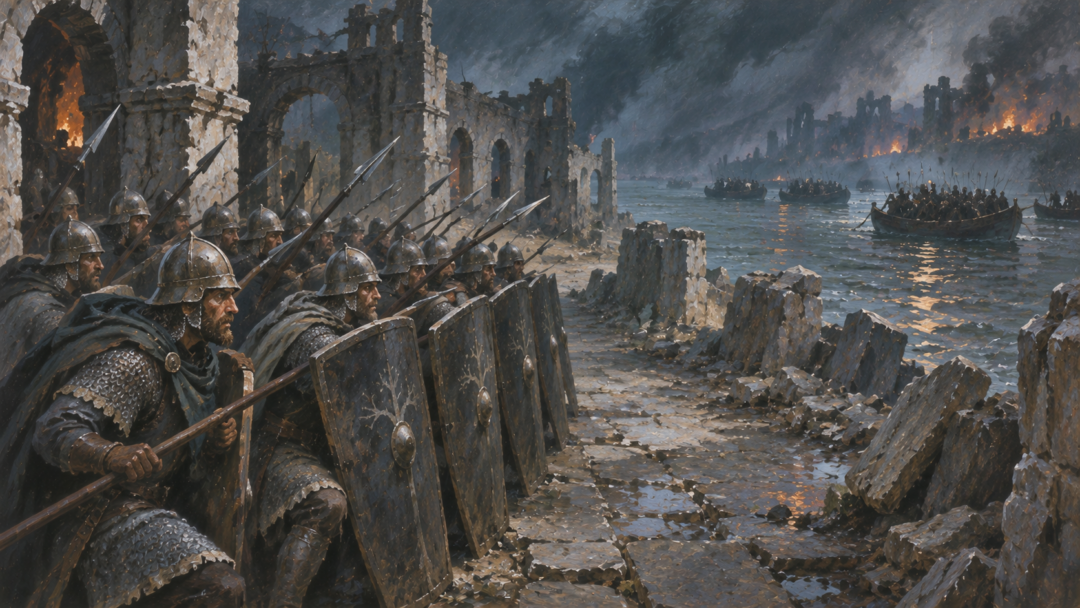
Devereaux proposes something more restrained: concentrate near the principal road through the ruins, strike the first wave with organized heavy infantry and delay movement through the city. Then withdraw before landings elsewhere turn the defenders' flanks. Such a plan would exploit the crossing without demanding that Gondor hold every broken wall. It is a historian's reconstruction of a possible deployment, not a plan Faramir is documented ordering or a guaranteed success.
The road matters because Osgiliath is more than a city to seize: it is a route onward. Mordor needs the crossing and western approaches to move toward Minas Tirith. Temporarily blocking the main passage could have value even if Orcs gained footholds elsewhere. Time to assemble, to withdraw and to force invaders to deploy for another fight are useful results. Holding ground and delaying an advance are not identical objectives.
A shield line, however, is not magic. A larger army can threaten its flanks, find other approaches or keep sending reinforcements. Faramir might still have to abandon Osgiliath quickly. But a withdrawal by troops who remain together can preserve a force for the next position. That is another weakness of the film's scramble: Gondor's defenders appear to lose their organization almost as soon as the assault reaches them.
What the filmmakers actually intended for Faramir
The production commentary for The Return of the King makes one point unusually clear. The writers and director wanted Osgiliath's fall to demonstrate Faramir's determination, not failure through his own mistakes. He was a captain doing all he could against an enemy whose strength dwarfed his. This is direct evidence for the character's intended portrayal, but not an explanation for the particular ambush behind the pillars.
The commentary also describes how the battle was assembled. Peter Jackson describes older Orc boat-landing footage intercut with new material he directed featuring David Wenham as Faramir. Some of Wenham's fighting was added separately to establish his participation in the defense. That confirms the scene combines differently produced material. It does not establish that the filming process caused the disputed timing or positioning.
We therefore cannot say the filmmakers deliberately gave Faramir bad tactics to create suspense, or that editing constraints forced Orcs to run past. Neither is documented. The supported reading is more limited: the story asks us to recognize an honorable defeat, but the staging leaves us wondering whether the defenders exploited their best immediate opportunity. Heroism and tactical persuasiveness do not always align on screen.
The book gives Gondor a different kind of battle
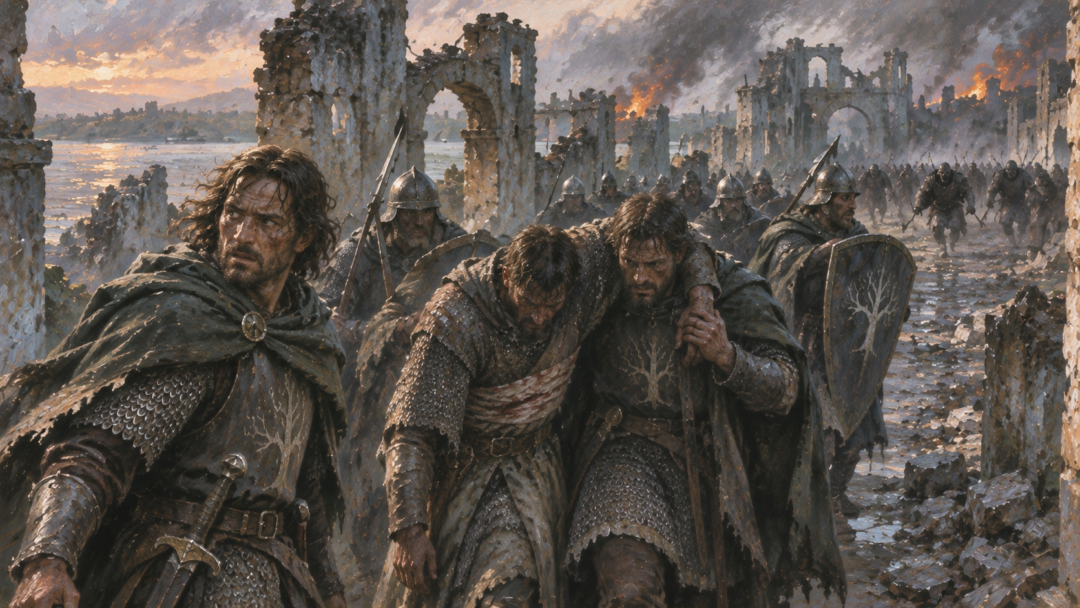
In The Return of the King, the defense of Osgiliath is mostly reported rather than witnessed at the waterfront. The Enemy's boats and barges cross the Anduin in force, and Gondor makes them pay for the crossing. Faramir nevertheless falls back. Denethor has sent him to reinforce that exposed position despite knowing the danger, making the withdrawal part of a larger effort to resist the advance. His effort is not a single street fight followed by the unprotected road to Minas Tirith: the book describes further defensive positions between the river and the White City.
These include the Causeway Forts at the Rammas Echor, the wall enclosing the Pelennor Fields. Faramir rallies his men there and later manages a withdrawal as Mordor presses onward. His command is tested not only by losses inflicted at the river, but by whether exhausted soldiers can remain an army. The account emphasizes successive resistance, a difficult rearguard action and the danger of retreat collapsing into flight.
The films omit that corresponding network of Causeway Forts and Rammas Echor defenses, simplifying the approaches to Minas Tirith. They also follow Osgiliath's fall with Denethor's order for a mounted attempt to retake it. That doomed charge is a separate decision, not the explanation for the earlier pillars. Nor does the novel describe precisely where the film's soldiers should stand as boats land. Comparing the versions reveals different military situations, not missing cinematic instructions.
The lasting image is Gondorian soldiers rising from broken stone as Orcs pour ashore. Their courage is not in doubt. Whether their ambush gives it the best chance is another matter. Osgiliath can fall because Mordor is too strong while its defense still invites scrutiny. Faramir is fighting for a city he cannot keep; the film makes his resistance honorable, but not every movement convincing.
Sources & Notes
This article is based on close reading and interpretation of Tolkien's published works and related source material where relevant.