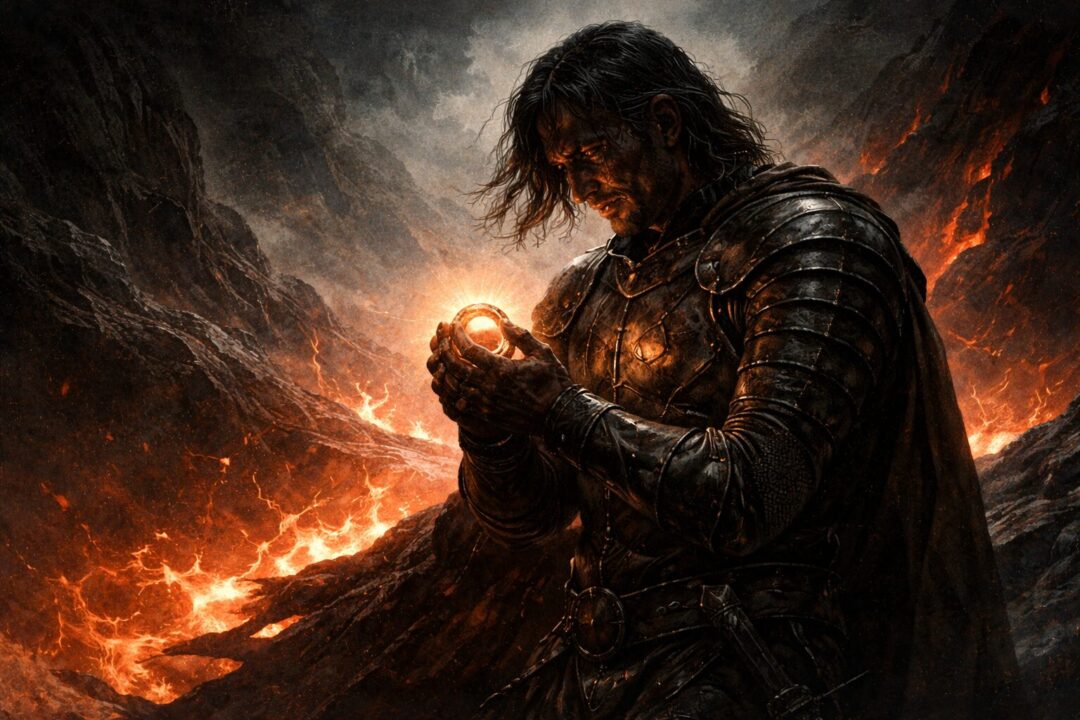
Few moments in Middle-earth provoke as much lingering frustration as the scene at the Cracks of Doom.
The war is over.
The Dark Lord has fallen.
The Ring—the source of so much ruin—lies within reach of the fire that forged it.
And yet, the chance is lost.
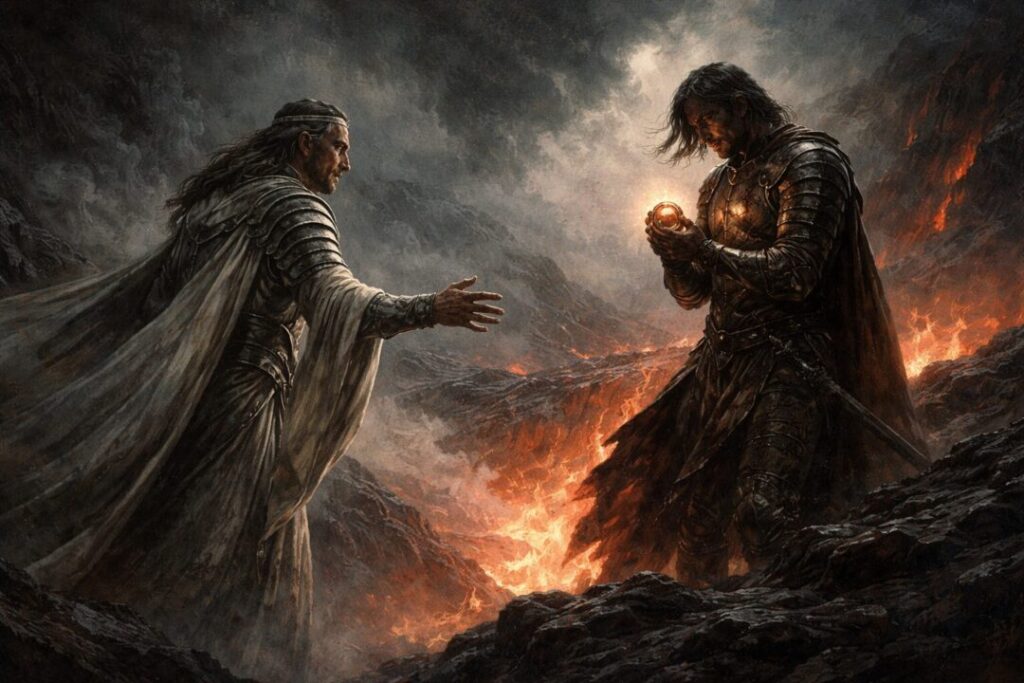
Isildur claims the Ring as a weregild for his father and brother, slain in the war against the Shadow. Beside him stands Elrond—ancient, clear-sighted, and fully aware of what the Ring truly is.
Elrond urges him to cast it into the fire.
Isildur refuses.
And Elrond lets him go.
For many readers, this feels like an unforgivable failure. A moment where wisdom falters, where mercy outweighs necessity, where the fate of the world is gambled on the weakness of one man.
Why allow grief, pride, or ambition to stand above the survival of Middle-earth?
The answer is not that Elrond did not understand the danger.
The answer is that the Ring cannot be destroyed through domination—not even for the right reasons.
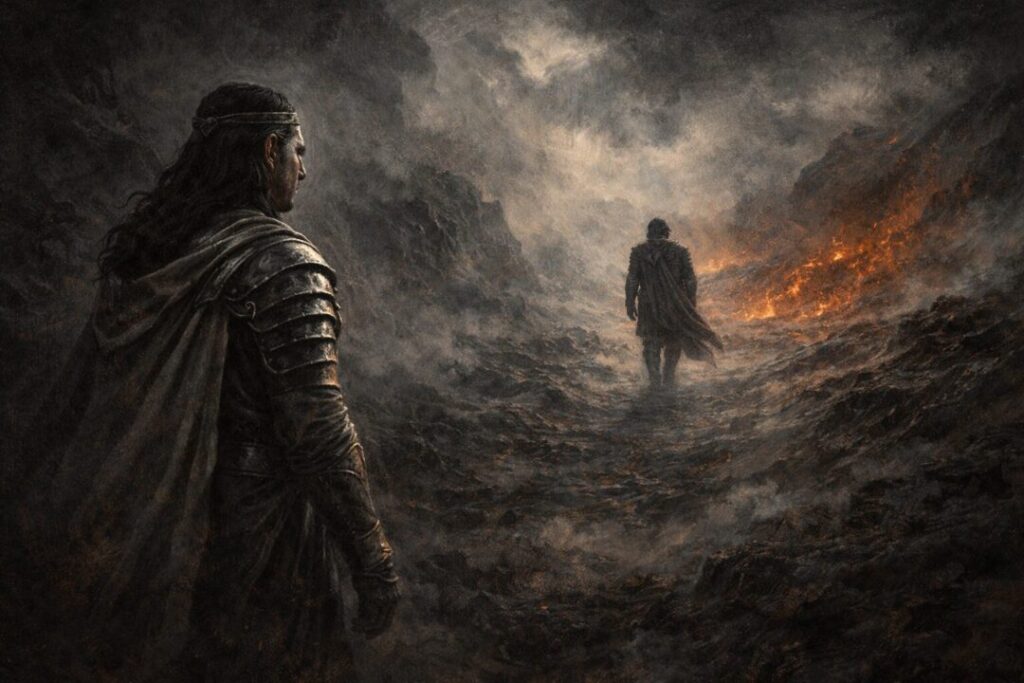
The Ring and the Nature of Force
The One Ring is not merely a powerful artifact. It is the distilled will of Sauron—a being whose entire philosophy is control.
Sauron does not simply seek victory. He seeks order imposed from above. His evil is not chaos, but domination. The Ring exists to bend other wills, to subdue resistance, to replace choice with obedience.
Because of this, every act of coercion aligns with the Ring’s own nature.
This is why the Ring corrupts not only those who desire power, but those who believe themselves strong enough to wield it wisely. The intention does not matter. The method does.
To seize the Ring by force—even to destroy it—is to speak the Ring’s language.
If Elrond had drawn his sword and compelled Isildur to obey, the Ring would not have been undone. It would have won, because its central principle would have been affirmed: that the world is saved through domination.
The Ring does not care who commands—only that command exists.
This is a crucial moral boundary in Middle-earth. Evil is not defeated by using its own tools more “responsibly.” Once domination is accepted as necessary, the victory is already hollow.
Why Violence Would Have Failed
It is tempting to imagine that a single shove, a swift strike, or a moment of ruthless resolve could have ended everything then and there.
But Tolkien’s world does not operate on such mechanical logic.
Violence does not bypass corruption—it accelerates it.
Had Elrond killed Isildur, several consequences would have followed immediately:
First, the act would have sanctified murder as a tool of salvation. That alone would poison any victory.
Second, it would have confirmed the Ring’s deepest lie: that moral ends justify absolute control.
Third, it would have placed the Ring’s fate in the hands of an act rooted in despair, not hope.
Middle-earth repeatedly shows that despair is never redemptive. When characters abandon hope and choose force as the final answer, they step onto the same road that leads to ruin.
The Ring is not destroyed by hatred of evil—but by resistance to becoming evil in response.
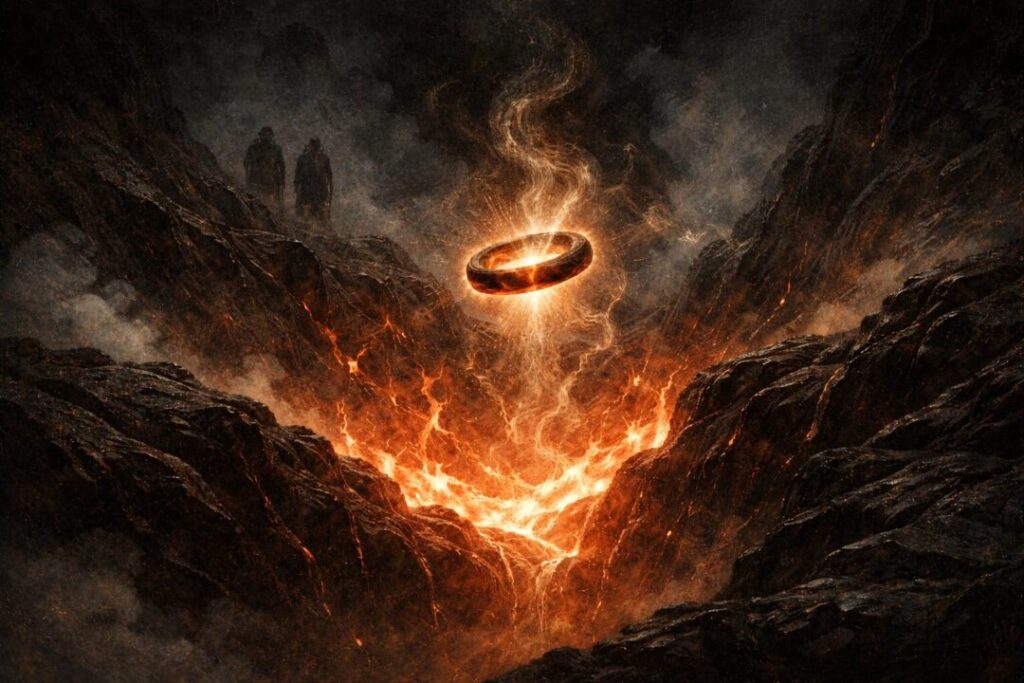
Isildur Was Not a Villain
Another common misunderstanding is the idea that Isildur was already irredeemably corrupted at Mount Doom.
He was not.
Isildur was wounded, exhausted, and grieving. He stood at the heart of the Ring’s power, at the very place where its pull is strongest. This is not a neutral setting—it is the Ring’s birthplace, its throne, its moment of maximum influence.
Even thousands of years later, Frodo—stronger in humility and mercy than almost anyone else—fails at this same point.
Isildur’s failure is not exceptional.
It is tragically human.
He does not seize the Ring out of cruelty. He names it a compensation for loss, an attempt to give meaning to unbearable grief. The Ring exploits that grief, but it does not invent it.
To kill Isildur in that moment would not have been justice.
It would have been an admission that Men are incapable of choice—and that conclusion runs counter to everything Middle-earth stands for.
Elrond’s Authority Had Limits
Elrond is wise, but he is not sovereign over Men.
He is not their judge.
He is not their executioner.
And he is not permitted—morally or spiritually—to strip another being of free will “for their own good.”
This boundary is consistent throughout the legendarium.
This is why Gandalf refuses to take the Ring, even when offered freely.
This is why Galadriel rejects it, despite knowing she could use it to preserve her realm.
This is why the Valar do not directly intervene in the Third Age.
Good cannot be imposed without ceasing to be good.
To force righteousness is to empty it of meaning.
Elrond understands this better than most. He has lived through the rise and fall of ages shaped by precisely this mistake—the belief that power, rightly used, can replace moral restraint.
That belief created the Ring in the first place.
The Cost of Allowing Choice
Letting Isildur walk away is not an act of optimism. It is an act of tragic realism.
Elrond knows the risk. He knows that the Ring will endure. He knows that suffering will follow.
But he also knows that a victory purchased through coercion would hollow the world beyond repair.
Middle-earth is not saved by flawless decisions. It is saved by imperfect beings choosing mercy, restraint, and humility—often at terrible cost.
Elrond chooses to preserve the moral order of the world, even when the immediate outcome is catastrophic.
That choice shapes everything that follows.
Why This Moment Still Matters
If the Ring could be destroyed by force, Middle-earth would be a simpler place.
But Tolkien does not write simple worlds.
Evil is not undone by strength, but by restraint.
Not by certainty, but by mercy.
Not by control, but by choice.
Elrond’s decision is not a narrative oversight. It is one of the clearest expressions of the story’s deepest values.
The tragedy is not that Elrond failed to act.
The tragedy is that there was no action available that could save the world without risking its soul.
And that is why the burden passes—not to kings or Elf-lords—but to Hobbits.
To small hands.
To fragile wills.
To courage that refuses domination even when domination seems easier.
That is the cost of freedom in Middle-earth.
And that is why Elrond steps back—and lets history unfold.