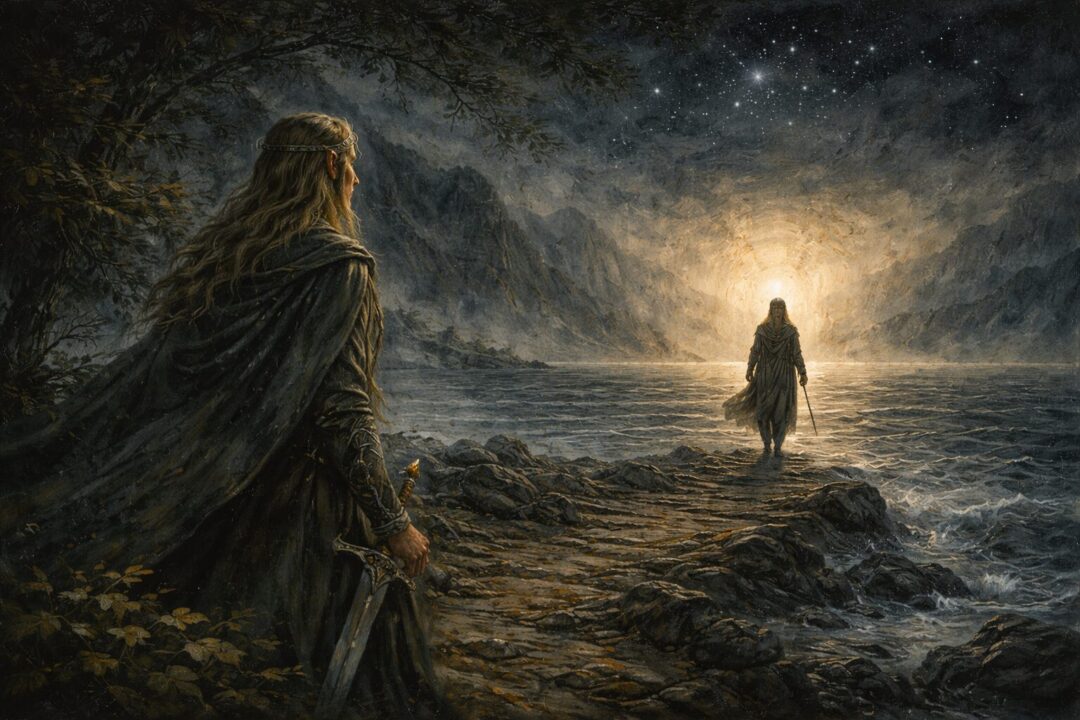
Immortality is often treated as the ultimate prize in fantasy.
To live forever is to win—outlasting enemies, escaping loss, standing untouched while the world bends around you. In many stories, immortality is power made permanent.
In Middle-earth, it is something far more complicated.
Elves do not die of age or sickness. Time alone has no authority over their bodies. An Elf may be slain by violence, or fade away under the weight of grief and long sorrow, but years themselves do not claim them. From the First Age onward, Elves remain physically unchanged, carrying memory upon memory as centuries pass like seasons.
At first glance, this seems like an obvious advantage.
But within the internal logic of Middle-earth, Elvish immortality is not a reward. It is not a mark of superiority. It is a consequence—rooted in how the Elves were made, and more importantly, why they were made.
Elves Were Made for the World, Not Beyond It
Elves are the Firstborn, awakened beside starlit waters before the Sun and Moon ever rose. When they opened their eyes, the world itself was still young and unfinished. Mountains had not yet settled into their final shapes. Forests were deeper, wider, and unbroken.
Unlike Men, whose destiny lies beyond the world, Elves were designed to belong entirely to it.
Their souls—fëar—are bound to Arda, the physical substance of creation. This bond is absolute and enduring. As long as the world exists, so too do they.
This distinction is fundamental.
Men pass through the world.
Elves remain within it.
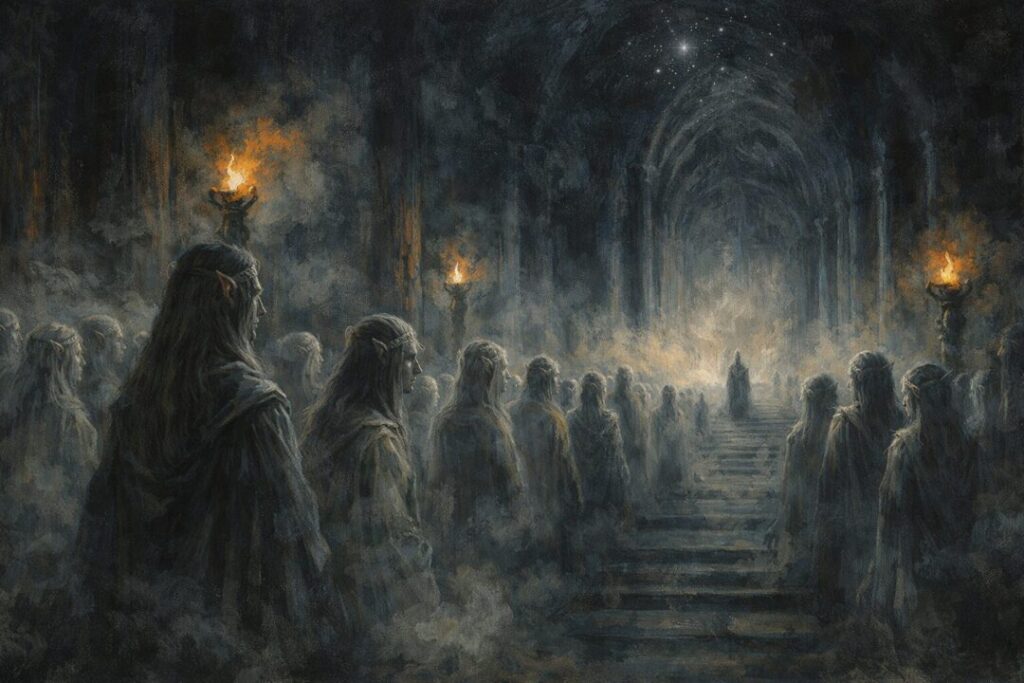
Even when an Elf is slain, their spirit does not leave creation. It is summoned instead to the Halls of Mandos, where it waits in reflection and judgment. Some spirits remain there until the end of days. Others are eventually rehoused—restored to a body identical in form, but forever shaped by memory, loss, and the weight of what has been endured.
Elvish immortality, then, is not endless life in the modern sense.
It is endless attachment.
They cannot step outside the world’s history. They must live inside it, from beginning to end.
Why Men Die—and Why Elves Do Not
In Elvish thought, the mortality of Men is called the Gift.
To mortals, death appears cruel and final. But to the Elves, it is something they do not possess—and something they quietly envy. Men are not bound to the world’s long decline. They are free to leave it entirely, passing beyond its circles to a fate unknown even to the Valar themselves.
That freedom is frightening. It is uncertain. But it is also full of hope.
Elves are denied this release.
They witness the rise and fall of kingdoms, knowing that each fall will remain with them forever. They watch forests cut down that once stretched unbroken to the horizon. They remember cities in their full beauty long after their stones have turned to dust.
Joy does not fade for Elves—but sorrow accumulates.
Every friendship lost is permanent.
Every home abandoned is remembered in detail.
Every song carries echoes of earlier, brighter versions of the world.
By the Third Age, this burden is visible everywhere.
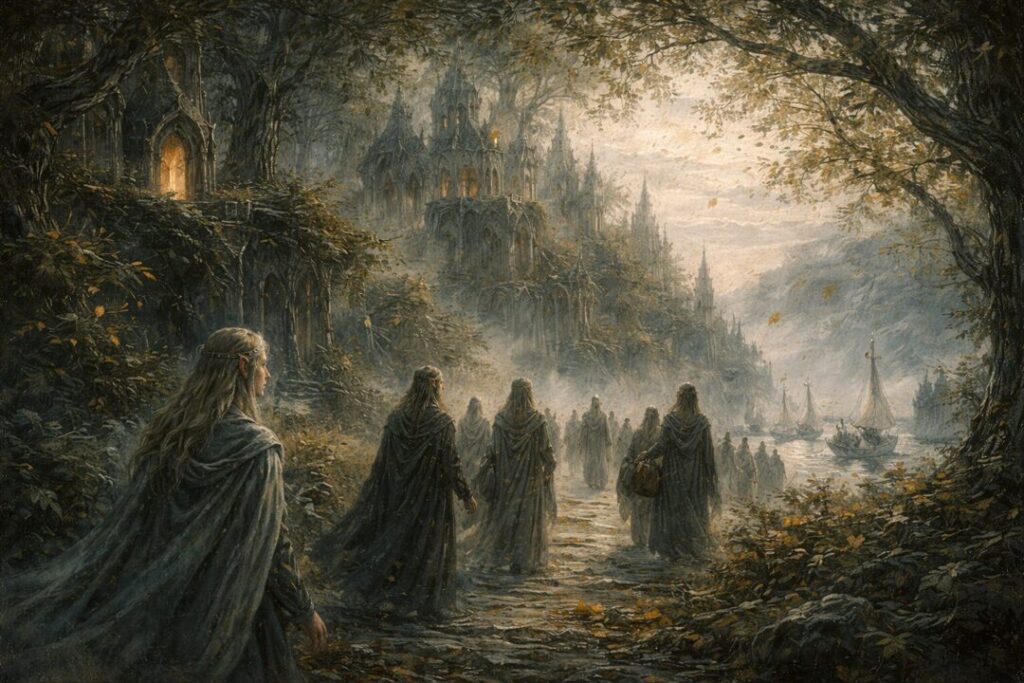
It lingers in the quiet halls of Rivendell, where songs preserve memories older than most realms of Men.
It rests in the fading light of Lothlórien, sustained by memory and power, yet already passing away.
Elvish immortality ensures that nothing is ever truly forgotten—and that is its deepest cost.
The Slow Fading of the Elves
Elves do not remain unchanged forever.
Though their bodies do not age as those of Men do, their relationship with the physical world weakens over time. As centuries pass, many Elves begin to “fade.” Their spirits grow stronger, more dominant, while their bodies become lighter, less substantial—until they exist more as memory and presence than as flesh.
This fading is not death.
It is a kind of withdrawal.
Elves who remain too long in Middle-earth risk becoming shadows of themselves—bound to the land, yet unable to fully participate in it. They become watchers rather than actors, keepers of memory rather than builders of the future.
This is why the Elves depart across the Sea.
Not because they are defeated.
Not because they are weak.
But because Middle-earth is no longer a place where they can remain fully themselves.
The world has changed. It now belongs to those who pass through it rather than those who endure within it. And the Elves, bound too closely to Arda to adapt in the same way, must choose between fading or leaving.
Immortality as Tragedy, Not Triumph
In many modern stories, immortality represents dominance—an escape from consequence, an elevation above ordinary life.
In Middle-earth, it represents responsibility.
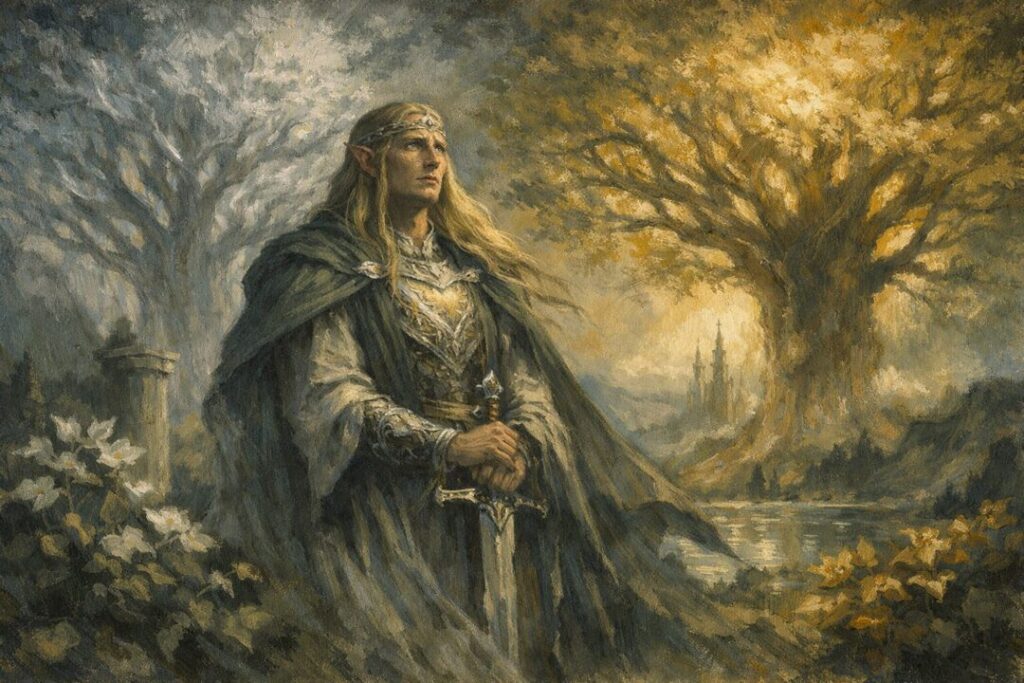
Elves were meant to preserve the memory of the world as it was meant to be. They were created to love it deeply, to give shape to beauty, to remember what others would forget. That role is noble—but it is also heavy.
When the world changes, Elves feel the loss more deeply than any other people.
They do not fear death.
They fear endurance.
To live forever means to watch everything you love become something else—or vanish entirely. It means knowing that no renewal will erase what has already been lost.
By the end of the Third Age, the time of the Elves is passing—not because they have failed, but because their role is complete. The future no longer belongs to those who remember the beginning of the world.
It belongs to those who can let go.
Why This Matters
Understanding Elvish immortality changes how we read the entire legendarium.
It explains the sorrow beneath Elven beauty.
It explains why their songs sound like laments even when they celebrate.
It explains why Men, not Elves, inherit the future.
And it explains why leaving Middle-earth is not an exile for the Elves—but a mercy.
Immortality, in this world, is not the greatest gift that can be given.
Sometimes, it is simply the cost of loving the world too deeply to ever leave it.