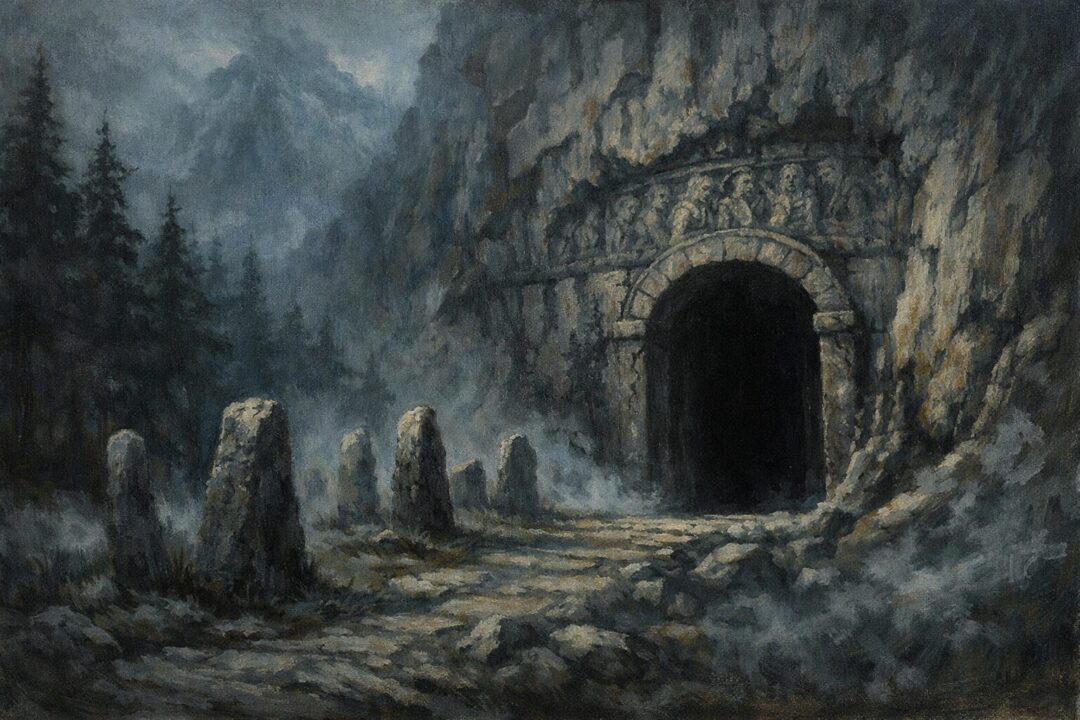
Most people remember the Paths of the Dead as Aragorn’s road.
That is true, as far as it goes.
But it is also misleading.
Because by the time Aragorn rides beneath Dwimorberg, the fear attached to that place is already ancient. The road under the mountain is not frightening merely because Aragorn chooses a desperate path in a desperate hour. It is frightening because the terror there belongs to a much older story: an oath broken in the days of Isildur, a people who never found rest, and a shadow that had lain over the southern vales for centuries.
And that is why the question matters.
Why did even Elven companions treat that place with such seriousness? Why is Legolas singled out so sharply at the Door? And why does Aragorn himself speak of the road with reluctance, not confidence? The answer is that the Paths of the Dead were never just a hidden passage. They were a lingering wound in the history of Gondor and the White Mountains.
The fear begins with the oath, not with Aragorn
The story starts in the early years of Gondor.
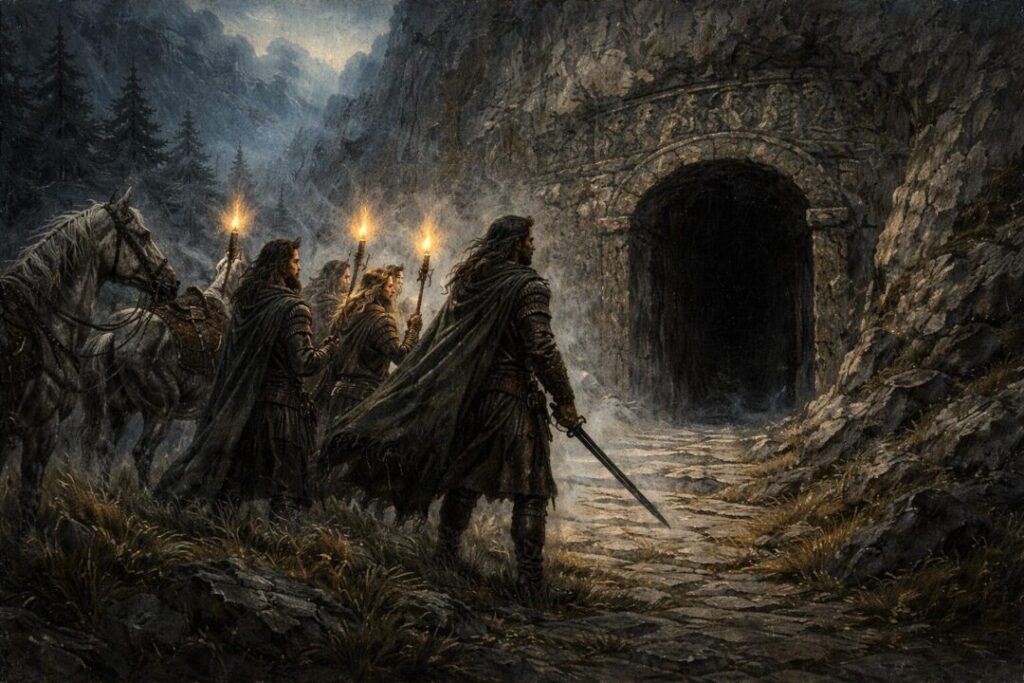
At the Stone of Erech, the King of the Mountains swore allegiance to Isildur. But when Sauron rose again in might, those Men did not fulfill their promise. Aragorn recounts that they had worshipped Sauron in the Dark Years, and when Isildur called them to war, they refused. Then came the curse: they would have no rest until their oath was fulfilled.
That matters because it tells you what sort of place the Paths later became.
The fear is not originally about underground darkness, or strange echoes, or a dangerous mountain road. It is moral before it is physical. The terror comes from oathbreaking and unrest. The Men of the Mountains become a people suspended between failure and fulfillment, and the land around them takes on that burden. Aragorn says plainly that “the terror of the Sleepless Dead lies about the Hill of Erech and all places where that people lingered.” The dread is attached not only to one tunnel, but to an entire history that has not been resolved.
So when readers imagine the Paths of the Dead as simply a haunted shortcut, they shrink the idea.
The texts present something larger.
This is a curse that endured through “years uncounted,” waiting for a final summons from the heir of the man to whom the oath had once been sworn. That is why Malbeth’s prophecy matters so much: it does not invent the terror. It recognizes that one day the old oath will be called in at last.
The dread was already old in the days of Rohan
By the time the Rohirrim come to Dunharrow, the place is already feared.
The Dark Door beneath Dwimorberg is not discovered in a neutral landscape. It stands in a region layered with old memory, old stonework, and old warnings. In the history of Rohan, Baldor son of Brego vows at the hallowing of Meduseld that he will tread the Paths of the Dead. He goes, and he never returns. His fate hardens the place’s reputation for later generations.
This episode is easy to skim past, but it does important work.
It shows that long before Aragorn uses the Paths successfully, the road is already known as something closed to the living. Baldor’s failure is not the beginning of the curse, but it is one of the clearest proofs that the dread of the place had become active historical memory. The people of Rohan do not treat the Paths as a forgotten legend. They treat them as a real boundary no wise person crosses.
That is one reason Aragorn’s decision strikes everyone around him so strongly.
He is not choosing a merely dangerous road. He is choosing the road other men have learned not to touch.
Aragorn does not go gladly
One of the most revealing details in the chapter is Aragorn’s tone.
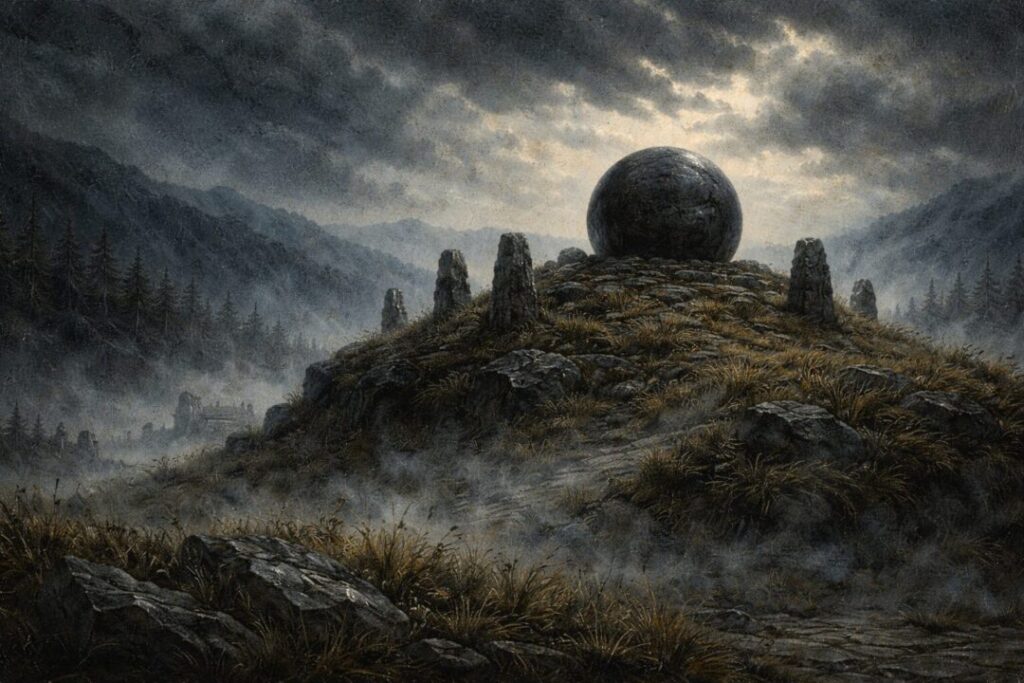
He does not boast about the Paths of the Dead. He does not speak as though he has mastered them in advance. He says that he must go that way, and that he does not go gladly, because only need drives him. He warns those who would follow that they will find “both toil and great fear, and maybe worse.”
That is a crucial detail.
Aragorn is the one person in Middle-earth who can fulfill the prophecy tied to that road. He is the heir of Isildur. He is the one who can summon the oathbreakers. He has received the reminder from Elrond through Elladan and Elrohir: “If thou art in haste, remember the Paths of the Dead.” And yet even he speaks of the choice as grim necessity, not bold opportunity.
So the text is careful.
Aragorn’s authority over the Dead does not cancel the horror of the place. It only gives him the right to endure it for a purpose no one else can accomplish.
What the text actually says about Elves and fear
This is where the title needs care.
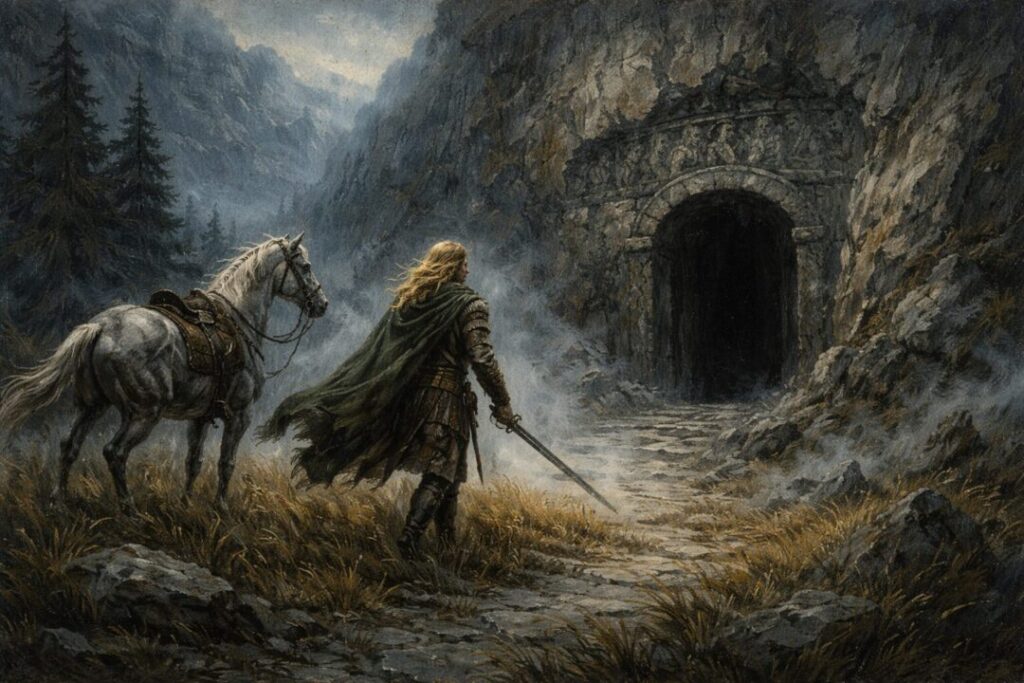
The texts do not say, in a flat universal statement, that all Elves feared the Paths of the Dead. That would be too strong. But they do give a detail that opens the question in a striking way. At the Door, the narrative says there was not a heart among the company that did not quail, “unless it were the heart of Legolas of the Elves, for whom the ghosts of Men have no terror.”
That sentence matters for two reasons.
First, it singles out Legolas. The wording does not say the Elves as a whole felt no fear. It marks Legolas individually as the likely exception. That alone tells you how overwhelming the atmosphere is. Legolas’ composure is presented as notable, not ordinary.
Second, Elladan and Elrohir are in the company. The text does not stop to explain their inner state. It does not explicitly say they feared the Dead, but it also does not separate them from the company the way it separates Legolas. So the most conservative reading is this: the passage leaves room for the idea that even Elven or Half-elven companions were not untouched by the dread of that place, while directly affirming only that Legolas stands apart from the terror of the ghosts of Men.
That is enough to support an important point.
The Paths of the Dead are not portrayed as a fear that belongs only to weak hearts or superstitious Men. Their terror is so deep that the text pauses to mark the one companion for whom the ghosts hold no terror.
And that makes the road feel older than any single traveler.
Why Legolas is singled out
Legolas later explains the scene in a way that sharpens the contrast.
After the war, when Merry and Pippin ask about the Paths, Gimli refuses to speak of them. Legolas says he felt not the horror and did not fear the shadows of Men, whom he deemed powerless and frail. That is completely consistent with the earlier line at the Door. Legolas is not brave because the place is harmless. He is brave because this particular kind of terror does not master him.
And that is exactly why the detail is so revealing.
If Legolas had simply been one more untroubled member of the company, the text would not need to emphasize him. Instead, his lack of fear is contrasted against a setting where dread is normal. The exception proves the force of the atmosphere around the Paths, not its weakness.
So when people remember the chapter only as a display of Aragorn’s kingly authority, they miss half the scene.
It is also a chapter about the weight of old terror.
The Paths were feared because they were unfinished history
At the deepest level, that is what makes this road different from other dark places in Middle-earth.
Moria is terrifying because of ancient ruin and present evil.
The Dead Marshes are terrifying because war has stained the land.
The Paths of the Dead are terrifying because the past itself is waiting there, unfinished. The oathbreakers have not passed on. The curse has not lifted. The heir has not yet come. The mountain is not merely haunted; it is holding open an old judgment.
That is why the fear is older than Aragorn.
Aragorn does not create the terror. He enters it. He becomes the one person able to bring it to its conclusion, but the dread has lain there through the long years already—over Erech, under Dwimorberg, and in the memory of peoples who knew better than to cross that threshold.
And once you see that, the chapter changes.
Aragorn’s passage through the mountain is not simply a daring shortcut before Pelargir. It is the final reckoning of a promise broken in the Second Age. The Dead do not merely help him; they answer at last for something left unresolved since Isildur’s day.
Why this changes how the scene reads
This is why the fear of the Paths matters so much.
Without that fear, Aragorn’s choice looks like bold strategy.
With it, his choice becomes something heavier: a king stepping into inherited history, into an oath he did not make but must answer, into a darkness that even he does not approach gladly. And the fact that Legolas is singled out as exceptional only sharpens the point. The dread there is not theatrical. It is real enough that the text has to pause and tell you who does not feel it.
So yes, people remember the Paths of the Dead because Aragorn used them.
But the reason they feared them long before that is much older.
They were never only a road.
They were the place where a broken oath remained alive until the end of the Age.