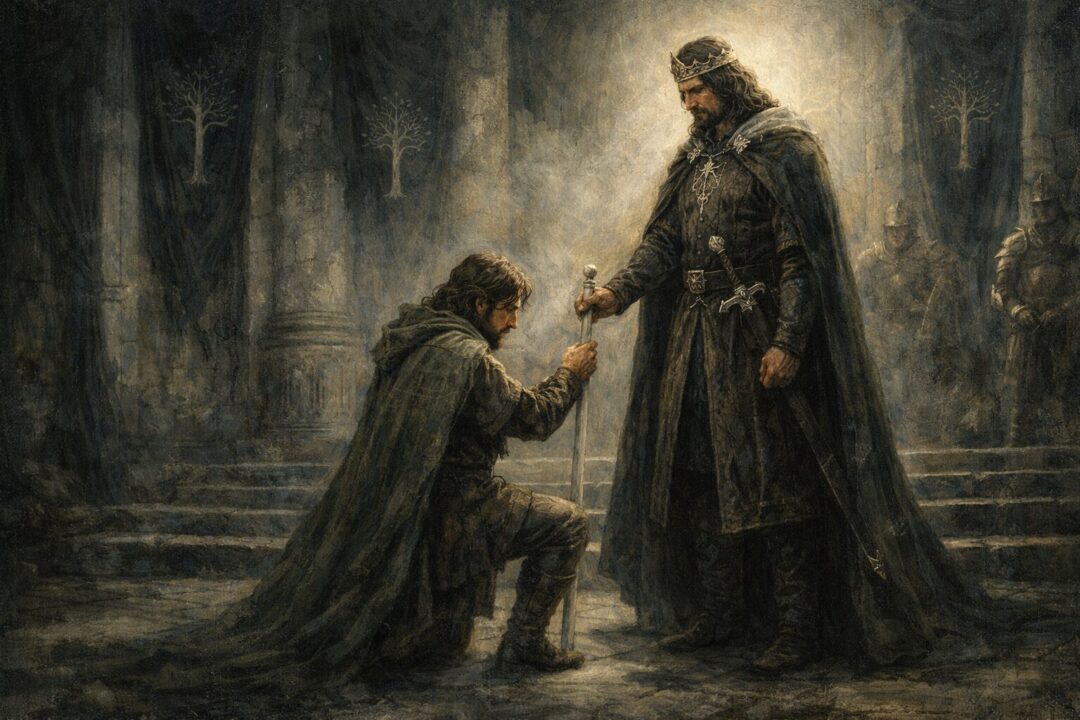
Among all the Men of the West in The Lord of the Rings, few inspire as much quiet admiration as Faramir.
He is thoughtful where others are rash.
Merciful where others seek domination.
Patient where others grasp for power.
He is also one of the very few characters who encounter the One Ring, understand its nature, and deliberately refuse it—not through ignorance or fear, but through moral clarity.
For many readers, this raises an obvious question.
If Faramir is so wise, so restrained, and so clearly “good,” why does he not rule Gondor after the War of the Ring?
Why does the crown pass instead to Aragorn, while Faramir returns to the office of Steward?
At first glance, this can feel like a missed opportunity. But Tolkien’s decision is neither accidental nor dismissive. In fact, Faramir’s story only makes full sense when we understand what Gondor represents—and what true restoration requires in Tolkien’s world.
Faramir’s Strength Is Moral, Not Regal
Tolkien is unusually explicit about Faramir’s inner qualities. After the events in Ithilien, Gandalf later tells him that he “showed his quality” when tested by the Ring.
That phrasing matters.
Faramir does not resist the Ring because he is untouched by ambition. On the contrary, he understands power, lineage, and duty very well. He knows exactly what the Ring could offer him—and what it would cost.
His strength lies in restraint.
Throughout The Two Towers, Faramir consistently places limits on himself. He obeys orders even when they pain him. He releases Frodo and Sam even though it risks his own standing. He refuses to treat the Ring as a weapon, even when Gondor is desperate.
He loves lore more than arms.
Memory more than mastery.
Stewardship more than possession.
These qualities make him exceptional—but they also define his role.
Faramir does not seek to reshape Gondor. He seeks to preserve what is good within it.
That distinction is crucial.
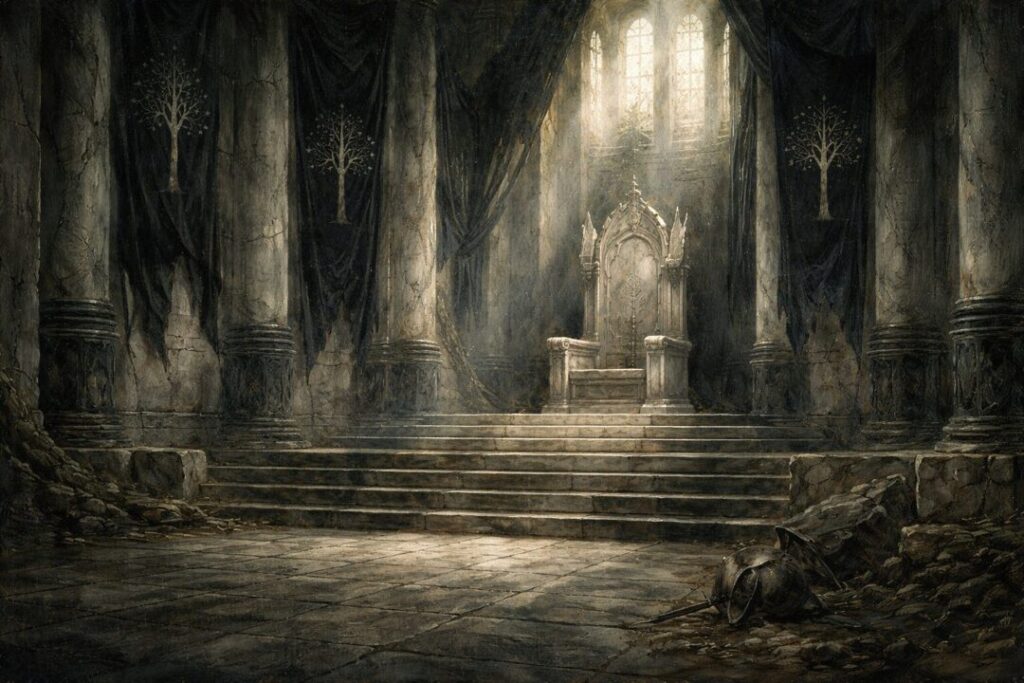
Gondor Was Never Meant to End With the Stewards
To understand why Faramir cannot rule alone, we must look beyond his character and examine Gondor itself.
The Ruling Stewards were never intended to replace the kings permanently. This is stated directly in the appendices: they governed “until the King returns.” Their authority is custodial, not foundational.
Even at their best, the Stewards rule in trust.
By the time of the War of the Ring, Gondor is not merely leaderless—it is incomplete. Its kingship has been absent for generations. Its ancient legitimacy is fractured. Its identity exists in a state of suspension, defined by endurance rather than fulfillment.
This condition cannot be resolved by wisdom alone.
No Steward, no matter how virtuous, can fully heal Gondor’s broken continuity. The problem is not competence. It is symbolism.
Gondor was founded as a Númenórean kingdom, bound to a royal line that carried historical, legal, and spiritual weight. Without a king, Gondor survives—but it does not truly renew.
Not even Faramir can change that.
Denethor’s Failure Is Not Faramir’s Inheritance
It is tempting to read Faramir as a corrective to Denethor—and in many ways, he is.
Where Denethor clings to control, Faramir accepts limitation.
Where Denethor seeks mastery through knowledge, Faramir seeks understanding without domination.
Where Denethor falls into despair, Faramir endures.
But Tolkien is careful not to frame this as a simple succession.
Faramir is not written as the “better Steward who should finally rule.” Instead, he represents what the office of Steward was meant to be before it became burdened by centuries of isolation and fear.
Faramir does not redeem the Stewardship by elevating it above kingship.
He redeems it by returning it to its proper place.
That place is service.
In this sense, Faramir does not inherit Denethor’s failure. He breaks the cycle by refusing to confuse guardianship with ownership.

Aragorn Represents Restoration, Not Replacement
The return of Aragorn is not simply a political event. It is the healing of a long-standing rupture in the history of the West.
Aragorn does not seize the throne. He waits to be recognized. He does not rule by conquest, but by lineage, prophecy, and consent.
This distinction is central to Tolkien’s vision.
Gondor does not gain a new ruler. It regains an old one.
The kingship of Gondor is not an optional upgrade. It is the restoration of an identity that predates the Stewards themselves. Aragorn’s reign reconnects Gondor to Númenor, to Elendil, and to a history that has been fading rather than growing.
Faramir’s role, therefore, is not to compete with Aragorn—but to support that restoration.
Why Faramir Thrives Beside a King
Once Aragorn is crowned, something important changes for Faramir.
He becomes Steward again—but this time, by choice rather than necessity.
He serves a king he respects, one who rules not through domination but through healing and renewal. The weight that crushed Denethor no longer rests entirely on the Steward’s shoulders.
This arrangement allows Faramir to flourish.
He governs Ithilien, not as a conqueror, but as a restorer.
He rebuilds lands long scarred by war rather than expanding borders.
He marries Éowyn, uniting two lines shaped by loss, endurance, and recovery.
None of this would be possible if Faramir were required to embody sovereignty itself.
Faramir is at his best when he can advise, preserve, and guide—without carrying the symbolic burden of kingship.
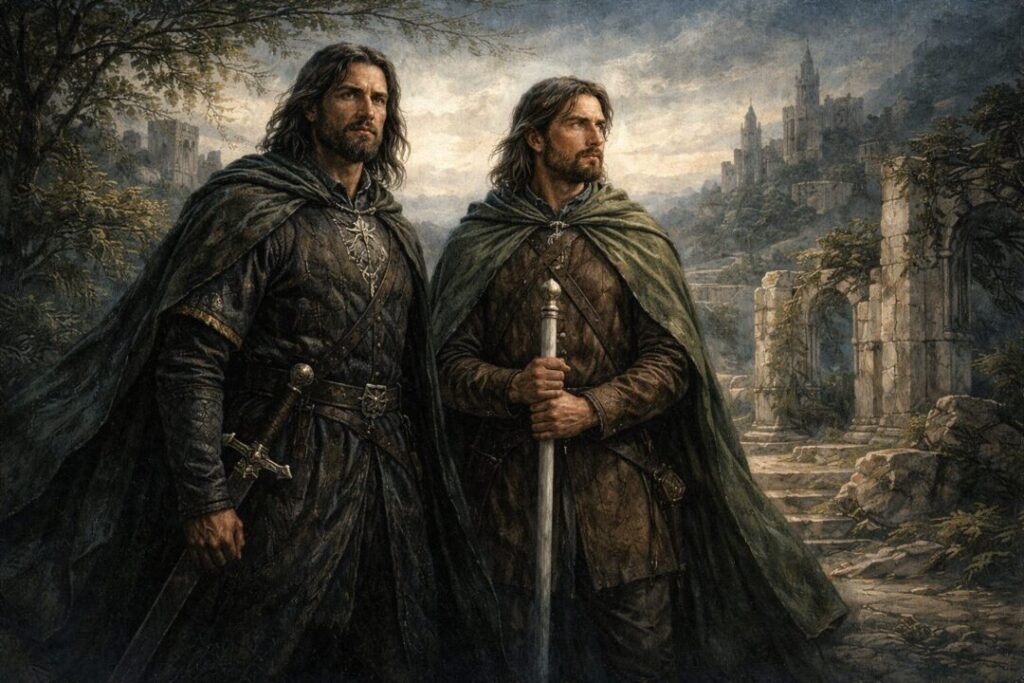
A Broader Pattern in Tolkien’s World
Faramir’s story fits a wider pattern that appears throughout Tolkien’s legendarium.
Moral authority and political supremacy are often separated.
Gandalf guides but does not rule.
Elrond counsels but does not command kingdoms.
Galadriel preserves but does not conquer.
These figures possess immense wisdom and influence—but they do not found new orders. They sustain, advise, and protect.
Faramir belongs among them.
He is a keeper of memory in an age that desperately needs remembering. A stabilizing presence in a world emerging from catastrophe.
He is not meant to inaugurate a new era.
Not a Denial, but a Completion
Faramir’s story is not a tragedy of lost kingship.
It is a story of alignment.
He becomes exactly what Gondor needs him to be—and no more.
In Tolkien’s world, greatness is not measured by how much power a character holds, but by how faithfully they accept the role that suits their nature.
Faramir does not lose a crown.
He lays aside something he was never meant to claim.
And in doing so, he becomes one of the clearest examples of Tolkien’s deepest conviction: that true strength lies not in ruling others, but in knowing when not to rule at all.