When people think about the lost years of the One Ring, they often picture absence in a vague and simple way.
The Ring falls from Isildur.
The Ring lies in the River.
The Ring is found again much later.
On the surface, the sequence seems straightforward.
But Middle-earth does not present it that way.
The deeper you look, the stranger the gap becomes. The Ring was not merely dropped and forgotten. It disappeared into one of the worst possible places in the world for anything small, plain, and deadly to vanish: the Great River Anduin, near the Gladden Fields.
And once that detail is taken seriously, the problem changes completely.
This was never just a lost object.
It was a lost object in running water, in marshland, in a landscape that even the Wise did not fully understand any longer, and under circumstances so confused that later generations could not even be sure where to begin.
The Ring Was Lost in Motion, Not in Stillness
One reason the loss is easy to underestimate is that “the River” can sound static in memory.
It was anything but.
The Ring was lost in the Anduin, the greatest river of western Middle-earth east of the Misty Mountains. It was broad, long, and always moving southward toward the Sea. Even before anyone later argued that it had been washed all the way downriver, that possibility itself tells you how immense the problem already was.
The Ring did not fall onto open ground where its place could be marked.
It fell into living water.
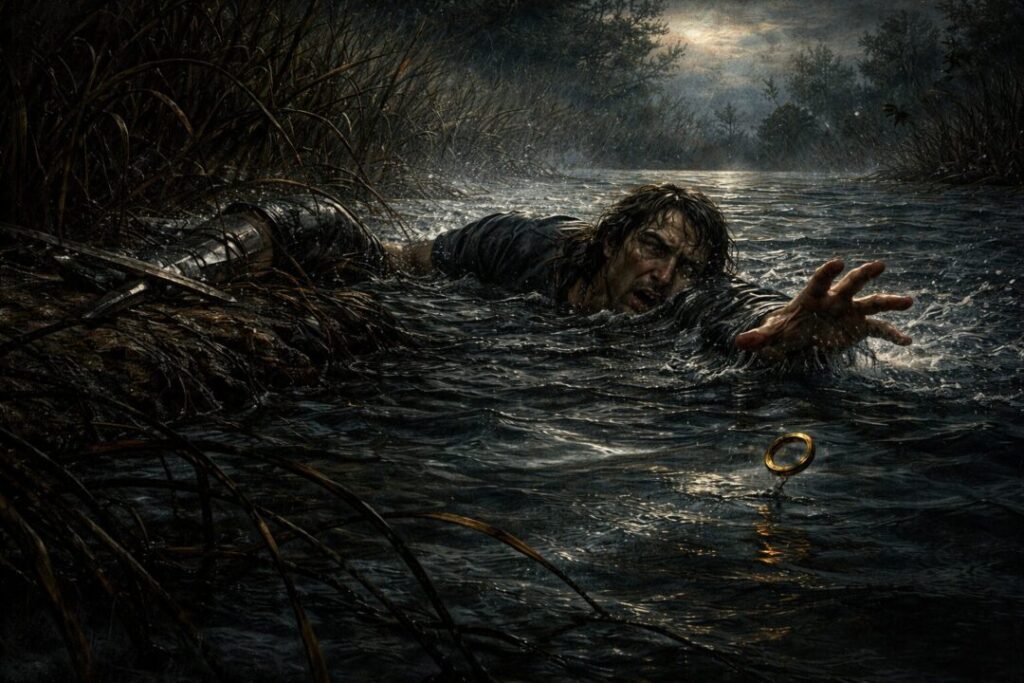
And that matters because the story does not describe Isildur calmly dropping it at a known spot. He was in flight, in darkness, in confusion, trying to cross the river after the disaster at the Gladden Fields. The Ring slipped from him as he swam.
That means the loss happened in motion, under stress, in a current.
Even if someone had arrived soon after and known exactly what had happened, certainty would already have been difficult.
But no such search followed.
Instead, the Ring vanished into water and uncertainty together.
The Gladden Fields Made the Search Worse
The place matters just as much as the river.
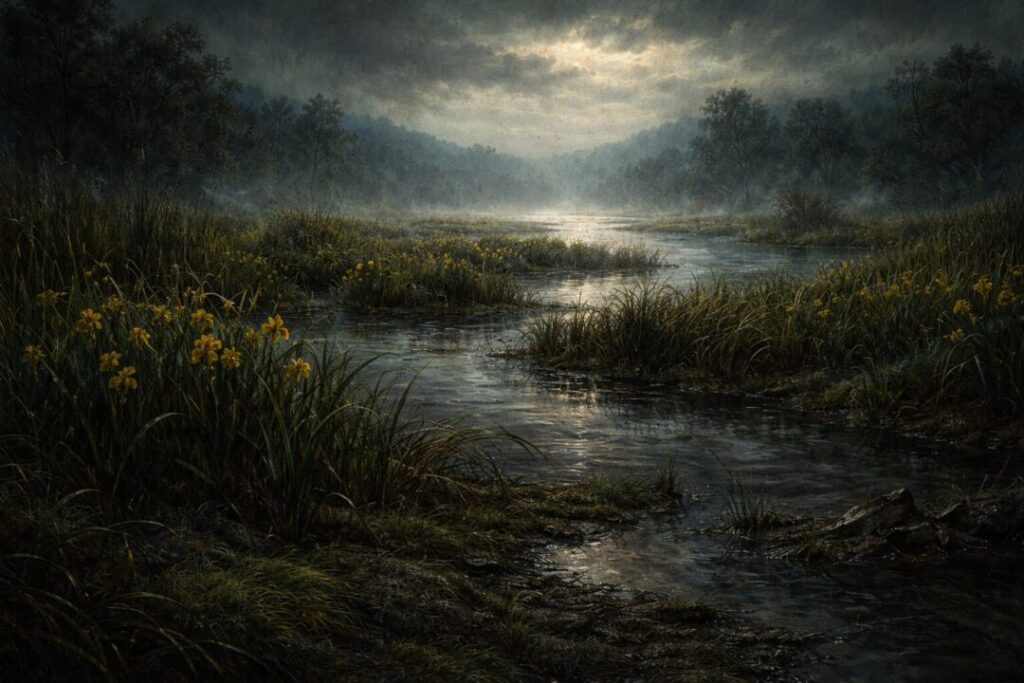
The Gladden Fields were not presented as a clean riverbank with a visible bottom. They were a region of pools, reeds, rushes, and marshy water beside the Anduin. Gandalf’s account in The Fellowship of the Ring emphasizes “dark pools amid the Gladden Fields,” and that phrase quietly does a great deal of work.
Dark pools are not just deep.
They conceal.
Reeds and marsh growth do not just decorate a place. They break sightlines, catch debris, alter edges, and turn the act of searching into guesswork. A small ring in such a place is not merely hard to spot. It can disappear beneath silt, weeds, mud, and shifting water with almost no trace at all.
And the Ring is especially suited to this kind of disappearance.
It is not a sword.
Not a helm.
Not even a jewel that throws obvious light.
In ordinary sight, it is only a plain gold ring.
That simplicity is one reason its loss becomes so absolute. A thing of vast importance enters a place that would make even an ordinary trinket nearly unrecoverable.
Nobody Knew Enough, Soon Enough
A lost object can sometimes be found if the people looking know three things:
where it was lost,
when it was lost,
and what exactly happened.
In this case, all three fail.
Isildur’s company was destroyed in ambush. Nearly all his folk were slain. What survived was fragmentary memory, not a clear report. Even within the later tradition, the event survives more as reconstructed history than as an eyewitness record rich in practical detail.
That distinction is crucial.
The people who came after knew that Isildur was attacked near the Gladden Fields and that the Ring was lost. But “near the Gladden Fields” is not a map pin. It is a region. A wet region. A changing region.
And even Gandalf’s much later summary says that the Council of the Wise could discover no more.
That is one of the most important lines in the whole problem.
It means the barrier was not laziness.
It was not indifference.
It was lack of recoverable knowledge.
The trail went cold almost at once.
Time Buried the Ring as Surely as Water Did
Water hid the Ring first.
Time hid it longer.
Once the Ring passed out of knowledge and legend, the search ceased to be a practical matter and became an inheritance of uncertainty. Centuries passed. Then more centuries. Peoples moved. Settlements changed. The political shape of the world changed. Even the urgency of the Ring faded, because so many came to believe it was gone beyond recall.
This is what makes the problem larger than a single lost artifact.
The Ring is hidden not only in a riverbed, but behind a historical collapse of precision.
There is a difference between “we know where it is, but cannot reach it” and “we do not even know where the real question begins.”
The Ring belongs to the second category for most of the Third Age.
By the time Déagol finds it, the gap is immense. The loss and the discovery are linked in story, but separated by so much time that the recovery feels less like a successful search than an intrusion into buried history.
That is because it was.
The Sea Theory Made the Search Even Harder
The uncertainty is made worse by one of the most consequential mistaken conclusions in the story.
Saruman assures the White Council that the Ring had been rolled down the River to the Sea.
Whether he fully believed this at first or used it because it served his own designs, the effect is the same: attention is pulled away from the true scale of the danger inland.
And this theory is plausible enough to be dangerous.
If the Ring entered the Great River and remained there long enough, why should it not be carried south? Why assume it lodged anywhere recoverable? The claim takes a difficult search and turns it into a hopeless one.
That matters because bad conclusions do not merely fail to solve a problem.
They reshape what anyone thinks is worth trying.
If the Ring is in the Sea, local searching is folly.
If the Ring is lost forever, watchfulness changes tone.
If the Ring is beyond reach, then the age of its practical return seems over.
This is one reason the Ring stays hidden for so long.
Not everyone is searching for the wrong thing.
Some are persuaded there is nothing left to search at all.
Even Saruman Could Not Simply Recover It
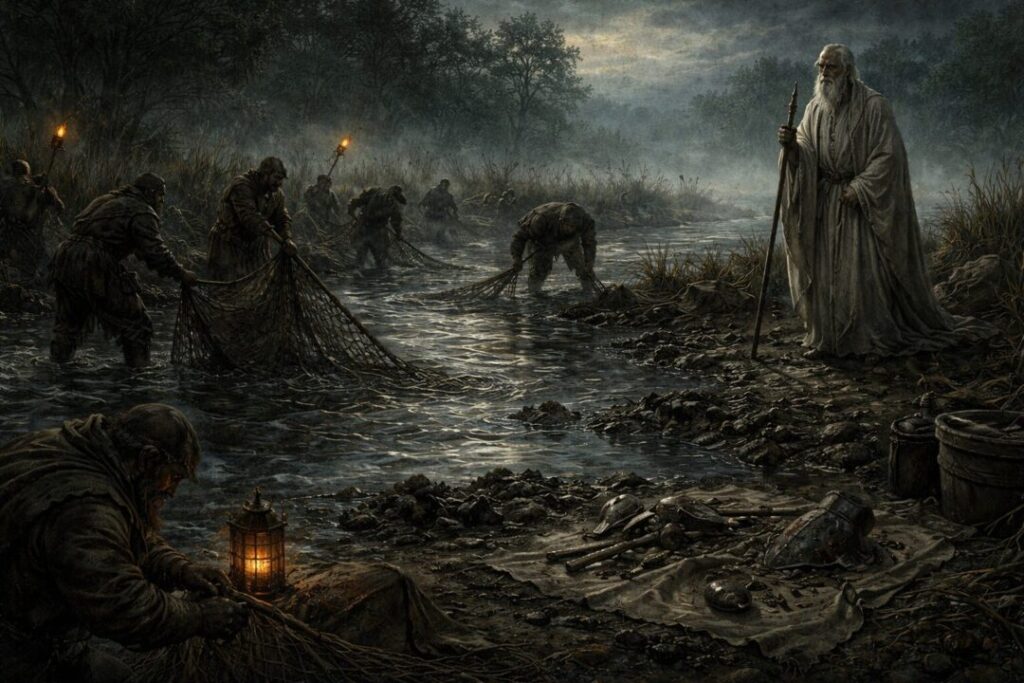
One of the strongest signs that finding the Ring there was nearly impossible is that Saruman later searched the Gladden region in secret and still failed.
That point deserves more attention than it usually gets.
Saruman was not guessing blindly. He was powerful, deeply learned in ring-lore, highly motivated, and eventually focused on the right general area. Yet that still did not place the Ring in his hand.
Why not?
Because being “near the Gladden Fields” is not the same as possessing certainty.
Because marshland does not surrender small things easily.
Because a ring can lie buried in mud, silt, or riverbed deposit for ages.
Because even an intelligent search of the correct region can fail when the object is tiny and the terrain is hostile.
This is exactly the kind of detail that proves the scale of the difficulty.
If Saruman, with ambition and secrecy driving him, cannot produce the Ring by method, then its earlier invisibility begins to look less surprising.
It begins to look almost inevitable.
Déagol Does Not Solve the Problem. He Proves It.
The rediscovery of the Ring does not show that the search was easy after all.
It shows the opposite.
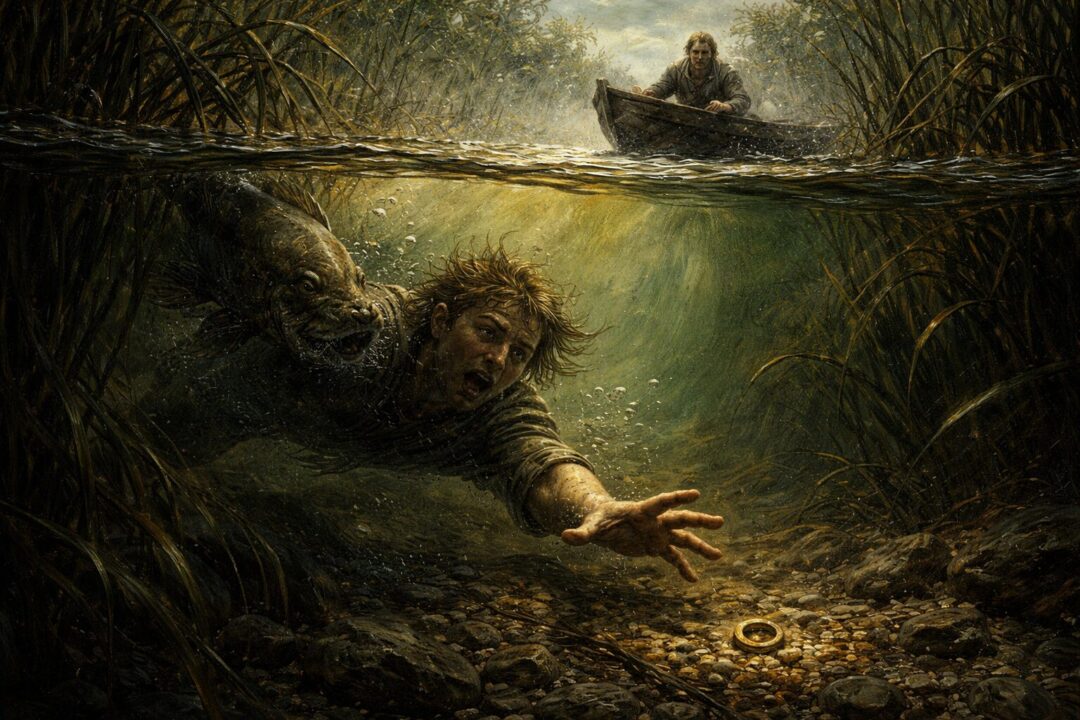
Déagol does not find the Ring by organized effort, inherited lore, or successful investigation. He finds it because he is pulled into the water by a fish and happens to see something shining in the riverbed.
That is not a plan.
That is accidental encounter.
You may read a deeper providential pattern into such moments, and the larger story often allows that kind of reading. But even without going beyond what is explicitly stated, one thing is plain: the Ring returns to light through chance, not through any recoverable search process.
That is the real answer hidden inside the event.
The Ring was not sitting in the Anduin waiting to be sensibly recovered by whoever bothered to look hard enough. It was effectively unreachable until an utterly improbable sequence brought a hand to exactly the right place.
The finding feels sudden because it is.
And it feels strange because it should.
The River Did What No Fortress Could
Sauron forged the Ring to dominate wills.
Yet for long ages, one of the best protections against its return was not a vault, an army, or a guardian.
It was a river.
Not because the Anduin was magical in itself.
Not because the Ring was destroyed there.
Not because the Wise ceased to care.
But because the Ring entered a world of current, mud, reeds, darkness, distance, and forgotten knowledge, and in that world even the most important object in Middle-earth could become almost unreachable.
That is the quiet force of the story.
The Ring was small enough to vanish.
The landscape was large enough to keep it.
And time was long enough to make the loss feel final.
So when people ask why the One Ring stayed hidden for so long, the answer is not simply that no one happened to look.
It is that Middle-earth placed it in exactly the kind of place where looking was never likely to be enough.
Why This Matters
The history of the Ring is full of battles, councils, betrayals, and great powers.
But one of the most important turns in that history depends on something humbler.
A ring.
A river.
A marsh.
A mistake.
And centuries of not knowing.
That is why its disappearance matters so much.
The Ring was not merely out of sight.
For most of the age, it was almost beyond recovery in any ordinary sense at all.
And once you see that, Déagol’s moment in the water no longer feels like a convenient plot turn.
It feels like what it really is:
the end of an impossibly long concealment.