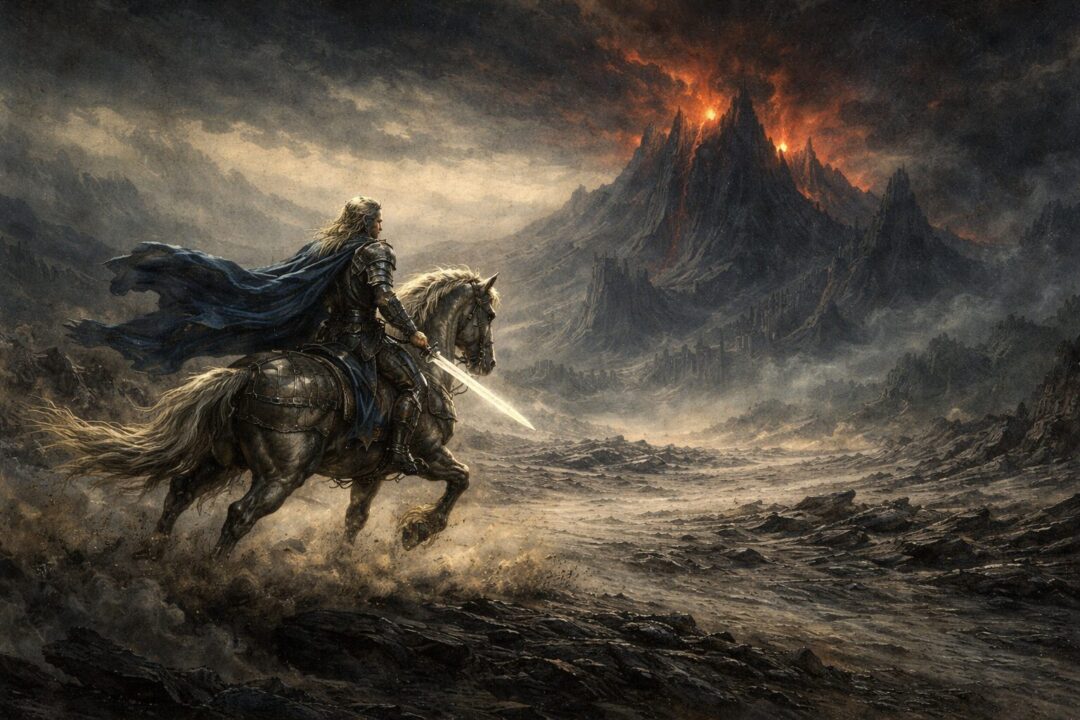
When Fingolfin rides to Angband, the scene feels almost too large to process.
An Elven king, alone, crossing the ash-choked north to strike at the gates of the great Dark Power. No army behind him. No hope of rescue. No real possibility of survival.
And yet he goes.
For many readers, the meaning seems obvious. Fingolfin is driven by courage so absolute that he would rather die in defiance than live under Morgoth’s shadow.
That reading is true as far as it goes.
But the text suggests something more exact, and more unsettling, than simple heroic despair.
Fingolfin does not challenge Morgoth because victory is likely.
He challenges him after victory has already become impossible.
That distinction matters.
The Challenge Comes After Ruin, Not Before
The duel does not happen in the middle of strength.
It comes after the Dagor Bragollach, the Battle of Sudden Flame, when Morgoth finally breaks the long siege of Angband. Fire pours from Thangorodrim. Ard-galen is burned into Anfauglith. Dorthonion is overrun. Angrod and Aegnor are slain. Fingolfin and Fingon march to aid their kin, but they are driven back with heavy loss.
This context is essential.
For centuries, the Noldor had contained Morgoth. The siege was never a final solution, but it gave Beleriand a shape that still felt livable. Kingdoms stood. Alliances held. There was still time.
Then that time ends.
The battle is not merely a defeat. It is the collapse of a whole strategic world. Fingolfin had earlier understood the danger of allowing Morgoth to sit behind Angband and devise new evils in secret. The texts note that he once considered assaulting Angband before Morgoth’s preparations were complete, but most of the Noldor would not accept the cost.
That older detail changes the later scene.
Fingolfin is not a reckless fool who suddenly abandons reason. He had long seen that delay carried its own danger. When Morgoth finally breaks out, Fingolfin is witnessing not only military disaster, but the fulfillment of a threat he had already perceived.
So when he rides to Angband, he is acting after the failure of every path that might once have avoided this moment.
What the Text Actually Says About His Motive
This is where careful wording matters.
The tradition around the duel often turns Fingolfin into a figure of cold, clear, fully calculated defiance. But the text is more severe than that.
It says he was sundered from his kin and saw what he believed to be the ruin of his people. Then he rode in wrath and despair.
That is not the language of optimism.
It is not even the language of measured confidence.
It is the language of a man reaching the limit of endurance.
And yet wrath and despair do not make the act meaningless.
In Tolkien’s world, despair can deform judgment. But here it does not reduce Fingolfin into confusion or collapse. Instead, it drives him toward the most naked and direct confrontation possible.
He does not hide from what Morgoth is.
He goes straight to him.
That is why the scene has such force. Fingolfin’s act is not presented as strategically sound in any ordinary sense. It is presented as the final refusal to accept Morgoth’s domination inwardly, even when the outward battle has already turned.
Why He Rode Alone
One of the most revealing details is that Fingolfin does not lead a final host.
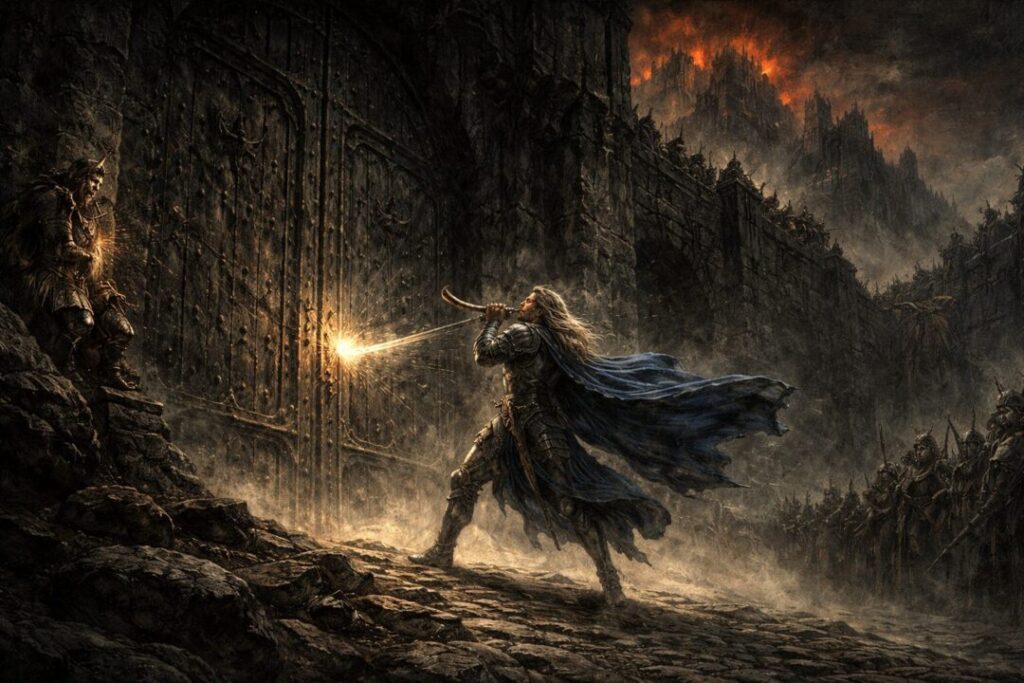
He rides alone to Angband’s gates. Those who see him in his fury take him for Oromë. He sounds his horn, strikes the brazen doors, and calls Morgoth out to single combat.
Why alone?
At the simplest level, because this is not a battle plan. It is a personal challenge. No army could realistically storm Angband at that moment. Bringing followers would only have multiplied the dead.
But the solitude also sharpens the meaning of the act.
A king riding alone strips the scene of all illusion. There is no tactical screen, no shield-wall, no confusion of battle. Morgoth is being summoned, personally, by the ruler of the Noldor.
And that forces the confrontation onto moral ground as much as military ground.
This is not Fingolfin saying, “I can defeat you with strength.”
It is Fingolfin saying, “Come out and answer.”
Morgoth’s Shame Matters
One of the most important details in the whole episode is that Morgoth does not come willingly.
He comes because he cannot bear to be openly named a coward before his captains. The tradition preserved in the text is explicit that Morgoth knew fear and would not have welcomed the duel, but he could not refuse after Fingolfin publicly shamed him.
This is crucial.
If the duel were only about Fingolfin’s suicidal bravery, then Morgoth’s reluctance would be secondary.
It is not secondary.
It is part of the point.
Fingolfin cannot overthrow Angband.
He cannot reverse the Dagor Bragollach.
He cannot save all that has already been lost.
But he can do one thing that almost no one else in Beleriand can do:
He can force Morgoth himself to emerge.
That transforms the ride from pure despair into defiance with consequence.
Even before the first blow falls, Fingolfin has already achieved something. He has exposed Morgoth. He has made the lord of Angband answer in person. He has turned the Dark Power, for one moment, from distant terror into a being that can be challenged, shamed, and struck.
Why “Impossible” Does Not Mean Meaningless
Victory, in the practical sense, is impossible.
Morgoth is vastly greater in native power than any Elf. Even diminished by pouring power into the corruption of Arda, he is still Morgoth. Fingolfin is the mightiest of the sons of Finwë, but he is not a being who can truly overthrow the Dark Enemy in single combat.
Yet the duel is not futile.
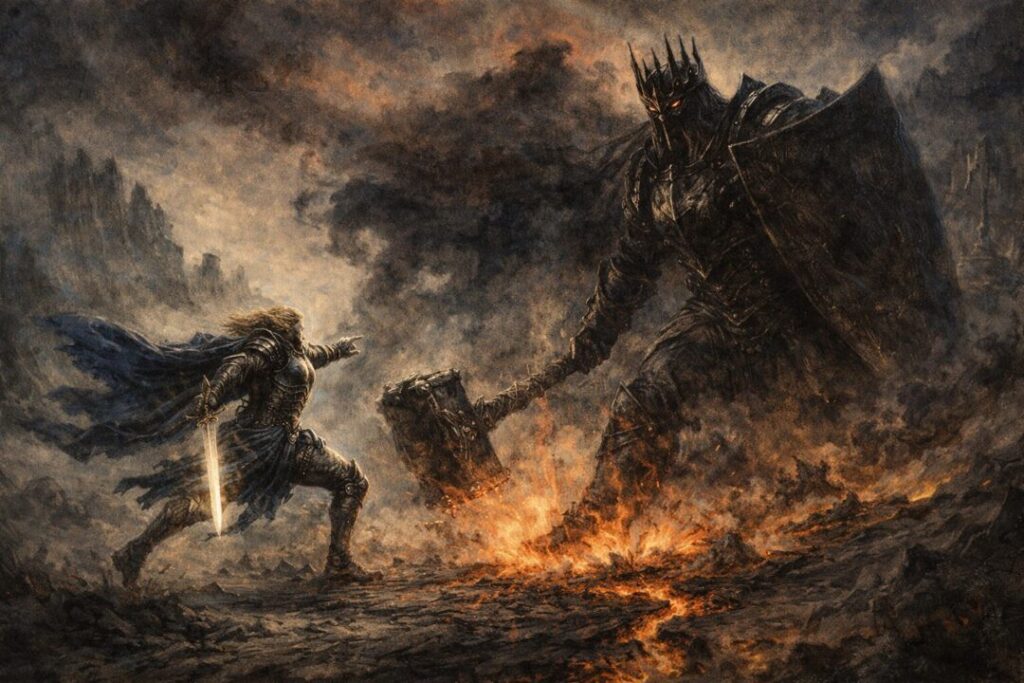
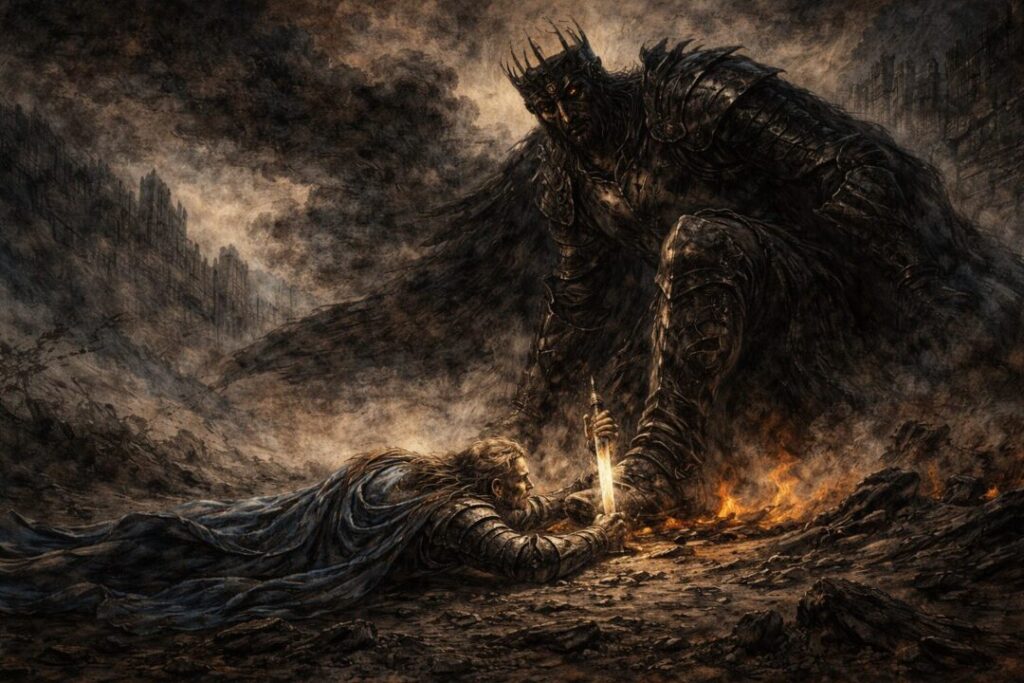
Fingolfin wounds Morgoth seven times. He evades Grond again and again. And before he dies, he strikes Morgoth’s foot so that the hurt never fully heals.
That matters on several levels.
First, it proves that even hopeless resistance is not always empty. Morgoth cannot be casually brushed aside, but neither is he untouched. The Dark Power is still vulnerable to pain, humiliation, and scar.
Second, it alters how Morgoth appears in the story. Morgoth prefers distance, scale, armies, terror, and overwhelming force. Fingolfin drags him into a mode of conflict that reveals something ugly beneath the grandeur: fear.
Third, it gives the Noldorin resistance a kind of moral continuity. The siege is broken. Lands are ruined. Great princes are dead. Yet the High King does not vanish into defeat. He meets the catastrophe in person.
He loses.
But he does not yield.
Was Fingolfin Trying to Win?
This is the question underneath the title, and the safest answer is a restrained one.
The texts do not say Fingolfin rode to Angband with a worked-out expectation of slaying Morgoth. They say he rode in wrath and despair, believing his people ruined.
So it would be too strong to claim that he had some hidden realistic plan for victory.
But it would also be too simple to say he went only to die.
The challenge has structure. It publicly shames Morgoth. It compels response. It creates witness. It turns a shattered military situation into a direct test of kingship, courage, and dominance.
The best reading is probably the most conservative one: Fingolfin does not ride because he thinks survival is likely. He rides because there is still one form of resistance left to him, and he chooses to carry it to its absolute limit.
That resistance is not strategic in the usual sense.
It is existential.
A King’s Last Power
At the end of all ordinary options, Fingolfin still possesses one thing Morgoth cannot simply take from him.
Choice.
Morgoth can break sieges, burn plains, kill princes, and scatter peoples. He can reduce whole regions to horror. But he cannot make Fingolfin answer ruin with submission.
That is what the challenge really reveals.
The duel is not important because it almost succeeds.
It is important because it refuses the logic of inevitability.
Morgoth wants more than conquest. He wants domination so complete that resistance feels absurd before it begins. Fingolfin’s ride breaks that spell.
For one terrible hour outside Angband, Morgoth is not merely the vast and distant Shadow in the North.
He is a dark king called out at his own doors.
And that may be the deepest reason the scene endures.
Not because Fingolfin believed impossible victory would somehow become possible.
But because when all victories were gone, he still found one thing left to defend:
the right to defy the darkness face to face.
Canon basis: The Silmarillion as summarized in Tolkien Gateway’s pages on the Dagor Bragollach, Fingolfin, Morgoth, and the Fall of Fingolfin.