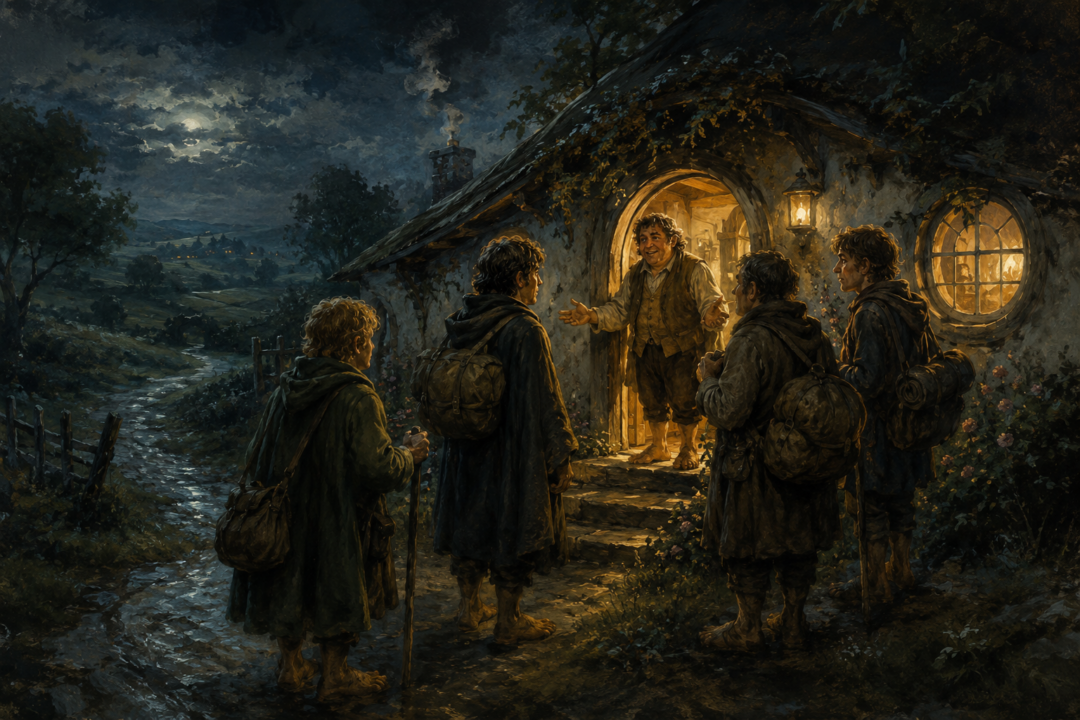
When Frodo Baggins sells Bag End and announces that he is moving to Crickhollow, the explanation sounds almost comically ordinary. He is leaving Hobbiton, giving up an expensive home, and settling among his mother’s relatives in Buckland. To the Shire, it is precisely the sort of domestic upheaval that can generate months of gossip without suggesting anything truly dangerous.
That is exactly why it works.
But Crickhollow is more than a false address invented to confuse curious hobbits. By the time Frodo actually reaches the little house, it has become something much more painful: a possible life he must abandon, a refuge already penetrated by the Enemy, and the place where he discovers that his attempt to protect his friends by deceiving them has failed.
The house is a decoy. Yet for one brief evening, it is also almost home.
The Cover Story Had to Be Believable
After Gandalf identifies Frodo’s ring as the One Ring, remaining indefinitely at Bag End is no longer safe. Frodo resolves to leave the Shire, eventually choosing Rivendell as his destination. But openly announcing a journey east would defeat the purpose of slipping away quietly.
His solution is unusually hobbit-like: instead of simply disappearing, he stages a retirement.
Frodo sells Bag End to the Sackville-Bagginses and buys a small house at Crickhollow in Buckland. The move is plausible because Frodo already has strong connections there. His mother, Primula Brandybuck, belonged to the Brandybuck family, and Frodo had spent part of his youth at Brandy Hall before Bilbo adopted him and brought him to Bag End.
The story therefore contains enough truth to survive ordinary scrutiny.
That matters because Frodo is not yet behaving like the leader of an epic quest. He is trying to leave without turning his departure into an event. The elaborate preparations reveal how deeply he still thinks in the social world of the Shire: property, relatives, gossip, furniture and appearances.
Even Sam’s presence fits the deception. Publicly, Sam can simply be understood as accompanying his master to help at the new home.
Frodo is trying to hide an extraordinary danger inside an ordinary life.
Crickhollow Is Chosen for Secrecy
The particular house also suits Frodo’s purpose.
Crickhollow lies in Buckland, east of the Brandywine. Frodo’s house stands in an out-of-the-way location without nearby dwellings. It is therefore useful not merely as a destination that sounds convincing but as a staging point from which Frodo might disappear more quietly.
Buckland itself is an interesting threshold.
Its inhabitants are hobbits, but their country lies beside the Old Forest and feels slightly different from the heartland of the Shire. The Bucklanders maintain the High Hay along their dangerous eastern boundary, and they are accustomed to precautions that seem unusual to hobbits farther west.
Frodo has therefore moved, symbolically as well as geographically, toward the edge of safety before he actually leaves hobbit country.
Bag End represents the settled world he inherited from Bilbo. Crickhollow stands closer to the border.
Beyond it waits the Old Forest.
That makes the move more than logistical convenience. Frodo has placed his false new home at almost exactly the point where the familiar world begins to give way to the unknown.
The Cruel Part Is That the False Home Feels Real
The emotional force of Crickhollow becomes clearest when Frodo finally arrives.
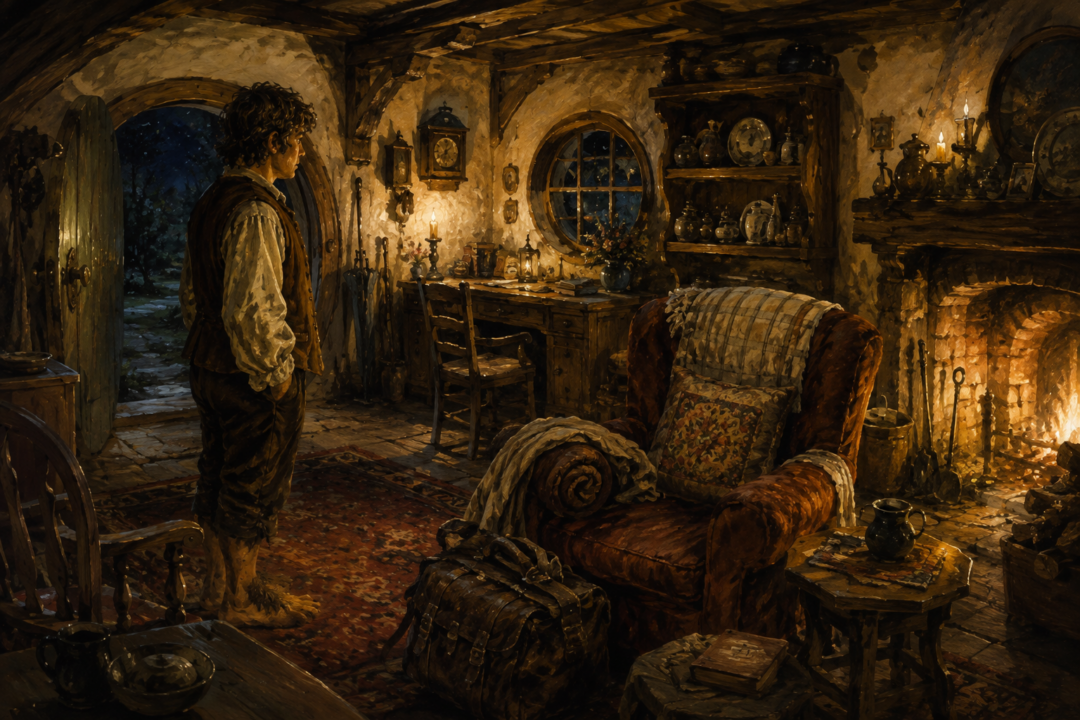
Merry and Fredegar Bolger have arranged his belongings inside. Familiar possessions from Bag End have been placed so that the little house genuinely resembles home. After days of walking, hiding from Black Riders and worrying about Gandalf’s unexplained absence, Frodo enters warmth, food, baths and friendship.
For a moment, the deception becomes dangerously attractive.
The narrative makes clear that Frodo wishes he really were coming to Crickhollow to settle peacefully. That small reaction changes the meaning of the entire scheme.
Until this point, “moving to Crickhollow” has been a story Frodo tells other people.
Now it becomes a story he wishes were true.
He has not left the Shire because he has ceased loving its comforts. He leaves precisely while understanding what they are worth. The courage of his departure is therefore not the courage of someone eager for adventure. Frodo has already had years to outgrow the youthful excitement associated with Bilbo’s stories. Faced with the Ring, he is giving up a life he still wants.
Crickhollow gives that lost possibility physical form.
There is a chair, supper, familiar furniture and a door that might have closed upon the dangerous world outside.
But Frodo cannot remain behind it.
Frodo’s Friends Have Seen Through Him
There is another problem with the Crickhollow plan: the people who know Frodo best do not believe it.
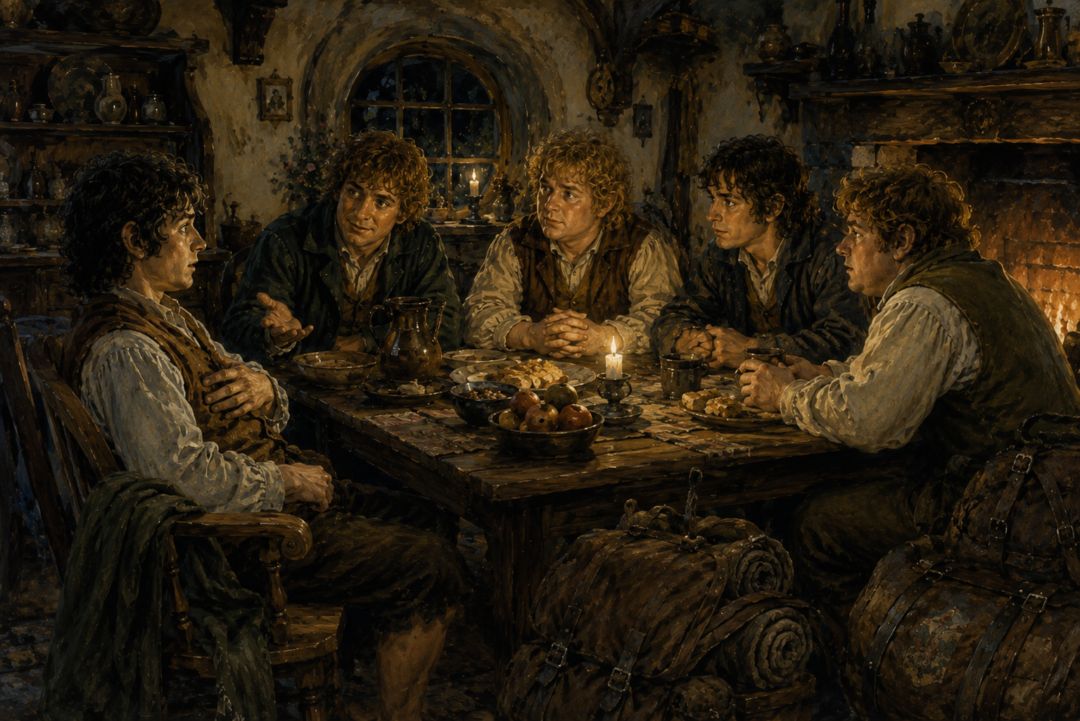
At the house, Merry, Pippin, Sam and Fatty Bolger reveal the existence of their conspiracy. They have understood that Frodo intends to leave the Shire. They also know that his departure is connected with Bilbo’s mysterious Ring.
Their knowledge has accumulated over time. Merry in particular has known more about Bilbo’s secret than Frodo realized, having once witnessed Bilbo use the Ring to disappear and later investigated further. Sam, meanwhile, had overheard part of Gandalf and Frodo’s conversation at Bag End and became the conspirators’ chief source of more recent information.
This turns Frodo’s secrecy inside out.
He believed he was deceiving his friends for their protection. They were secretly watching him because they feared he would try to protect them by leaving them behind.
That distinction matters.
Frodo’s concealment does not arise from distrust. He knows the road may lead into mortal danger and does not want his friends drawn into it. Their conspiracy is similarly rooted in loyalty rather than curiosity alone.
Crickhollow therefore becomes the place where two different forms of love collide: Frodo’s desire to bear danger without imposing it upon others, and his friends’ refusal to let him bear it alone.
The Fellowship Begins Before Rivendell
The formal Fellowship of the Ring will not be established until the Council of Elrond. Yet something essential to it appears much earlier at Crickhollow.
Merry and Pippin choose danger knowingly.
They do not understand the full scale of the War of the Ring, and none of the hobbits yet knows what the road will demand. But they know enough to understand that Frodo is fleeing a deadly threat. Their response is not to release him from friendship but to insist upon it.
Their preparations are strikingly practical.
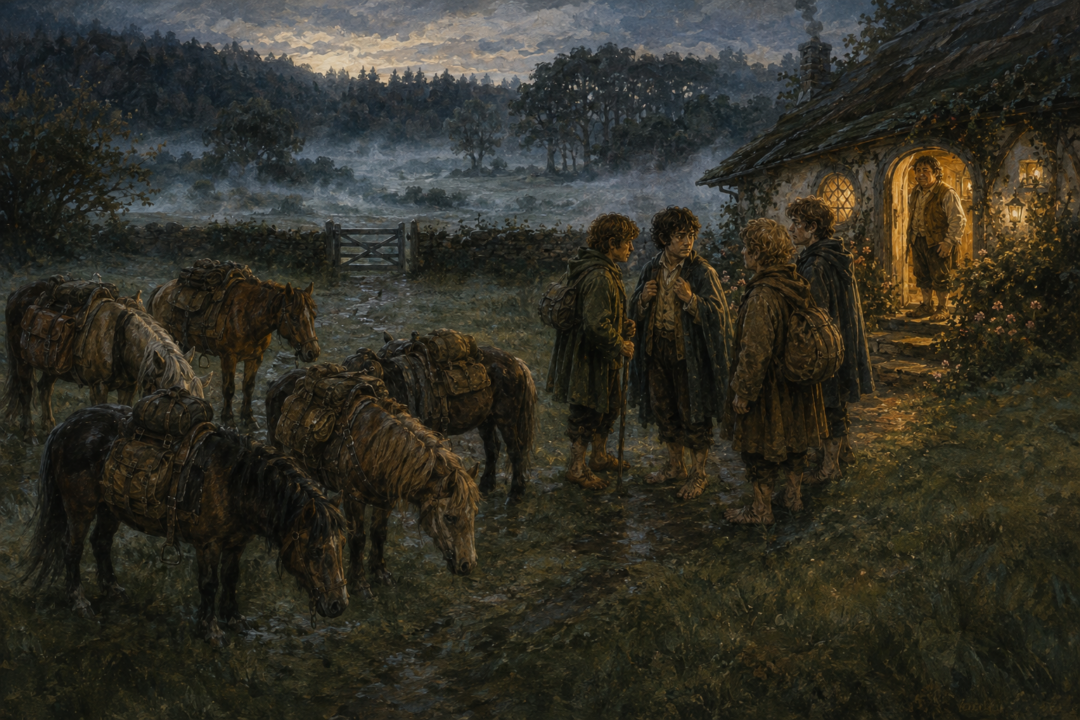
Ponies and provisions are ready. Routes have been considered. Fatty will remain behind. The conspiracy has not merely uncovered Frodo’s secret; it has prepared for his departure.
This is an important counterpoint to the grander powers that will soon enter the story. Before Elrond, Aragorn, Galadriel or the armies of Gondor become central, Frodo survives because ordinary people take friendship seriously.
There is no prophecy forcing Merry and Pippin to accompany him.
They simply refuse to abandon him.
Fatty Bolger Turns the Cover Story Into a Real Risk
Fredegar Bolger’s role also reveals that the Crickhollow deception does not simply end once Frodo departs.
Fatty remains behind partly to maintain the appearance that Frodo is still living at the house and to deal with questions. He can also bring news to Gandalf if the wizard arrives.
This places him in genuine danger.
On the night of 29 September, the Black Riders attack the house at Crickhollow. Fatty escapes and raises the alarm, crying that Black Riders are attacking Buckland. The Horn-call of Buckland sounds, and the Nazgûl withdraw.
The incident proves something disturbing: the cover story worked well enough to attract the Enemy.
The Riders had traced Frodo toward Buckland and came to the house expecting their quarry. Crickhollow, created as a shield between Frodo and pursuit, becomes a target in his absence.
Yet the deception also buys Frodo something invaluable: distance.
By the time the Riders strike the empty house, Frodo is already far beyond it.
The Enemy Can Follow an Address More Easily Than a Friendship
There is a quiet irony in the failure and success of Frodo’s plan.
His false destination can be discovered.
His movements can be followed.
The Nazgûl can question people, search roads and eventually reach Crickhollow.
What Frodo himself fails to anticipate is the loyalty of his companions.
He plans as though the safest arrangement is for him to carry the burden away from everyone else. But Merry, Pippin and Sam make that impossible. Fatty accepts danger without even accompanying the quest.
One reading of Crickhollow, therefore, is that it exposes the limitation of secrecy when secrecy becomes isolation.
Frodo absolutely needs concealment from the Enemy. Yet he cannot successfully conceal himself from those who love him, and that failure becomes one of his greatest protections.
The distinction will matter throughout the story. The Ring encourages possessiveness, secrecy and separation. The resistance to it repeatedly depends upon trust, pity, loyalty and burdens shared even when they cannot be completely transferred.
Crickhollow offers an early, domestic version of that larger conflict.
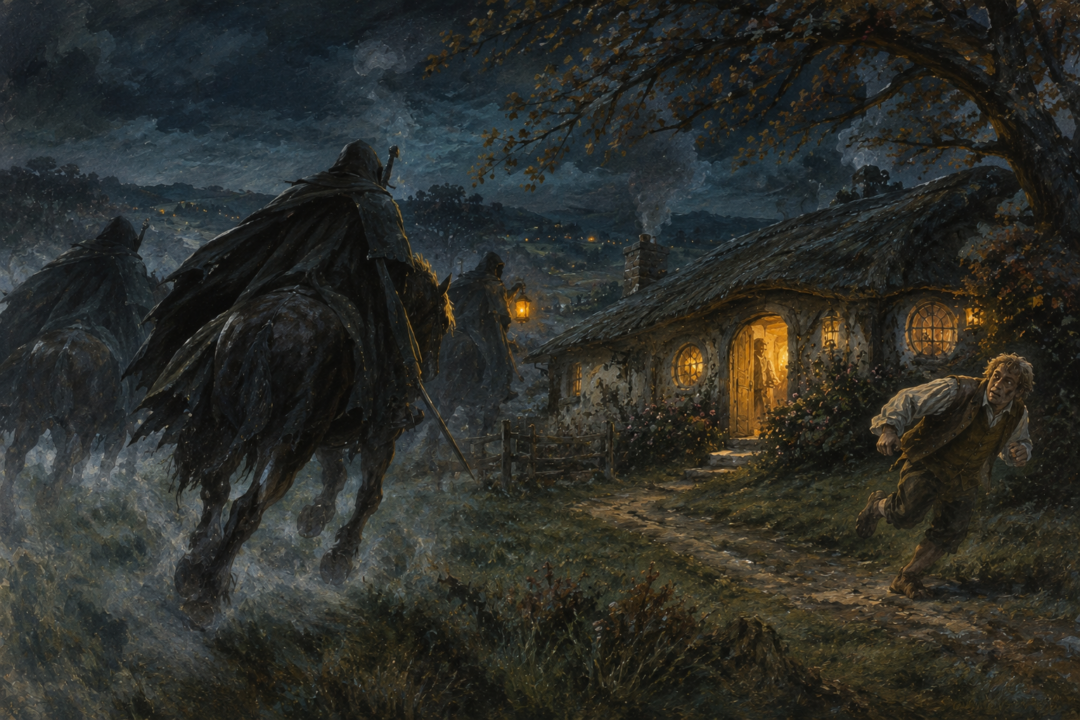
The House Frodo Never Really Lived In
Frodo’s ownership of Crickhollow is strange because the house is prepared for a life that scarcely begins.
He arrives on 25 September 3018. The following morning he leaves with Sam, Merry and Pippin through the Old Forest.
His supposed retirement has lasted one night.
Later, after the War of the Ring, Crickhollow remains connected with Merry and Pippin, who live there together for a time. But for Frodo, its deepest significance belongs to that first arrival.
It is the last carefully constructed imitation of the ordinary future he might have had.
Bag End was the home he truly possessed and surrendered. Crickhollow is the home he pretended to choose and briefly wished he could keep.
That is why the move matters.
The house succeeds as a cover story because it looks like retreat from adventure: Frodo Baggins selling the grand family home and settling quietly near his Brandybuck relations.
In reality, it is the final chamber before the road closes behind him.
At Crickhollow, Frodo discovers that his enemies are closer than he hoped, his friends know more than he imagined, and the peaceful life represented by his unpacked possessions is no longer available to him.
The next morning, he walks through a gate in the High Hay and enters the Old Forest.
The false move is over.
The real departure has begun.
Sources & Notes
- The Encyclopedia of Arda — Crickhollow: history of Frodo’s secluded Buckland house, its role in his false relocation, the conspiracy’s preparations, and the later Black Rider attack — https://www.glyphweb.com/arda/c/crickhollow.php
- The Encyclopedia of Arda — Buckland: geographic and cultural background for the Brandybuck country beyond the Brandywine, including its border with the Old Forest — https://www.glyphweb.com/arda/b/buckland.php
- The Encyclopedia of Arda — Fredegar Bolger: biography covering Fatty’s part in the friends’ conspiracy, his decision to remain at Crickhollow, and his flight when the Riders came — https://www.glyphweb.com/arda/f/fredegarbolger.php
- The Encyclopedia of Arda — Bag End: reference on Frodo’s inherited home, its sale to the Sackville-Bagginses, and the domestic life relinquished under the Crickhollow cover story — https://www.glyphweb.com/arda/b/bagend.php
Sources document the two homes at the center of Frodo’s deception, Crickhollow’s threshold location in Buckland, and Fatty Bolger’s role in maintaining the cover after Frodo departed.