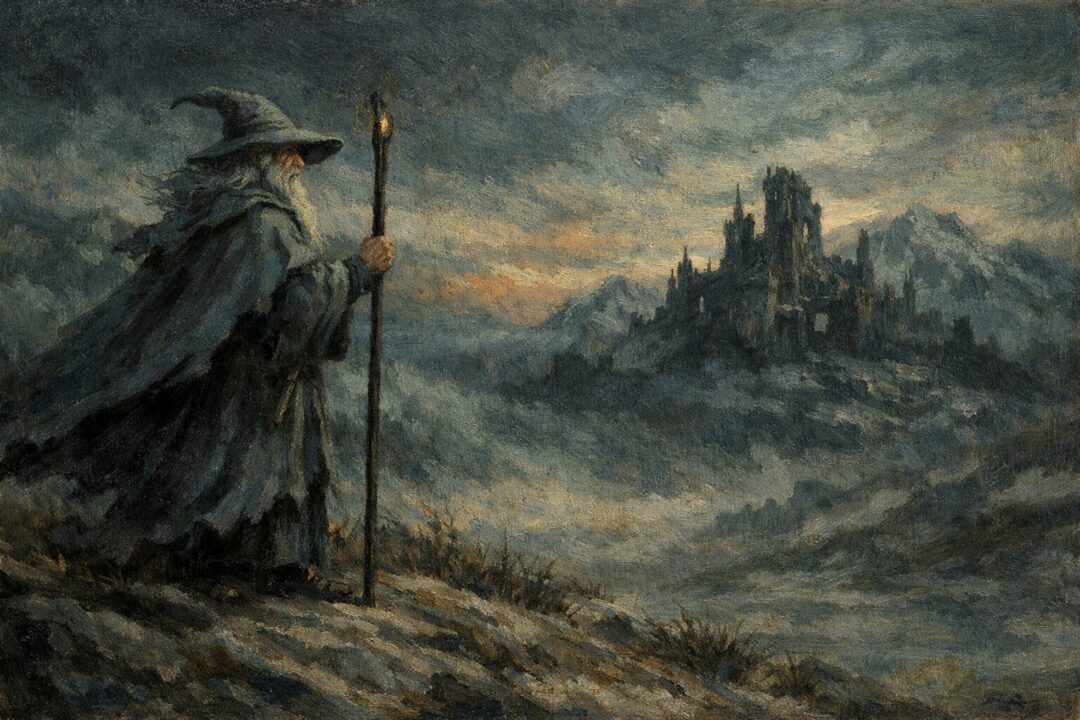
The Witch-king of Angmar is one of the most enduring evils in Middle-earth.
He destroys kingdoms, commands fear itself, and survives the downfall of his master—only to return stronger, darker, and more terrible than before. Long before the War of the Ring, he brings about the ruin of Arnor, shattering the northern realms of Men. Centuries later, he emerges again as the foremost terror of the Nine, Sauron’s chief lieutenant, a shadow that rides openly in the world.
For generations, he remains active while the Free Peoples struggle to resist him.
And throughout all of this, one figure stands conspicuously nearby—but never intervenes directly.
Gandalf
At first glance, this feels like a failure of action.
Gandalf understands the Nazgûl better than almost anyone in Middle-earth. He knows what they are, how they were made, and what binds them. He studies ancient records, traces the history of Angmar, and keeps watch as darkness slowly gathers again. He even encounters the Witch-king’s servants openly on several occasions.
So why does he never seek out the Witch-king and end the threat early?
Why allow such a figure to persist, to return again and again, unchecked?
The answer lies not in fear or ignorance—but in Gandalf’s nature, his authority, and the limits placed upon him long before he ever set foot in Middle-earth.
Gandalf Is Not a Free Agent
Although Gandalf appears as a wandering old man, he is not simply a powerful individual choosing when and where to act.
He is one of the Istari.
The Wizards were sent to Middle-earth with a mandate that is easy to misunderstand. They were not dispatched as generals or champions, and certainly not as executioners. Their purpose was subtle: to advise, to encourage, to awaken resistance, and to unite the Free Peoples against the rising shadow.
They were forbidden to dominate the wills of others or to confront Sauron with force equal to his own.
This distinction matters deeply.
Gandalf’s power is real, but it is intentionally veiled. He is bound to a form that can hunger, tire, and suffer. He is meant to persuade rather than command, to kindle courage rather than impose order.
Hunting the Witch-king would violate that purpose.
To pursue and destroy the chief of the Nazgûl would be an act of judgment and domination—deciding, unilaterally, who should live and who should be removed from the world. That is precisely the role Gandalf is forbidden to assume.
His restraint is not indecision.
It is obedience.
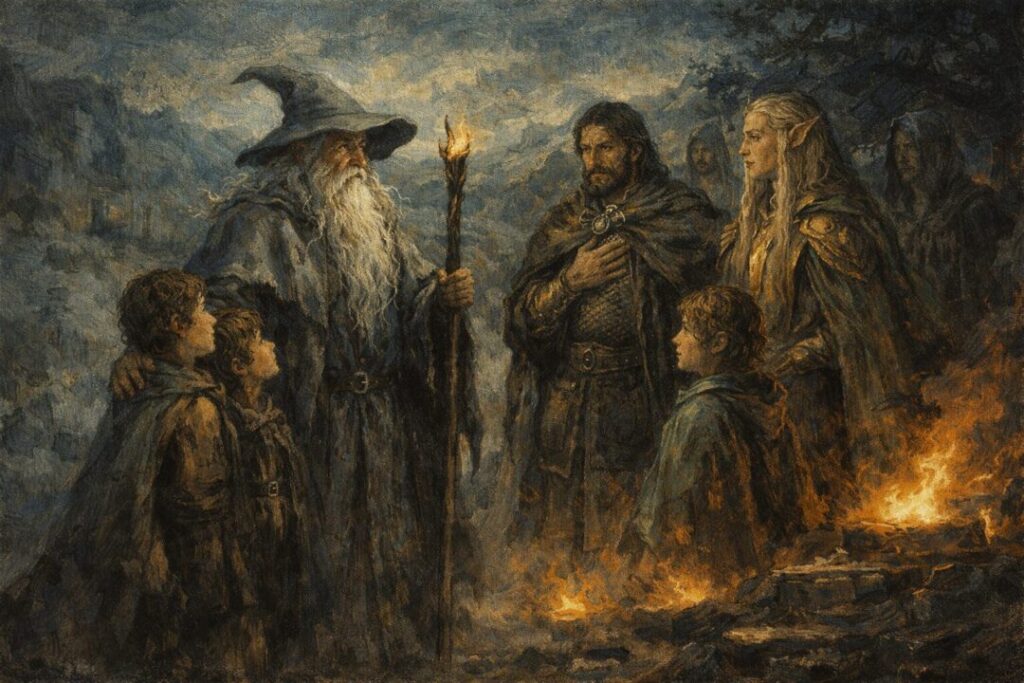
The Witch-king Is Not the Root of the Darkness
It is tempting to see the Witch-king as the central villain behind many of Middle-earth’s tragedies.
After all, his hand is visible everywhere: in the fall of Arnor, in the long terror of Angmar, in the dread that follows the Nazgûl wherever they ride. He is ancient, cunning, and terrifying in a way few other beings are.
But Gandalf understands something crucial.
The Witch-king is not the source of the evil he represents.
He is a servant—enslaved utterly to Sauron through the Rings of Power. His will is not his own. His existence is sustained by forces far older and darker than himself.
Destroying him early would not end the shadow.
It would merely remove one instrument.
Sauron has always relied on replaceable servants. When one falls, another is raised. Even the Nazgûl themselves are not independent actors; they are extensions of their master’s will.
Gandalf’s task is not to prune branches from a poisoned tree.
It is to weaken the roots.
That means focusing not on spectacular victories, but on slow, fragile work: preserving alliances, guarding knowledge, strengthening those who must one day stand without him.
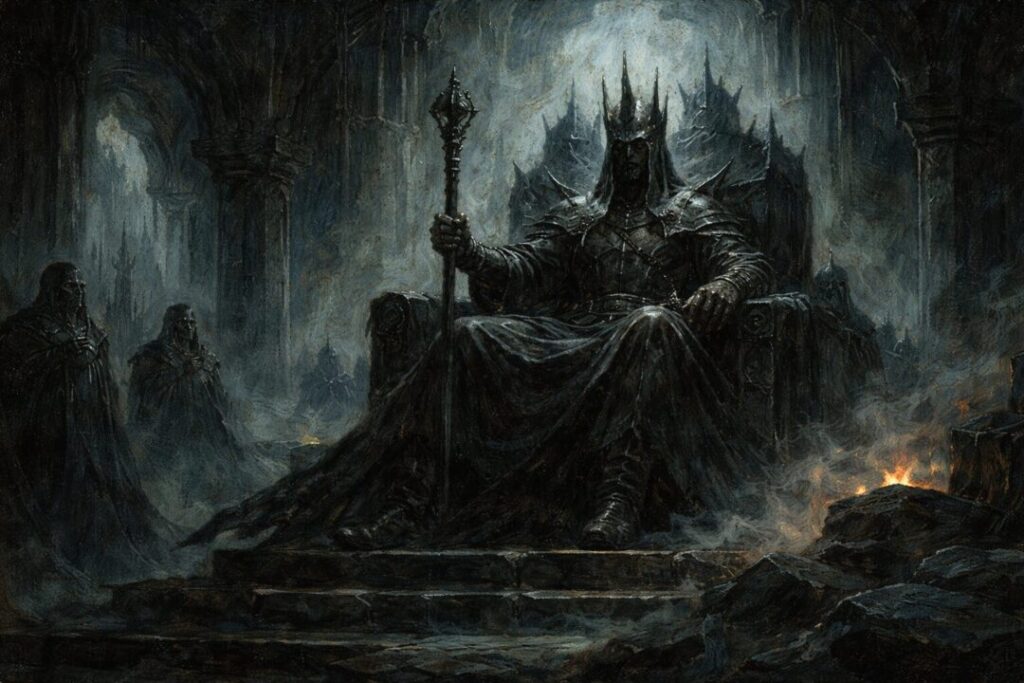
Why the Witch-king Was Allowed to Rise Again
From a strategic perspective, Gandalf’s restraint can seem costly.
The Witch-king’s return to Mordor, his command of Minas Morgul, and his leadership in the War of the Ring all have devastating consequences. Entire regions fall into despair under his shadow.
Yet this too reflects a deeper truth of Middle-earth.
Evil is not eradicated through preemptive strikes by the powerful. It is resisted—and ultimately undone—by the courage of those who refuse to surrender hope.
Gandalf’s role is to ensure that when the final confrontation comes, Middle-earth is not dependent on him alone.
If he removes the Witch-king prematurely, the Free Peoples learn nothing. They remain passive, waiting for rescue rather than learning resistance.
That lesson would be fatal.
Why Gandalf Finally Confronts Him at Minas Tirith
When Gandalf finally stands before the Witch-king, the moment is precise, deliberate, and limited.
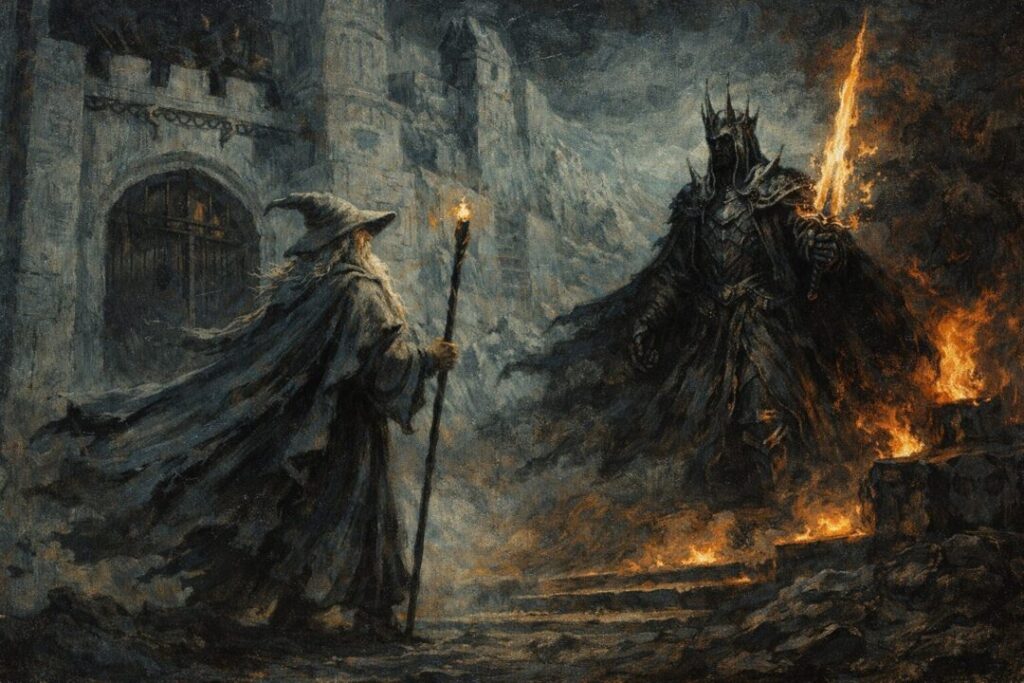
It happens at the gates of Minas Tirith, at the very brink of despair. The city is under siege. Hope is fading. The Witch-king rides forward in open defiance, confident that all resistance has been broken.
And Gandalf does not charge.
He does not pursue.
He does not strike first.
He does not attempt to destroy the Witch-king.
He stands.
This matters.
Gandalf is not acting as a hunter seeking prey. He is acting as a boundary—a final line that despair cannot cross unopposed. His presence is enough to halt the Witch-king’s advance, if only briefly.
That is all he is meant to do.
His role is defensive, symbolic, and temporary. He buys time. He holds space. He prevents total collapse until others can act.
And crucially, he steps aside.
The Witch-king’s end does not come from Gandalf’s power. It comes from courage where no one expects it—from resolve, sacrifice, and defiance by those the world has long overlooked.
This is not coincidence.
It is the design of Middle-earth itself.
A World That Rejects Easy Victory
Middle-earth consistently rejects the idea that evil can be solved through decisive violence by the powerful.
Victories come at great cost.
Triumphs are incomplete.
Even success carries loss.
If Gandalf could simply hunt down the Witch-king early, the War of the Ring would become a story about might overcoming might—about superior power eliminating inferior power.
That is not the story being told.
Instead, the world operates on limits.
Limits on power.
Limits on authority.
Limits on intervention.
Gandalf’s restraint is not weakness.
It is faithfulness.
He remains within the boundaries of his purpose, even when stepping beyond them might seem easier, faster, or safer.
Why This Choice Still Matters
Modern fantasy often escalates by introducing ever-stronger heroes and more spectacular confrontations. Problems are solved by bigger spells, stronger warriors, and more decisive action.
Middle-earth does the opposite.
Its most important victories are quiet.
Its greatest strengths are humility and endurance.
Its most powerful figures choose restraint over domination.
Gandalf does not hunt the Witch-king because the world does not need another tyrant—even a benevolent one.
It needs people willing to stand, to resist, and to act when the moment finally arrives.
And that is why the Witch-king endures for so long.
Not because Gandalf cannot stop him.
But because Middle-earth was never meant to be saved that way.