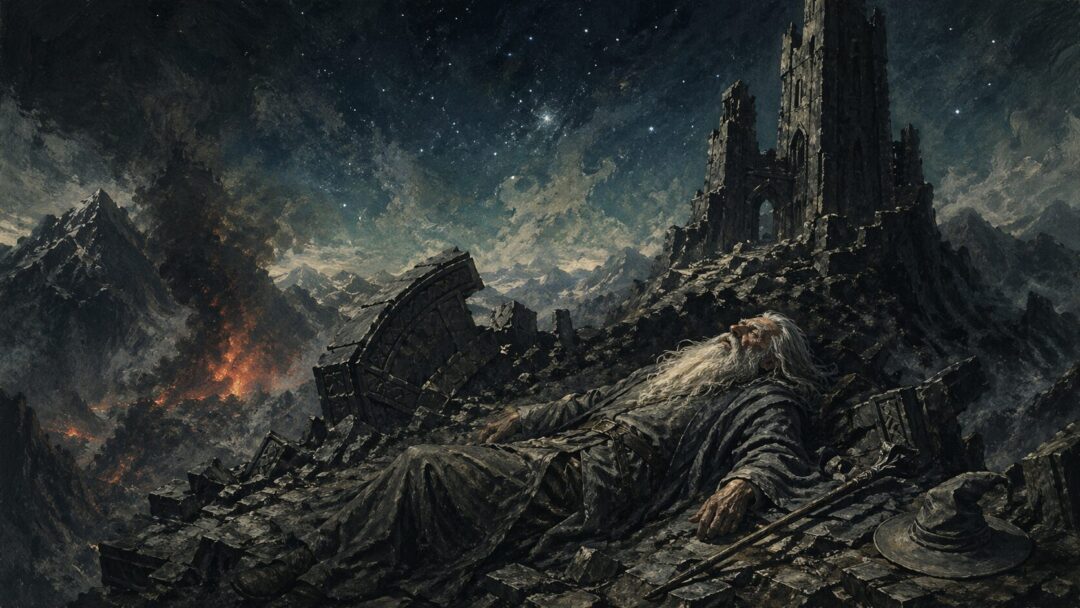
Most people understand the change from Gandalf the Grey to Gandalf the White in the simplest possible way.
He dies, returns, and comes back more powerful.
That is true.
But it is not yet the full answer.
Because if we reduce the change to raw magical strength, we miss what the story is actually doing. Gandalf the White is not merely Gandalf with brighter robes and a higher power level. The deeper shift is in what kind of figure he becomes within the war against Sauron. The texts support that his wisdom and power are greater after his return, but they also point toward something more specific than a general increase.
The question is not just, “What can Gandalf the White do that Gandalf the Grey could not?”
The harder question is this:
What role is Gandalf the White now filling that Gandalf the Grey was never meant to fill in the same open way?
That is where the real answer begins.
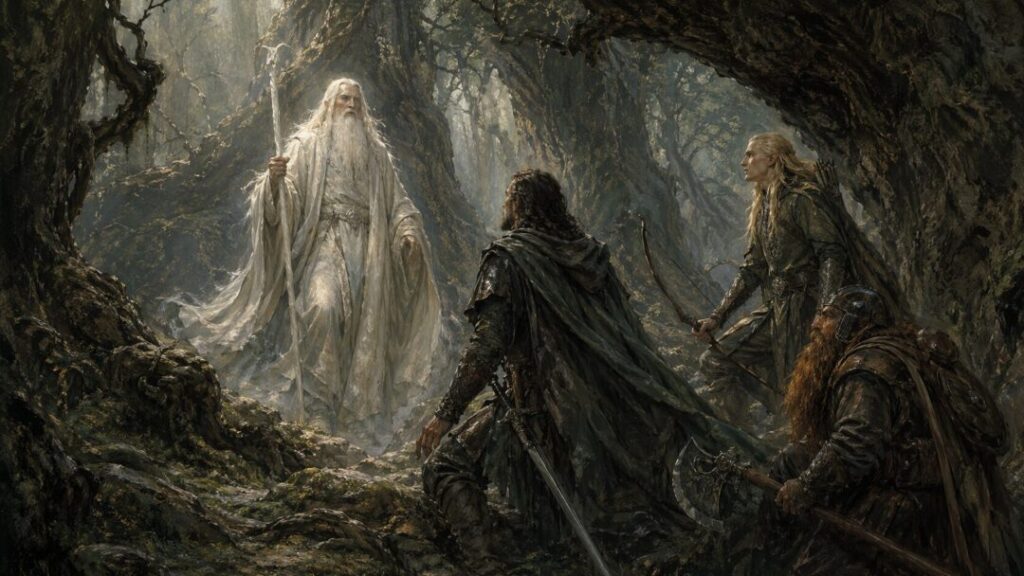
Gandalf the Grey Was Deliberately Restrained
To understand Gandalf the White, we have to begin with what Gandalf the Grey already was.
Gandalf was one of the Istari, emissaries sent to Middle-earth in old age and humility rather than in unveiled majesty. Their purpose was not to crush Sauron by force or rule the peoples of Middle-earth directly. They were meant to encourage resistance, awaken courage, and help Elves and Men oppose evil by their own choices. Later explanation is very explicit on this point: they were sent to guide, not dominate, and so they appeared as old wise figures rather than overwhelming powers.
That matters enormously.
Because it means Gandalf the Grey is not simply “pre-upgrade Gandalf.” He is already operating under conditions of limitation. His wisdom is immense, his native being is far greater than his visible form suggests, but much of that inner strength remains veiled. Even when he acts powerfully in The Hobbit or The Lord of the Rings, the pattern is restraint. He kindles hearts, gives counsel, warns against deception, and intervenes sharply only at need.
So when people ask whether Gandalf the White is stronger, the answer is yes.
But the more exact answer is that more of Gandalf is now permitted to be seen.
Moria Is Not Just a Battle. It Is a Test
The turning point is the Bridge of Khazad-dûm.
There Gandalf stands against the Balrog so that the others may escape. In later explanation, this is treated as more than battlefield heroism. It is a true act of self-sacrifice, a moment in which Gandalf gives himself up without any personal guarantee of success. The explanation attached to Letter 156 makes the importance of this very clear: Gandalf really died, and his return is bound to the fact that he passed the test that the others had failed.
This is why his return should not be read as ordinary fantasy resurrection.
The story does not suggest that death simply bounced off him. On the contrary, the explanation stresses that death made a real difference. Gandalf is changed. The crisis has become too grave. The mission of the wizards, considered as a whole, has failed in its earlier form. What returns is not merely the same Gandalf continuing uninterrupted. He is accepted, enhanced, and sent back with greater wisdom and power.
That phrase matters.
Changed.
Enhanced.
Sent back.
All three are necessary to understand what the White means.
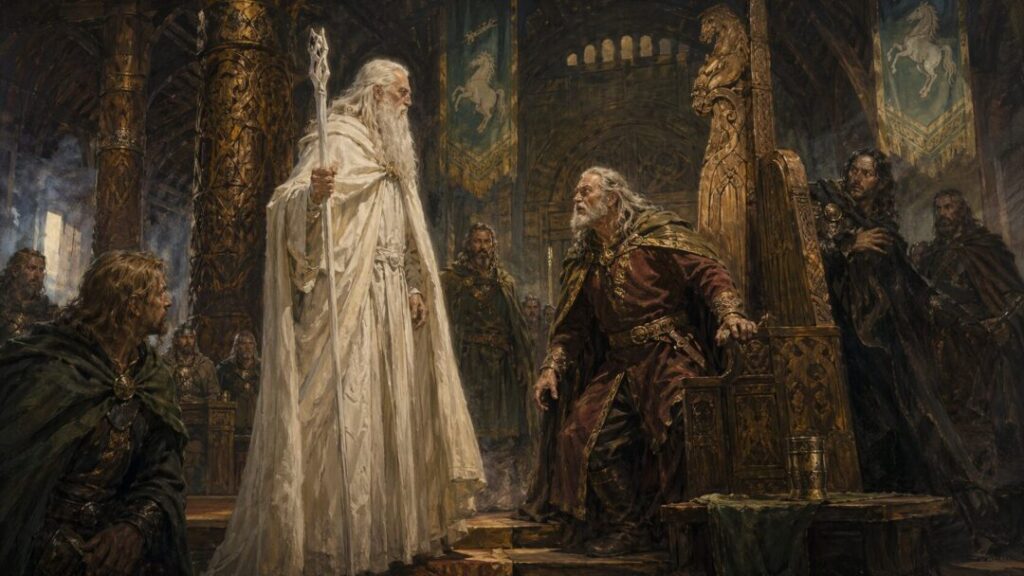
The White Means More Than Rank
At first glance, white looks like a promotion.
In one sense, it is.
Saruman had been the White, the head of the order, the chief among the Istari in authority and standing. But Saruman had fallen. He had turned from his mission, sought mastery, and openly betrayed the purpose for which the wizards had been sent. Gandalf, by contrast, is presented as the one who remained faithful. Later tradition is blunt: of all the Istari, one only remained faithful, and that one was Gandalf.
So when Gandalf returns in white, he is not only stronger.
He is now standing in the place Saruman should have occupied.
That is why one of the most revealing moments comes when Gandalf identifies himself, in effect, as Saruman as he should have been. This is not a casual line. It tells us that the change is institutional and moral as much as personal. Gandalf has not merely recovered from death. He now bears the authority that belonged to the head of the order before that office was corrupted.
That helps explain why the change feels so immediate to everyone around him.
He is not merely more impressive.
He is more final.
What Actually Becomes Greater
It is tempting to ask for a list of new powers.
But the texts do not frame the difference mainly as a catalogue of spells.
Instead, they show a broad change in presence, authority, and effectiveness. The later explanation says both his wisdom and power are much greater. Tolkien Gateway’s summary also notes greater charisma, some increased perceptive reach, and a level of authority that lets him cast Saruman out and break his staff with a spoken command.
That gives us a better way to describe the increase.
Gandalf the White is more powerful in judgment.
More powerful in command.
More powerful in revelation.
And, when necessary, more powerful in open confrontation.
The phrase “significantly more powerful figure” should therefore not be read in a narrow, flashy sense. The increase is real, but it is not mainly about turning Gandalf into a battlefield weapon. It is about making him equal to the final phase of the war. He can now act with a directness that the Grey generally did not display, not because his mission has changed into domination, but because the age has reached the point where hidden guidance alone is no longer enough.
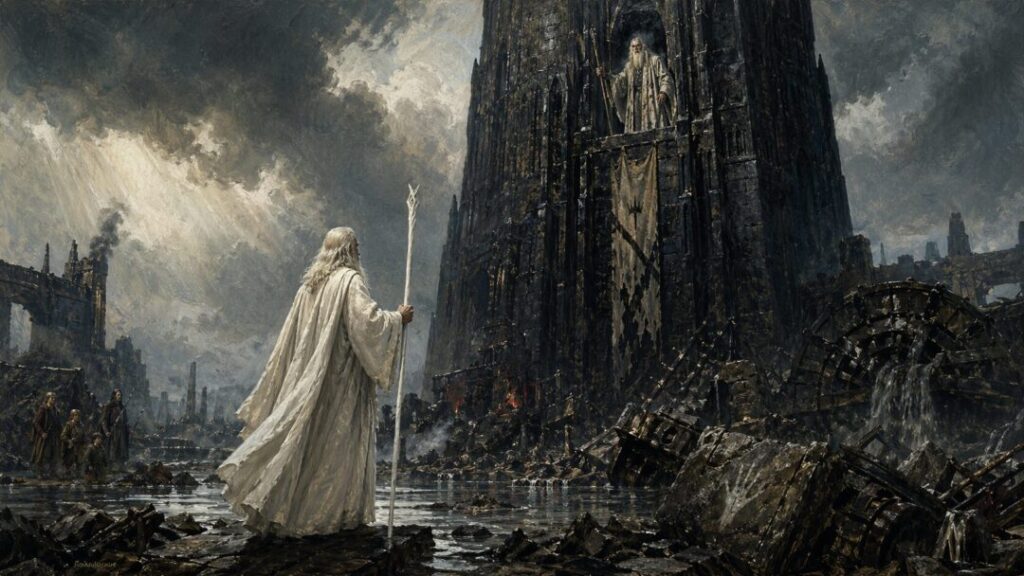
Why Rohan Shows the Difference So Clearly
One of the clearest places to see the change is in Rohan.
As Gandalf the Grey, he often worked indirectly. He warned, suggested, nudged, and prepared. As Gandalf the White, he enters a kingdom already half-collapsed under bad counsel, despair, and Saruman’s long pressure. Now his words strike with a different force. Later explanation explicitly says the old Gandalf could not have dealt in the same way with Théoden or with Saruman.
That does not mean Gandalf the Grey was weak.
It means Gandalf the White now speaks with a revealed authority that cuts through resistance more sharply.
This is one of the most important distinctions in the whole question. Gandalf does not become “different” because he abandons wisdom for force. He becomes more effective because the same wisdom now carries greater weight. His speech lands harder. His rebukes bite deeper. His presence changes the moral atmosphere of a room. Even before any visible act of power, people respond to him differently.
That is why the White feels larger than the Grey even in scenes without spectacle.
He Still Is Not Unleashed Without Limit
An easy mistake is to imagine Gandalf the White as finally operating without restraint.
The texts do not support that.
His mission remains essentially the same: to support, strengthen, and help the opponents of Sauron rather than to seize control of the war by sheer superior force. Tolkien Gateway’s summary is careful here. Even after his return, more of his inner strength may be revealed, but it is still seldom used in naked form. He remains a servant of the same larger purpose.
This is crucial for keeping the reading honest.
Gandalf the White is not simply “full Maia Gandalf.” The texts do not present him as suddenly unconstrained in every sense, nor as free to overthrow Sauron by direct power. If that had been the design, the whole structure of the War of the Ring would change. Instead, what changes is that Gandalf becomes the right figure for the war’s final stage: more unveiled, more authoritative, more terrible when opposed, but still fundamentally ordered toward guidance rather than tyranny.
The Deepest Difference Is Moral, Not Spectacular
So how is Gandalf the White a significantly more powerful figure than Gandalf the Grey?
Yes, he is stronger.
Yes, he is wiser.
Yes, he can do things the Grey was not in a position to do, and the texts themselves say the earlier Gandalf could not have dealt so with Théoden or Saruman.
But the deepest difference is not that he gains a handful of new abilities.
It is that he becomes the openly authoritative figure the age now requires.
Saruman has failed.
The hidden stage of the struggle is ending.
The war is moving into its last and hardest shape.
So Gandalf returns not as a different person in essence, but as the same faithful servant with more of his true stature allowed to appear. He is stronger because more has been entrusted to him. He is greater because he has been changed for a graver hour. And he is “white” not merely because he shines more brightly than before, but because he now bears the office, authority, and moral place that Saruman abandoned.
That is why Gandalf the White feels so different.
Not because Middle-earth suddenly needs a wizard with louder power.
But because, at the edge of catastrophe, it needs the one wizard who remained faithful to become visible in full enough measure to carry the war to its end.
Sources & Notes
- J.R.R. Tolkien, The Lord of the Rings, Book III, Chapter 5, “The White Rider” — Gandalf returns in white and says he is “Saruman as he should have been,” framing the change as authority as well as power.
- J.R.R. Tolkien, The Lord of the Rings, Book III, Chapter 6, “The King of the Golden Hall” — Gandalf’s restored authority is shown in Théoden’s healing and the breaking of Wormtongue’s hold over Rohan.
- J.R.R. Tolkien, The Lord of the Rings, Book III, Chapter 10, “The Voice of Saruman” — Gandalf casts Saruman from the order and breaks his staff, showing the White Wizard’s new office openly superseding Saruman’s.
- J.R.R. Tolkien, The Letters of J.R.R. Tolkien, Letter 156 — Tolkien explains Gandalf’s real death, self-sacrifice, return, and enhancement with greater wisdom and power for the final crisis.
- J.R.R. Tolkien, Unfinished Tales, “The Istari” — the Wizards are sent to guide and encourage resistance to Sauron rather than dominate by force, and Gandalf is singled out as the one who remained faithful.