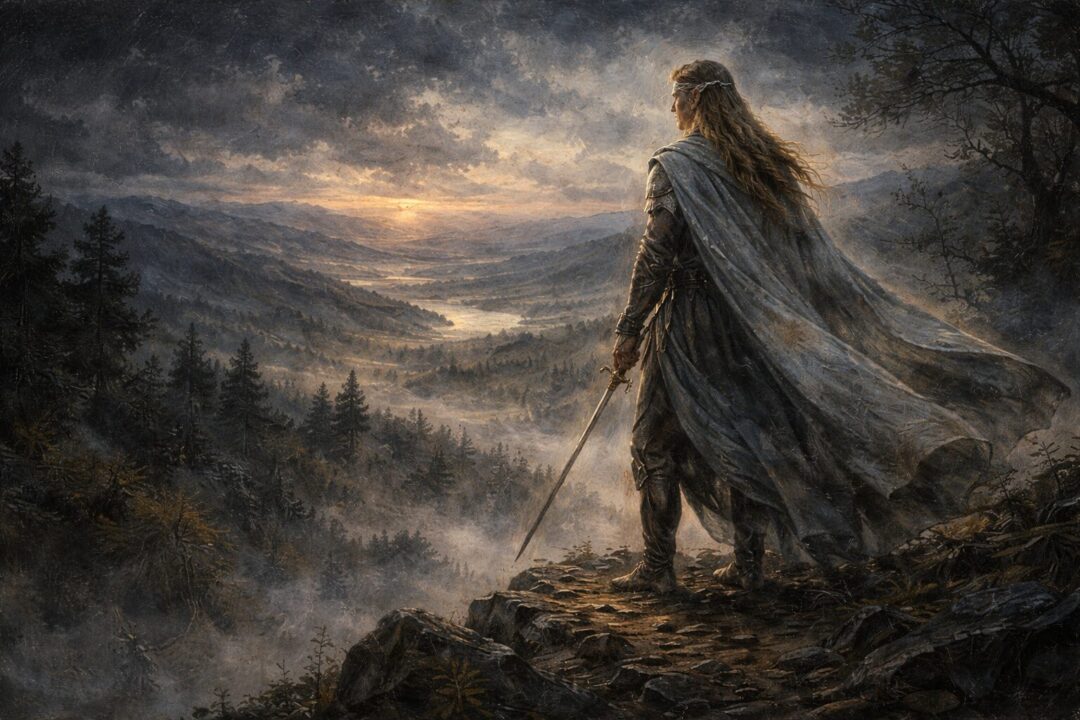
Gildor Inglorion enters The Lord of the Rings quietly—but unmistakably.
When Frodo Baggins and his companions encounter him in the Shire, the tone of the story subtly but decisively shifts. The laughter fades. The night grows deeper. The Black Riders, who moments before seemed unstoppable, hesitate at the edge of the trees. Frodo senses—without understanding how or why—that he is suddenly no longer alone in the world.
He is in the presence of something ancient and watchful.
Gildor is no wandering minstrel, no incidental traveler meant only to add color to the road. From his first words, he carries authority. He speaks not only to Frodo, but through him—addressing the larger movement of events already unfolding beyond the Shire’s borders.
Later, Gandalf confirms what the reader may already suspect: Gildor is one of the High Elves, of the House of Finrod, a lineage that reaches back to the Elder Days and the tragedies of the First Age. He has lived through the fall of great realms, the defeat of dark powers, and the slow diminishing of the Elves in Middle-earth.
And then—almost as soon as he appears—Gildor vanishes.
He does not guide Frodo to Rivendell.
He does not stand beside Elrond at the Council.
He does not ride to war, nor does his name appear in the chronicles of the great battles to come.
In the vast narrative of the War of the Ring, he leaves barely a trace.
This absence is not a gap in the story.
It is a pattern.
Gildor’s True Function in the Narrative
Gildor’s role is not to act, but to signal.
He appears at a liminal moment—at the threshold between the safe, pastoral world of the Shire and the vast, perilous history that lies beyond it. Until this encounter, Frodo’s danger feels abstract. The Black Riders are frightening, but mysterious. The wider world is still half-legend.
Gildor changes that.
He names the Riders for what they are. He confirms that the danger is real, ancient, and deliberate. And he makes something else clear as well: this danger cannot be solved by intervention from above.
Crucially, Gildor refuses to take responsibility for the Ring.
He does not escort Frodo.
He does not summon aid.
He does not attempt to “fix” the problem that now sits in Frodo’s pocket.
Instead, he offers shelter for a single night—and then he waits for Gandalf.
This restraint is not indifference. It is wisdom.
Among the Eldar of the Third Age, there is a growing understanding that certain evils cannot be opposed directly by those who perceive them too clearly. Power, in Tolkien’s world, is never neutral. To act with great knowledge is to risk bending the story toward domination, even with good intentions.
Gildor knows this.
And so he steps aside.
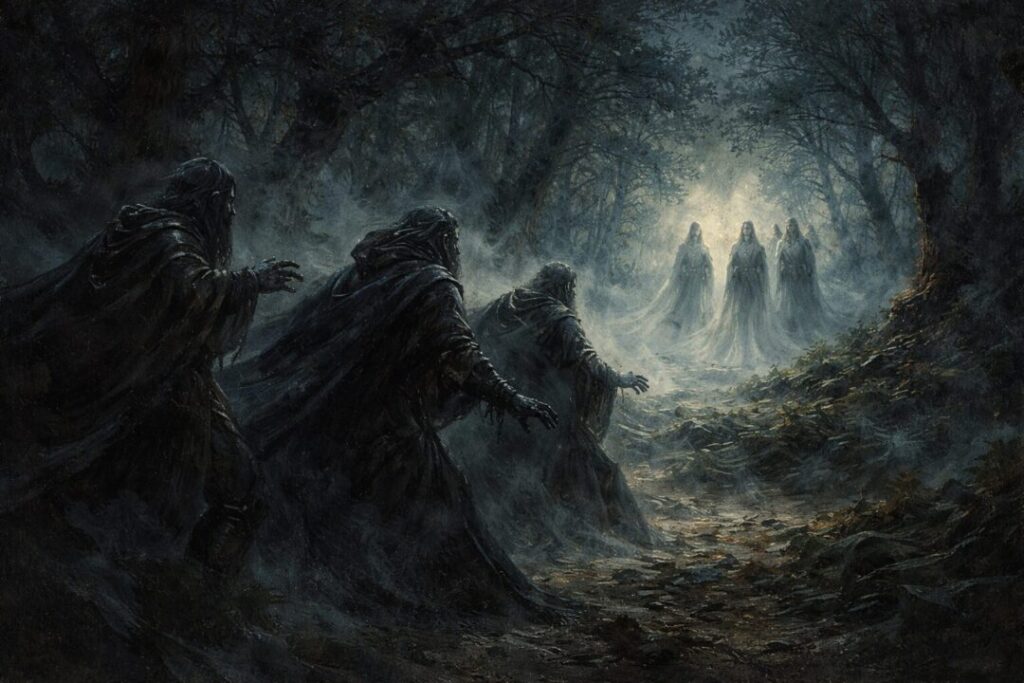
The High Elves Are No Longer Central Actors
By the time of The Lord of the Rings, the High Elves are a people in retreat—not from fear, but from history itself.
Their great wars belong to earlier ages. Their brightest works were forged in a world closer to creation, when the light of the Two Trees still lingered in memory. What remains now is preservation, not conquest; endurance, not renewal.
Figures like Gildor still walk Middle-earth, but they do so lightly. They guard borders. They watch roads. They offer counsel when necessary. But they no longer shape the fate of the world through decisive action.
This is why Gildor does not attend the Council of Elrond.
Not because he is unworthy.
Not because he is ignorant.
But because the decisions made there belong to a different chapter of history—one that will conclude with the passing of the Elves themselves.
The Council is not about preserving the old world.
It is about letting it end.
Knowledge as Burden, Not Advantage
One of the quietest but most consistent truths in Tolkien’s world is that knowing too much can disqualify you from action.
Gildor understands the Ring more clearly than Frodo ever could at that stage. He understands the Nazgûl. He understands the Enemy behind them. And, most importantly, he understands that the path ahead cannot be guided safely by those who already see its end.
This is why the Ring-bearer is a Hobbit.
Not because Hobbits are strong.
Not because they are wise.
But because they are small—spiritually and historically.
They do not blaze in the unseen world. They do not attract the Eye by their mere presence. They can move quietly through history without reshaping it simply by existing.
Gildor cannot do that.
To walk beside Frodo would be to draw attention, to pull the story back into the orbit of the Elder Days. And that would doom the quest before it truly began.
A World That Must Move Beyond the Eldar
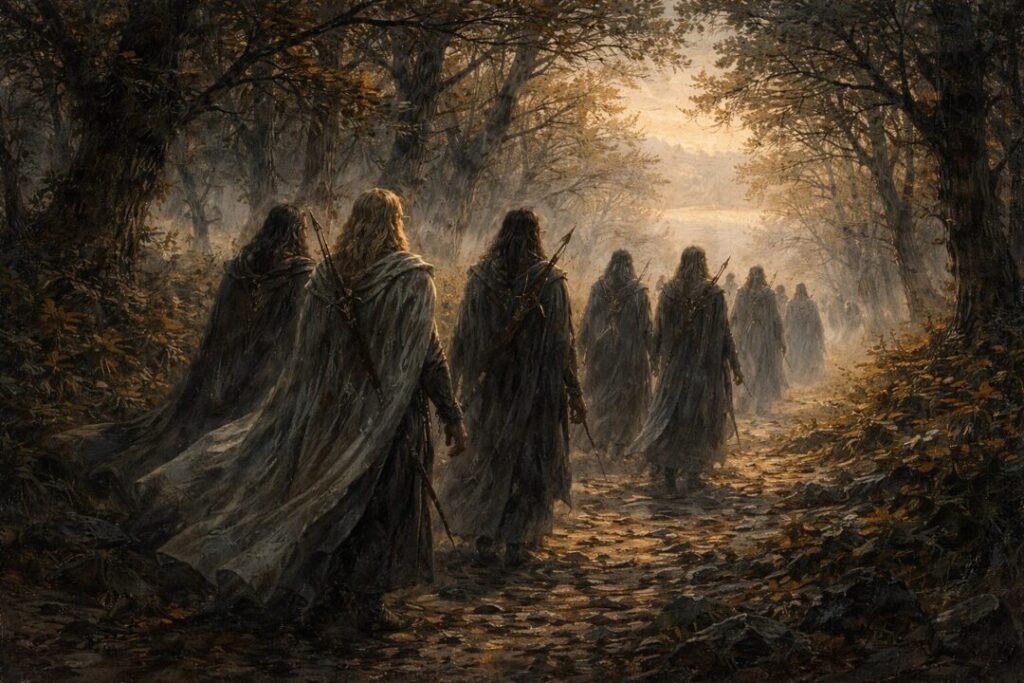
Gildor’s disappearance mirrors a broader movement in Middle-earth: the withdrawal of the Firstborn.
The Elves are not defeated. They are not diminished in worth. But their time as protagonists is ending. The world must now be shaped by those who do not remember its beginning.
Men will inherit the world.
Hobbits will save it.
And the Elves will depart, quietly, without triumph or tragedy.
Gildor remains somewhere east of the Sea—wandering, watching, and waiting. He continues his role as a guardian and witness, not as a hero whose name fills songs.
His silence is deliberate.
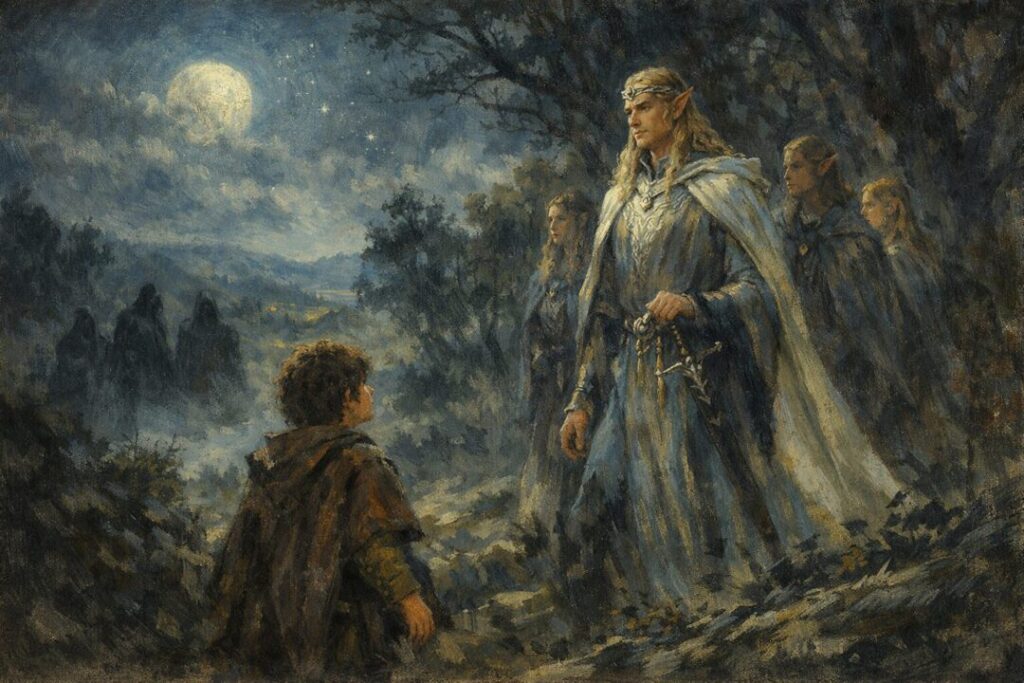
Why His Absence Matters
Gildor vanishes because the story cannot move forward if figures like him remain too close.
If ancient wisdom stays in the foreground, growth becomes impossible. The future would forever be judged against a past it can never equal.
His withdrawal is not neglect.
It is mercy.
By stepping aside, Gildor allows the world to belong to those who must live in it after the Elves are gone. He allows uncertainty, failure, and fragile hope to matter more than inherited authority.
And once you see that, Gildor Inglorion is no longer a forgotten character.
He becomes one of the clearest symbols of why Middle-earth changes forever—not through conquest, but through letting go.