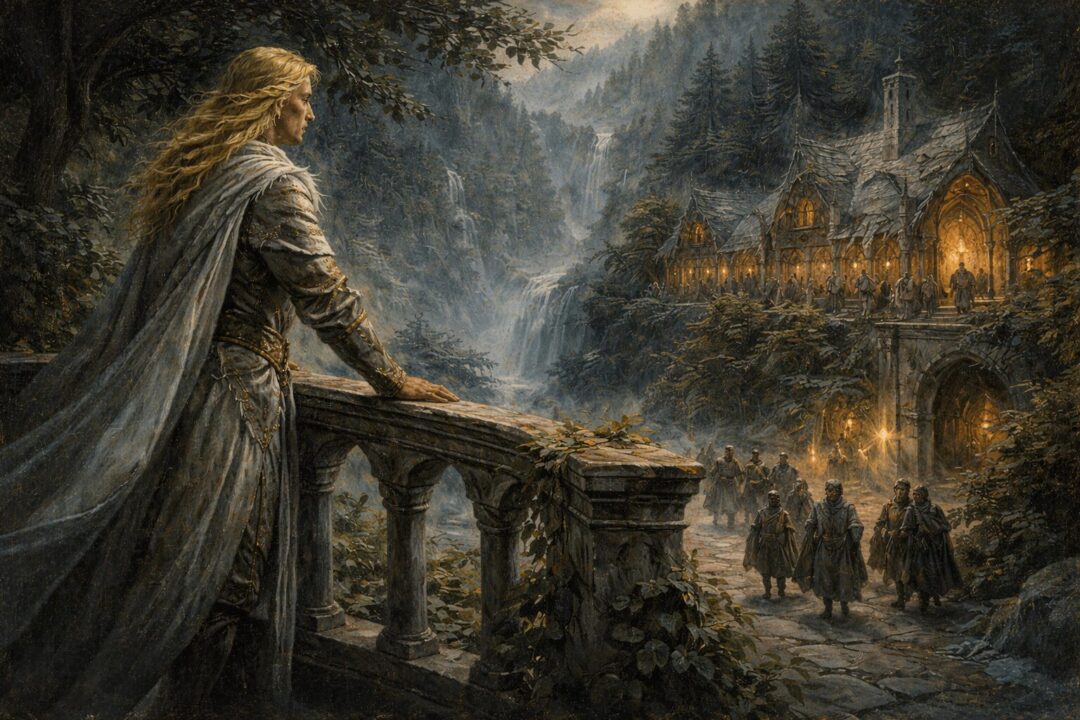
Death, for Elves, is not the same as it is for Men.
But it is also not trivial.
Among modern readers, it is sometimes assumed that Elves simply “come back” after death, as though reincarnation were routine. Tolkien’s texts do not support this view. In fact, they point in the opposite direction: death is a profound rupture, and return is rare, conditional, and deeply bound to moral and spiritual judgment.
This makes the case of Glorfindel extraordinary.
He dies in the First Age.
And yet, by the Third Age, he walks again in Middle-earth—stronger in spiritual presence than almost any other Elf remaining east of the Sea.
That fact alone demands explanation.
Death and the Fate of Elves
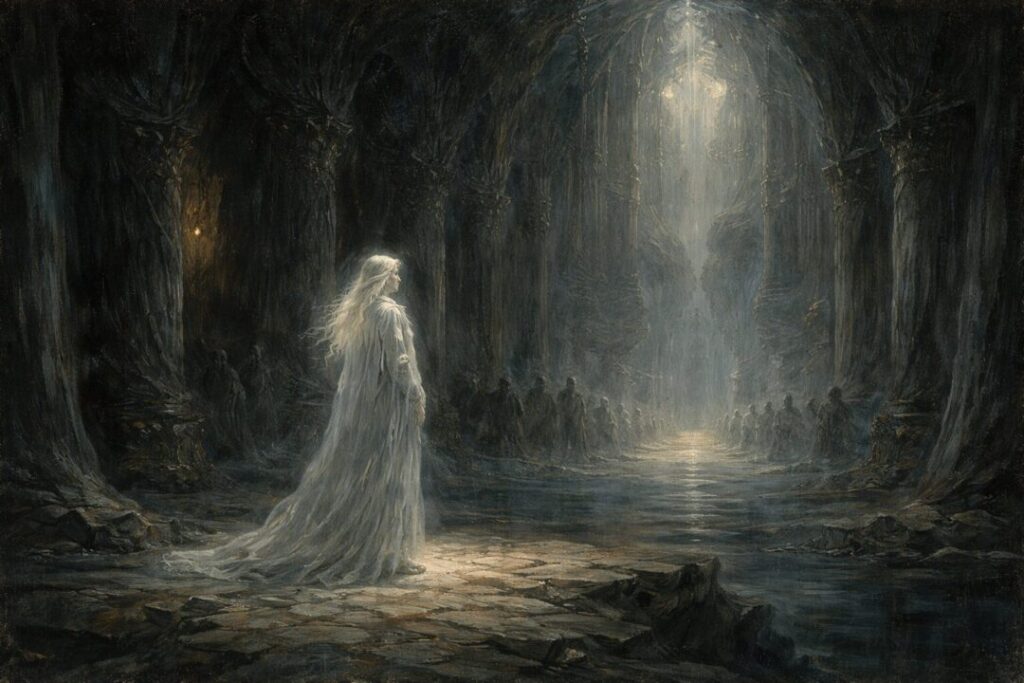
When an Elf dies, the body perishes, but the spirit (the fëa) is summoned to the Halls of Mandos in the Blessed Realm. There, the spirit may remain for a long time—sometimes for ages beyond the reckoning of Middle-earth.
Tolkien is explicit that this is not punishment by default. It is a place of waiting, healing, and reflection. Only after judgment may an Elf be rehoused: restored to a body similar to the one they had in life.
But crucially, rehousing is not automatic.
Some spirits remain in Mandos until the end of Arda. Some refuse rehousing. Others are not permitted to return. The process depends on the condition of the spirit, the choices made in life, and the harmony—or disharmony—between the Elf’s will and the deeper order of the world.
This means that any Elf who returns to Middle-earth after death does so not by entitlement, but by allowance.
And that places Glorfindel in a very small company.
Glorfindel’s Death Was Extraordinary—but Not Unique
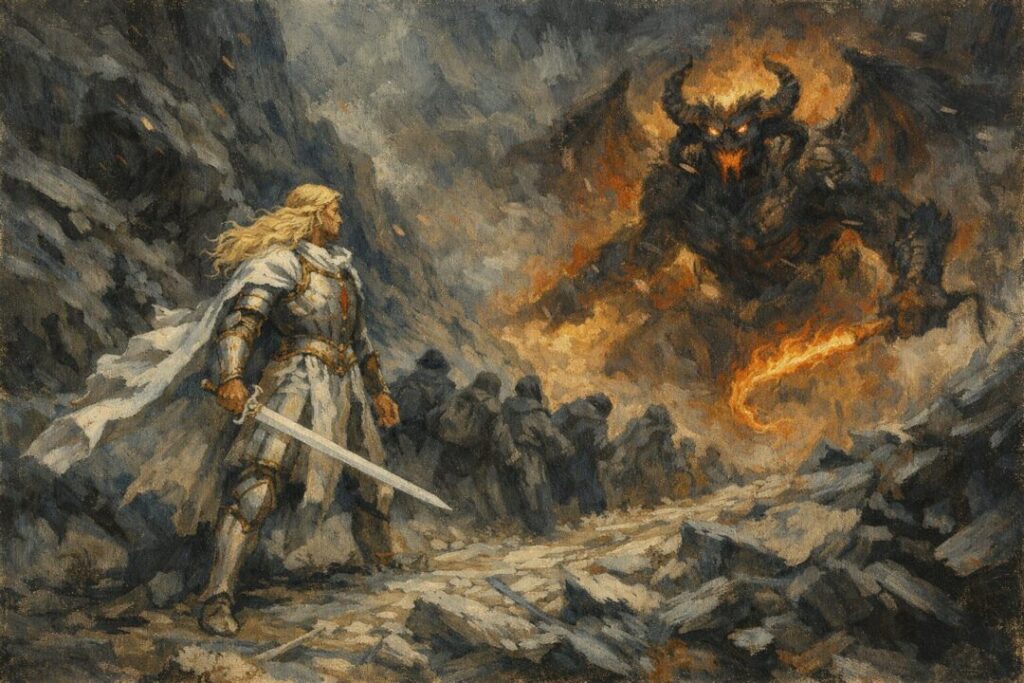
Glorfindel dies during the fall of Gondolin, one of the great catastrophes of the First Age. As Morgoth’s forces overwhelm the hidden city, refugees flee through a narrow mountain pass.
Glorfindel remains behind.
In The Silmarillion, he confronts a Balrog and slays it, but is himself killed in the struggle. His body falls into the abyss below.
This is an act of great courage. It is also an act of complete self-sacrifice.
But it is important to be precise: Balrog-slaying alone cannot explain his return.
Other figures—Elves and Men alike—perform deeds of equal or even greater martial magnitude. Some die heroically. Some save others at the cost of their lives. None of them are explicitly described as returning to Middle-earth in the same way Glorfindel does.
This tells us something essential.
If reincarnation were a reward for valor, the texts would show a pattern. They do not.
So the reason must lie elsewhere.
Rehousing Is a Judgment, Not a Prize
In Tolkien’s later writings, especially those preserved in Unfinished Tales and related notes, rehousing is described as a process tied to spiritual readiness.
Three ideas recur consistently:
- The spirit must be healed of the wounds of life.
- The will must be brought back into harmony with the Music of the world.
- The individual must be judged fit to return.
This is not a transactional system. It is not “earn a resurrection by doing something impressive.”
Instead, it is moral and metaphysical.
Glorfindel’s death is marked by something Tolkien consistently values: self-abnegation.
He does not seek glory.
He does not attempt to escape.
He does not even fight with hope of survival.
He holds the pass because someone must—and because others cannot survive unless he does.
Throughout the legendarium, Tolkien repeatedly associates this kind of humility with spiritual clarity. The greatest victories are achieved not by domination, but by renunciation: Finrod breaking his chains, Frodo refusing the Ring’s power, Sam carrying what he cannot master.
Seen in that light, Glorfindel’s death is not simply brave. It is aligned.
It is therefore reasonable—though still interpretive—to suggest that his rehousing is connected not to power, but to moral orientation.
What Changed When Glorfindel Returned
When Glorfindel appears in The Fellowship of the Ring, he is not presented as merely ancient or experienced. He is qualitatively different.
Several textual details point to this.
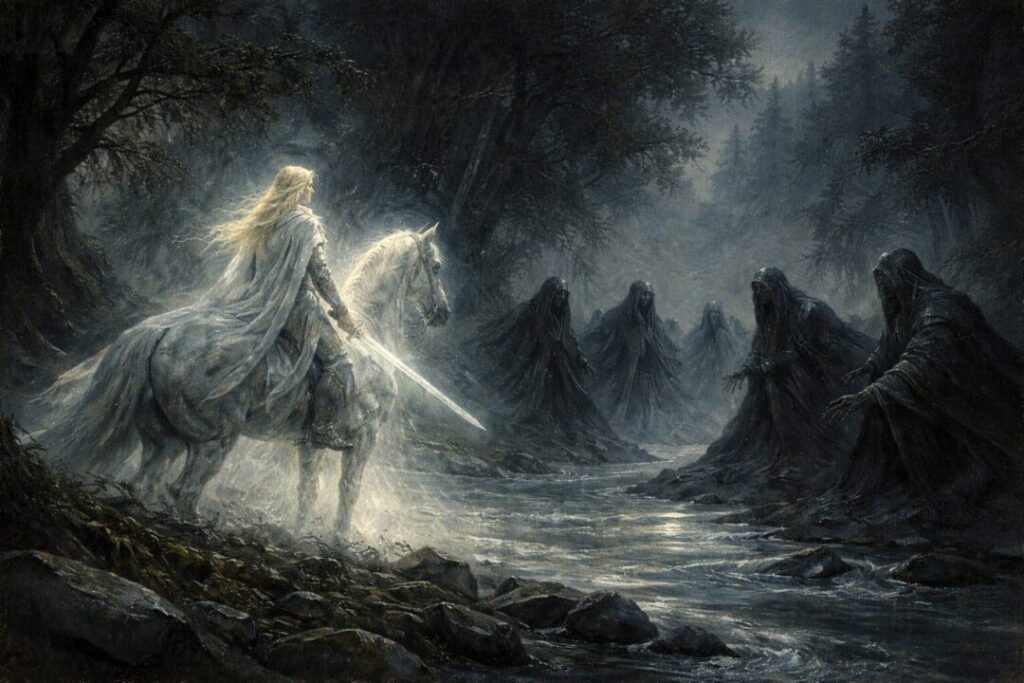
Frodo, wearing the Ring, sees Glorfindel shining in the unseen world—white, radiant, and terrible to behold. The Nazgûl recoil from him directly, not merely from his weapons or courage. Gandalf treats him with a respect that approaches equality.
These are not traits shared by most Elves of Rivendell.
Tolkien later clarifies that Glorfindel, having passed through death and been rehoused, possesses enhanced spiritual authority. He exists more fully in both the Seen and the Unseen than ordinary incarnate beings.
This does not make him a Maia, nor does it erase his Elvish nature. But it places him closer to the boundary between worlds.
In practical terms, this explains why his presence affects the Nazgûl so strongly. They exist almost entirely in the Unseen. Glorfindel, having passed through Mandos and returned, meets them on their own ground.
A Parallel—But Not an Equivalence—with the Istari
It is tempting to equate Glorfindel with the Wizards. The comparison is understandable, but it must be handled carefully.
The Istari are Maiar incarnated under restriction, deliberately limited in power and memory. Glorfindel is an Elf, rehoused and enhanced, but still bound by Elvish nature.
What they share is not origin, but visibility.
Both exist in a way that draws attention in the Unseen world. Both are spiritually “bright.” Both would be disastrous companions for a mission dependent on secrecy.
This is why Glorfindel does not join the Fellowship.
Not because he is unwilling.
Not because he is unneeded.
But because his presence would blaze like a beacon.
Why Glorfindel’s Return Is Rare
If reincarnation were common, death would lose its gravity. Tolkien avoids this carefully.
Glorfindel’s return does not establish a system.
It establishes an exception.
The Valar intervene rarely, and only when the moral balance of Arda requires it. Glorfindel’s presence in the Third Age strengthens the defenses of the Free Peoples without overturning the story’s central dynamic: that evil is not defeated by overwhelming force.
He can guard.
He can defend.
He can stand openly against terror.
But he cannot carry the Ring.
That task belongs to the small, the overlooked, and the spiritually inconspicuous.
A Being Between Ages
Glorfindel embodies a transition.
He belongs to the Elder Days—the world of Balrogs, hidden cities, and catastrophic wars. Yet he walks in a time when such figures are fading from the center of history.
His reincarnation is not about restoring the past.
It is about preserving what must endure long enough for something new to begin.
The Elves are not meant to rule Middle-earth forever. They are meant to prepare it, protect it, and then pass away.
Glorfindel’s role reflects this truth.
He does not dominate the story.
He does not lead armies into Mordor.
He appears briefly, decisively, and then steps back.
Why Tolkien Leaves This Mostly Unexplained
One of Tolkien’s most deliberate narrative choices is restraint.
He does not pause the story to explain Glorfindel’s rehousing. He does not provide exposition in the main text. He allows the mystery to remain partially veiled.
This mirrors how the Hobbits experience the world.
They see wonders they do not fully understand. They benefit from powers whose origins are never explained to them. The deeper metaphysics of Arda operate quietly, offstage.
Glorfindel is part of that hidden structure.
His story is not loud.
It is not triumphant.
And it is not finished on the page.
That, perhaps, is the point.
Glorfindel returns not to be the hero of the age—but to ensure that the age can end rightly.