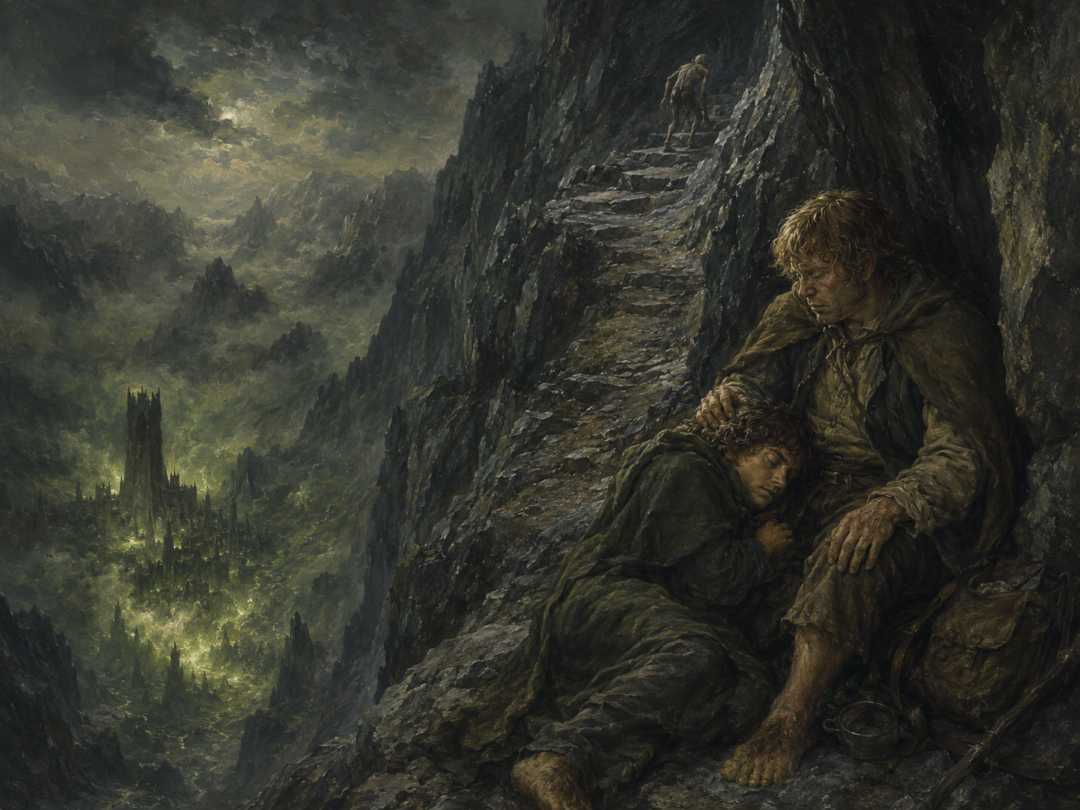
The most frightening moment on the Stairs of Cirith Ungol is not when Gollum bares his teeth, grabs Sam, or openly turns against Frodo.
It is when he is simply gone.
Frodo and Sam have climbed above the dreadful valley of Minas Morgul, passed through exhaustion, fear, and the oppressive nearness of Mordor, and reached a narrow place where they can rest. Gollum, their guide through country neither hobbit understands, disappears ahead of them for hours. When he returns, Frodo and Sam are asleep.
The absence can seem almost minor compared with what follows. Shelob’s tunnels, Gollum’s attack on Sam, and Frodo’s apparent death are far more dramatic.
But Gollum’s disappearance is actually one of the most dangerous stages of the entire journey.
A direct attack would reveal him as an enemy.
His disappearance allows him to remain useful.
And that difference nearly destroys the Quest.
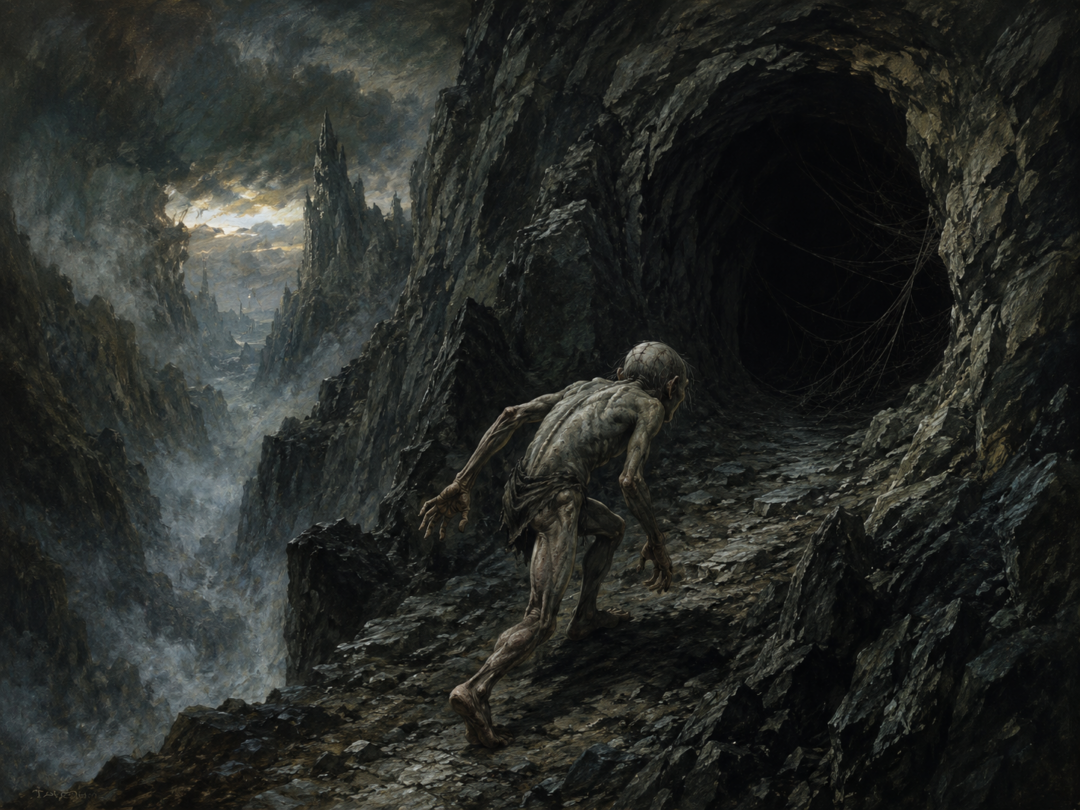
A Visible Enemy Would Be Easier to Understand
By this point, Sam has distrusted Gollum for a long time. He expects betrayal. He watches him closely and repeatedly warns Frodo.
Yet suspicion is not the same thing as proof.
Frodo’s relationship with Gollum is more complicated. He understands that Gollum desires the Ring, but he also knows that Gollum hates Sauron and the Orcs. More importantly, Frodo recognizes something of himself in the ruined creature. Both are Ring-bearers, though their experiences are very different, and Frodo continues to hope that Sméagol is not entirely lost.
That makes a straightforward attack almost self-defeating for Gollum.
If he assaulted Frodo on the road and failed, his usefulness would end immediately. Sam would no longer need to argue that their guide was dangerous. Frodo would know it.
Gollum would become nothing more than an enemy following them through the mountains.
Instead, he maintains the one advantage that matters most: Frodo still needs him.
The hobbits do not know the secret ways into Mordor. They do not know the pass. They do not understand what waits beyond the Stairs.
Gollum does.
His power therefore comes less from strength than from information.
The Climb Has Already Weakened Frodo and Sam
The timing of Gollum’s disappearance matters.
He does not vanish while Frodo and Sam are strong, well supplied, and travelling through friendly country. He disappears after they have passed Minas Morgul and endured the exhausting ascent toward Cirith Ungol.
The climb is punishing. Frodo is increasingly burdened, physically and spiritually, by the Ring and by his proximity to Mordor. The hobbits are operating on limited food, limited sleep, and very little certainty about what lies ahead.
By the time they reach their resting place above the Stairs, rest is not a luxury. They need it.
That creates exactly the kind of vulnerability Gollum can exploit.
A violent enemy announces danger. Exhaustion disguises it.
The hobbits cannot remain permanently awake simply because they distrust their guide. Sam tries to keep watch, but even he eventually sleeps.
Gollum does not have to overpower them.
He only has to leave while they are no longer capable of controlling what he does.
His Absence Conceals the Real Battlefield
The most important thing about Gollum’s disappearance is that Frodo and Sam do not know where he goes.
The text later makes clear that his treachery is connected with Shelob. Gollum has known of her before and has conceived a plan in which she will kill the hobbits, after which he hopes to recover the Ring from what remains.
That means the true danger is being prepared away from Frodo’s sight.
This is fundamentally different from an ambush.
In an ambush, the danger eventually reveals itself as an attacker.
Gollum’s scheme uses the landscape itself.
He is leading Frodo and Sam toward a creature already dwelling in the pass. Shelob does not need to be recruited like a soldier or commanded like an Orc. Gollum merely has to bring prey into her reach.
His disappearance therefore represents something larger than personal betrayal.
He is turning knowledge of the terrain into a weapon.
Frodo and Sam think they are following a guide through a dangerous road.
In reality, their guide is arranging for the road to kill them.
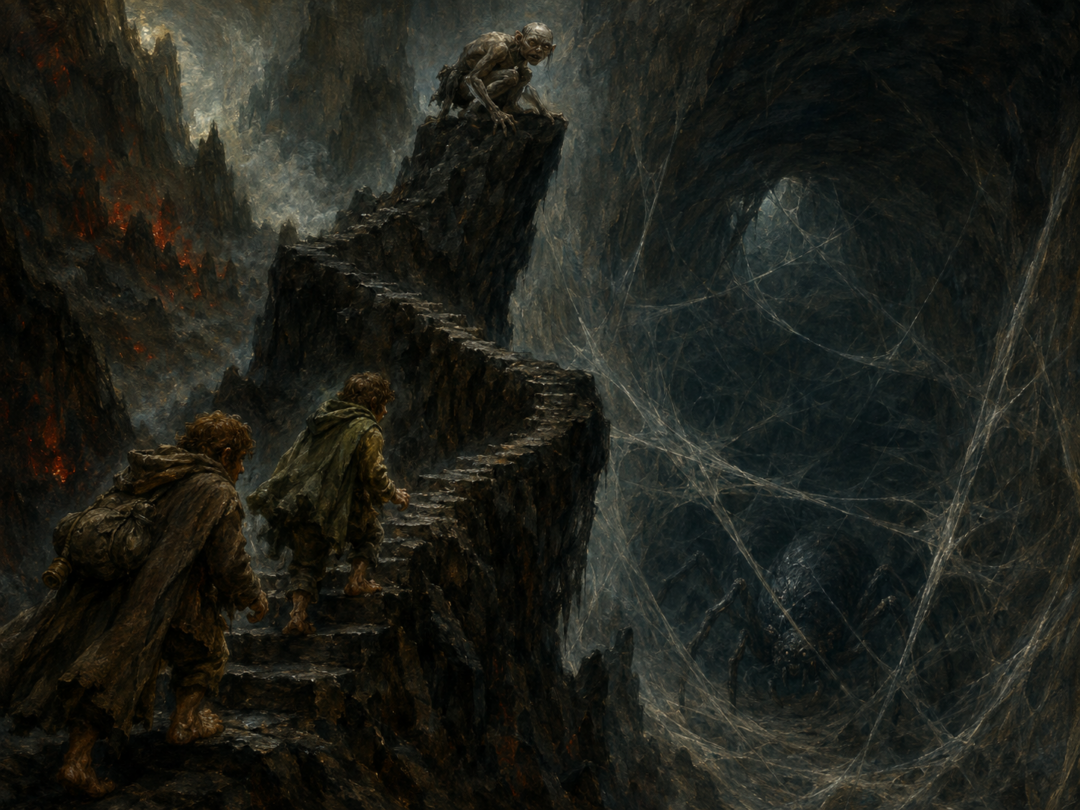
Gollum Does Not Need to Defeat Sam
There is another practical reason indirect betrayal is more dangerous.
Sam is extremely difficult for Gollum to remove while Frodo is still alive and alert.
Later, when Gollum finally attacks Sam near Shelob’s lair, the struggle does not go as Gollum hopes. Sam resists him and drives him off.
That later confrontation shows the weakness of Gollum’s position in a direct fight.
He is quick, cunning, and dangerous, but Sam is fiercely protective of Frodo. An obvious assault allows Sam to focus all of his anger on a visible enemy.
Shelob changes the equation.
Gollum’s plan divides the hobbits’ attention. Frodo must deal with the terror ahead while Sam is attacked from behind. The danger is no longer one enemy but several threats converging at once: darkness, webs, Shelob, Gollum, and the Orcs of Cirith Ungol beyond.
This is what makes the disappearance strategically effective.
Gollum does not become stronger.
He creates circumstances in which Frodo and Sam become easier to destroy.
The Guide Remains Trusted After the Betrayal Has Already Begun
Perhaps the darkest part of the episode is that Gollum returns.
If he vanished forever, Frodo and Sam would at least understand that something had changed.
Instead, he comes back and resumes his role.
Frodo even tells him that he has fulfilled what was required of him and may leave if he wishes. Gollum insists on continuing.
That decision is crucial.
He is no longer merely guiding them toward Mordor. He needs them to follow him far enough for his plan to work.
The danger therefore depends upon continuity.
Everything must look almost normal.
He must remain the bent, suspicious, miserable creature they already know rather than suddenly becoming an open murderer.
That is one reason his disappearance is more unsettling than an attack: the betrayal has advanced without visibly altering the relationship.
Frodo is already in greater danger when Gollum returns than when Gollum left.
Frodo simply does not know it yet.
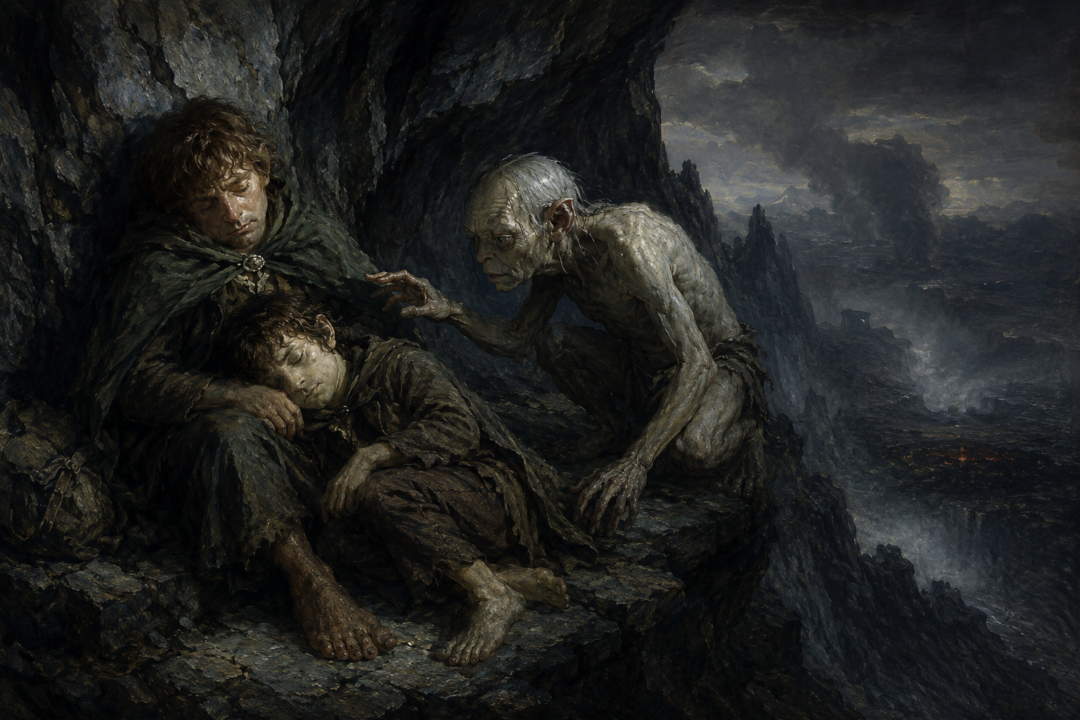
The Most Tragic Moment Happens When Gollum Comes Back
Yet the episode is not morally simple.
When Gollum returns, he finds Frodo asleep with his head resting in Sam’s lap. For a brief moment, something changes in him. His expression softens, and he reaches toward Frodo.
The scene strongly suggests the re-emergence of Sméagol, the person buried beneath centuries of possession, loneliness, fear, and corruption.
Sam awakens and immediately interprets Gollum’s behavior as another act of sneaking.
From Sam’s point of view, that suspicion is entirely understandable. He has repeatedly seen reasons not to trust Gollum.
But the moment collapses.
Gollum hardens again.
This is what makes his earlier absence so important. He has apparently already gone forward in connection with the plot against them, yet even after that choice the conflict inside him is not entirely finished.
The betrayal has begun, but repentance may still have been possible.
That does not make Sam responsible for Gollum’s later actions. Gollum remains morally responsible for his treachery.
It does, however, make the scene tragic rather than mechanical.
The most dangerous enemy on the mountain is also still divided against himself.
Shelob Allows Gollum to Avoid the Meaning of Murder
There is also a psychological advantage in using Shelob.
Gollum wants the Ring, but Frodo has shown him pity and has become his “master” under the oath sworn by the Precious. Gollum’s relationship with Frodo is therefore tangled with obedience, resentment, desire, and genuine attachment.
His plan with Shelob creates distance between intention and act.
He does not need to personally stab Frodo to death and take the Ring from his body.
He can lead Frodo somewhere else and allow another creature to do the killing.
The text does not excuse him for this distinction. He is deliberately arranging the hobbits’ destruction.
But it reveals something about his cunning.
Indirect violence lets Gollum imagine himself as guide, victim, servant, and betrayer almost simultaneously.
That is harder to defend against than simple hatred.
A declared enemy can be resisted.
A guide who partly cares for you and partly intends your death is far more dangerous.
His Greatest Weapon Is What Frodo Does Not Know
Frodo knows many terrible things by the time he reaches Cirith Ungol.
He knows the Ring is becoming heavier.
He knows Mordor lies ahead.
He knows the Nazgûl are near.
He knows Gollum cannot be trusted completely.
But he does not know about Shelob.
That single missing fact outweighs almost everything else.
Gollum knows the route, the tunnel, and the creature inhabiting it. Frodo knows only that the path may offer a way into Mordor.
This imbalance of knowledge gives Gollum an advantage no knife could provide.
Had he attacked openly, Frodo and Sam would have known where the danger stood.
Instead, Gollum allows them to continue believing that the greatest threat is still somewhere ahead in Mordor.
The real trap is already beside them.
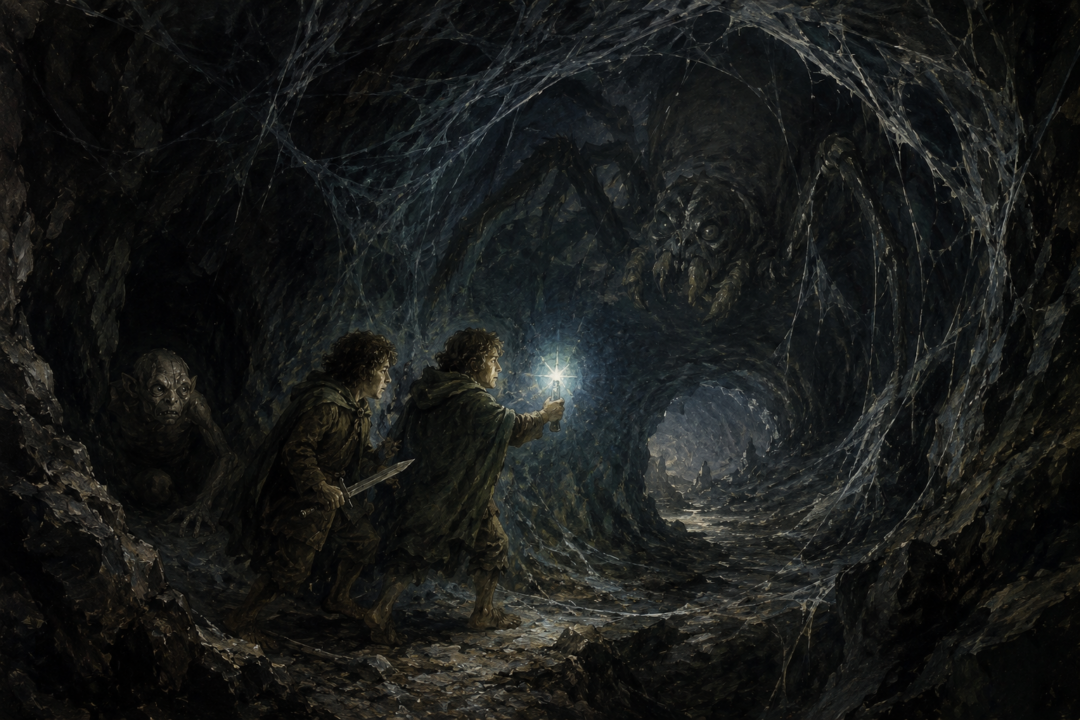
Why the Disappearance Matters So Much
Gollum’s disappearance on the climb is frightening because nothing visibly catastrophic happens.
No sword is drawn.
No one cries out.
No blood is spilled.
Yet during those missing hours, the structure of the journey changes.
The guide becomes an active betrayer. The unknown road becomes a prepared trap. Frodo and Sam continue forward without realizing that their enemy’s strongest move has already been made.
And when Gollum returns, the terrible irony deepens: he may still be capable, for a moment, of turning away from what he has planned.
That is why his absence is more dangerous than a direct attack.
An attack would expose Gollum.
His disappearance conceals him.
It preserves his usefulness, exploits the hobbits’ exhaustion, weaponizes his knowledge of Cirith Ungol, and allows Shelob to become the instrument of a murder he cannot easily accomplish himself.
Gollum almost destroys Frodo not by becoming a stronger enemy.
He nearly destroys him by remaining, for just a little longer, his guide.
Sources & Notes
- The Encyclopedia of Arda, “Gollum” — biographical account of Sméagol/Gollum, his enslavement to the Ring, and his role in Frodo and Sam’s journey: https://www.glyphweb.com/arda/g/gollum.html
- The Encyclopedia of Arda, “Stairs of Cirith Ungol” — geography of the Straight and Winding Stairs leading from Minas Morgul toward Cirith Ungol: https://www.glyphweb.com/arda/s/stairsofcirithungol.html
- The Encyclopedia of Arda, “Shelob” — account of Shelob, her lair in Cirith Ungol, and Gollum’s use of her against Frodo and Sam: https://www.glyphweb.com/arda/s/shelob.html
- The Encyclopedia of Arda, “Torech Ungol” — description of Shelob’s tunnel-lair at the head of the pass into Mordor: https://www.glyphweb.com/arda/t/torechungol.html
References for Gollum’s divided loyalties and betrayal, the exhausting route up the Stairs of Cirith Ungol, and the hidden geography of Shelob’s lair that makes his disappearance strategically dangerous.