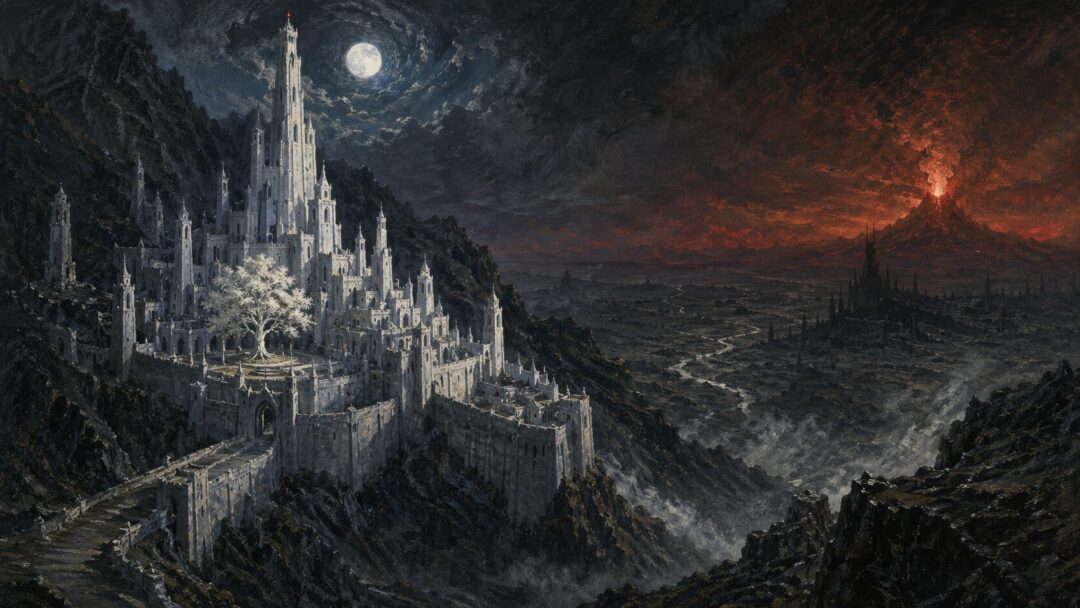
At first glance, Gondor’s position looks almost absurd.
A great realm of Men rises in the South. Its chief cities stand along the Anduin. One of its strongest towers, Minas Ithil, is set near the very borders of Mordor. And in time, that choice seems to invite exactly the disaster everyone would expect.
So the question naturally follows:
Why would anyone build Gondor so close to the darkest land in Middle-earth?
It sounds like a failure of foresight.
But the texts point in a very different direction.
Gondor was not founded near Mordor because its rulers underestimated the danger. It was founded there because they already understood what Mordor was, what lay beyond it, and what kind of kingdom would be needed in the South if Sauron ever rose again.
Gondor Was Not Founded in Empty Land
One of the biggest mistakes in this question is the assumption that Gondor was created as if Elendil’s sons simply chose a random stretch of map and planted a kingdom there.
That is not what happened.
After the Downfall of Númenor, Isildur and Anárion came to the Mouths of Anduin and founded Gondor in a region where Númenórean colonies and outposts already existed. Pelargir had stood there for centuries, and there were already many Faithful and people of Númenórean descent in the region.
That matters more than it first seems.
Gondor was not a speculative frontier settlement. It was a realm built upon existing Númenórean presence, sea-access, river access, stone-built infrastructure, and populations ready to align with the exiles. In practical terms, this was one of the strongest places the Faithful could have established a southern kingdom after Númenor’s fall.
So even before Mordor enters the picture, the location already makes sense.
The lands about the lower Anduin were rich, strategic, and familiar to Númenórean power.
Mordor Was Already There
The next key point is even more important.
Mordor did not become dangerous only after Gondor appeared.
Sauron had already settled in Mordor around the year 1000 of the Second Age, long before Gondor was founded in 3320. Barad-dûr had already been built near Orodruin, and Mordor had long since become the center of Sauron’s power in the East.
That changes the emotional shape of the whole question.
It was not that Gondor was founded, and only later discovered that a dark land happened to be next door.
Mordor was already the known seat of the Enemy.
So when Gondor was established in the South, its rulers were not ignorantly settling too near a future threat. They were founding a kingdom in the one southern region where the Faithful already had strength, while knowingly placing that kingdom in opposition to Sauron’s old stronghold.
In other words, proximity to Mordor was not an oversight.
It was part of the reality Gondor was created to face.
Minas Ithil Was Built on Purpose
Nothing makes this clearer than Minas Ithil.
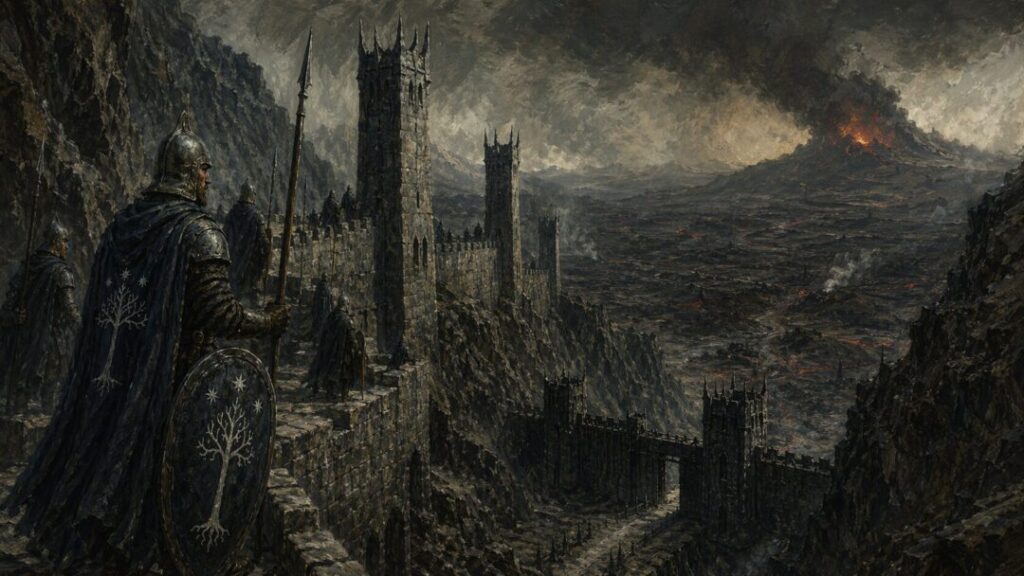
The sources state that after founding the South-kingdom, Isildur took the land later called Ithilien and built Minas Ithil near Mordor “as a threat” to the Black Land. The tower also guarded the western passes through the Ephel Dúath.
That is one of the most important facts in the whole discussion.
Minas Ithil was not foolishly misplaced.
It was strategically placed.
Its position only looks reckless if one assumes Gondor’s goal was to put as much distance as possible between itself and Sauron. But the texts suggest something harder and more deliberate: Gondor was meant to watch, contain, and oppose. Minas Ithil stood near Mordor because someone had to stand there.
And when you place that beside Minas Anor on the western side of the Anduin, and Osgiliath between them, the design of early Gondor begins to look highly intentional.
This was not a kingdom drifting too near danger.
It was a kingdom laid out as a line of strength across the South.
Osgiliath Was Chosen for Power, Not Distance
Osgiliath, the first capital, is sometimes treated as further proof that Gondor sat uncomfortably close to Mordor.
But Osgiliath was not built as a border post.
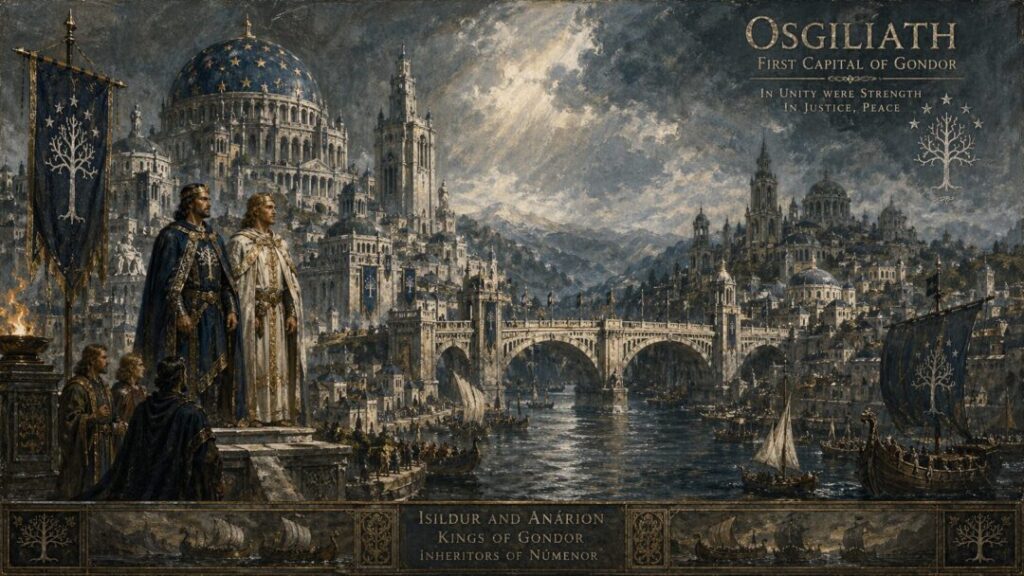
It stood on both sides of the Anduin, roughly between Minas Anor and Minas Ithil, and served as the capital from which Isildur and Anárion jointly ruled. It was a river city, a seat of government, a place of stone bridges, quays, and the Dome of Stars with the chief palantír.
That tells us what mattered.
Control of the Great River mattered.
Connection between the western lands, Ithilien, and the sea mattered.
Central rule mattered.
If Gondor had been founded farther away merely to avoid Mordor, it would have lost many of the advantages that made it viable in the first place. The founders were not choosing between “safe” and “dangerous” land in the abstract. They were balancing settlement, communications, defense, and inherited Númenórean power.
Gondor’s Founders Did Not Think in Terms of Retreat
There is also something deeper in the political and moral logic of the story.
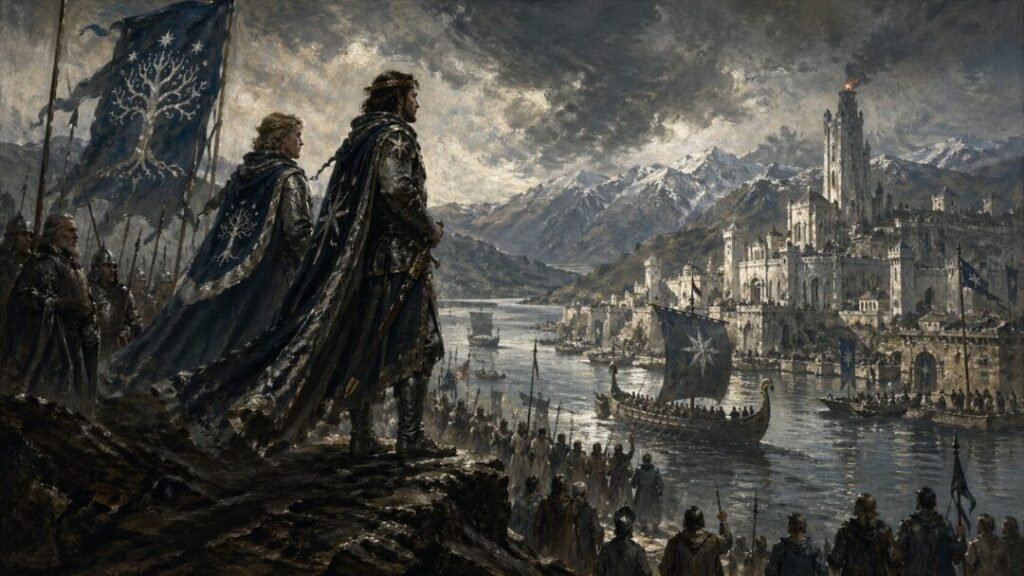
The Faithful who survived Númenor were not merely refugees looking for hiding places. They came as heirs of a great people, establishing Realms in Exile in both North and South. Arnor and Gondor were not meant to be concealed remnants. They were meant to endure openly and rule.
That mindset matters.
A kingdom founded in deliberate withdrawal from the Enemy would have reflected fear and reduction. But Gondor’s earliest architecture and city-planning suggest the opposite. The exiles built large, permanent, monumental works. They did not behave like a people trying to retreat from history. They behaved like a people re-establishing authority in Middle-earth.
So the question was never simply, “How far can we get from Mordor?”
It was, more likely: “Where can the South-kingdom stand with strength, continuity, and the power to resist what remains in the East?”
The answer to that was the lower Anduin.
After Sauron’s Defeat, Gondor Stayed on the Border
What happened after the Last Alliance makes the original logic even clearer.
When Sauron was overthrown, Gondor did not abandon the region around Mordor and move its whole center far away. Instead, the Men of Gondor built and maintained fortifications to keep watch on the Black Land and hinder Sauron’s return. The Towers of the Teeth were raised for that purpose, and the Tower of Cirith Ungol was originally a Gondorian watchtower guarding the high pass.
That is a major clue.
If Gondor’s location had been an early blunder, one might expect the kingdom to correct it once victory was won.
Instead, Gondor doubled down on the frontier.
It watched Mordor for generations because the danger had not truly ceased. Even in Sauron’s absence, the passes had to be guarded and the Black Land contained.
This does not prove that the entire realm was founded solely as an anti-Mordor fortress. The texts support more than that: settlement, inheritance, geography, and Númenórean continuity all mattered. But it does show that closeness to Mordor was never treated as an obvious mistake by Gondor itself.
It was treated as a burden the kingdom was expected to carry.
So Why Was Gondor Founded So Close to Mordor?
Because Gondor was founded where the Faithful already had strength.
Because the Mouths of Anduin and the lands around Pelargir gave the exiles population, ports, river-access, and continuity with older Númenórean settlements.
Because Mordor was already Sauron’s stronghold, and any southern kingdom of the Dúnedain would have to reckon with that fact rather than pretend it did not exist.
Because Minas Ithil was intentionally placed to watch and threaten Mordor, not accidentally stranded beside it.
And because the founders of Gondor did not think like people trying to hide from the Shadow.
They thought like people who meant to stand against it.
That does not mean Gondor was invulnerable. In time, the very closeness that made it strategically necessary also made it suffer. Minas Ithil fell. Ithilien became contested and then haunted. Osgiliath became ruin. The border that had once shown Númenórean confidence became one of the longest, hardest wounds in the history of the South-kingdom.
But that later tragedy should not blind us to the original design.
Gondor was not founded too close to Mordor because its makers failed to understand the map.
It was founded there because they did.
Sources & Notes
- J.R.R. Tolkien, The Lord of the Rings, Appendix B, “The Tale of Years”: Sauron chooses Mordor about S.A. 1000, Barad-dûr is begun, Pelargir is founded by the Faithful in S.A. 2350, and Elendil’s sons found Gondor in S.A. 3320.
- J.R.R. Tolkien, The Silmarillion, “Akallabêth”: after Númenor’s fall, Elendil’s sons establish the South-kingdom, with Osgiliath, Minas Ithil, and Minas Anor as its great works.
- J.R.R. Tolkien, The Lord of the Rings, Appendix A, “The Númenórean Kings,” “Gondor and the Heirs of Anárion”: Isildur and Anárion rule jointly from Osgiliath, with Minas Ithil in Ithilien and Minas Anor west of Anduin.
- J.R.R. Tolkien, The Lord of the Rings, Book IV, Chapter 8, “The Stairs of Cirith Ungol”: Minas Ithil is described as Isildur’s city, set as a menace to Mordor before it became Minas Morgul.
- J.R.R. Tolkien, The Lord of the Rings, Book VI, Chapter 2, “The Land of Shadow”: the Towers of the Teeth and the Tower of Cirith Ungol are identified as Gondorian works made to guard Mordor after Sauron’s overthrow.