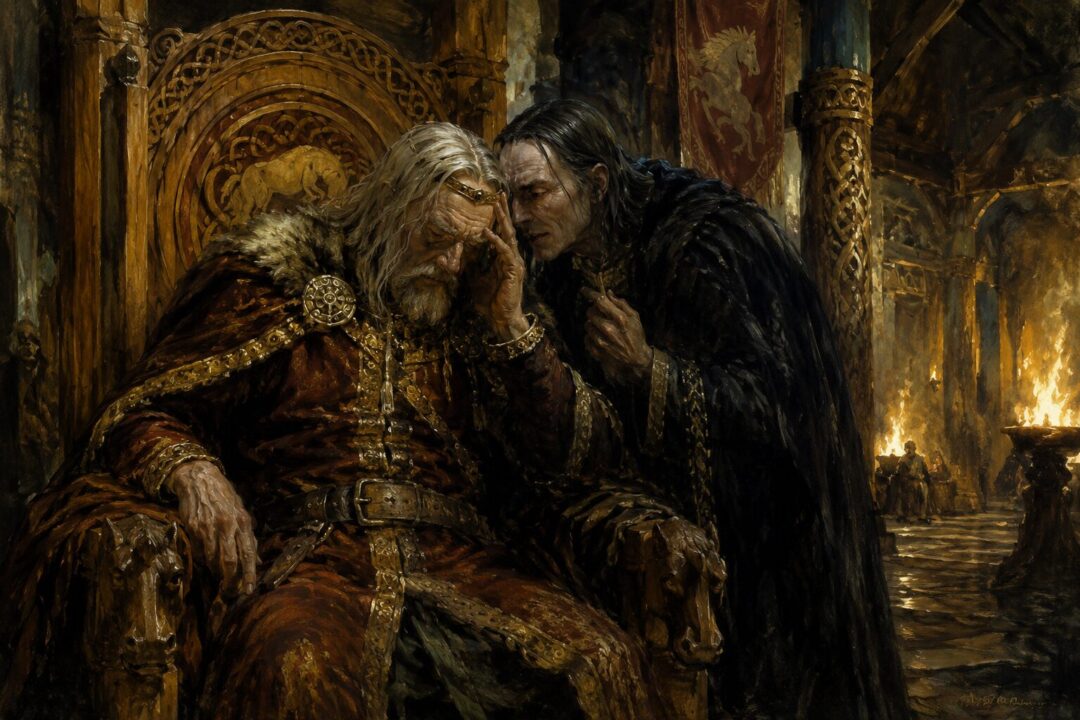
Few figures in Middle-earth appear less imposing than Gríma, called Wormtongue. He carries no legendary sword, commands no great army, and performs no feats of battlefield heroism. Beside warriors like Aragorn, Éomer, or even ordinary Riders of Rohan, he seems insignificant. Yet for years, one soft-spoken counselor nearly accomplished what countless Orcs and armies could not: the quiet collapse of an entire kingdom from within.
That contrast reveals one of the most unsettling truths in Tolkien's world. Evil does not always arrive wearing black armor or carrying a spear. Sometimes it enters a hall through trusted advice, patient manipulation, and carefully chosen words. Gríma's greatest weapon was never strength. It was access to a weary king's mind.
His story is therefore not merely about treachery. It is about how fear, isolation, despair, and deception can weaken even honorable people when repeated day after day.
A Servant Hidden in Plain Sight
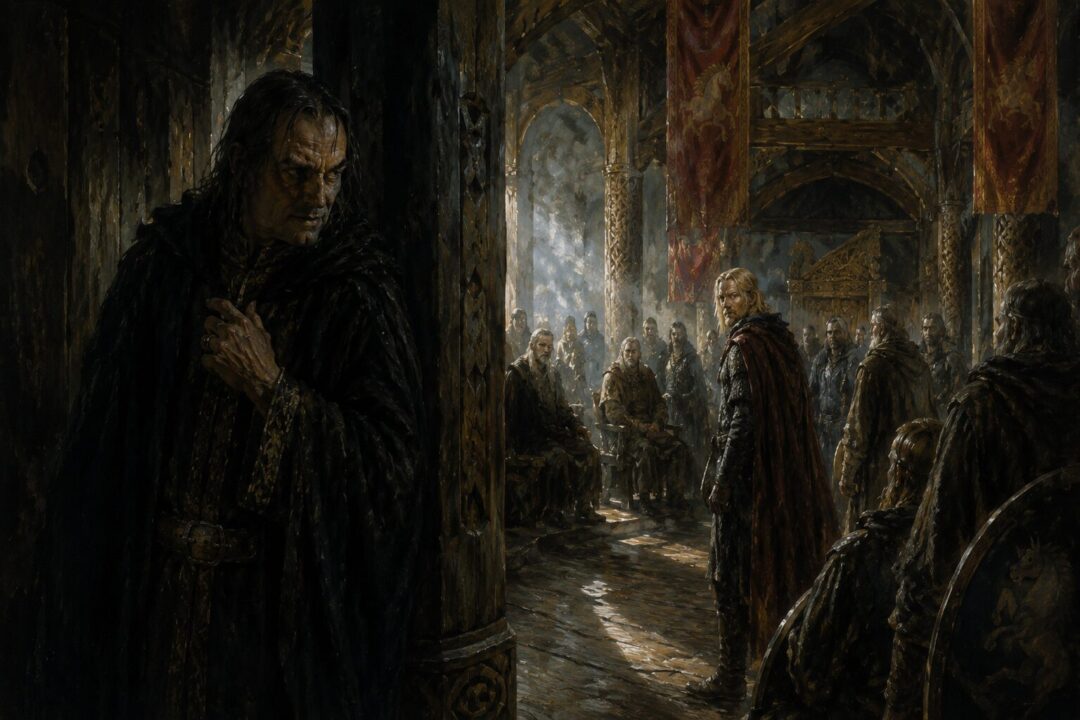
When readers first meet Gríma in The Lord of the Rings, he already occupies one of the most influential positions in Rohan. As counselor to King Théoden, he speaks with the authority of someone who has earned his ruler's confidence over many years.
The exact beginnings of Gríma's loyalty to Saruman are never fully described. The narrative establishes that he became Saruman's agent before the events at Edoras, but Tolkien does not provide a detailed account of how or precisely when he was corrupted. Whether driven by ambition, fear, greed, or some combination of these motives, the result is clear: he begins serving another master while appearing to serve his king.
That hidden allegiance makes him uniquely dangerous.
Unlike invading armies, Gríma does not need to force open the gates of Meduseld. They are already open to him. Every conversation with Théoden becomes another opportunity to shape decisions, encourage hesitation, and discourage hope.
The Slow Weakening of Théoden
One of the most remarkable aspects of Gríma's success is its gradual nature.
Nothing suggests that Théoden suddenly loses his judgment overnight. Instead, the king becomes increasingly withdrawn, suspicious, and inactive. By the time Gandalf arrives, Théoden appears prematurely aged and almost resigned to decline.
The text presents several causes working together.
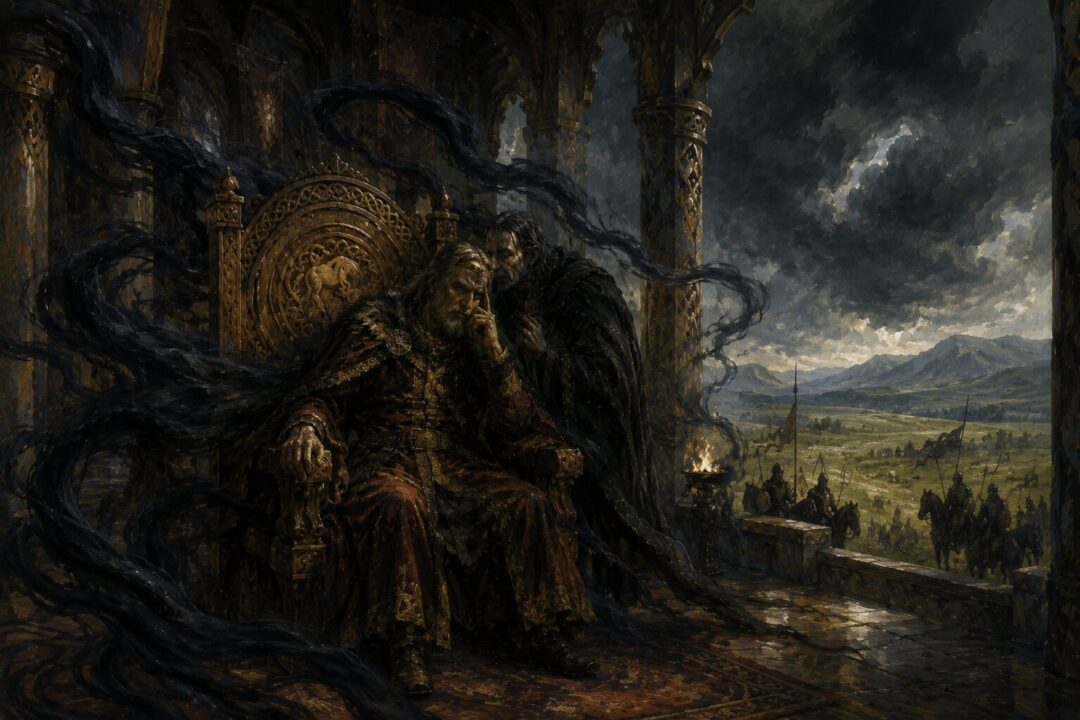
Saruman's influence operates from afar. Gríma constantly reinforces despair. Théoden himself is elderly and burdened by repeated losses. None of these factors alone fully explain his condition, but together they create a ruler who no longer believes decisive action is possible.
Gríma's advice consistently encourages passivity.
Rather than inspiring resistance, he recommends delay.
Rather than strengthening alliances, he raises doubts.
Rather than preparing for war, he fosters uncertainty.
This pattern matters more than any single lie. Even truthful statements can become destructive when selected solely to produce fear or hopelessness.
The Power of Isolation
Successful manipulation often begins by separating people from those who would challenge falsehood.
Gríma repeatedly works to isolate Théoden from trusted voices.
The king's relationship with his nephew Éomer deteriorates until Éomer is imprisoned after acting against Orc raiders without royal permission. Loyal men lose influence while Gríma remains constantly beside the throne.
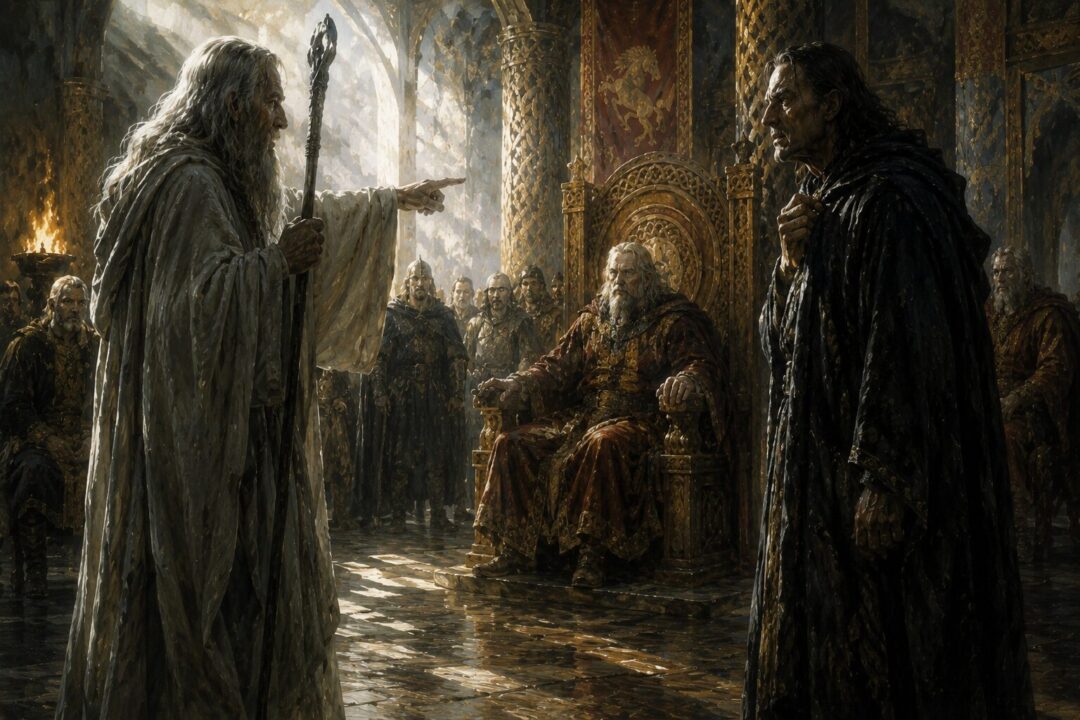
When Gandalf finally arrives, Gríma immediately attempts to undermine him.
He questions the wizard's intentions.
He discourages Théoden from listening.
He portrays outside help as dangerous interference.
The goal is not simply disagreement. It is control over which voices may even be heard.
That pattern feels strikingly modern, but it remains entirely grounded in Tolkien's narrative. Whoever controls counsel often shapes action long before swords are drawn.
Fear Can Become a Political Weapon
Gríma rarely promises glorious victories.
Instead, he emphasizes risks.
He warns against military action.
He questions the loyalty of others.
He magnifies uncertainty.
Fear itself becomes his instrument.
This reflects an important theme throughout The Lord of the Rings. Courage is not the absence of danger but the willingness to act despite danger. Gríma steadily erodes that willingness.
By making every possible decision appear too dangerous, he effectively encourages surrender without ever needing to recommend surrender openly.
This is one reason Gandalf's arrival is so transformative. His words restore perspective rather than merely providing military advice.
Hope returns before armies move.
Why Lies Were Not Always Necessary
One subtle feature of Gríma's manipulation is that outright lies are not always required.
Many effective deceivers mix truth with distortion.
The threat from Isengard is real.
War is approaching.
Rohan has suffered losses.
The kingdom is vulnerable.
None of these facts are invented.
The manipulation lies in the conclusion drawn from them.
Instead of treating danger as a reason to unite and resist, Gríma presents danger as proof that resistance is pointless.
The same facts become tools for opposite purposes.
Tolkien repeatedly shows that wisdom depends not only on possessing information but on interpreting it rightly.
A Kingdom Can Fall Before Its Walls Do
Military conquest usually begins after political failure.
Rohan illustrates this clearly.
Before Saruman's armies threaten Helm's Deep, the kingdom has already endured years of weakening leadership, declining confidence, and internal division.
Gríma prepares the ground.
His work resembles erosion rather than explosion.
The armies of Isengard become dangerous partly because the kingdom has already been discouraged from responding decisively.
Had Théoden remained fully active, united with his marshals, and confident in his allies throughout those years, Saruman's military campaign might have faced a much stronger opponent from the beginning. The texts do not explicitly speculate on this alternative history, but they clearly portray Gríma's influence as strategically valuable to Saruman.
The whisper comes before the siege.
The Contrast with Gandalf
Tolkien deliberately places two counselors beside Théoden in quick succession.
One diminishes the king.
The other restores him.
Gríma speaks constantly of weakness.
Gandalf reminds Théoden of responsibility.
Gríma encourages dependence.
Gandalf encourages action.
Gríma keeps the king seated.
Gandalf calls him to ride again.
This difference highlights an important moral distinction.
Good counsel does not control another person's will.
Instead, it helps that person recover the ability to exercise sound judgment independently.
After Gandalf's intervention, Théoden makes his own decisions once more. He chooses to ride. He chooses to gather his people. He chooses to fight.
The king is not replaced.
He is restored.
Gríma's Personal Desires Made Him Easier to Control
Gríma's obsession with Éowyn also reveals the limitations of his own character.
The narrative makes clear that he desires her, and Gandalf openly exposes this before the court. Saruman appears to exploit Gríma's ambitions rather than eliminate them.
This is another recurring pattern in Middle-earth.
Power often corrupts by encouraging people to place private desire above duty.
Boromir wishes to save Gondor through the Ring.
Denethor increasingly trusts only his own judgment.
Saruman seeks power for himself.
Gríma sacrifices loyalty for personal advantage.
Although these characters differ greatly, each allows desire to distort wisdom.
Gríma's betrayal therefore begins inside his own heart before it becomes visible in the politics of Rohan.
Even After His Defeat, He Remains Dangerous
Expelled from Edoras, Gríma does not suddenly become harmless.
He follows Saruman despite repeated humiliation.
The relationship between the two has become deeply unequal. Saruman insults and mistreats him openly, yet Gríma remains attached to his master's service.
The reasons are not fully explained. Fear, dependency, hopelessness, and long habit may all contribute, but Tolkien never offers a single explicit psychological explanation.
Eventually both reach the Shire.
There, Gríma participates in Saruman's final attempt to dominate another peaceful land.
Only after enduring further abuse does he finally kill Saruman.
Even this act is not presented as redemption.
It is an eruption of accumulated misery rather than a clear moral awakening.
Moments later, Gríma himself is killed by Hobbit archers.
His story ends not with restoration but with complete ruin.
Why Gríma Never Needed a Sword
Readers often remember great battles because they are spectacular.
Gríma reminds us that wars are frequently decided long before armies meet.
A ruler convinced that resistance is futile may lose more than one defeated in honest combat.
A divided kingdom invites invasion.
A discouraged people stop preparing.
A suspicious court begins turning against itself.
None of these outcomes require physical violence.
They require only enough influence over the right people.
That is exactly what Gríma possessed.
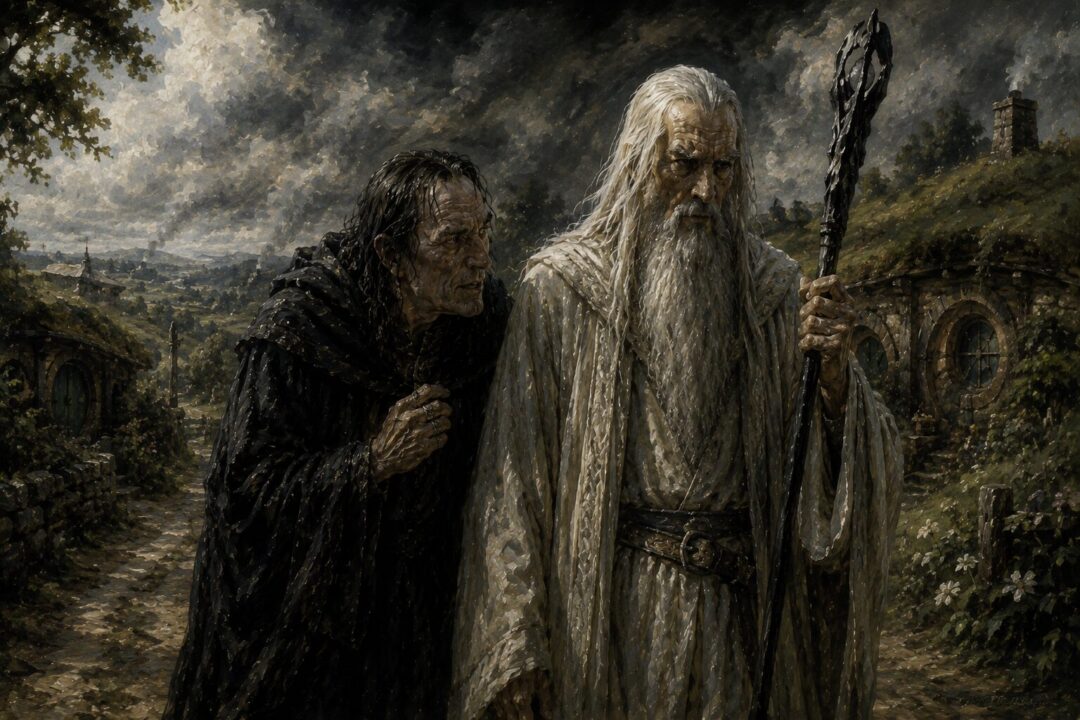
The Larger Theme Behind Wormtongue
Throughout The Lord of the Rings, evil repeatedly attempts to dominate the wills of others.
The One Ring seeks mastery.
Sauron rules through fear.
Saruman uses persuasion, deception, and the power of his voice.
Gríma becomes one expression of that same desire for domination, operating on a smaller but deeply personal scale.
Unlike mighty Dark Lords, however, Gríma demonstrates how devastating ordinary corruption can become.
He has no supernatural powers described in the text.
He performs no miraculous feats.
His influence depends on observation, patience, proximity, and careful speech.
That makes him unsettling because his methods remain recognizable.
He studies weakness.
He encourages despair.
He isolates trust.
He rewards fear.
He slowly reshapes another person's understanding of reality.
Tolkien's narrative ultimately rejects that approach through characters who restore rather than dominate. Gandalf strengthens freedom instead of replacing it. Théoden regains his agency rather than becoming someone else's instrument. Even the victory of Rohan depends less on overwhelming force than on recovered courage and renewed fellowship.
Gríma therefore stands as one of Middle-earth's clearest reminders that the greatest threats are not always those standing outside the gates. Sometimes they sit quietly beside the throne, speaking softly until a kingdom forgets its own strength.
Sources & Notes
- Wikipedia overview of Gríma Wormtongue and his influence over Théoden — https://en.wikipedia.org/wiki/Gr%C3%ADma_Wormtongue
- Wikipedia overview of Théoden and the weakening of Rohan’s leadership — https://en.wikipedia.org/wiki/Th%C3%A9oden
- Wikipedia overview of Saruman, whose power Gríma serves — https://en.wikipedia.org/wiki/Saruman
Sources selected for Tolkien-lore context and reader verification.