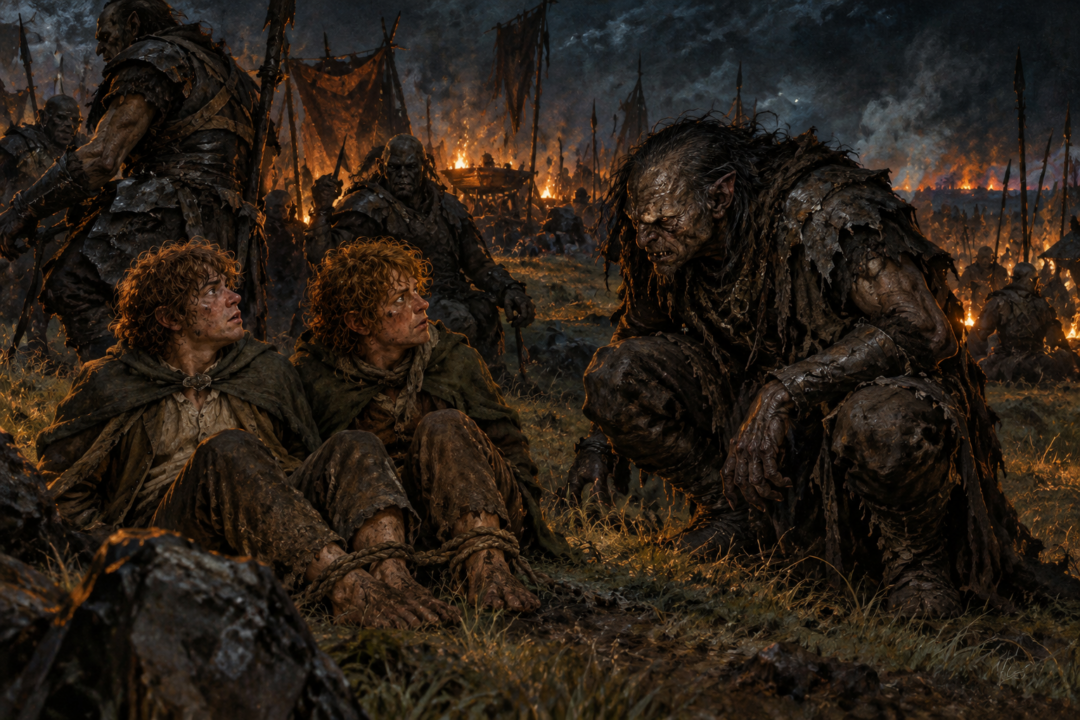
Merry and Pippin are surrounded by enemies near Fangorn, trapped inside a ring of armed Orcs while the Riders of Rohan wait outside. Their captors have orders, commanders, and competing loyalties. Yet the moment that finally gives the hobbits their chance does not come from any organized rescue.
It comes from one Orc deciding that he wants something for himself.
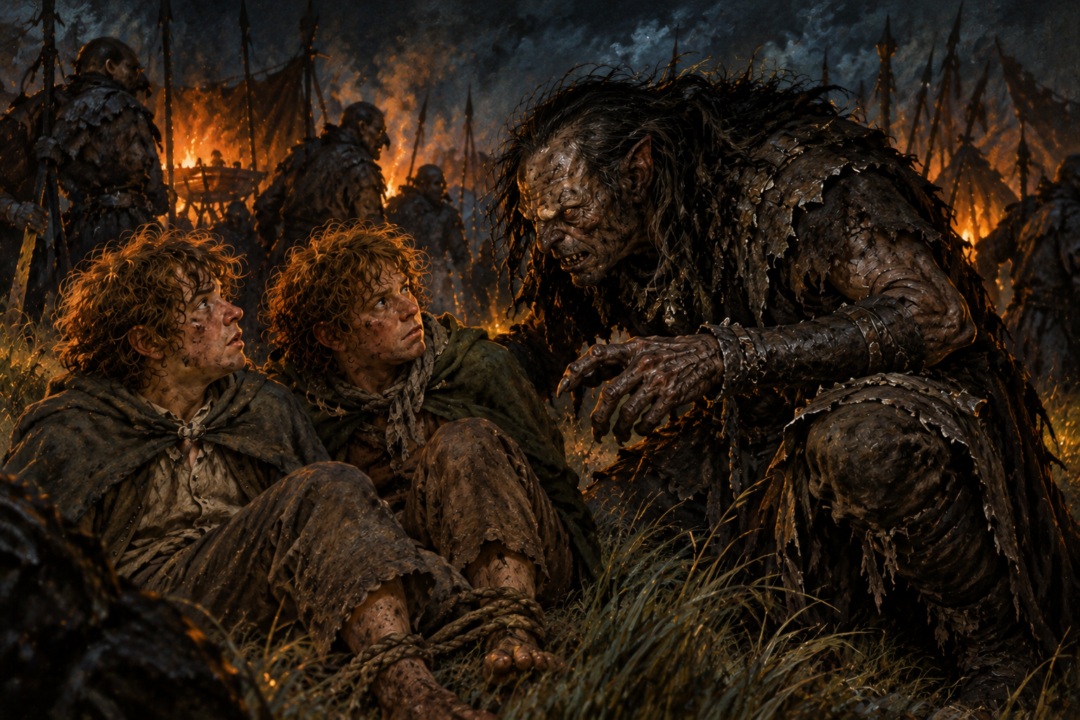
Grishnákh’s behavior in “The Uruk-hai” is one of the most revealing small episodes in The Two Towers. He recognizes something in Merry and Pippin’s hints that the other Orcs do not openly pursue. When Pippin deliberately imitates Gollum’s language and manner, Grishnákh reacts strongly. The hobbits realize that he knows enough about the Ring to be dangerous.
They also realize that his knowledge can be used against him.
What follows is not simply an Orc searching two prisoners. It is a contest in which Merry and Pippin deliberately encourage Grishnákh’s suspicions, while Grishnákh abandons the relative security of the Orc company to pursue his own purpose.
That private decision is exactly what the hobbits need.
Grishnákh Knows More Than He Should
The Orc company that carries Merry and Pippin across Rohan is not a unified force.
Uglúk leads the Isengarders and insists that the prisoners are to be taken to Isengard. Grishnákh belongs to Mordor and invokes the authority of Lugbúrz, the Dark Tower. Other Orcs have their own grievances and priorities.
The arguments Merry and Pippin overhear therefore reveal a larger struggle behind their capture. Saruman and Sauron are ostensibly allies against the West, but their interests are not identical. The prisoners have become pieces in that conflict.
Grishnákh is especially important because his knowledge appears to extend beyond the simple fact that the captives are halflings.
When he later approaches Merry and Pippin, they test him.
Pippin makes a noise associated unmistakably with Gollum and speaks suggestively about something “precious.” Grishnákh’s response tells the hobbits what they need to know: their captor understands the significance of the hint.
The text does not explain exactly how Grishnákh acquired this knowledge. Any detailed reconstruction of what he had personally been told, witnessed, or learned in Mordor goes beyond what is established.
What matters is what Merry and Pippin can observe.
Grishnákh knows something about the Ring.
And he wants to know whether they have it.
Merry and Pippin Turn His Suspicion Against Him
This is where the scene becomes much more interesting than a straightforward interrogation.
The hobbits do not actually possess the One Ring. Frodo has it and is already travelling toward Mordor with Sam.
But Grishnákh does not know that.
Merry and Pippin exploit the gap between what he knows and what he desperately wants to know.
Their position is dreadful. They are prisoners inside an Orc encirclement, with little apparent possibility of escape. Yet Grishnákh’s interest gives them something almost as useful as a weapon: leverage.
Pippin deliberately encourages the idea that they know about the Ring. Merry quickly understands what he is doing and joins the deception.
They never need to prove that they possess it. They only need Grishnákh to believe that searching them might be worthwhile.
That distinction is crucial.
The hobbits are manipulating suspicion, not revealing a secret.
And Grishnákh proves vulnerable precisely because he cannot safely dismiss the possibility.
Why Grishnákh Makes the Search Private
Grishnákh’s actions make the most sense when viewed against the divisions within the Orc company.
If his only goal were ordinary prisoner control, there would be no obvious reason to pursue a private search. Merry and Pippin are already captives.
Instead, he waits for an opportunity during the confusion caused by the Rohirrim and Uglúk’s response to the attack.
He first searches them while their guards are away. When their hints about the Ring make the exchange more dangerous, he takes the hobbits himself.
The text does not provide a neat statement of Grishnákh’s complete internal motive, so it is safest not to claim more than the scene supports. But his behavior strongly implies that whatever he hopes to discover, he does not want the matter handled openly by Uglúk and the rest.
The Ring explains why secrecy matters.
If Merry and Pippin really possessed the object Grishnákh suspects, openly searching them among rival Orcs would create an immediate problem. The discovery would no longer belong to him alone.
His private action therefore separates his personal purpose from the company’s existing command structure.
That is the fatal decision.
His effort to keep control of the search ultimately leads him to remove the prisoners from the place where they are most securely guarded.
The Rohirrim Give Him His Opportunity
By this point the Orcs have been surrounded near Fangorn by Éomer’s Riders.
The Rohirrim do not simply charge blindly into the encampment and immediately destroy it. They contain the Orcs, and the pressure of the encirclement makes an already divided company increasingly unstable.
During the night there is fighting.
Uglúk and his Isengarders respond to the attack, and Grishnákh recognizes his chance.
He takes Merry and Pippin away.
This movement is the hinge of the entire episode.
Minutes earlier, the hobbits are two prisoners among a large body of Orcs. Escape means somehow getting through their guards and then surviving the mounted warriors surrounding them.
Once Grishnákh carries them away, that equation changes.
They still have an Orc captor.
But now they effectively have one immediate captor rather than an entire company around them.
Grishnákh thinks he is creating privacy.
In reality, he is creating isolation.
The Search Reveals How Completely He Has Taken the Bait
The search begins inside the Orc position, while Uglúk and the Isengard guards are occupied by the Riders’ attack.
Grishnákh puts his arms around the hobbits and feels over their bodies. It is during this search that Pippin guesses what he wants and begins encouraging his suspicion about the Ring.
The hobbits try to turn that suspicion into a bargain.
They demand that he untie their legs before they offer any help. Merry also points out that if they reach Isengard, Saruman—not Grishnákh—will take whatever can be found.
But Grishnákh does not accept their terms.
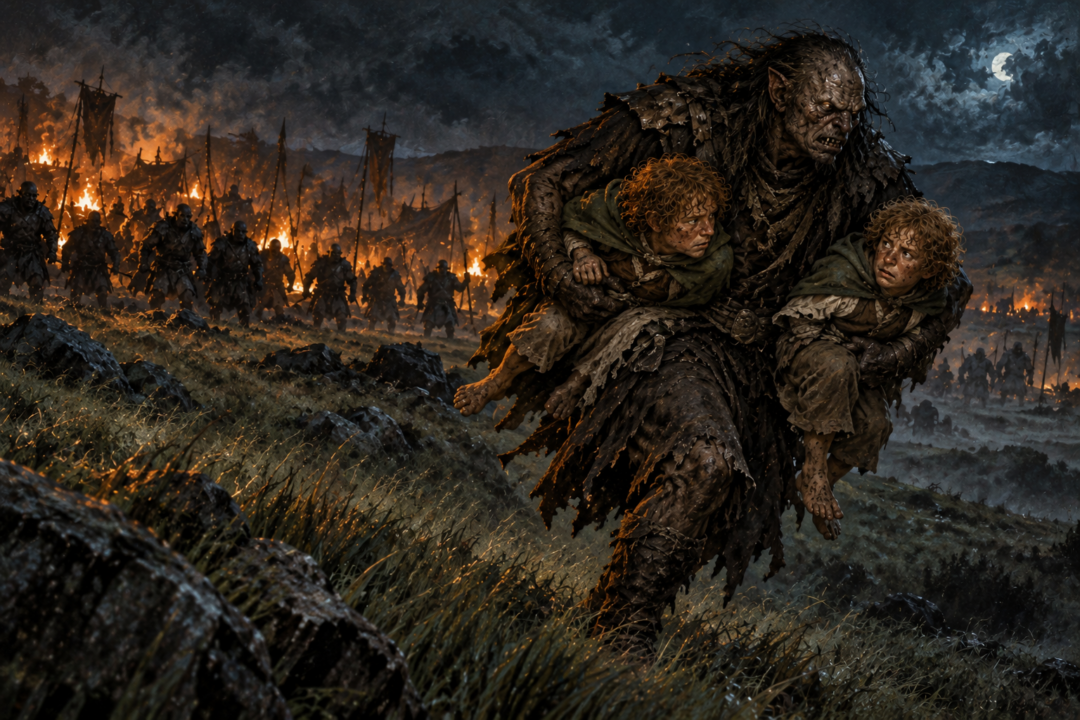
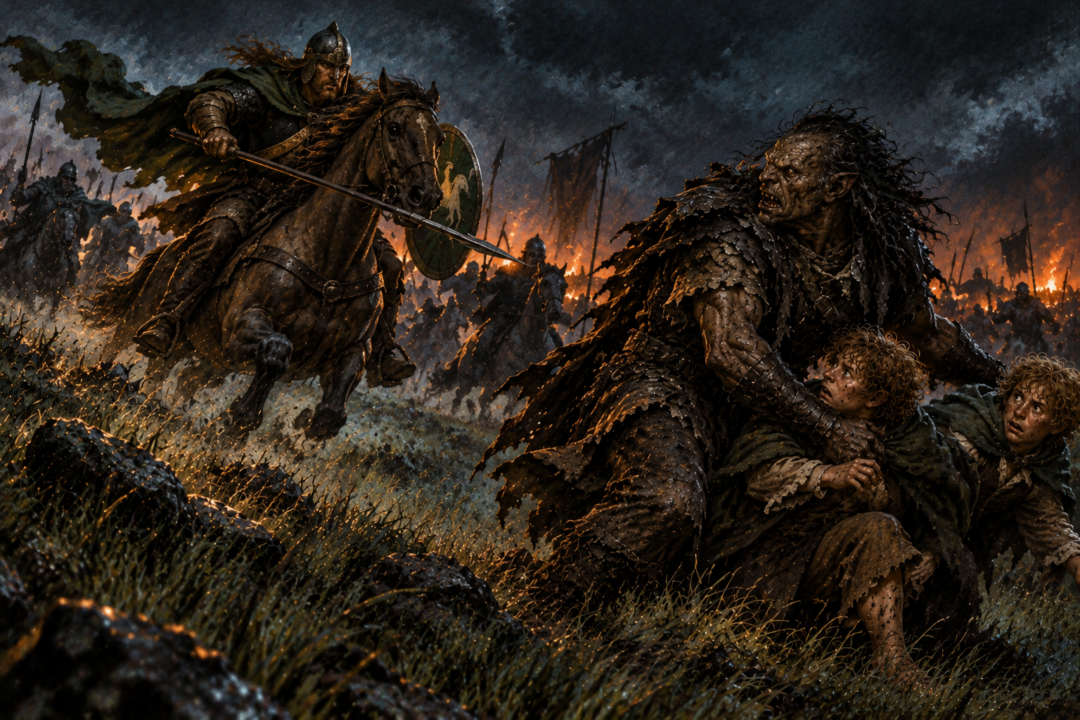
He refuses to untie them and threatens to search them violently. Then, rather than waiting for their cooperation, he seizes them, tucks one under each arm, covers their mouths, and carries them out of the Orc position.
That distinction matters. His desire does not make him remove their restraints. It makes him remove the prisoners themselves from the larger body guarding them.
Grishnákh Still Has One Problem
Once outside the camp, Grishnákh must get past the Riders surrounding it.
He chooses a gap between the watchers and moves toward the river. His attempt at secrecy has separated him from the other Orcs, but it has not removed the danger outside their position.
A Rider suddenly appears in front of him.
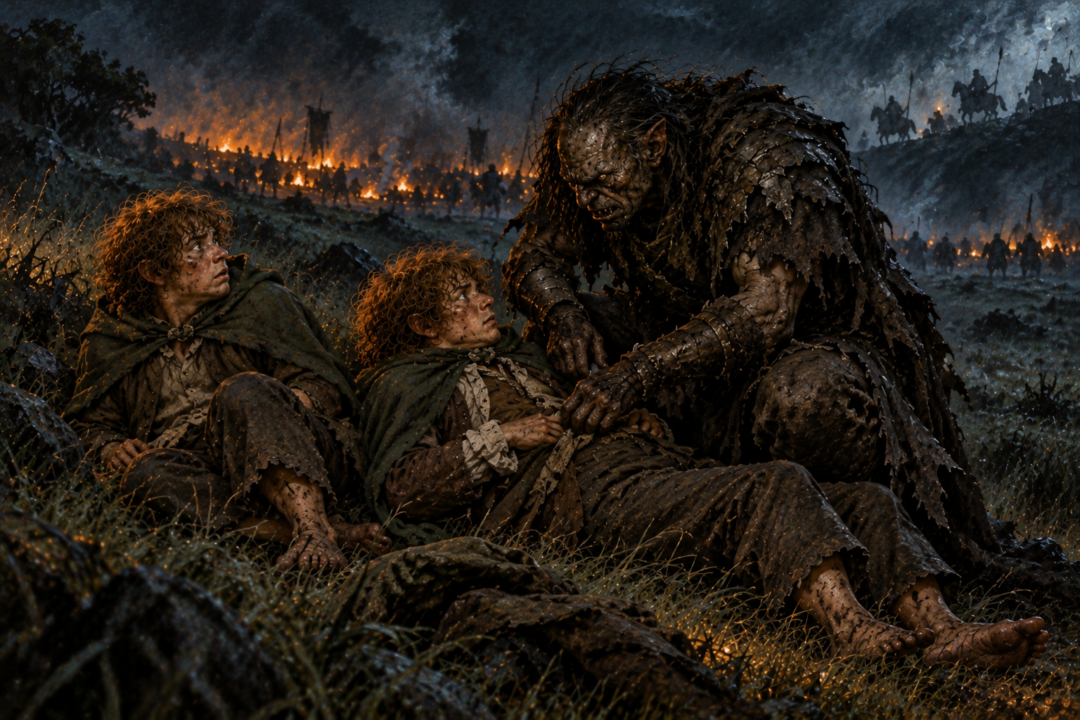
Grishnákh throws himself down, dragging the hobbits beneath him, and draws his sword. The narrator suggests that he intends to kill his captives rather than allow them to escape or be rescued.
An arrow strikes his hand, making him drop the sword. As he tries to run, a Rider bears him down and kills him with a spear.
Merry and Pippin remain on the ground, concealed by their Elven cloaks and overlooked by the horsemen.
They are not yet free of their bonds.
Pippin had already loosened his wrist-cords earlier in the journey and kept the loops in place for show. After Grishnákh’s death, he removes them. He then takes the Orc’s knife and cuts the remaining bonds.
The practical opening therefore depends on three separate things: Grishnákh carries them away from the other Orcs, the Riders kill him, and Pippin uses his earlier preparation and the fallen Orc’s knife to free them.
The opportunity Grishnákh created for himself becomes theirs.
His Greed Does Not Rescue the Hobbits—But It Creates the Opening
It would be too simple to say that Grishnákh alone causes Merry and Pippin’s escape.
Several things have to come together.
The Rohirrim have surrounded the Orcs. Fighting creates confusion. Merry and Pippin have already shown remarkable alertness during their captivity, including Pippin’s earlier efforts to leave signs behind for potential rescuers. And after Grishnákh falls, the hobbits still have to avoid both Orcs and mounted Men who cannot necessarily distinguish them in the darkness.
But Grishnákh changes their physical situation at exactly the right moment.
He takes them away from the larger body.
He refuses to cut their bonds, but carries them into the dangerous space outside the Orc position.
Then he is killed, and Pippin cuts the remaining bonds with his knife.
The result is almost the opposite of what he intended.
He wants exclusive control over whatever secret the hobbits may possess.
Instead, his attempt to gain that control breaks the collective control the Orcs already have over them.
The Scene Exposes a Weakness Inside the Enemy
There is a larger pattern here that runs throughout the War of the Ring.
The forces serving evil can cooperate, march, fight, and obey. They can also be formidable soldiers. Uglúk in particular maintains discipline with brutal effectiveness during the journey across Rohan.
But domination does not create genuine trust.
The Orcs quarrel over authority, destination, orders, and allegiance. Grishnákh represents Mordor; Uglúk represents Isengard. Their masters are pursuing overlapping but competing designs.
The Ring intensifies this problem because knowledge of it is itself dangerous.
Anyone who suspects that Merry and Pippin might possess it has a reason to care about who searches them, who controls them, and where they are taken.
Grishnákh’s private search is therefore more than personal cruelty. One reading of the episode is that it exposes the strategic weakness created when servants of rival powers cannot completely trust one another with a prize of overwhelming importance.
Merry and Pippin survive partly because they recognize that weakness quickly enough to exploit it.
The Cruel Irony of Grishnákh’s Choice
Grishnákh believes he has discovered an opportunity.
In one sense, he has.
Merry and Pippin deliberately feed his suspicion because they understand that he wants something the other Orcs do not openly know he is seeking. He responds by separating himself from normal group procedure and taking personal control of the prisoners.
That is exactly what the hobbits need him to do.
He does not find the Ring.
He does not capture its bearer.
He does not successfully carry Merry and Pippin away.
Instead, his private search takes them farther from the Orc company. When the Rohirrim kill him, Pippin can turn that separation into escape by cutting their remaining bonds.
Soon the hobbits are crawling away from the battle toward Fangorn.
From there, consequences vastly larger than Grishnákh could have anticipated begin to unfold. Merry and Pippin meet Treebeard. The Ents eventually march against Isengard. Saruman’s stronghold is overwhelmed.
It would go too far to make Grishnákh solely responsible for that chain of events. The choices of the hobbits, the Rohirrim, Treebeard, and the Ents all matter independently.
But there is still a sharp irony at the center of the episode.
Grishnákh searches Merry and Pippin himself because he thinks private possession of their secret might benefit him.
Instead, by taking them for himself, he gives them the separation that—together with the Riders’ intervention and Pippin’s resourcefulness—lets them slip from the hands of the Enemy altogether.
Sources & Notes
- Penguin Random House — The Two Towers teacher’s guide, book III, chapters 3–4 — https://images.penguinrandomhouse.com/teachers_guides/9780345339713.pdf
- The Thain’s Book — Pippin: Grishnákh’s private seizure of the hobbits, his knowledge of the Ring, and Pippin’s attempted escape. https://thainsbook.minastirith.cz/pippin.html
- The Encyclopedia of Arda — Grishnákh — https://www.encyclopedia-of-arda.com/g/grishnakh.html
Primary passage: The Two Towers, ‘The Uruk-hai’. Grishnákh’s recognition of the Ring hint and private search are textual; conclusions about his intended advantage should remain inference.