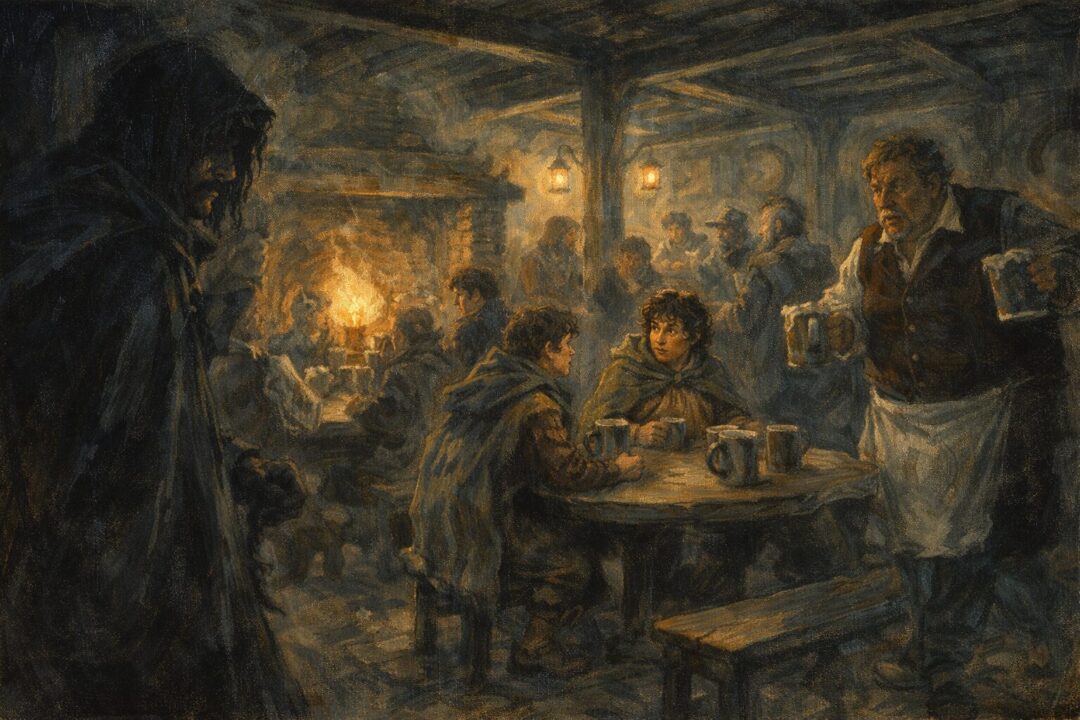
Most people think power in Middle-earth looks obvious.
It looks like a Dark Tower.
A hidden ring.
An army on the march.
A king returning to his throne.
And of course, those things matter.
But the deeper pattern is quieter than that.
Again and again, the turning points of the story gather in places that seem too ordinary to deserve attention: a ferry on a river, an inn on the roadside, a tavern where people swap rumors after dark. These are not the places readers are trained to fear or revere. They are not holy places, not seats of government, not vaults of ancient power.
Yet the story keeps using them as hinges.
That matters, because Middle-earth is not built on the idea that history belongs only to the mighty. The great struggle is real, but it repeatedly passes through common doors and over ordinary crossings. Important things happen where travelers pause, where gossip spreads, where roads meet, and where one small delay or encounter changes everything.
Once you notice that pattern, inns, taverns, and ferries stop feeling like background detail.
They start looking like one of the ways the story thinks about power.
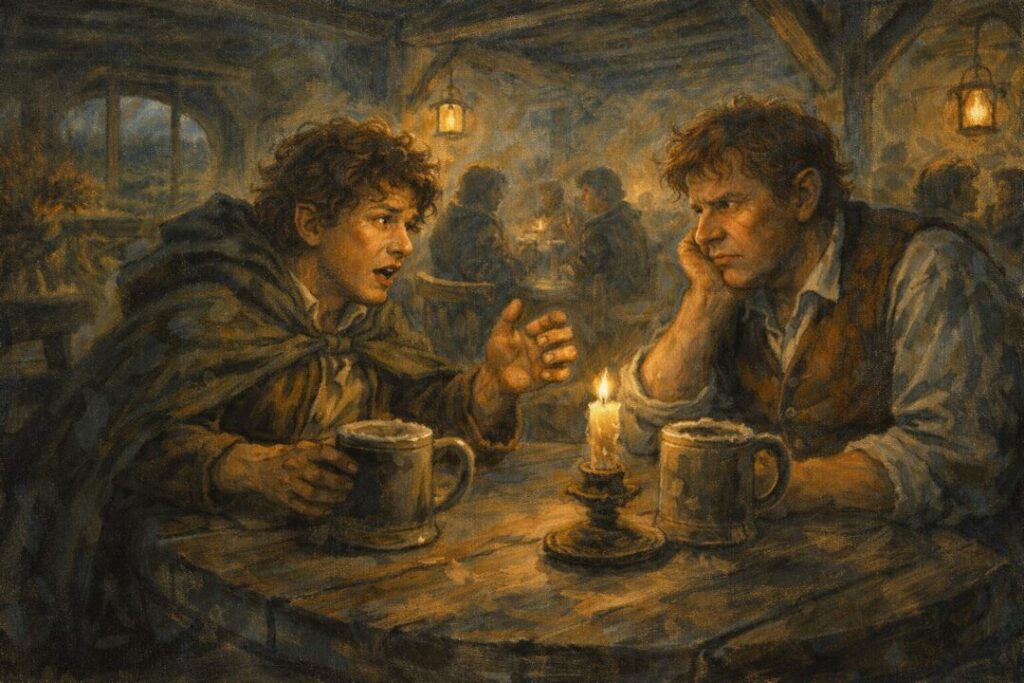
These Places Are Thresholds, Not Decorations
What joins an inn, a tavern, and a ferry is not their size.
It is their function.
They are thresholds.
A ferry is the edge between one side and another. An inn is where strangers and locals briefly share the same roof. A tavern is where private knowledge becomes public rumor. None of these places belongs entirely to departure or arrival. They stand between. And in Middle-earth, the “between” is often where destiny becomes visible.
That is especially true in The Lord of the Rings, where the early journey eastward is marked by crossings of exactly this kind. The Shire is not left in one dramatic break. Frodo moves through layers: road, border, ferry, Buckland, Old Forest, Barrow-downs, Bree. Each stage narrows the distance between homely life and the wider danger already moving toward him.
So when these ordinary places keep appearing, the pattern is not accidental.
The story is telling us that power often enters quietly.
Not with trumpets.
With passage.
The Bucklebury Ferry Is Small, but the Escape Is Not
The Bucklebury Ferry may be the clearest example.
On the surface, it is only a practical crossing on the Brandywine, the usual way between the Shire and Buckland. There is nothing grand about it. It is not defended like a fortress or guarded like a citadel. It is simply there, part of ordinary hobbit life.
And yet when Frodo and his companions reach it, that ordinary crossing becomes momentarily decisive.
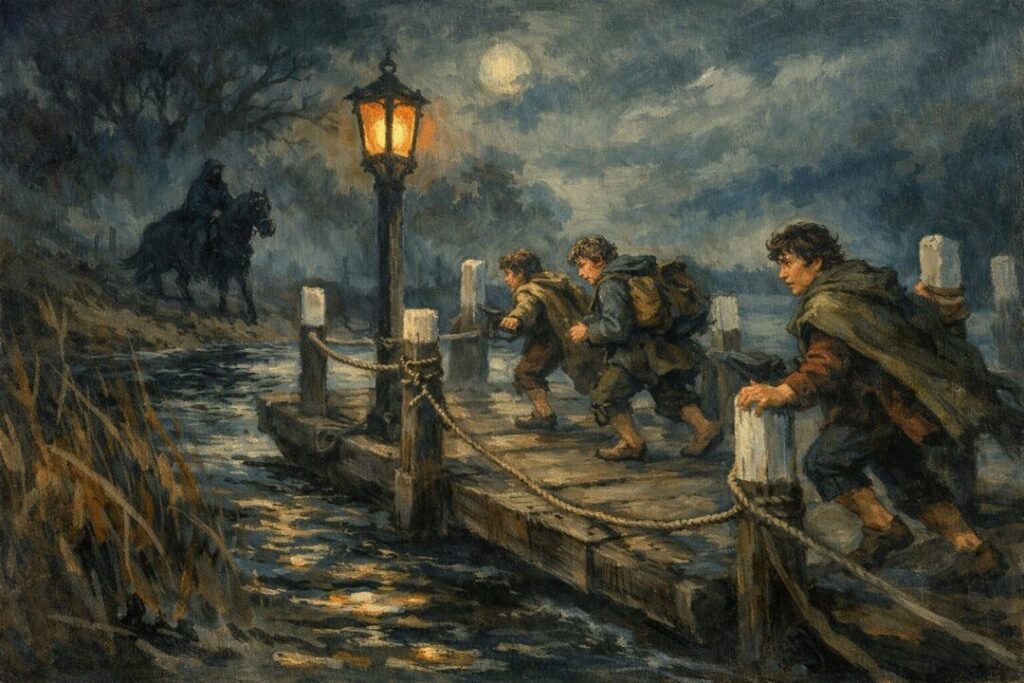
They get over the river ahead of the Black Riders. The Rider on the western bank is left behind, and the lack of another easy crossing nearby forces the pursuit to change shape. Later, the Nazgûl have to work around that obstacle through other routes and through Buckland itself. The ferry does not defeat them. But it buys time, breaks immediacy, and turns panic into a narrow escape.
That is a very Middle-earth kind of power.
The ferry is not magical.
It is not heroic in itself.
But it matters because geography matters, delay matters, and small material realities matter.
The larger war does not float above the world. It runs into roads, rivers, hedges, gates, missed timings, and ordinary structures built for ordinary use.
So the Bucklebury Ferry is important not because it looks powerful, but because it reveals how fragile the journey still is. At that stage, the fate of the Ring can still depend on whether a handful of hobbits reach a crossing first.
That is a startlingly humble image of history.
And the book means it.
Taverns Reveal the Shadow Before Armies Do
Before danger fully arrives, it is often heard first in talk.
That is where taverns matter.
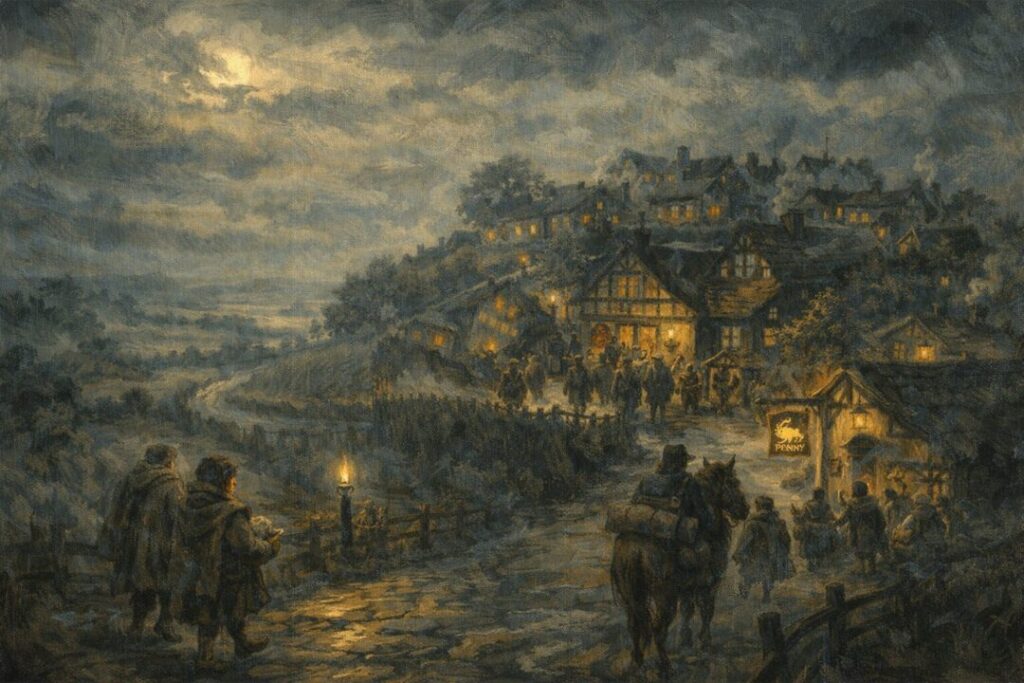
In the Shire, places like the Ivy Bush and the Green Dragon are not centers of command. But they are places where rumor gathers before certainty does. At the Ivy Bush, local talk circles around Bilbo, Frodo, Bag End, and old gossip about hidden wealth. At the Green Dragon, Sam and Ted Sandyman discuss strange reports from beyond the Shire, including unsettling hints that the wider world is moving again.
This is an easy detail to pass over, but it matters.
The Shadow does not first appear to ordinary people as a clear map of events. It arrives as fragments. Strange travelers. Unsettling stories. News that sounds absurd until it suddenly does not.
That is exactly what taverns are good at holding.
Not certainty.
Circulation.
They gather what no single household can know. In them, Middle-earth becomes larger than local life. The Shire remains comfortable, but the talk already shows that comfort is porous. News leaks in. The outside world presses at the edges before the people at the center understand what they are hearing.
So the tavern scenes do more than add rustic atmosphere.
They show that history is already moving among ordinary listeners long before it announces itself openly.
The Prancing Pony Is One of the Great Hinges of the Story
If the Bucklebury Ferry shows the power of a crossing, the Prancing Pony shows the power of a meeting-place.
Bree sits at the crossing of the East Road and the Greenway, and that position is crucial. It is one of the few places in Eriador where different kinds of people still mix with any regularity: Men, Hobbits, travelers, wanderers, Dwarves, and Rangers. The Prancing Pony, standing within that crossroads settlement, is therefore more than lodging. It is a node.
That matters immediately when Frodo arrives.
He is no longer protected by the closed familiarity of the Shire, but he has not yet reached Rivendell or any recognized refuge. In this unsettled middle ground, the common room of an inn becomes the place where concealment fails, danger draws close, and help appears in a form he does not yet trust.
There Frodo meets Strider.
There Butterbur eventually produces Gandalf’s letter, confirming that Strider is indeed Aragorn and an ally.
And there, by accident and exposure, the sense of danger sharply deepens. The hobbits are not merely traveling anymore. They are being watched, tracked, and drawn into the wider design of the quest.
This is one of the most important transitions in the entire journey, and it happens not in a royal house or ancient sanctuary, but in an inn with beer, muddy travelers, side rooms, and a distracted innkeeper.
That contrast is the point.
The story keeps insisting that what appears humble may still be world-shaping.
Bree Does This More Than Once
The importance of Bree is not limited to Frodo’s visit.
Long before that, Bree was also the site of the chance meeting between Gandalf and Thorin that set the Quest of Erebor in motion. That matters enormously, because the recovery of Erebor, the death of Smaug, and Bilbo’s finding of the Ring all follow from that chain. In other words, one of the key background turns behind both The Hobbit and The Lord of the Rings begins near Bree as well.
That does not mean Bree possesses mystical power in itself.
The texts do not present it that way.
But they do present it as a place where roads converge, where different peoples cross paths, and where “chance” meetings repeatedly become history. That is a pattern worth taking seriously. The place is ordinary in social scale, but strategic in narrative scale.
Bree is what the mighty often overlook.
And that is precisely why it matters.
Why These Small Places Feel So Powerful
The deeper reason these places matter is moral as much as practical.
Middle-earth never treats the ordinary world as irrelevant. Meals, roads, inns, hedges, weather, fields, ponies, and river crossings are not ornamental details around the “real” story. They are the medium in which the real story happens.
That is why the ordinary places feel powerful.
They keep reminding us that evil must enter the same world everyone else inhabits. It must pass gates, question innkeepers, search roads, rely on spies, and respond to missed opportunities. And on the other side, good does not survive by grandeur alone. It survives by hospitality, warning, timing, memory, local knowledge, and small places still doing their ordinary work.
A ferry can matter because it is there when needed.
An inn can matter because the right person is under its roof.
A tavern can matter because rumor is the first form truth sometimes takes.
None of that looks dramatic at first.
Until you realize how often the fate of the larger story passes through exactly such moments.
The Real Power of Inns, Taverns, and Ferries
So why do these places hold more power than they seem to?
Not because they overpower anyone.
Because they connect worlds.
They join safe places to dangerous ones, private people to public events, rumor to revelation, and wandering to destination. They are the points where the large world enters the small one. And in a story so deeply concerned with the dignity of ordinary life, those points of contact matter immensely.
That is why a ferry on the Brandywine can hold off terror for a moment.
Why an inn in Bree can change the course of the quest.
Why tavern talk in the Shire can hint that the age is already turning.
The greatest powers in Middle-earth may sit in towers, hidden realms, or ancient bloodlines.
But the story never lets us forget that history often changes hands somewhere much humbler than that.
At a crossing.
At a doorway.
At a table in a common room.
And once you notice that, these places never feel minor again.