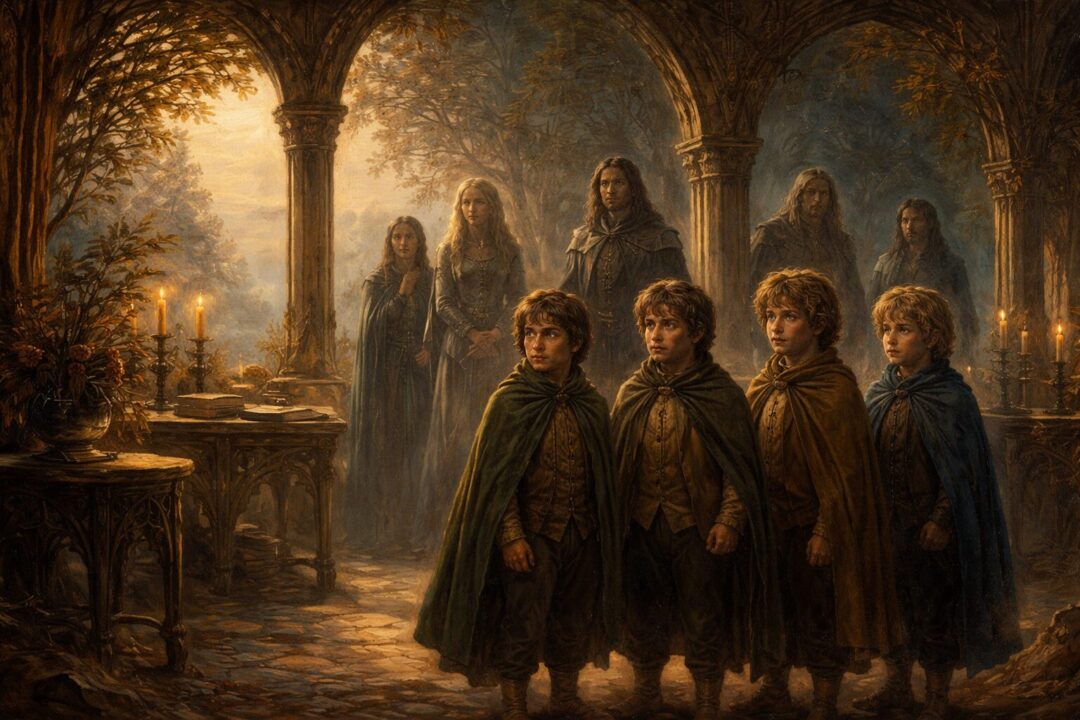
When the Fellowship of the Ring sets out from Rivendell, two of its members seem out of place.
Meriadoc Brandybuck and Peregrin Took are not warriors. They are not learned in ancient lore. They carry no great authority, no titles that matter beyond the Shire. One of them—Pippin—is barely of age by Hobbit standards, impulsive and untested.
And yet, Tolkien does not frame their inclusion as a mistake.
There is no narrative voice suggesting that Elrond chose poorly. No later reflection implying that the quest would have been safer or wiser without them. Their presence is treated as unusual, even risky—but never as wrong.
That framing is important.
Because The Lord of the Rings is not a story about the most qualified people doing the most important things. It is a story about who is able to bear a burden without seeking to dominate others—and who is not.
Merry and Pippin are not exceptions to the rule of the story.
They are the rule, made visible.
They Did Not “Sneak In”
A persistent misconception is that Merry and Pippin somehow stumble into the Fellowship through carelessness or cleverness—that they are accidents of the plot who simply refuse to go home.
The text does not support this.
Long before Rivendell, Merry is already deeply involved in Frodo’s plans. He helps organize the so-called “conspiracy” among Frodo’s friends, gathering intelligence, preparing supplies, and coordinating escape routes. He understands that Frodo carries something dangerous and that leaving the Shire is not a temporary adventure.
When Frodo attempts to leave quietly, Merry confronts him—not to stop him, but to insist on joining him, fully aware of the risk.
Pippin, though younger and more impulsive, is not ignorant either. He knows that Black Riders are hunting Frodo. He knows the danger is real. He chooses to go anyway.
By the time they reach Rivendell, neither Hobbit can plausibly claim innocence.
At the Council of Elrond, their participation is explicit and voluntary. They speak openly. They ask to be included. They do not hide behind Frodo or Sam. Tolkien gives them voices, not excuses.
They are not drafted.
They are not misled.
They are not carried along by events they fail to understand.
Elrond initially resists. He points out—correctly—that including them increases the Fellowship’s vulnerability. The quest is already perilous; adding two more companions, especially untrained ones, compounds the risk.
And yet, Elrond ultimately allows them to go.
Tolkien offers no editorial correction. No ominous hint that this was an indulgence. No suggestion that Elrond is bowing to sentiment.
That silence matters.
Hobbit Resistance to Power
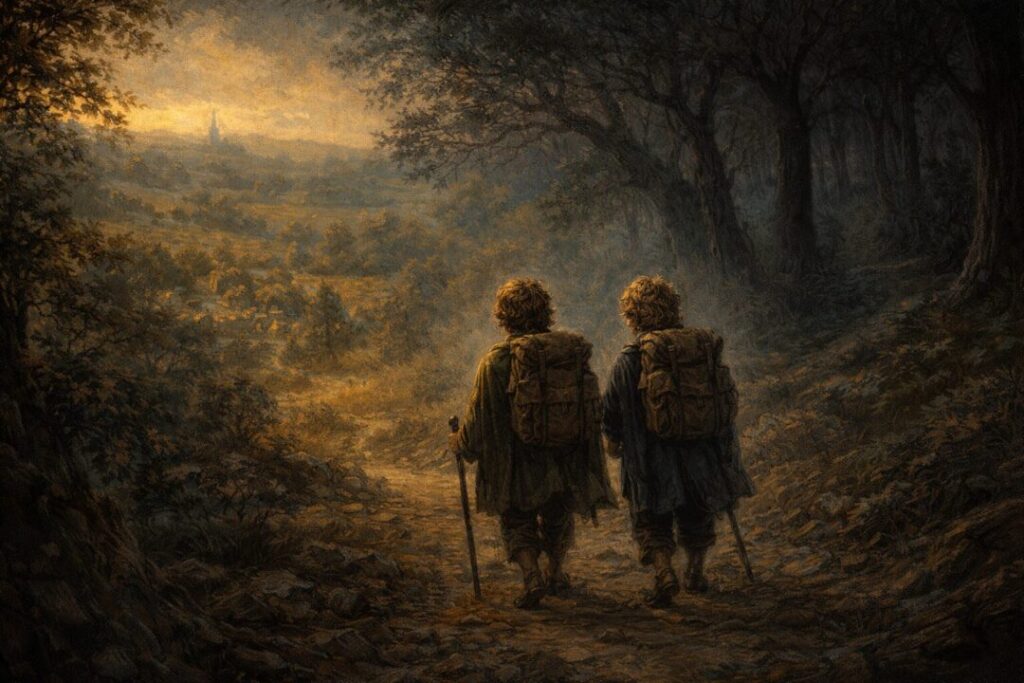
Tolkien never claims that Hobbits are immune to the Ring.
Frodo’s suffering is central to the story. Bilbo struggles to let the Ring go. Even Sam briefly imagines himself as a great hero when he bears it. Hobbits are not incorruptible.
But the texts consistently show that Hobbits are less inclined toward domination, control, and ambition on a large scale. They have little interest in ruling others. They do not seek to reshape the world according to their own vision.
This is not presented as moral superiority.
It is cultural and social smallness.
Hobbits live in a society without kings, standing armies, or imperial ambition. Their disputes are local. Their concerns are immediate. Power, as understood by the great, barely enters their imagination.
That smallness is not incidental to the story.
The Ring amplifies desire—especially the desire to order the world according to one’s own will. Those who already possess authority, or who are accustomed to command, are more vulnerable to its temptation. This is why Gandalf fears to take it. Why Galadriel refuses it. Why Elrond will not bear it east.
Merry and Pippin are not offered the Ring—not because they are wiser, but because they are not candidates.
They do not carry the kind of internal ambition the Ring feeds upon.
And that, too, is part of the design.
The Council’s Unspoken Logic
Tolkien does not give Elrond a long strategic speech explaining why two additional Hobbits are acceptable risks. But the composition of the Fellowship itself suggests an underlying principle.
The quest relies on secrecy, obscurity, and restraint.
The Ring cannot be carried openly. It cannot be defended by force. It cannot be escorted by hosts or heralded by banners. The more visible the bearer becomes, the more likely the Eye will find them.
Sending the Ring with mighty captains or renowned warriors would make its path legible to the Enemy.
Sending it with Hobbits makes it disappear into the margins of the world.
Merry and Pippin amplify that effect.
They are not strong—but they are unremarkable in the eyes of power. They do not blaze in the unseen world. They do not announce themselves by presence alone.
Their inclusion is not about what they can do.
It is about what they do not provoke.
Their Impact Was Not Planned—and That Is the Point
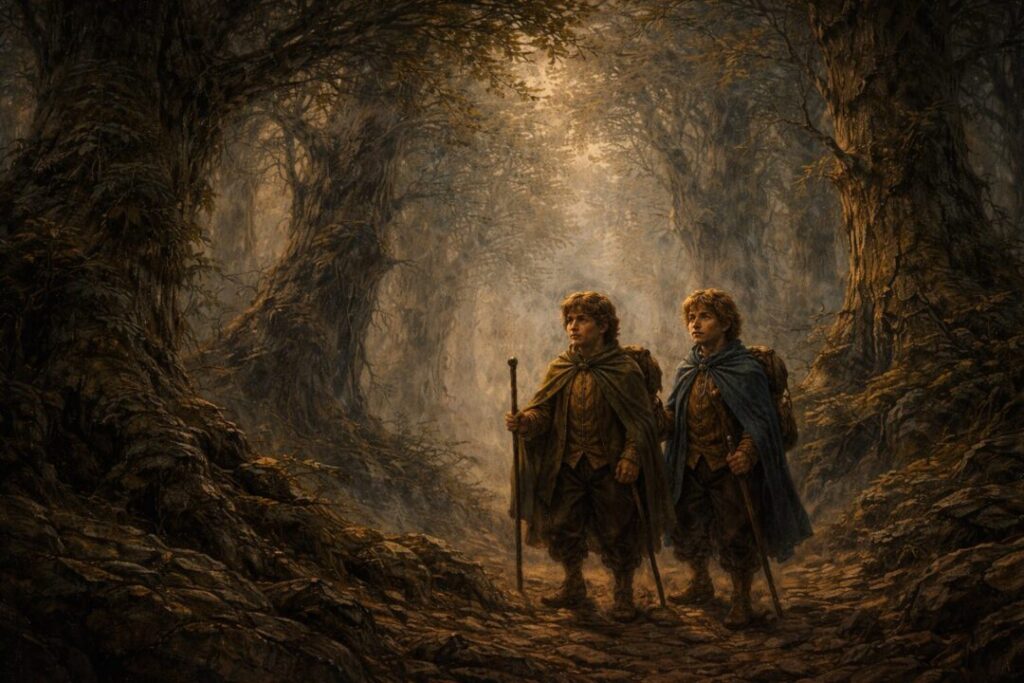
It is tempting to retroactively justify Merry and Pippin’s inclusion by pointing to what they eventually accomplish.
They awaken the Ents.
They aid Rohan.
Merry plays a crucial role in the downfall of the Witch-king.
But Tolkien never claims that these outcomes were foreseen.
Nothing in the Council of Elrond suggests that anyone anticipated these developments. The text does not present them as part of a grand design.
They emerge after the choice.
This matters because Tolkien consistently portrays history as shaped by unintended consequences. The defeat of evil does not come from perfect foresight or flawless planning. It comes from acts of loyalty, mercy, and courage that ripple outward beyond their original intent.
Merry and Pippin do not change the course of the War of the Ring because they were destined to.
They change it because they remained faithful to their choice—because they stayed on the road when retreat would have been easier.
Not Comic Relief—A Different Kind of Courage
Although Pippin in particular provides moments of levity, Tolkien never treats him as expendable. His mistakes have consequences. His curiosity leads to danger. His growth is gradual, uneven, and costly.
Merry, too, matures—not by becoming stronger than he is, but by learning where his courage belongs.
By the end of the story, neither Hobbit is unchanged. They return to the Shire bearing authority not imposed by rank, but earned through experience and endurance.
They are not heroes in the traditional martial sense.
They are witnesses.
They are participants.
They are carriers of responsibility.
This is precisely the kind of heroism Tolkien values most.
Why Tolkien Needed Them
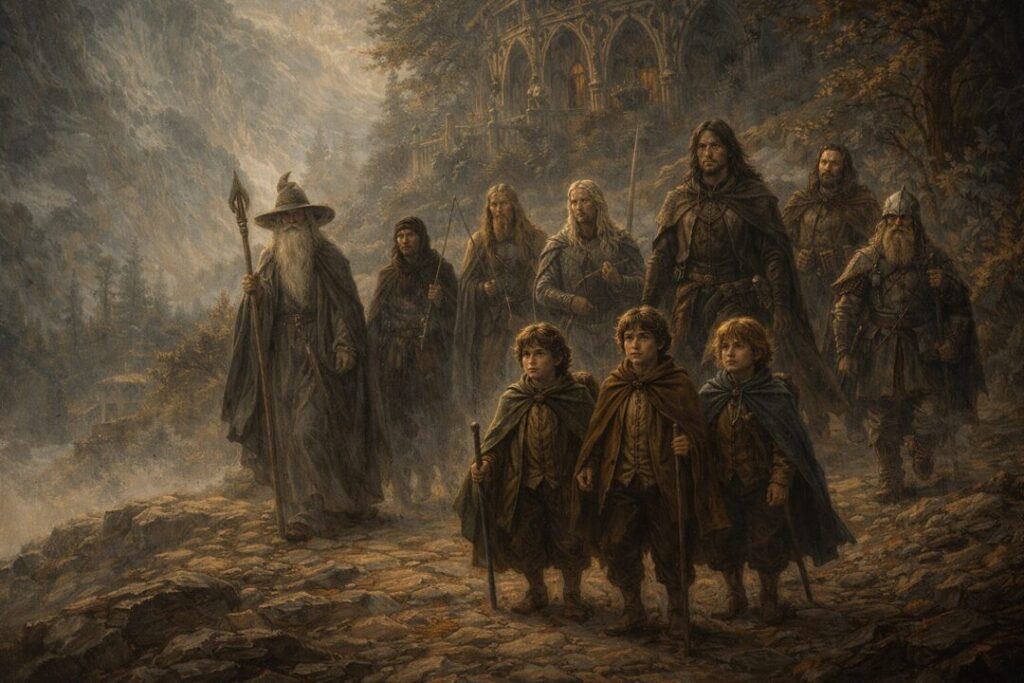
If the Fellowship consisted only of the wise, the strong, and the ancient, the story would collapse under its own weight.
The Ring is not destroyed by mastery, but by endurance.
Not by command, but by faithfulness.
Not by foresight, but by perseverance.
Merry and Pippin embody that truth.
They do not overcome evil by force. They survive it long enough for mercy, chance, and courage to do their work.
They were never accidents.
They were evidence.
Evidence that the fate of Middle-earth does not turn on greatness as the world understands it—but on the willingness of small people to walk into darkness without expecting to rule what lies beyond it.