One of the quietest patterns in late Middle-earth is easy to miss because the world still feels full of wonder.
There are Wizards, Elves, ancient heirlooms, hidden realms, prophetic dreams, Eagles, Ents, and powers that seem to belong half to history and half to myth.
But if you look closely, a strange thing happens.
Almost none of the greatest powers in The Lord of the Rings are new.
They are old powers, old peoples, old artifacts, old wisdom, old bloodlines, old names still holding on.
The Third Age is rich in remnants.
It is poor in beginnings.
That is not just a background detail. It is one of the clearest signs of what kind of age the War of the Ring actually takes place in.
The texts do not present the late world as a place where new wonders are rising to replace the old. They present it as a place where the old is thinning, surviving in enclaves, and in some cases being artificially preserved against the normal wear of time.
That is why so much of Middle-earth in the Third Age feels beautiful and endangered at once.
Its greatness is real.
Its greatness is also passing.
The Third Age is not an age of increase
The simplest place to begin is with the way the age itself is framed.
The Third Age is not remembered as a great era of fresh making among Elves and Dwarves. It is remembered as a long decline in which the ancient powers remain present, but do little that is genuinely new on the scale of earlier ages.
That does not mean nothing happens. Kingdoms rise and fall. Wars are fought. Peoples migrate. Sauron regathers strength. Arnor is broken. Gondor diminishes and endures.
But the deep pattern is different from the First Age especially.
In the First Age, the world still feels crowded with foundations: hidden kingdoms are built, mighty realms rise, terrible powers reveal themselves openly, and the scale of ruin matches the scale of creation.
By the late Third Age, much of that is over.
What survives is diminished, guarded, or remote.
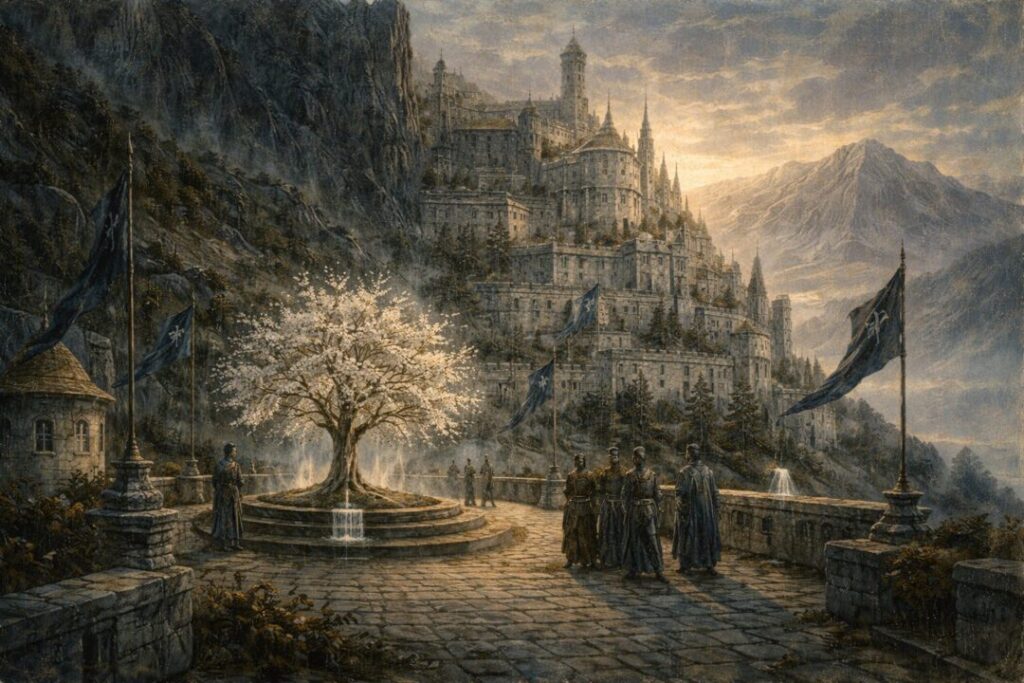
That is why so many of the most arresting things in The Lord of the Rings arrive already aged. Orthanc is old. Minas Tirith is old. Fangorn is ancient. The palantíri come from Númenor. Aragorn’s authority comes from a line far older than himself. Even the blades that matter most often have deep histories behind them.
Middle-earth still contains power.
But it often contains it in the form of inheritance.
The greatest “magic” is preservation, not invention
This becomes clearest with the Elves.
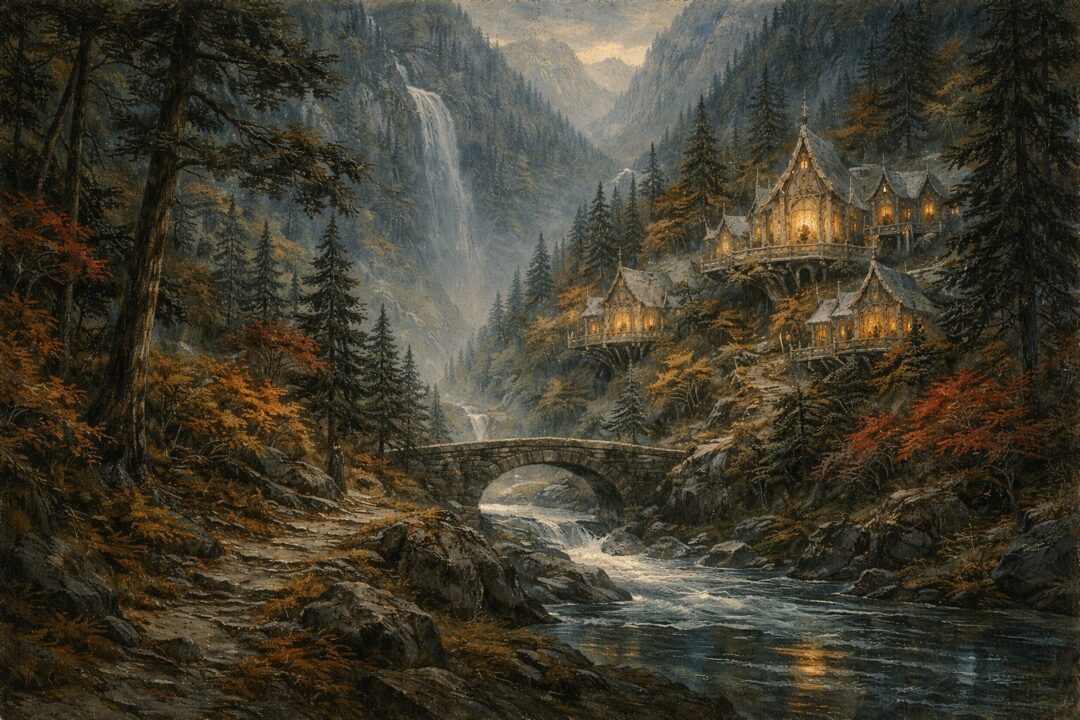
Lórien and Rivendell feel enchanted because they are. But the texts suggest that this enchantment is not a new flowering that will expand into the future. It is bound up with preservation.
That distinction matters.
The Three Rings are not chiefly instruments for launching a new age of power in Middle-earth. They are used to hold back change, ward off decay, and preserve memory, beauty, and peace for a while longer.
That means some of the most striking beauty in late Middle-earth is, in a real sense, defensive.
It is not the beginning of something.
It is the staying of a hand against the clock.
Galadriel says this most clearly in effect when she explains that if the One Ring is destroyed, Lórien will fade, and the tides of time will sweep over it. That is a remarkable admission. It means one of the most wondrous places in the whole narrative is not proof that Elvish power is growing.
It is proof that Elvish power is being spent to delay loss.
And once the One is destroyed, even that delay ends.
So when readers ask why there are so few “new” powers in the Third Age, part of the answer is this: the greatest surviving powers are occupied with resistance to diminishment, not expansion into a new future.
They are preserving islands of an older world.
Even the Wizards arrive under limitation
The Istari sharpen the same pattern.
At first glance, Wizards might look like a new intervention. They do indeed arrive in the Third Age, and their coming matters enormously.
But they are not sent to remake Middle-earth through unveiled force. They are deliberately limited.
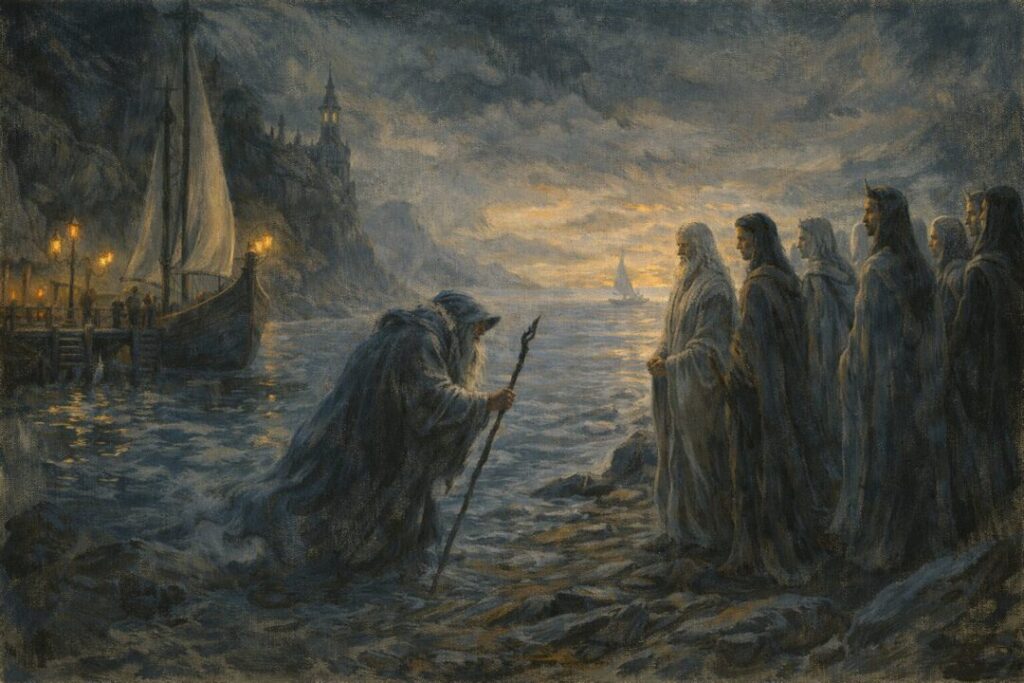
They come in aged bodies. They are forbidden to dominate by open power. Their task is to guide, encourage, awaken resistance, and help others stand against Sauron.
That is a crucial detail.
If the Third Age were meant to be a fresh age of spectacular divine display, the Wizards would look very different. Instead, the greatest emissaries sent against Sauron are clothed in weakness, patience, and restraint.
Gandalf is powerful, yes. But his role is not to found a new visible order of wonder that transforms the world into something more enchanted than before.
His role is almost the opposite.
He is there to help free peoples act for themselves in a world that is passing into other hands.
That makes the Third Age feel morally profound, but not creatively abundant in the older mythic sense.
Its victories are often quieter.
Its power is often indirect.
The old world is still visible—but mostly in fragments
Another reason the age feels short on “new” powers is that so much of its wonder appears in fragments of once-larger things.
The shards of Narsil matter because they come from a broken past.
The palantíri matter because they are surviving relics from Númenor.
The Dúnedain matter because they are remnants of a greater people.
The Elves of Middle-earth are not at the beginning of their history, but near the end of it in these lands.
Even beings like Treebeard seem less like signs of a coming age than living memories of one already half-lost.
This is why discovery in The Lord of the Rings often feels archaeological.
The story keeps uncovering what remains.
It rarely suggests that Middle-earth is about to produce a new race of powers equal to the old ones.
That silence is meaningful.
The world has not become empty. But it has become historically deep. Its marvels are layered behind it, not massing ahead of it.
Sauron is not creating a new wonder either
Even the great enemy fits the pattern.
Sauron’s most important act of “making” belongs to an earlier age: the forging of the One Ring in the Second Age.
By the Third, his strength lies less in creating unprecedented wonders than in domination, organization, fear, military force, corruption, and the recovery of what he once had.
He regathers. He rebuilds. He extends shadow.
But he is not presented as inaugurating a fresh mythology of powers greater than the past. He too belongs to the old world.
In a sense, the War of the Ring is fought between old powers in their final great collision, while a newer, less overtly enchanted world waits beyond the outcome.
That helps explain why victory does not end with a larger outpouring of magic.
Instead, the Ring is destroyed, Sauron falls, and the powers most closely tied to the Elder world begin to pass away.
Aragorn’s triumph is restoration, not invention
Aragorn is one of the most revealing examples of all.
He feels kingly in a way that seems almost supernatural at times. He heals. He commands. He moves through the story with the gravity of lost Númenor still alive in him.
But Aragorn is not a sign that Middle-earth is suddenly producing new higher powers.
He is a restoration.
The return of the king matters precisely because the kingship is ancient. His authority is not self-created. It is inherited, proven, and renewed after long diminishment.
This is one of the central patterns of the whole age.
Again and again, what looks like resurgence is really recovery.
The White Tree flowers again—but it is the White Tree returning.
The throne is filled again—but by the heir of a very old house.
The realm is renewed—but as Gondor and Arnor restored, not as some wholly new order of wonder replacing the old.
The text is careful about this.
The renewal of Men is real, but it is not the same thing as the rebirth of the Elder Days.
What this implies about the ending of Middle-earth
This is where the deeper implication appears.
The scarcity of truly “new” powers in the Third Age suggests that Middle-earth is not moving toward a higher concentration of visible enchantment.
It is moving toward history.
Not empty history. Not disenchanted in a modern cynical sense. But a world in which the old, more mythic forms withdraw, diminish, or depart, and Men increasingly bear the burden of rule without the same kind of open proximity to ancient beings and preserved realms.
That is why the end of The Lord of the Rings is so moving.
The victory is real, but it is accompanied by relinquishment.
The Ring is destroyed, but the Three lose their power.
Sauron is overthrown, but the Elves do not reclaim permanent dominion in Middle-earth.
The King returns, but the Elder world does not return with him in full.
The great war is won, and something beautiful still leaves.
That is not a contradiction. It is the point.
The Third Age has so few “new” powers because it is the age in which Middle-earth is ceasing to be the kind of place where such powers openly gather.
Its surviving wonders are old lights burning late.
And when the story ends, it does not end by multiplying them.
It ends by letting many of them go.
The last wonder of the Third Age
In that sense, the most important “new” thing in the Third Age may not be a new power at all.
It may be a new condition.
A world where courage, pity, memory, healing, loyalty, and rightful rule must remain after the greatest visible enchantments have begun to fade.
That is why Hobbits matter so much in this story. They are not grand in the old heroic mode. Yet the age turns on them.
That is why Gandalf guides rather than dominates.
That is why Aragorn restores rather than replaces.
That is why the ending feels both triumphant and sorrowful.
Middle-earth does not lack new powers by accident.
It lacks them because the world is crossing a threshold.
The old magnificence is still there, but mostly as inheritance, resistance, and farewell.
And once you see that, the ending of the Third Age stops looking like the restoration of the ancient world.
It starts looking like its final, graceful handing-on.