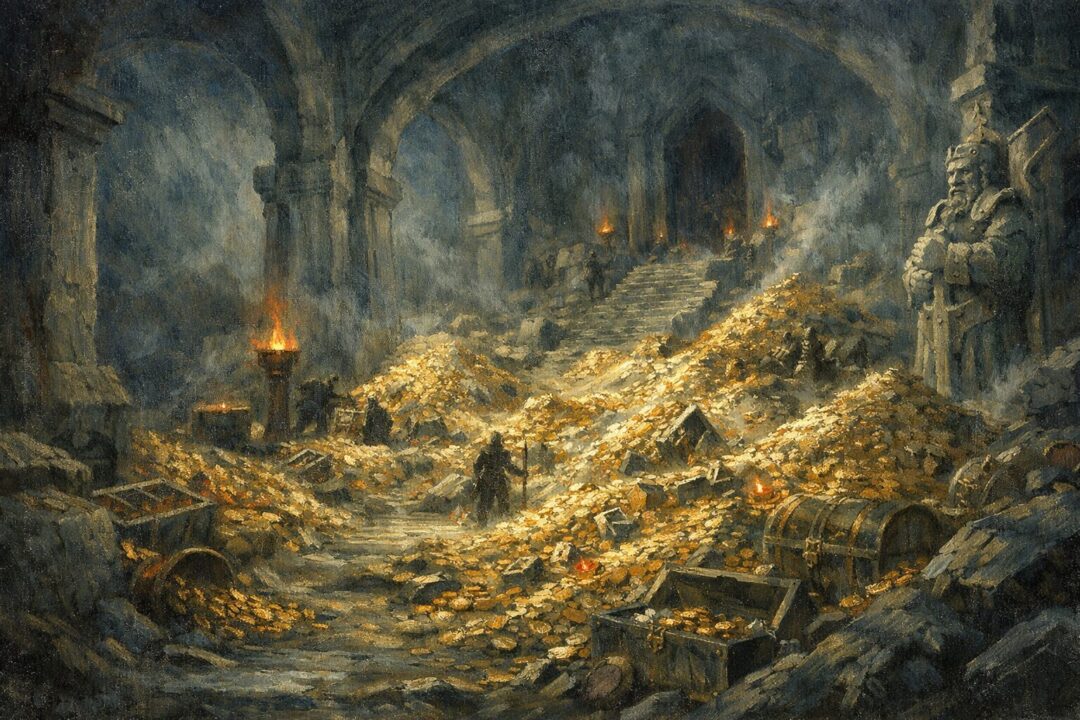
In J.R.R. Tolkien’s Middle-earth, wealth is never abstract. Gold is mined from the earth, silver is counted by hand, jewels are hoarded, and treasure is stored in halls, caves, and vaults. When money appears at all, it exists as coins you can touch, carry, lose, or steal. There are no banks, no credit systems, no invisible transfers of value moving quietly across the map.
This absence is not a gap in worldbuilding. It is a deliberate choice, rooted deeply in Tolkien’s understanding of power, morality, history, and human (and non-human) nature. Middle-earth is a world where value must exist physically, because power that becomes detached from physical reality becomes dangerous, corrupting, and uncontestable.
To understand why Middle-earth never develops abstract money, we need to look at how Tolkien presents wealth itself.
Wealth as Possession, Not Concept
In The Hobbit, the central conflict revolves entirely around physical treasure beneath the Lonely Mountain. Thorin Oakenshield does not speak of reclaiming economic influence, trade dominance, or financial leverage. He speaks of his gold. The Arkenstone is not symbolic capital—it is a jewel you can hold in your hand, hide in a pocket, or bargain with at swordpoint.
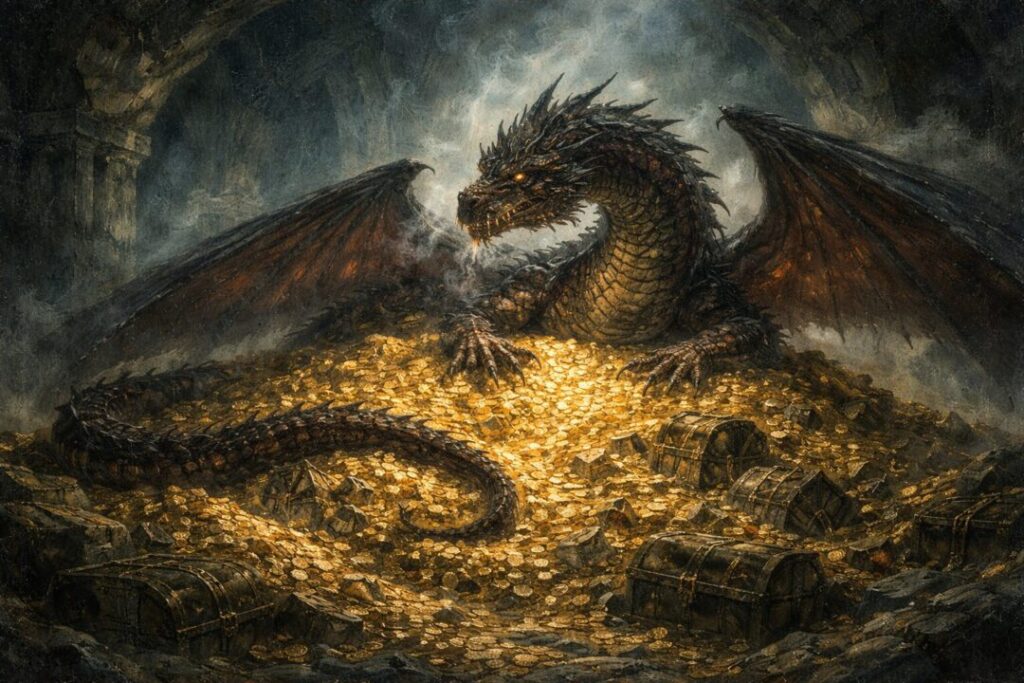
Smaug’s power over Erebor is not political or administrative. He does not rule the Dwarves through laws or taxation. He rules simply because he possesses the hoard. He sleeps on it, coils around it, and counts it instinctively. His control is absolute precisely because it is physical.
This is a recurring pattern in Tolkien’s work. Power flows from possession. Whoever holds the thing of value holds authority—until someone stronger, cleverer, or more determined takes it away.
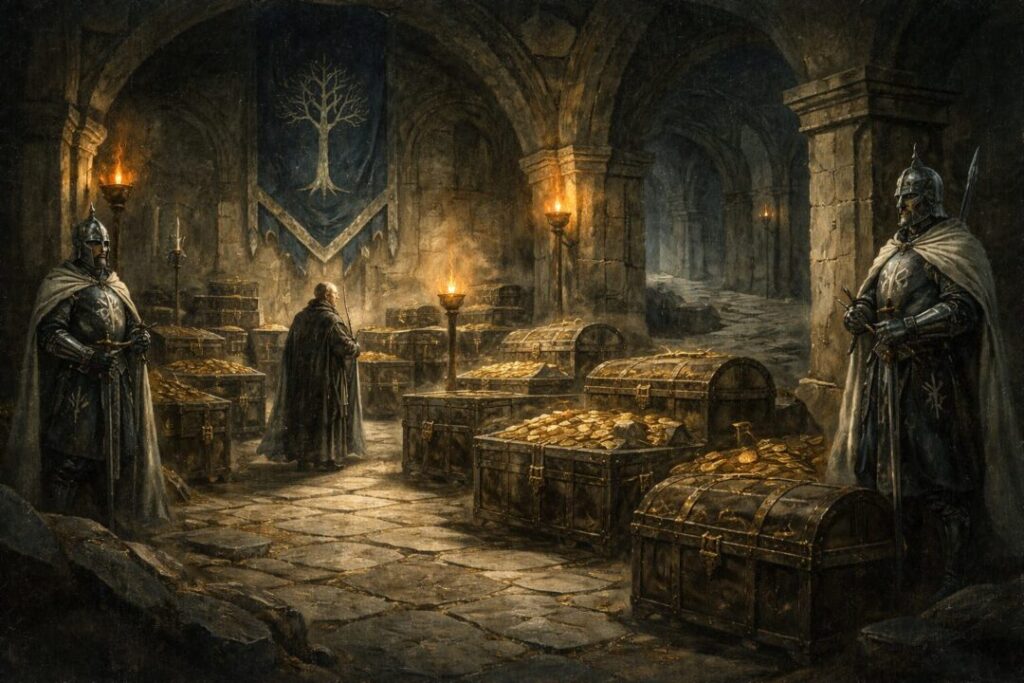
The same idea carries directly into The Lord of the Rings. While coinage exists, it never replaces physical stores of wealth or authority. Minas Tirith is not powerful because it controls trade routes or monetary policy. It is powerful because it is ancient, fortified, and ruled by a lineage stretching back thousands of years. Its strength lies in stone walls, loyal soldiers, and remembered oaths—not financial abstraction.
Coinage Exists, But It Never Replaces Possession
Tolkien is not depicting a barter-only world. Coins are mentioned repeatedly. We hear of silver pennies in inns, payments made for ponies, and compensation given for services. But coins in Middle-earth function as portable pieces of wealth, not as representations of distant value.
A silver penny is valuable because it is silver, not because it is backed by a centralized authority. No character ever speaks of accounts, reserves, or trust in an institution guaranteeing worth. A coin’s value exists entirely in the metal itself.
This distinction matters. In Middle-earth, money does not allow power to become distant. Wealth must still be guarded, carried, and risked. If you lose your purse, your wealth is gone. If a city falls, its treasury is captured. There is no invisible safety net where power continues to exist untouched after physical defeat.
Why There Are No Banks in Middle-earth
The absence of banks is not an oversight. It reflects how Tolkien’s societies are structured.
Middle-earth is profoundly local. Loyalty is personal. Trust does not extend easily beyond known relationships.
- A Dwarf trusts his kin.
- A Rohirrim trusts his lord.
- Gondor trusts the Stewards.
- Hobbits trust neighbors they have known all their lives.
There is no universal authority powerful enough—or trusted enough—to guarantee abstract value across cultures that barely tolerate one another. Elves, Dwarves, Men, and Hobbits do business together, but they do not share institutions.
Even trade reflects this reality. In Bree, commerce is entirely face-to-face. Goods change hands directly. Payment is immediate and tangible. No one references credit, debt records, or delayed settlement. If you cannot pay now, the deal does not happen.
A banking system requires trust in strangers and belief in continuity. Tolkien’s world, shaped by wars, collapses, and fading civilizations, offers neither.
The Moral Danger of Abstraction
This practical explanation only goes so far. Tolkien’s deeper reason for rejecting abstract wealth is moral.
Again and again, Tolkien associates abstraction with corruption. When power becomes detached from physical responsibility, it grows unchecked. When authority no longer requires presence, it becomes tyrannical.
This is why Tolkien consistently ties power to objects, places, and bodies. Kings must sit on thrones. Stewards must physically rule cities. Even evil must incarnate itself.
Nowhere is this clearer than with the One Ring.
The One Ring as the Ultimate “Hard Asset”
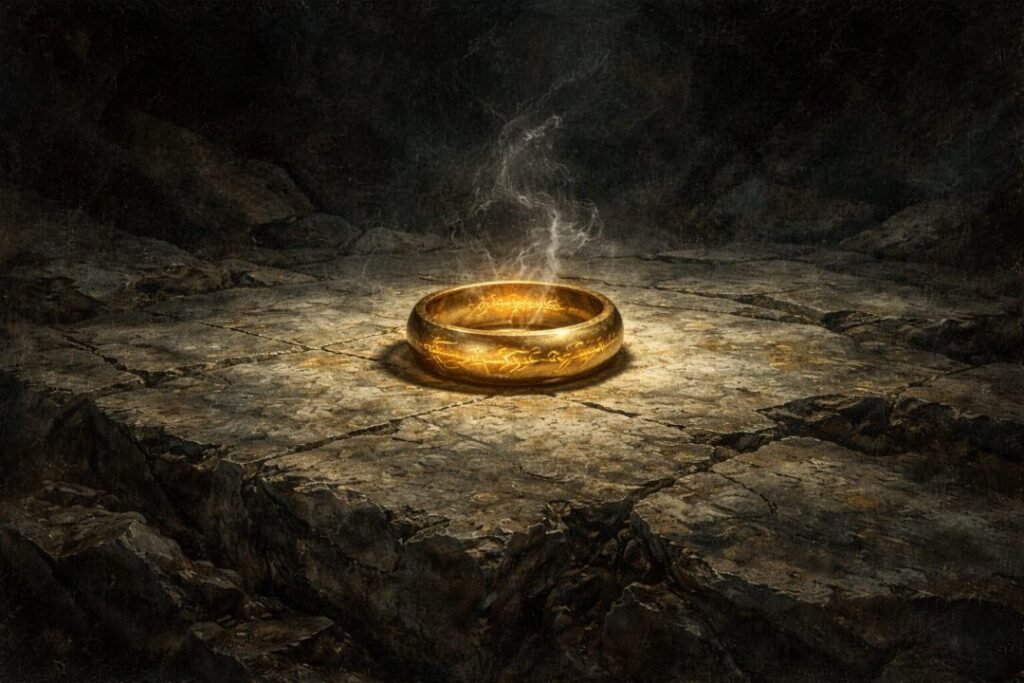
The One Ring is not symbolic power. It is not an idea, a system, or a philosophy. It is a thing. It can be held, stolen, lost, hidden, and destroyed.
Sauron does not rule Middle-earth through economic dominance or bureaucratic systems. He pours his power into a physical object, believing that concentrating power will make it secure. That choice becomes his undoing.
His armies are not defeated because Gondor out-produces him or out-manages resources. They collapse because the Ring—the physical container of his power—is destroyed.
This is Tolkien’s clearest statement on abstraction: power that exists only as an idea cannot be challenged, but power bound to a thing can always be contested.
The Ring must be carried. It tempts, corrupts, and weighs on the bearer precisely because it is tangible. You cannot escape responsibility for it.
Dwarves, Hoards, and Cultural Memory
No people illustrate Tolkien’s philosophy of wealth more clearly than the Dwarves.
For Dwarves, gold is not merely currency. It is history, craft, and identity. Every hoard represents centuries of labor, skill, and inheritance. When Dwarves lose their treasure, they do not simply rebuild through trade systems. They wander. They mourn. They remember.
Erebor is not valuable because it generates income. It is valuable because it contains the work of generations. That is why Thorin’s obsession is tragic rather than greedy. He is not chasing profit; he is chasing restoration.
When that hoard is taken, no ledger can replace it. No system can recreate what was lost. Wealth in Middle-earth is finite, earned, and deeply personal.
Power Must Be Vulnerable to Be Moral
This is the core idea tying Middle-earth’s economy together.
Tolkien believed that power must be vulnerable to loss in order to remain moral. Gold can corrupt—but it can also be given away. Frodo relinquishes treasure. Sam carries coins home not to hoard, but to rebuild the Shire. Aragorn does not enrich himself with conquest; he restores what already exists.
Abstract power cannot be refused. Physical power can.
That is why Middle-earth resists abstraction at every level. It is not a primitive world waiting to modernize. It is a moral world designed to show what happens when power remains grounded in reality—and what happens when it does not.
Conclusion: A Deliberate World, Not an Incomplete One
Middle-earth never evolves beyond physical wealth because Tolkien never wanted it to.
Gold must be mined. Treasure must be guarded. Power must be carried, defended, and sometimes destroyed. Wealth that can be touched can be challenged. Value that exists physically can be lost—and that loss matters.
In Tolkien’s world, abstraction is not progress. It is danger.
And that is why Middle-earth still counts its coins by hand.