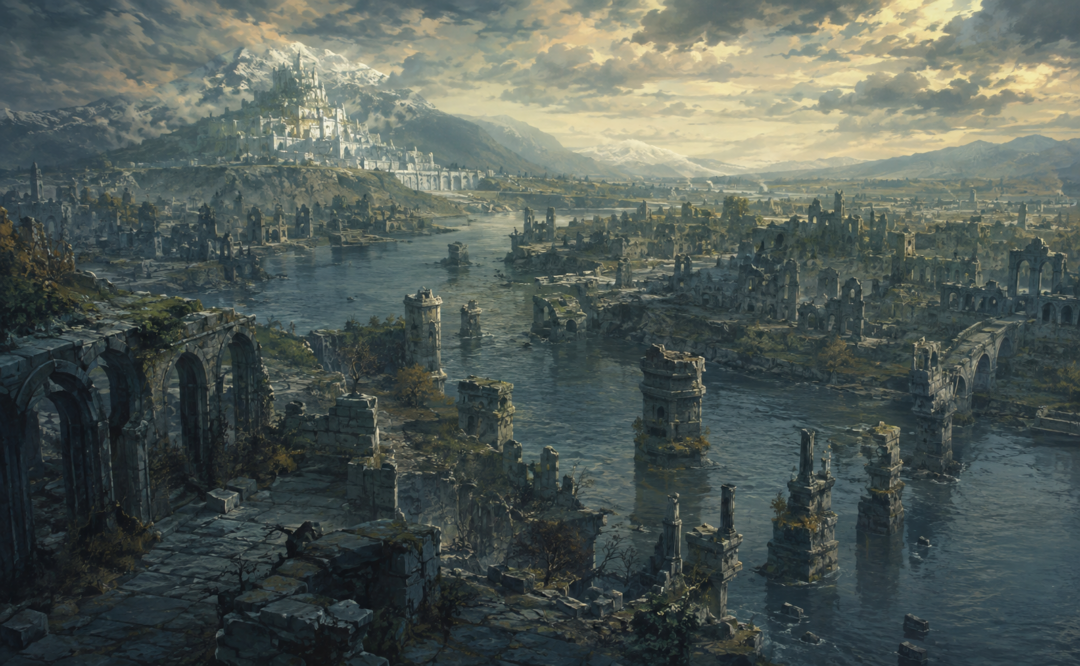
When the War of the Ring ends, Minas Tirith is battered but alive. Its Great Gate has been destroyed, parts of its defenses have suffered, and many of its people have endured siege, fire, fear, and loss. Yet it remains a functioning city. It still has streets, houses, walls, a Citadel, a population, and—most importantly—a future already gathering inside it.
Osgiliath is something else entirely.
The old capital of Gondor has not merely been damaged in one terrible war. By the time Aragorn becomes King, Osgiliath has endured centuries of depopulation, civil war, plague, invasion, abandonment, broken bridges, and repeated fighting. It has ceased to function as a city at all. Gondor's soldiers use its ruins because the crossing of the Anduin remains strategically vital, but they do not truly live there as citizens.
That distinction explains why restoring Osgiliath would be a far greater undertaking than repairing Minas Tirith.
And it also explains something important about Gondor's new age: healing the kingdom does not necessarily mean recreating its past exactly as it was.
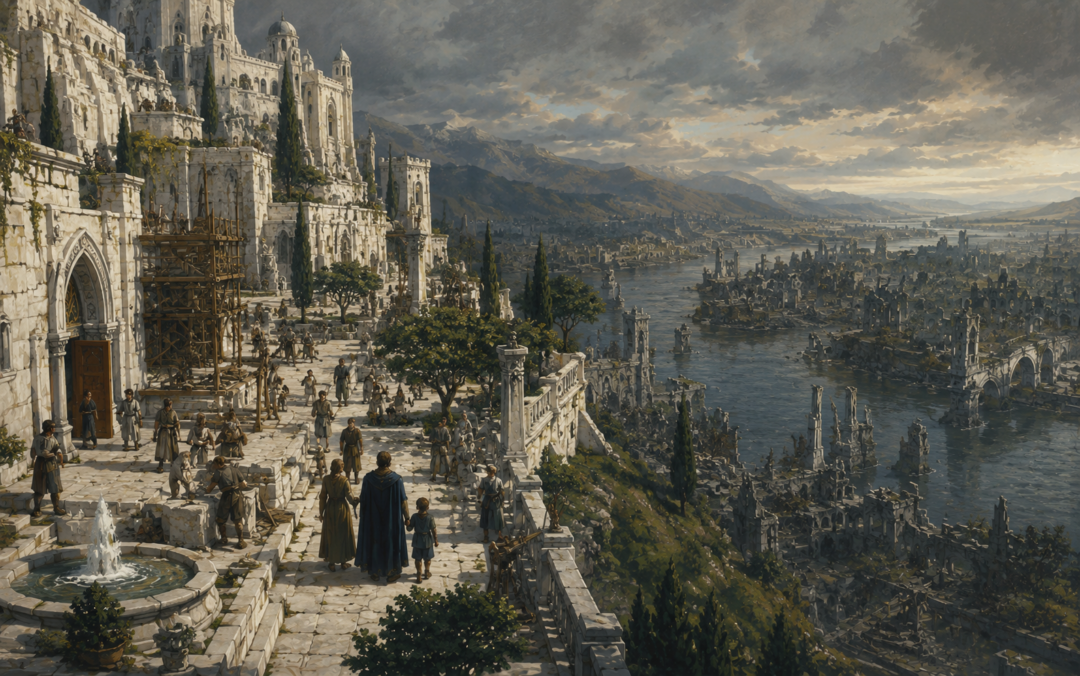
Minas Tirith Was Wounded; Osgiliath Had Already Died
The easiest way to understand the difference is to compare what each place actually is at the end of the Third Age.
Minas Tirith is a living capital under siege.
Osgiliath is an ancient capital being used as a battlefield.
Beregond makes the distinction especially clear when speaking with Pippin. He explains that Osgiliath had once been Gondor's chief city, while Minas Tirith had originally been only a fortress. But by the War of the Ring, Gondor had recovered Osgiliath not for ordinary habitation but as an outpost and strategic crossing.
That is an enormous difference.
A damaged inhabited city already possesses the human systems required for recovery. Families remain connected to homes. Roads still lead somewhere. Government already operates there. Craftsmen, soldiers, merchants, healers, servants, and officials have reasons to return after danger passes.
Osgiliath would require something closer to refounding.
Its stones could perhaps be repaired. Restoring the society that once made those stones a city would be much harder.
Osgiliath's Destruction Took Centuries
Osgiliath did not fall in a single catastrophe.
Its decline came in layers.
During the Kin-strife in the fifteenth century of the Third Age, the city became one of the principal victims of Gondor's civil war. Osgiliath was burned, and the great palantír associated with the city was lost in the Anduin.
Then came the Great Plague of 1636.
Osgiliath suffered terribly. Its population was devastated, and afterward many who had fled did not return. Four years later King Tarondor moved the King's House permanently to Minas Anor, the city that would eventually become Minas Tirith.
That decision mattered enormously.
Once the royal residence departed, Osgiliath was no longer simply a damaged capital awaiting recovery. The political heart of Gondor had moved elsewhere.
The situation worsened after Minas Ithil fell to the Nazgûl in 2002. The eastern frontier became increasingly dangerous, placing Osgiliath between Gondor's surviving strength in the west and an enemy-held stronghold near Mordor.
Finally, in 2475, Uruks from Mordor swept into Ithilien and captured Osgiliath. Gondor drove them back, but the city was ruined and its great bridge was broken.
By the War of the Ring, therefore, Aragorn would not be inheriting a city recently destroyed by Sauron.
He would be inheriting ruins created by nearly sixteen centuries of decline.
The River That Made Osgiliath Great Also Makes It Difficult
Osgiliath's geography is both its greatest advantage and one of its greatest problems.
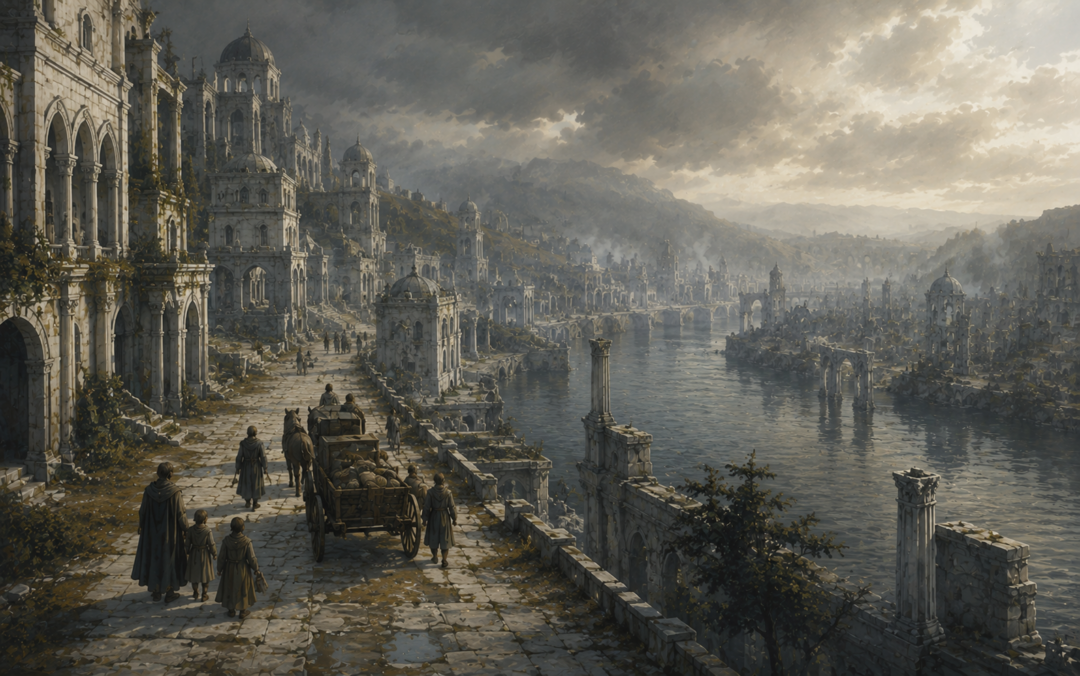
The city was built on both sides of the Anduin.
In Gondor's age of strength, this was magnificent. Osgiliath stood at the center of the South-kingdom, binding its eastern and western territories together. Its bridges transformed the river from a barrier into an artery.
But after Gondor lost control of much of Ithilien, that same geography became dangerous.
A city on one bank can defend the river.
Osgiliath must master both banks.
Its bridges are therefore not merely civic architecture. They are strategic infrastructure. Whoever controls a reliable crossing there gains a route between Anórien and Ithilien.
This is why the bridges repeatedly matter in the wars against Mordor. In 3018, when Boromir and Faramir fought during the Enemy's assault on Osgiliath, the defenders destroyed the remaining bridge behind them as they withdrew from the eastern side.
During the final offensive in 3019, Sauron's forces prepared floats and barges in East Osgiliath and forced their way across the Anduin despite Gondor's resistance.
So rebuilding Osgiliath would mean rebuilding more than houses.
It would mean restoring major crossings of one of Middle-earth's greatest rivers and reconnecting two halves of a city that had spent centuries on a military frontier.
Minas Tirith Already Had What Osgiliath Lacked: People
Stone is not the hardest part of rebuilding a city.
People are.
This may be the greatest practical difference between Minas Tirith and Osgiliath.
Minas Tirith's population was diminished, and during the crisis many civilians were evacuated. But the city remained the administrative and political center of Gondor. Its identity had survived.
After Aragorn's coronation, the text gives an unusually hopeful description of its renewal. The City becomes fairer, filled with trees and fountains; its streets and gates are renewed; its houses once again fill with families and children.
The point is not merely architectural.
Minas Tirith can recover because life returns to something that already exists.
Osgiliath has no comparable surviving civic population described in the late Third Age. Gondor holds portions of the ruins militarily, but Beregond explicitly distinguishes holding the place as an outpost from dwelling there.
To restore Osgiliath as a true city, Gondor would therefore need inhabitants willing to settle among enormous ruins on the Anduin.
Homes would need rebuilding.
Markets would need reopening.
Roads, quays, bridges, water access, defenses, and public spaces would have to serve civilians again rather than soldiers.
The difficulty is demographic as much as architectural.
Minas Tirith Had Dwarves and Elves Ready to Help
The Fourth Age also gives Minas Tirith something remarkable: allies with extraordinary skills.
Gimli eventually establishes a Dwarven community in the Glittering Caves of Aglarond. His people perform great works in Gondor and Rohan, and the shattered Great Gate of Minas Tirith is replaced with one wrought of mithril and steel.
Legolas likewise brings Elves south, and the renewal of the City includes trees and gardens.
This is not simply cosmetic restoration.
The postwar Minas Tirith becomes a symbol of cooperation between peoples who had fought together against Sauron. Stonework, living greenery, flowing water, and renewed habitation transform the old fortress-city.
Could such craftsmen also have worked at Osgiliath?
Possibly. The texts say that Gimli's people accomplished great works in Gondor, leaving room for possibilities beyond those specifically named. But no surviving canonical account explicitly tells us that Gimli rebuilt Osgiliath, nor does the narrative provide a detailed Fourth Age restoration of the old capital.
That distinction matters.
It is reasonable to imagine that the restored kingdom would eventually secure and perhaps redevelop such an important site. It is not safe to describe a complete rebuilding as a stated fact.
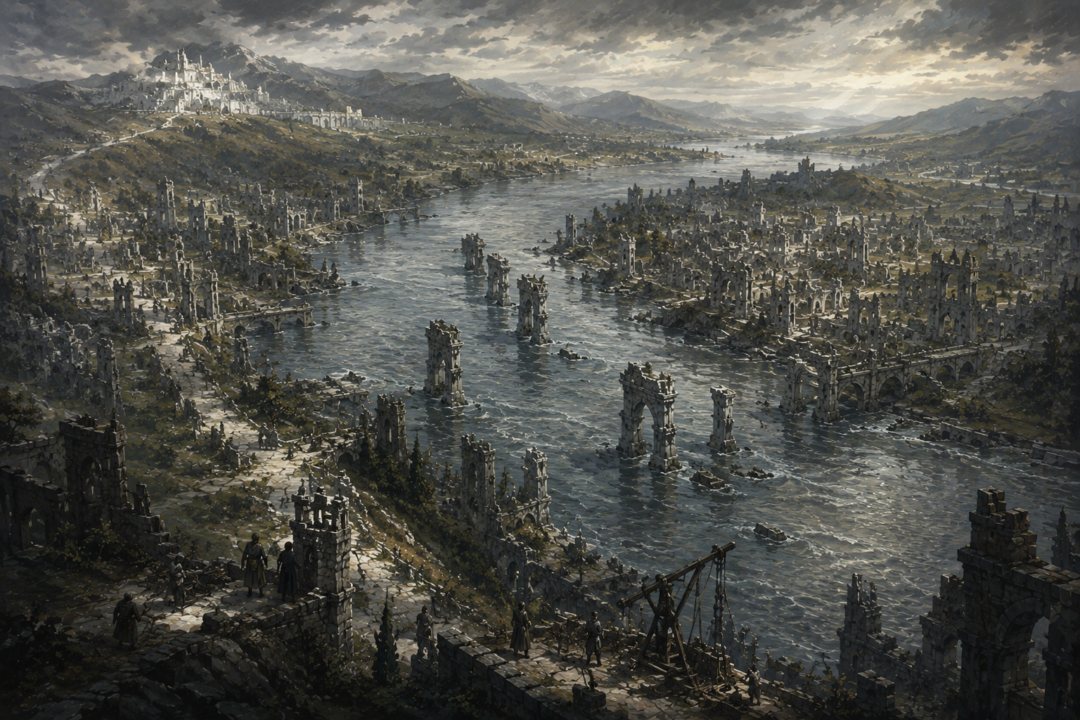
Osgiliath's Old Purpose No Longer Exists
There is also a deeper political problem.
Why rebuild Osgiliath as it was?
The city had originally been the capital of a Gondor very different from the kingdom Aragorn inherits.
In the early Third Age, Gondor possessed extensive lands east of the Anduin. Osgiliath's central position therefore made political sense. Minas Anor and Minas Ithil stood to either side, while the chief city occupied the river between them.
By the late Third Age, that arrangement had vanished.
Minas Tirith had been Gondor's seat of government for well over a thousand years. It contained the Citadel, the White Tower, the Steward's institutions, and the living political memory of the kingdom.
Aragorn does not abandon it after becoming King.
Instead, Minas Tirith is renewed.
This suggests an important distinction between restoration and reversal.
The Return of the King does not depict Aragorn trying to rewind Gondor to an earlier century. His kingship joins ancient legitimacy to present realities. The White Tree returns, but the kingdom does not simply pretend that everything lost during the Third Age never happened.
Osgiliath's glory belongs to Gondor's past.
Minas Tirith is the capital of its future.
Even Victory Does Not Erase Geography
Sauron's fall dramatically changes Osgiliath's strategic situation.
Mordor is no longer ruled by the Dark Lord. Faramir becomes Prince of Ithilien, and Aragorn's realm enters a period of renewed strength. The eastern bank of the Anduin is no longer the exposed boundary it had been during the long struggle with Mordor.
That would make settlement far more plausible.
But victory does not instantly rebuild infrastructure.
The Anduin still flows through the middle of the ruins. Bridges still need engineering and labor. Centuries of collapsed structures still have to be cleared or replaced. A civilian population still has to be established.
Meanwhile, Gondor has countless other demands.
Minas Tirith needs repair. Ithilien must be resettled. Roads and defenses have suffered. The reunited kingdom also extends north into Arnor, where ancient centers such as Annúminas again become relevant to the restored kingship.
Osgiliath would therefore compete for the same finite resources required to heal an enormous realm.
Its historical importance does not make the labor smaller.
It makes the temptation to rebuild it greater.
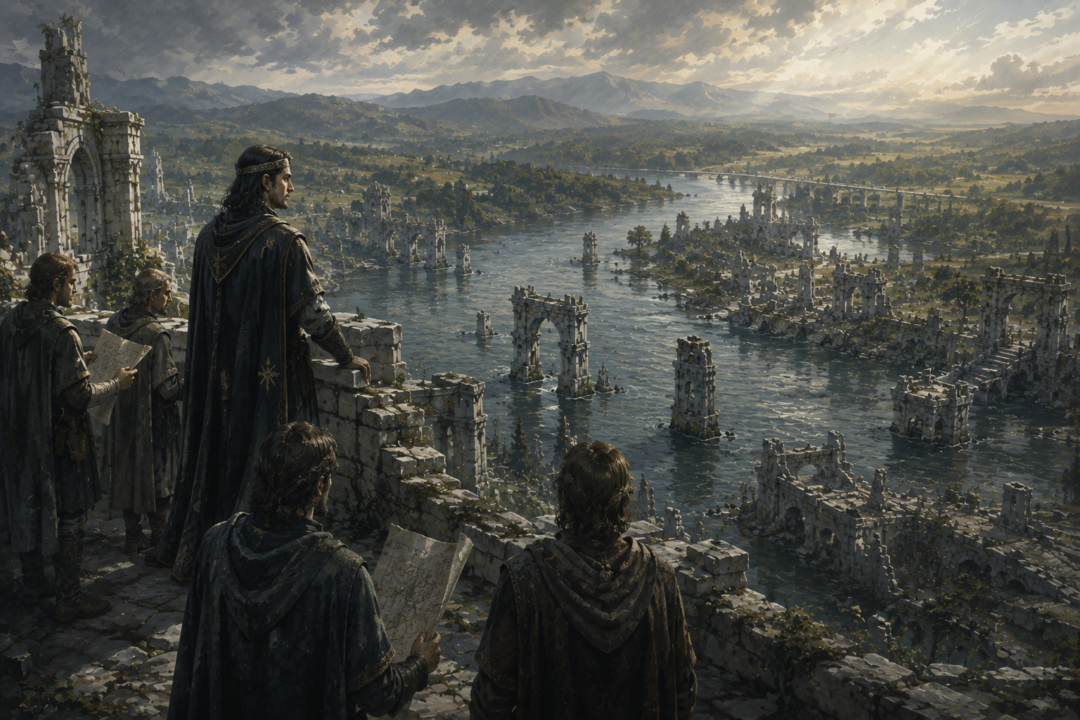
Perhaps the Ruins Matter Too
There is one final possibility worth considering.
Osgiliath may not need to become what it once was.
The surviving texts do not give us a detailed account of its ultimate fate in the Fourth Age. That silence should prevent certainty. A restored settlement is plausible; a complete reconstruction of the ancient capital is not explicitly confirmed.
But the silence also fits the larger mood of Middle-earth.
Some things are healed.
Others pass away.
Aragorn restores kingship, but Númenor does not rise from the sea. The White Tree flowers again, but the Elves continue departing. Minas Tirith becomes more beautiful, yet the Third Age still ends.
Osgiliath could therefore stand as one of Gondor's deepest reminders that renewal is not the same thing as undoing history.
Minas Tirith needed masons, gardeners, gates, streets, and returning families.
Osgiliath would need all of those things—and something harder.
It would need a reason to become a living city again.
That is why the old capital is harder to restore. Its greatest loss is not the broken stone beside the Anduin.
It is the vanished world that once made those stones the center of Gondor.
Sources & Notes
- https://www.glyphweb.com/arda/o/osgiliath.html — The Encyclopedia of Arda: Osgiliath’s founding, division across the Anduin, repeated destruction, depopulation, and strategic exposure
- https://www.glyphweb.com/arda/m/minastirith.html — The Encyclopedia of Arda: Minas Tirith’s fortified design, role as Gondor’s surviving capital, and history through the War of the Ring
- https://www.glyphweb.com/arda/r/reunitedkingdom.html — The Encyclopedia of Arda: the restored realm under Elessar, combining Gondor and Arnor after the War of the Ring
- https://www.glyphweb.com/arda/g/gondor.html — The Encyclopedia of Arda: Gondor’s political geography, capitals, wars, and postwar restoration context
Sources cover Osgiliath’s long decline, Minas Tirith’s continuing civic role, and the political geography of restored Gondor.