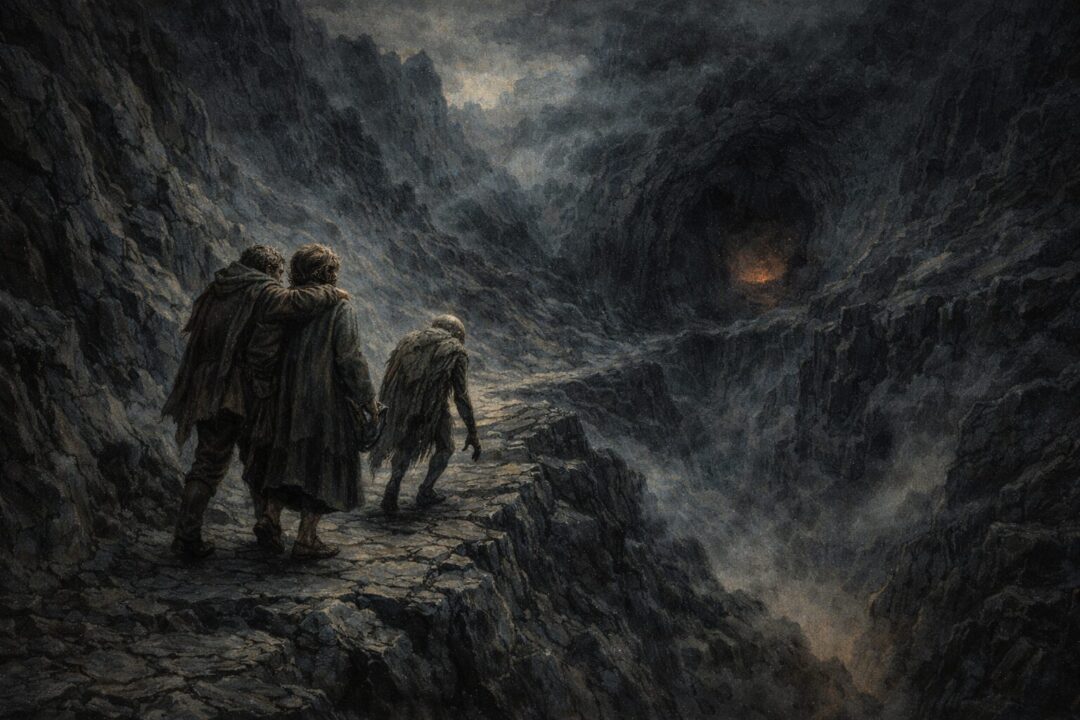
Samwise Gamgee is usually remembered as the cure for everything dark in The Lord of the Rings.
He is steadfast. He is practical. He is the voice that refuses despair.
And he is loyal—so loyal that many readers treat Sam as morally uncomplicated, the one character who is never really in doubt.
But Tolkien does not write him that way.
In the book, Sam’s devotion has a seam running through it: a hard thread of possessiveness, something that can look like jealousy when Frodo’s attention turns toward Gollum.
That thread is not an accident. It is not merely “hobbit pettiness.”
Tolkien later singled out the consequences of this exact dynamic as one of the most tragic turns in the entire story.
And that is why the book’s version matters more than the film’s.
Because the film externalizes the rupture with a practical device (the lembas plot) and a dramatic separation.
The book keeps Sam and Frodo together—but shows a subtler, more unsettling truth:
Sometimes loyalty can be so fierce it becomes unable to share.
What the film needs (and what it replaces)
The Return of the King film sequence is built for clarity.
Gollum engineers evidence. Frodo judges wrongly. Sam is dismissed. The audience understands instantly what happened, and the plot creates a temporary “break” so Sam can return at the right moment.
That structure works on screen because films often need visible causes.
But the cost is that it turns the Frodo–Sam bond into something mechanically disrupted, almost like a misunderstanding in a different genre.
The book chooses a harder path.
It does not need Sam to leave. It does not need Frodo to be fooled by crumbs.
Instead, Tolkien places the fracture inside a moral and emotional pressure point: Frodo’s pity for Gollum, and Sam’s inability to trust it.
Sam’s devotion includes pride (Tolkien says so)
Readers often speak about Sam’s humility, and it is real.
Sam does not think of himself as heroic. He does not posture.
Yet Tolkien explicitly describes something mixed into Sam’s service: pride, and a kind of possessiveness that is difficult to separate from devotion.
In Letter 246 (preserved in The Letters of J.R.R. Tolkien and also quoted in a Tolkien Estate letter), Tolkien calls attention to Sam’s failure to perceive what is happening between Frodo and Gollum, and frames it as part of Sam’s character—devotion with an edge.
This matters because it means Sam’s jealousy is not merely a modern psychological reading forced onto the text.
Tolkien himself points to Sam’s limitations here, and he does it without condemning him.
Sam is acting out of love.
But love can still be blind.
The book’s turning point is not bread—it’s the Stairs
In The Two Towers, Book IV, Chapter 8 (“The Stairs of Cirith Ungol”), Tolkien gives us one of the most delicate scenes Gollum ever receives.
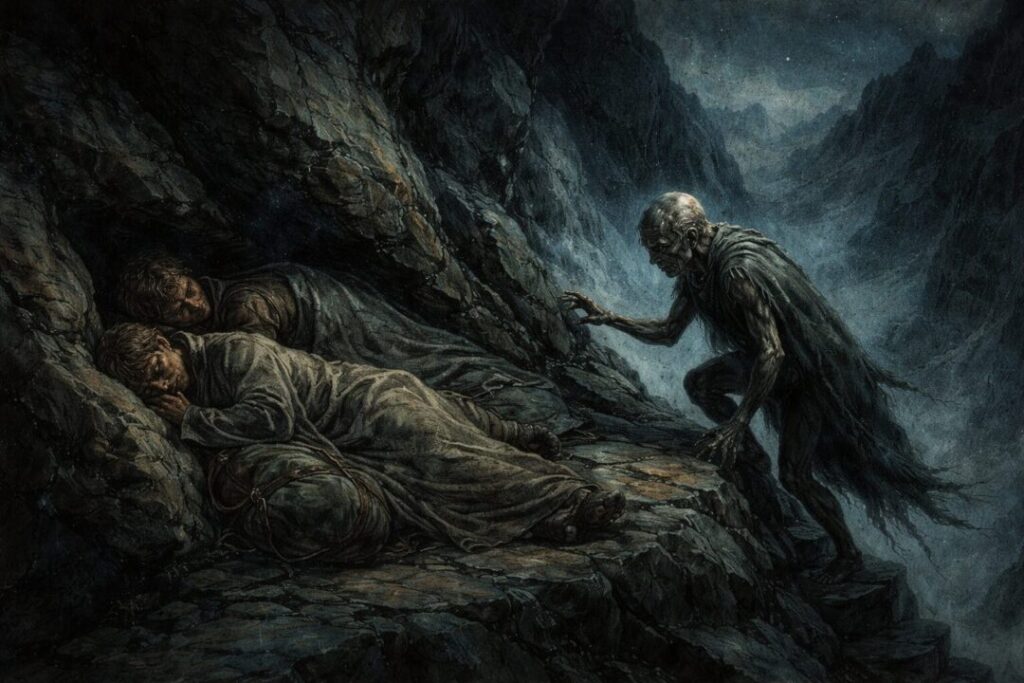
Frodo and Sam fall asleep. Gollum returns and looks at them.
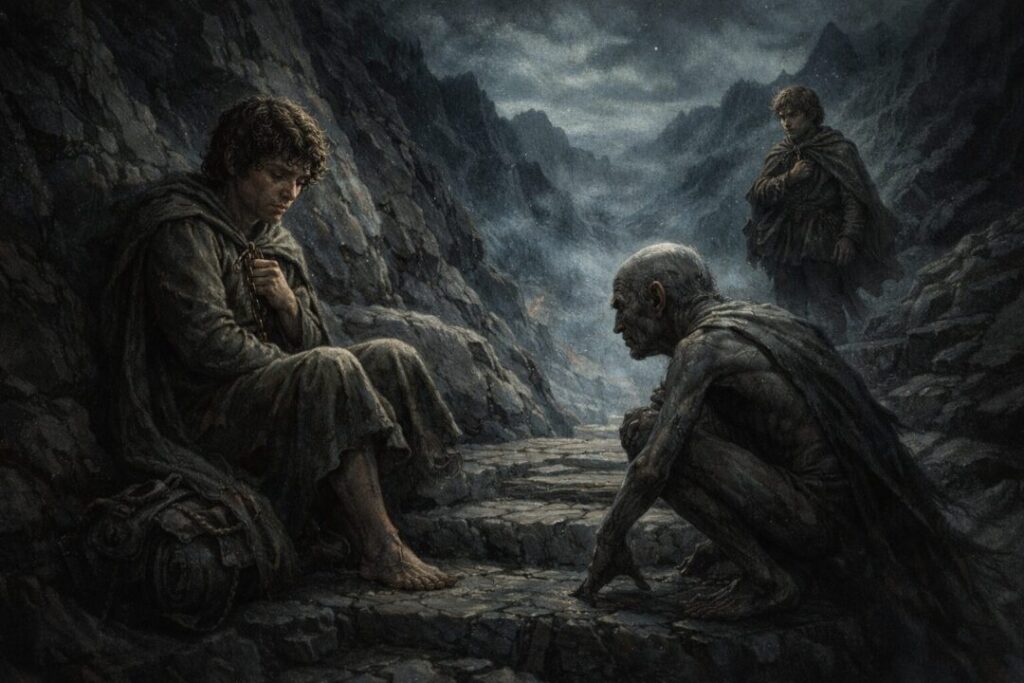
Then comes the moment that is easy to miss if you’re reading quickly: the narration shows Gollum hesitating, wavering inwardly, with a strange expression—as if caught in an internal argument.
He reaches out and touches Frodo—so cautiously it is “almost” a caress, and then recoils, as if ashamed.
Tolkien does not say, “Gollum repented.”
But Tolkien does show a near-turning, and later he interprets it for us: this is a moment where repentance was possible—then lost.
And the loss is not caused by a battle, or a prophecy, or a spell.
It is caused by a sentence.
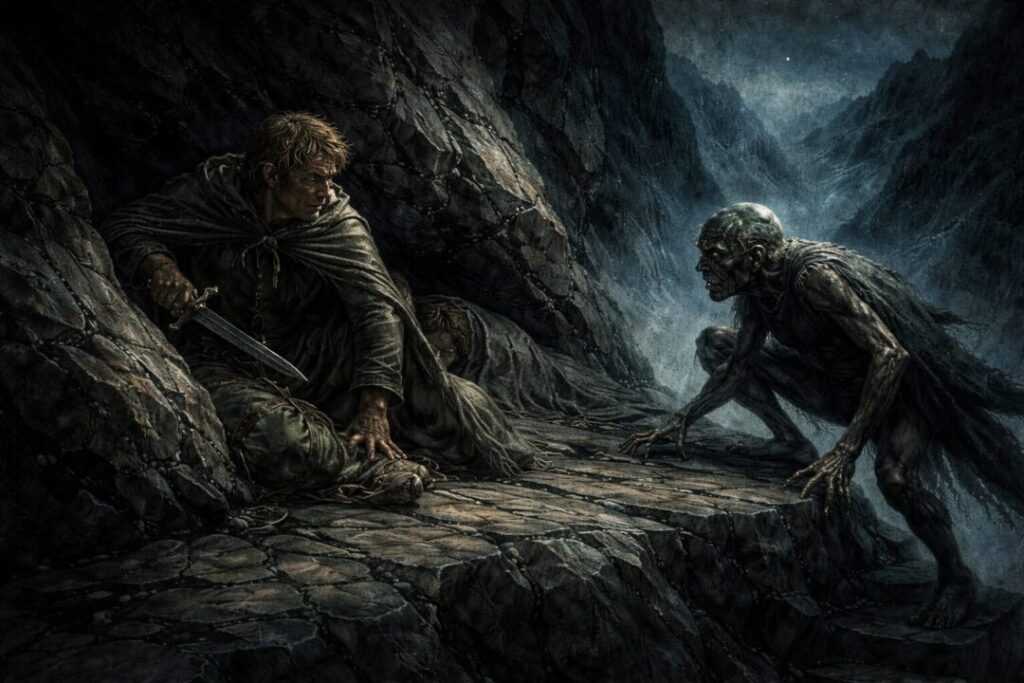
Sam wakes.
He speaks to Gollum “roughly,” suspiciously, with the contempt Sam believes is justified. And Gollum’s brief softness collapses into the familiar defensive malice.
In a scholarly paper that quotes the passage directly, the text describes the fleeting moment passing “beyond recall.”
That is the hinge.
Not because Sam is “wrong” to distrust Gollum.
But because Tolkien is showing how thin the bridge is between mercy and disaster.
Why Tolkien calls it tragic
Tolkien later wrote that for him “perhaps the most tragic moment in the Tale” comes here: when Sam “fails to note the complete change in Gollum’s tone and aspect,” and as a result Gollum’s “repentance is blighted,” Frodo’s pity is “wasted,” and Shelob’s Lair becomes inevitable.
That is a staggering authorial statement.
It reframes the entire episode as more than suspense.
It turns it into tragedy: the sense that something good almost happened—and didn’t—because the people involved were not capable of seeing clearly in the moment.
Frodo is exhausted and burdened by the Ring.
Sam is vigilant and protective.
Gollum is divided against himself.
No one is in a position to make the best choice.
And that is exactly Tolkien’s point.
What Sam is “jealous” of (careful wording)
The word “jealousy” can mislead, because it can sound petty or romantic.
The book does not present Sam as envious of attention in a shallow sense.
What the text supports more safely is this:
Sam experiences Frodo’s pity toward Gollum as a threat—both to Frodo’s safety and to the closeness of the bond Sam has built his identity around.
Sam calls Frodo “master” repeatedly, and his role is bound up in service.
Tolkien’s later commentary frames Sam’s devotion as containing an ingredient of possessiveness that is “difficult to exclude” from such loyalty.
So Sam’s jealousy is not “I want Frodo to like me.”
It is: “I cannot bear the idea that this creature could share what I have vowed to give.”
It is protective—and that is why it is so dangerous.
Because protective love can justify harshness.
And harshness, in this scene, helps shut the one door that might have led away from Shelob.
The film loses the moral geometry
In the film, the emotional logic is simple:
- Gollum tricks them.
- Frodo believes a lie.
- Sam is sent away.
- Sam returns and saves Frodo.
That creates momentum and clean catharsis.
But the book’s moral geometry is more complex—and more Tolkien-like:
- Frodo’s pity is real, deliberate, and morally meaningful.
- Gollum’s inner conflict is real, if unstable.
- Sam’s loyalty is real, but not purely “wise.”
- The tragedy is that all three truths collide in the dark.
That collision is the story.
And it matters because it keeps Tolkien’s themes intact:
Mercy is powerful, but fragile.
Good intentions are not the same as good outcomes.
And even the best characters can become instruments of doom—not through betrayal, but through limitation.
Why this changes how you read Sam (without diminishing him)
None of this makes Sam lesser.
If anything, it makes him more human—and more heroic.
He is not a saint placed beside Frodo.
He is a person under strain, doing the best he can with the perception he has.
And Tolkien does not blame him in a simplistic way. Tolkien highlights the tragedy precisely because it is understandable.
Sam has every reason to mistrust Gollum.
He has watched Gollum’s hunger, heard his arguments with himself, felt the threat.
Sam’s suspicion is not irrational.
But Tolkien’s point is that being justified is not the same as being salvific.
Sometimes you can be right about danger and still contribute to disaster.
That is what makes this moment “more important” in the book than the film:
It is not a plot device.
It is a revelation about how evil wins ground—through exhaustion, fear, and the tiny failures of insight that occur inside love.
The open question the text leaves hanging
Would Gollum truly have repented if Sam had spoken gently?
Tolkien does not give a definitive alternate history.
He tells us only what matters: there was a moment where something in Gollum changed, and it was not recognized, and it passed “beyond recall.”
That is the ache of it.
The book doesn’t ask you to condemn Sam.
It asks you to feel the cost of a world where even the faithful can’t always see the miracle when it flickers in front of them.
And once you see that, the Stairs of Cirith Ungol stop being a transition on the way to Shelob.
They become one of the places where the fate of the Quest quietly narrowed—without anyone realizing it at the time.