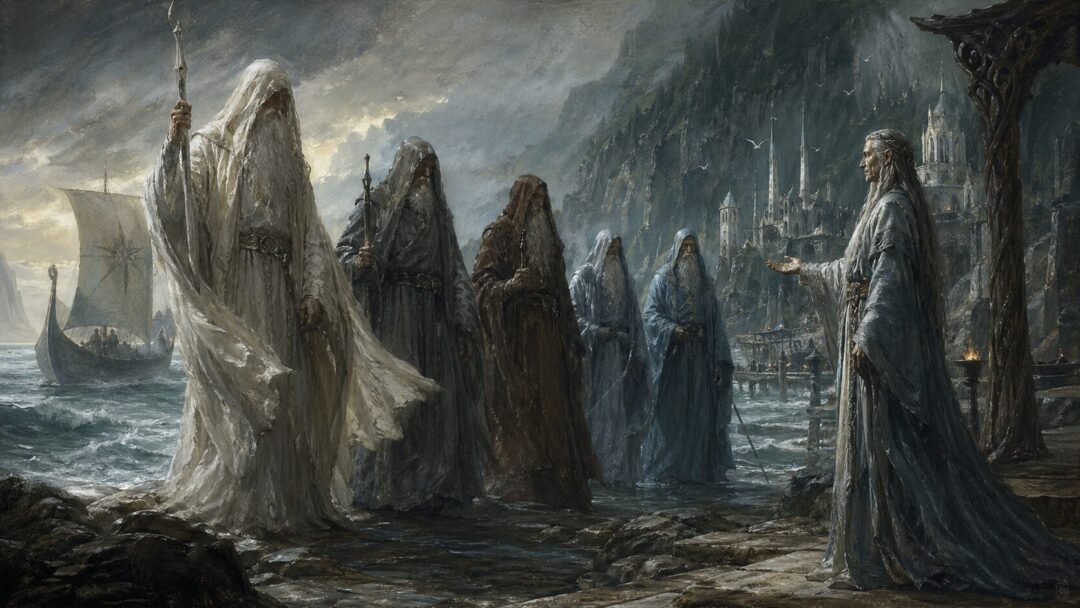
Saruman did not come to Middle-earth as a villain.
That is easy to forget.
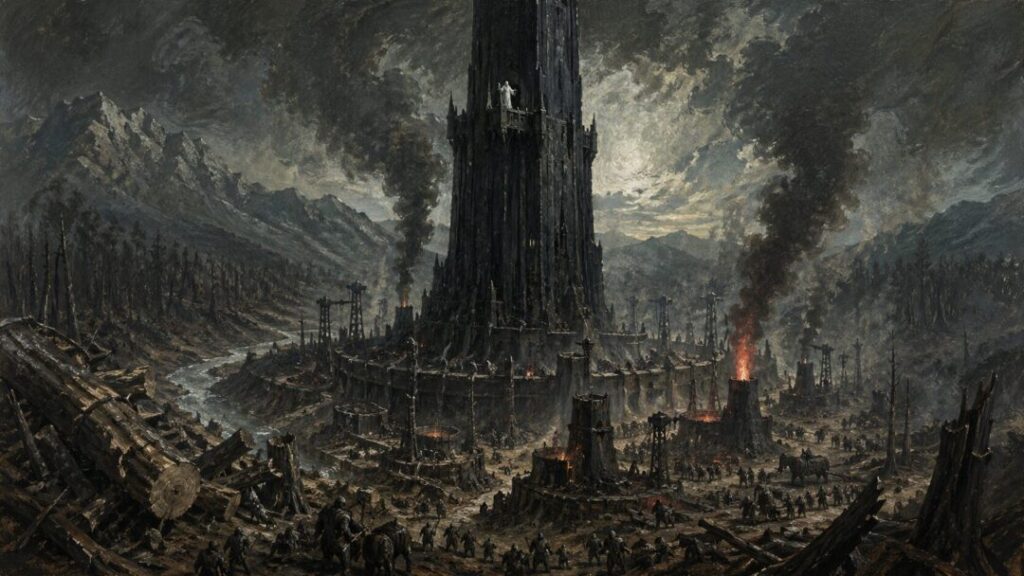
By the time most readers meet him fully, he is already deep in treachery. He has imprisoned Gandalf. He has taken Isengard for himself. He has bred armies, cut trees, searched for the Ring, and wrapped himself in a vision of order that looks more and more like the shadow he claims to oppose.
But that is not how his story began.
Saruman was sent to Middle-earth for a noble purpose. He was one of the Istari, the Wizards: beings sent by the Valar in the Third Age to help the Free Peoples resist Sauron. They were not ordinary old men, though they appeared in that form. They were Maiar, spirits of the same order of being as Sauron himself, though lesser than the Valar.
That alone makes Saruman’s mission remarkable.
The Powers did not send armies from the West. They did not overthrow Sauron by open force. They sent messengers, counsellors, and guides, clothed in humility and limitation.
Saruman was not sent to rule Middle-earth.
He was sent to help save it from rule.
And that is where the tragedy begins.
The Wizards Were Not Sent as Conquerors
The most important thing to understand about Saruman’s mission is what it was not.
He was not sent to defeat Sauron by becoming a rival Dark Lord. He was not sent to dominate Elves, Men, Dwarves, or Hobbits for their own good. He was not sent to take command of Middle-earth and force victory from above.
The Istari were sent under restraint.
Their purpose was to aid resistance to Sauron, especially by counsel, wisdom, encouragement, and the strengthening of hearts. They were meant to move among the peoples of Middle-earth, not stand above them as masters.
This matters because it explains the shape of the entire War of the Ring.
Victory does not come through a greater tyrant replacing a lesser one. It comes through pity, endurance, friendship, sacrifice, and the refusal to use the Enemy’s own tools. The Ring is not mastered by the righteous. It is rejected.
Saruman’s mission belonged to that same moral pattern.
He was meant to oppose domination without practicing it.
That was the test.
Why Send Someone Like Saruman?
Saruman, originally named Curumo, was associated with Aulë, the Vala of craft, making, and deep knowledge of the substances of the world.
That detail is not accidental.
Sauron too had once been connected with Aulë before his corruption by Morgoth. This does not mean Saruman and Sauron were identical, nor does it mean Saruman was doomed to fall. But it does create a striking parallel. Both were beings deeply concerned with order, skill, craft, and the shaping of things according to will.
In a hopeful sense, that made Saruman useful.
Sauron’s power was not merely brute strength. It worked through design, system, deception, craft, and domination. The One Ring itself was not a simple weapon. It was a made thing, a device of control, a work of terrifying intelligence.
A messenger who understood craft and order might be especially equipped to perceive the danger.
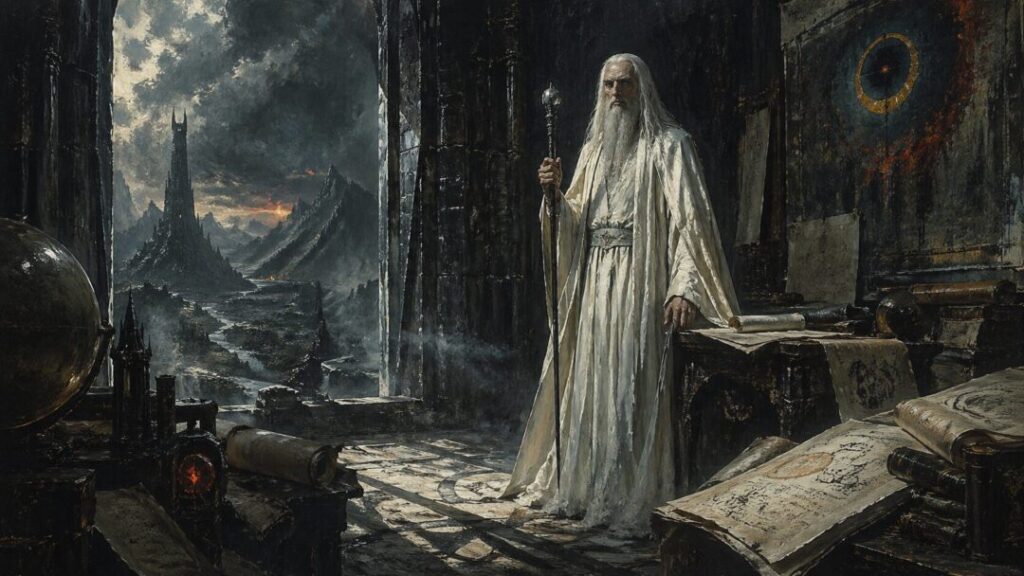
Saruman’s wisdom, knowledge, and authority made him appear suited to lead the effort against Sauron. He became known as Saruman the White. He was regarded as the chief of the Istari. Later, he also became the head of the White Council, the gathering formed to oppose the growing shadow.
On the surface, he looked like exactly the sort of figure Middle-earth needed.
But the same qualities that made him useful also made him vulnerable.
The Chief of the Order
Saruman’s position was not minor.
Among the Wizards known in the West of Middle-earth, he stood first in rank. Gandalf himself speaks of Saruman as the chief of his order and the head of the Council. Saruman’s voice, knowledge, and authority carried enormous weight.
This is part of what makes his fall so dangerous.
A lesser figure might have done less harm. A weaker mind might have been easier to dismiss. But Saruman’s treachery was powerful precisely because he had once been trusted.
He was not an obvious servant of darkness. He was wise. He was persuasive. He knew the language of prudence, strategy, and necessity. He could make betrayal sound reasonable.
That is why his corruption is more frightening than simple villainy.
Saruman does not begin by worshipping Sauron. He begins by studying him. Then he begins to envy him. Then he begins to imagine that he can use the same methods for a better end. Eventually, the difference between opposing Sauron and imitating him becomes thinner and thinner.
By the time Gandalf comes to Orthanc, Saruman no longer speaks like a messenger sent to preserve freedom.
He speaks like someone who has decided that freedom is disorder.
Saruman Was Sent to Resist a Temptation
This is the heart of the matter.
Saruman was sent to Middle-earth to help others resist Sauron. But in doing so, he had to stand near the very temptation that had ruined Sauron: the desire to order the world according to one’s own will.
That temptation did not appear immediately as evil.
It appeared as wisdom.
As efficiency.
As realism.
As the belief that the world was too dangerous to be left free.
Saruman’s fall shows how easily the desire to defeat evil can become the desire to control everything evil threatens.
He wanted knowledge of the Rings. He searched old records. He studied the lore of power. None of that was necessarily wrong in itself. But over time, his interest bent inward. He did not merely want to understand the Ring so it could be destroyed. He began to desire it.
And once he desired the Ring, his mission had already failed in spirit.
The Ring could not be used for the purpose of the Istari. Its entire nature contradicted their mission. It was an instrument of domination, and the Wizards were sent to oppose domination.
Saruman wanted to win by becoming what he was sent to resist.
Why the Valar Did Not Simply Send Greater Force
A common question follows naturally.
If the Valar knew Sauron was dangerous, why send limited messengers at all? Why not send overwhelming power and end the threat directly?
The answer lies in the history of Middle-earth.
The great interventions of the past had terrible consequences. The wars against Morgoth broke lands and reshaped the world. Power used openly, even for just ends, could bring ruin with it.
By the Third Age, the struggle against Sauron had to take another form.
Middle-earth’s peoples had to be strengthened, not replaced. Men, Elves, Dwarves, and even Hobbits had to act within history. Their choices mattered. Their courage mattered. The West could aid them, but not simply erase their part in the story.
The Istari fit that purpose.
They were powerful, but veiled. Wise, but limited. Sent, but not enthroned.
Their form itself was a lesson: help must not become domination.
Saruman forgot that lesson.
Gandalf and Saruman Show Two Paths
The contrast between Saruman and Gandalf is one of the clearest ways to understand why Saruman was sent.
Both were Wizards. Both were sent to help oppose Sauron. Both moved through the same age of fear and uncertainty. Both understood that the Shadow was rising.
But they answered the mission differently.
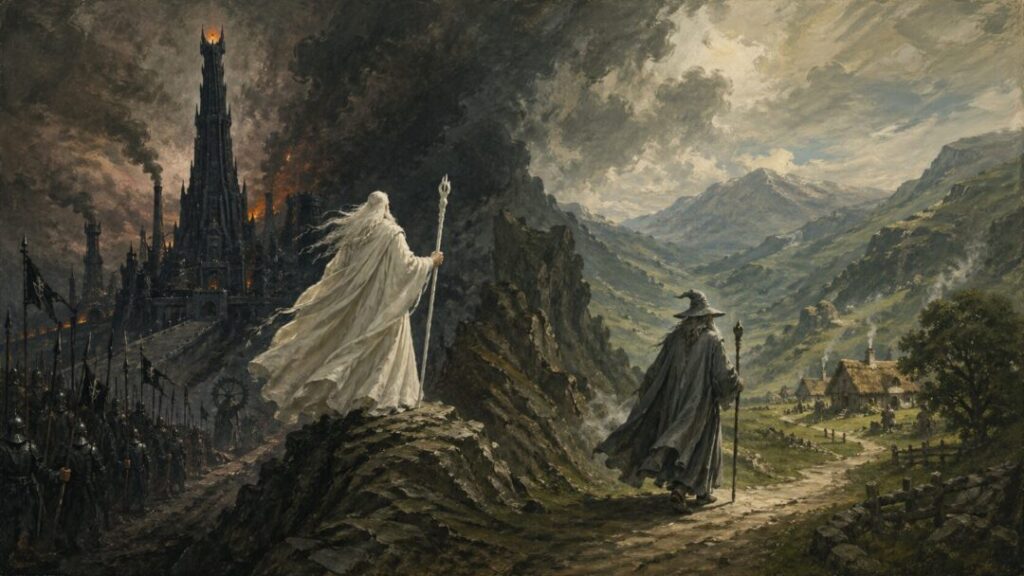
Saruman gathered information, influence, and eventually military strength. He settled in Orthanc. He became increasingly concerned with devices, plans, and control. He looked at the weakness of others and concluded that they needed direction from above.
Gandalf worked differently.
He kindled courage. He befriended the small and overlooked. He trusted pity where Saruman trusted calculation. He did not dominate the Free Peoples into victory. He helped them become brave enough to choose it.
This does not mean Gandalf was passive. He labored, warned, fought, planned, and suffered. But he never tried to become the master of Middle-earth.
That is why he succeeds where Saruman fails.
Not because he has more raw power.
Because he remains faithful to the mission.
Saruman’s Fall Was Not Inevitable
It is important not to make Saruman’s fall too simple.
He was not sent as a trap. He was not doomed from the beginning. The texts do not present him as secretly evil from the moment he arrived in Middle-earth.
His fall is moral, and therefore tragic.
He had a purpose. He had wisdom. He had authority. He had the chance to serve. But he slowly turned from service toward possession.
Even his jealousy of Gandalf reveals this inward turn. When Círdan gave Gandalf the Red Ring, Narya, Saruman later came to resent it. That resentment did not create his fall by itself, but it exposed something already dangerous in him: the inability to rejoice that another might be trusted for the good of the mission.
Saruman wanted to be first.
And eventually, being first mattered more to him than being faithful.
The Meaning of Saruman’s Mission
So why was Saruman sent to Middle-earth?
He was sent to help the Free Peoples resist Sauron.
He was sent as one of the Wise.
He was sent as a counsellor, not a king.
He was sent with knowledge that could have served the cause of freedom.
He was sent to oppose the misuse of power without misusing power himself.
That final point is the key.
Saruman’s mission was not only strategic. It was moral.
He was placed in a world threatened by domination, and he was asked to resist domination without becoming its mirror. His tragedy is that he saw the danger clearly enough to imitate it.
He looked at Sauron and did not merely think, “This must be defeated.”
He began to think, “This can be used.”
And in Middle-earth, that is the beginning of ruin.
Why Saruman’s Story Still Matters
Saruman’s fall is not just the story of a wizard who chose the wrong side.
It is the story of wisdom without humility.
Knowledge without obedience.
Power without pity.
Order without love.
He was sent to Middle-earth because the world needed guidance against Sauron. But his own story reveals why guidance had to be humble. The greatest danger was never only Sauron’s armies. It was the idea that the methods of the Enemy could be turned toward good if only placed in wiser hands.
Saruman believed he could master that idea.
He could not.
In the end, he became smaller than the mission he had been given. The White Wizard became Saruman of Many Colours, then a bitter voice in a ruined tower, then a petty tyrant in the Shire, still trying to dominate something even after his great designs had collapsed.
That is the dark brilliance of his story.
Saruman was not sent because he was evil.
He was sent because he was great enough to help.
And he fell because he chose to be great in the wrong way.
Sources & Notes
- J.R.R. Tolkien, Unfinished Tales, “The Istari” — gives the Wizards as emissaries from the Lords of the West, Maiar sent in humble form to counsel and encourage resistance to Sauron rather than rule by force.
- J.R.R. Tolkien, Unfinished Tales, “The Istari” — identifies Saruman/Curumo as connected with Aulë and as the chief figure among the Istari who came to Middle-earth.
- J.R.R. Tolkien, The Silmarillion, “Valaquenta” — notes that Sauron was originally one of the Maiar of Aulë before his corruption by Morgoth, supporting the craft/order parallel with Saruman.
- J.R.R. Tolkien, The Lord of the Rings, Book II, Chapter 2, “The Council of Elrond” — Gandalf describes Saruman as chief of his order and head of the Council, then recounts Saruman’s Ring-lore, jealousy, and desire to wield the Ring.
- J.R.R. Tolkien, The Letters of J.R.R. Tolkien, Letter 131 — explains Sauron’s drive toward rule, order, and domination, giving useful storycraft context for why Saruman’s imitation of those methods is a moral failure.