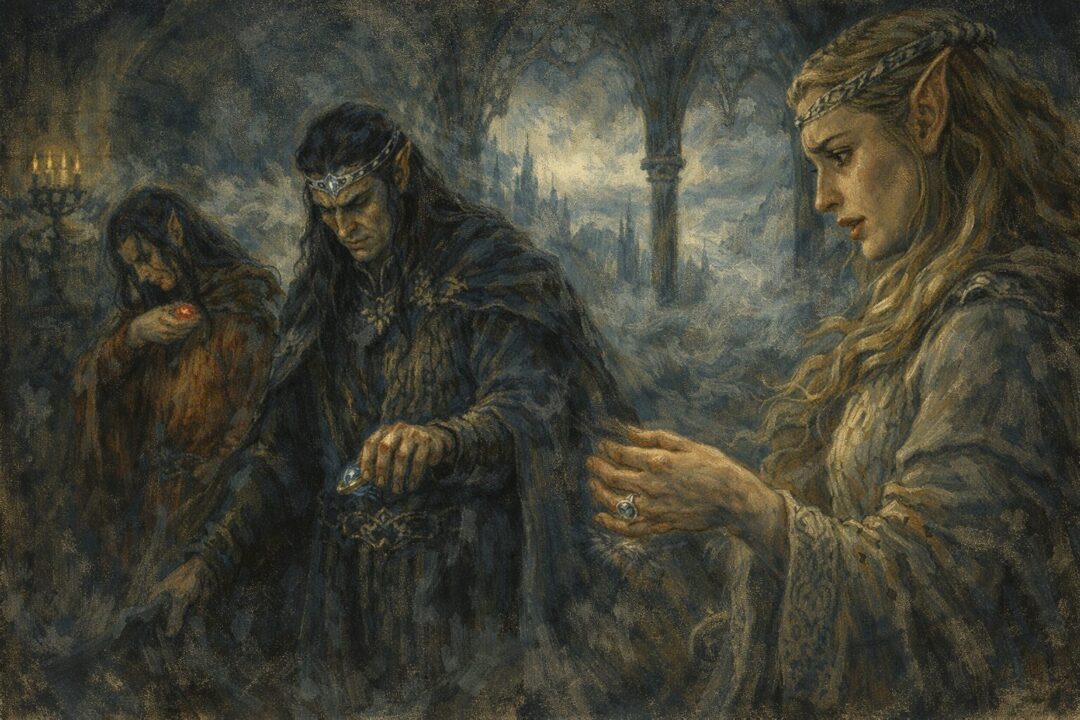
At first glance, the answer seems obvious.
The One Ring was made to rule the others.
Sauron forged it for domination.
The Three were still bound to it.
So if Sauron had won—especially if he had regained the One—wouldn’t the Three simply have become his?
That is the common assumption.
But the texts are more exact than that, and more interesting.
They do not say that the Three were independent of Sauron. They were not.
They do not say that their bearers were safe if he recovered the One. They were not.
They do not even say that the works achieved through the Three could survive his final triumph. They could not.
What they do say is narrower—and that narrower point changes everything.
The Three could be exposed. Their works could be undone. Their wielders could be laid bare.
But the Three were never truly his in the way the other Rings were.

The first distinction: the Three were not made by Sauron
This is where the whole question begins.
The Three were forged by Celebrimbor alone. The tradition preserved in the ring-lore is explicit that Sauron never touched them. That does not mean they were wholly outside his system, because the craft behind them still grew out of the knowledge he had brought to Eregion. But it does mean there was a real difference between the Three and the Rings that came more directly under his hand.
That difference is easy to flatten if you summarize too quickly.
“Subject to the One” is true.
“Made by Sauron” is not.
And the texts keep those two ideas separate for a reason.
Elrond says as much at the Council: the Three were not made by Sauron, nor did he ever touch them. He goes on to describe their purpose in terms that matter just as much as their origin. They were not made as weapons of war or conquest. Their makers desired understanding, making, healing, and preservation.
That is already enough to complicate the usual picture.
A ring can be linked to Sauron’s great device of domination without becoming identical in purpose to the One.
And the Three never stop being Three.
The Elves understood the danger immediately
One of the most important details in the ring-history is also one of the easiest to overlook.
Sauron did not spend centuries secretly controlling the bearers of the Three while they continued to use them unsuspectingly.
The moment he first set the One Ring on his finger, the Elves perceived him. They understood his intent. They took off their rings. They hid them.
That means Sauron’s original design failed at the very point where the Three were concerned.
He had hoped to dominate all the Ring-makers and govern what they wrought. But the Elves were aware too quickly, and the Three disappeared from his reach before he could use that mastery in the simple, direct way many readers imagine.
This matters because it shows the limit of his success.
The Three were within the architecture of the Rings of Power.
They were not outside the danger.
But they were also never captured in the decisive instant that would have turned them into openly enslaved instruments.
Sauron wanted them badly. He desired to possess the Three above all the others. Yet the traditions also emphasize that he never found them.
So from the start, his relation to the Three is defined by frustration.
He built the trap.
They stepped out of it.
And after that, everything becomes more indirect.

What “subject to the One” actually meant
This is the center of the issue.
If the Three were unsullied in the sense that Sauron never touched them, why were they still dangerous to keep? Why did the Wise fear what would happen if he recovered the One?
Because being outside his hand was not the same as being outside his power.
The Three had been made with an art that belonged to the same larger ring-lore. They were bound into the structure that the One was created to dominate. That is why the Elves dared not use them openly while Sauron held the Ruling Ring.
But the canon language about that domination is careful.
Elrond does not say: if Sauron regains the One, then the Three will become ordinary tools of his conquest.
He says something more exact: all that has been wrought by those who wield the Three will turn to their undoing, and their minds and hearts will become revealed to Sauron, if he regains the One.
That is a remarkable phrasing.
The emphasis falls on revelation, exposure, and reversal.
Not: the Three become Nazgûl-rings for Elves.
Not: Sauron suddenly wears the Three and uses them according to their native power.
Not: their essential purpose is converted into his own.
Instead, what had been preserved through them becomes vulnerable. Their hidden labor becomes the means of their undoing. Their bearers cease to be concealed.
In other words, Sauron’s mastery works through dependence.
The Three sustained realms like Lórien and Rivendell in ways the texts link to preservation, warding, and resistance to weariness. If he recovered the One, that whole achievement would be opened to his sight and pressure. But that is not the same thing as saying he could make the Three become what they were never made to be.
Why the Three were never rings of domination
This is the point many summaries skip.
The Three are powerful, but their power is not conquest.
Elrond’s description is unusually clear: they were not made as weapons of war or conquest. Their proper sphere is preservation and healing, not domination or amassed wealth.
That does not make them harmless, and it certainly does not make them morally simple.
There is sorrow bound up in them. There is postponement in them. There is an attempt to hold back change, to preserve beauty unstained in a world that is moving on. The texts do not hide that melancholy. Galadriel herself makes it plain that if the One is destroyed, Lórien will fade and the tides of Time will sweep it away.
But their orientation still matters.
The Nine work toward enslavement.
The Seven inflame wealth and possessiveness in Dwarves, though not in the same way as Men.
The Three preserve.
So even in the counterfactual where Sauron wins, his victory does not erase the nature of the Three.
He could break what they protect.
He could uncover those who use them.
He could render their long labor futile.
But there is no textual basis for saying he could finally make Nenya, Vilya, and Narya into rings whose own inner office was domination.
That is exactly the line the canon does not cross.
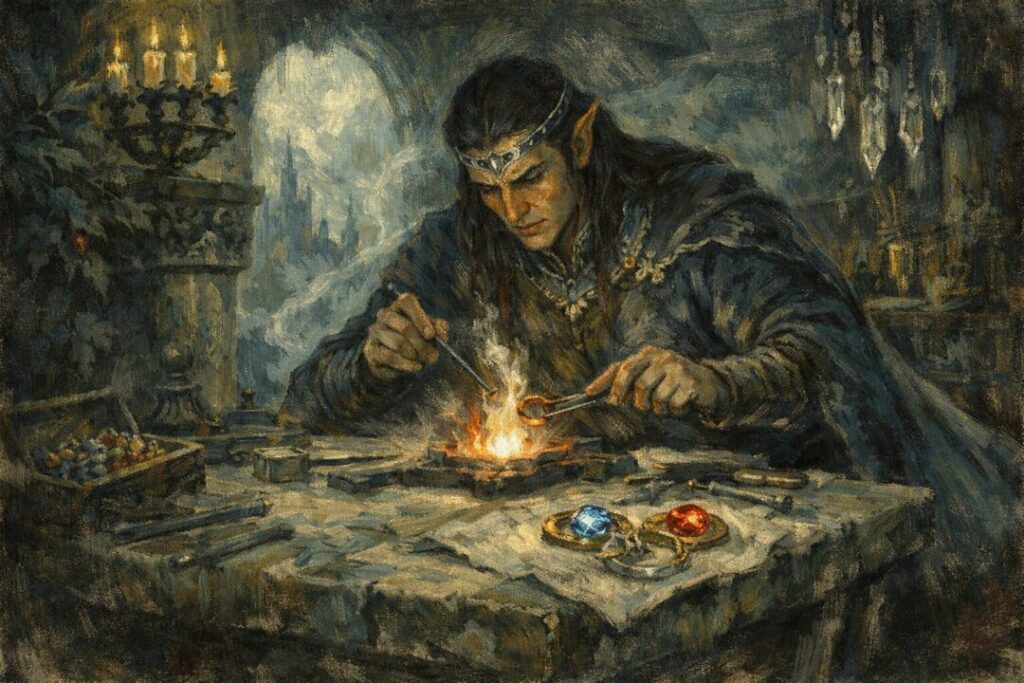
If Sauron had won the war without the One
This is where the title question becomes sharper.
Suppose Sauron had crushed the West militarily but had not yet recovered the One Ring.
Could he then truly control the Three?
The safest answer is no—or at least, not in the fullest sense the phrase suggests.
The texts show that Sauron never discovered where the Three were hidden, and that they remained concealed from him. Without the One in his possession, the direct mode of mastery described by Elrond is not in force. He could defeat kingdoms, overrun lands, and reduce the last free peoples to ruin, but that is not identical to mastering the Three themselves.
He could force the bearers into retreat.
He could lay siege to their realms.
He could make continued resistance impossible.
But military victory alone is not the same as ring-mastery.
That distinction matters because the Three are not just treasure objects. They are bound up with hidden stewardship. Their greatest effects are subtle: preservation, resistance to decay, a kind of sheltering of memory and beauty. A conqueror can destroy such things without ever fully possessing the instruments that upheld them.
That is part of the tragedy.
Sauron does not need to “use” the Three to devastate what they sustain.
If Sauron had regained the One
This is the darker scenario, and the texts are plainer here.
If Sauron recovers the One, then the bearers of the Three are laid open. What they have made becomes the avenue of their undoing. Their minds and hearts are revealed to him. Galadriel’s warning to Frodo points in the same direction: if the quest fails, Lórien is laid bare to the Enemy.
That is real mastery, but it is still not quite the same thing as “the Three become his” in the simplistic sense.
What he gains is overriding supremacy over a system to which they belong.
What he gains is access, exposure, and reversal.
What he gains is the collapse of the hidden defenses sustained by the Elven Rings.
But the Three remain, even then, the Three: unsullied in origin, not made by him, not fashioned for war, not described as direct engines of domination.
He can make their use fatal.
He can make their achievements perish.
He can make their keepers visible.
That is terrible power.
It is also a more limited and more precise form of control than readers often assume.
The real answer hidden inside the ring-lore
So why could Sauron never truly control the Three Rings, even if he won the war?
Because the texts never present the Three as objects he could simply absorb into his will in the same manner as the others.
They were tied to his greater design, yes.
They were vulnerable to the One, yes.
Their bearers would have been in dreadful danger if he regained it, yes.
But they were not made by him. He never touched them. Their purpose was different. And the Elves escaped the first and most direct act of domination by perceiving him at once and removing them from use.
That leaves Sauron in a position that is stronger than mere military conquest, but weaker than absolute authorship.
He can expose.
He can corrupt by supremacy.
He can undo.
What he cannot do, in the strict sense, is make the Three cease to be what they are.
And that is why the fate of the Elven Rings is one of the saddest subtleties in the legendarium.
They are not saved by Sauron’s defeat.
They are only spared his domination long enough to fade with the passing of their age.