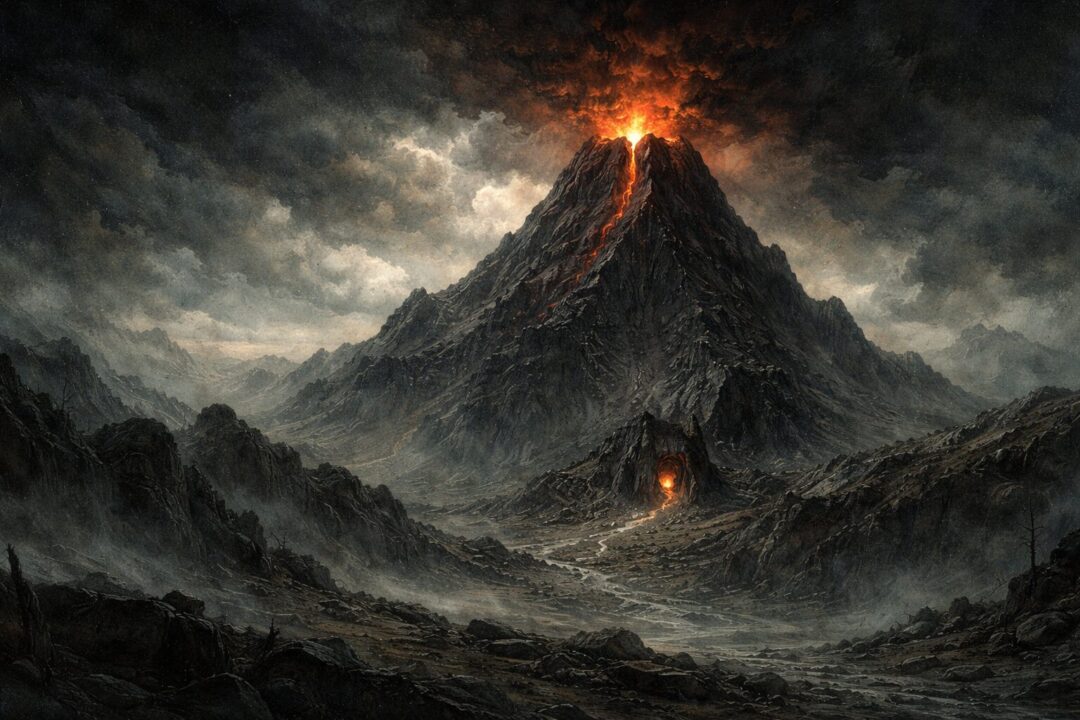
At the center of Mordor stands a mountain that decides the fate of the world.
Mount Doom—called Orodruin in the ancient tongue—is not merely another volcanic peak in a land of ash and fire. It is the place where the One Ring was forged, where Sauron bound much of his own power into a single object, and the only place where that Ring could ever be destroyed.
And yet, when the final moment arrives—when Frodo and Sam climb the slopes and pass into the Sammath Naur—they encounter no great watch.
No fortress commands the entrance.
No army stands ready to intercept them.
No permanent guard waits at the Crack of Doom.
For a Dark Lord defined by control, surveillance, and domination, this absence feels almost impossible to explain.
At first glance, it looks like a catastrophic oversight.
But Sauron did not fail to guard Mount Doom because he was careless, distracted, or foolish.
He failed because he was incapable of imagining the kind of threat that would undo him.
Sauron’s Mind Is Built on Domination
To understand why Mount Doom was left unguarded, we must first understand how Sauron sees the world.
From his earliest existence, Sauron understands reality as a hierarchy of power. Order, in his view, is imposed from above. The strong rule. The weak obey. Harmony comes through control, not consent.
This worldview does not change across the Ages.
When Sauron rises again in the Third Age, every one of his strategies reflects this same belief:
- He builds vast armies, not alliances of equals.
- He rules through fear, not loyalty.
- He seeks to dominate wills rather than persuade hearts.
In Sauron’s understanding, power is not merely a tool. It is identity itself.
This is why the Ring matters so deeply to him.
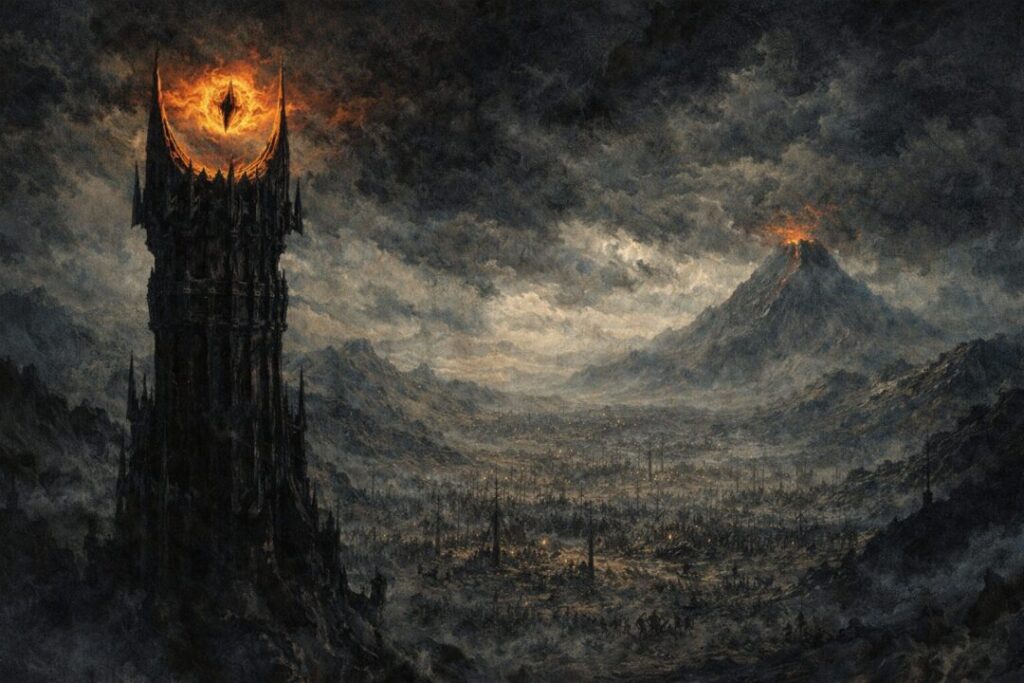
The Ring Is Not an Object to Sauron — It Is Himself
The One Ring is not simply a weapon that Sauron carries. It is an extension of his being.
By pouring much of his native power into the Ring, Sauron does something unprecedented: he externalizes himself. His will, his authority, and his capacity to dominate others become bound to a physical object.
This act has consequences.
As long as the Ring exists, Sauron can endure—even if his body is destroyed. But the Ring is also now inseparable from his sense of self. To imagine its destruction is to imagine his own diminishment, perhaps even his unmaking.
This is why the idea of destroying the Ring is not merely unlikely to Sauron.
It is incomprehensible.
The Idea of Destroying the Ring Is Unthinkable to Him
The crucial point is not that Sauron believed the Ring was safe.
It is that he could not conceptually process the idea of its destruction.
In Tolkien’s moral universe, evil consistently equates power with existence. To lose power is to lose meaning. To give up power willingly is, in a sense, to cease to be.
Sauron cannot imagine anyone choosing such a path.
So when he considers his enemies, he sees only two possibilities:
- They will claim the Ring and challenge him openly.
- They will fail to use it and be crushed.
A third option—quietly carrying the Ring back into Mordor in order to unmake it—does not exist within his moral imagination.
Even those who oppose him most fiercely, in his mind, are still driven by the same hunger for domination that defines him.
This assumption shapes every decision he makes.

Why Guarding Mount Doom Didn’t Make Sense to Him
From Sauron’s perspective, Mount Doom is not a vulnerability.
It is a symbol of ownership.
He forged the Ring there. He mastered the fire. The mountain itself answers to his will. Why would he guard a place that no enemy would ever willingly approach with destructive intent?
To Sauron, the only beings capable of reaching Mount Doom are great lords, powerful warriors, or figures of immense authority.
And such figures, in his experience, do not seek annihilation of power.
They seek to replace him.
Guarding Mount Doom against destruction would require Sauron to accept that someone might choose humility over dominion. That someone might willingly surrender power rather than seize it.
This is not merely unlikely to him.
It is impossible.
The Eye Watches Strength, Not Smallness
Sauron’s attention is always drawn outward, toward visible power.
He watches Gondor.
He watches the movements of armies.
He watches the mustering of strength in the West.
His Eye searches for threats that resemble himself.
This is why he fears Aragorn—not because Aragorn secretly carries the Ring, but because he acts like someone who might claim it.
This is why he obsesses over Minas Tirith—because it stands openly against him as a symbol of resistance and authority.
What he does not watch for is quiet persistence.
He does not watch for small figures moving unnoticed through ash and shadow. He does not imagine that the greatest threat to him would arrive not with banners and armies, but with exhaustion, fear, and fragile resolve.
By the time Sauron realizes that the Ring is inside Mordor, carried by beings he never truly considered, the end is already inevitable.
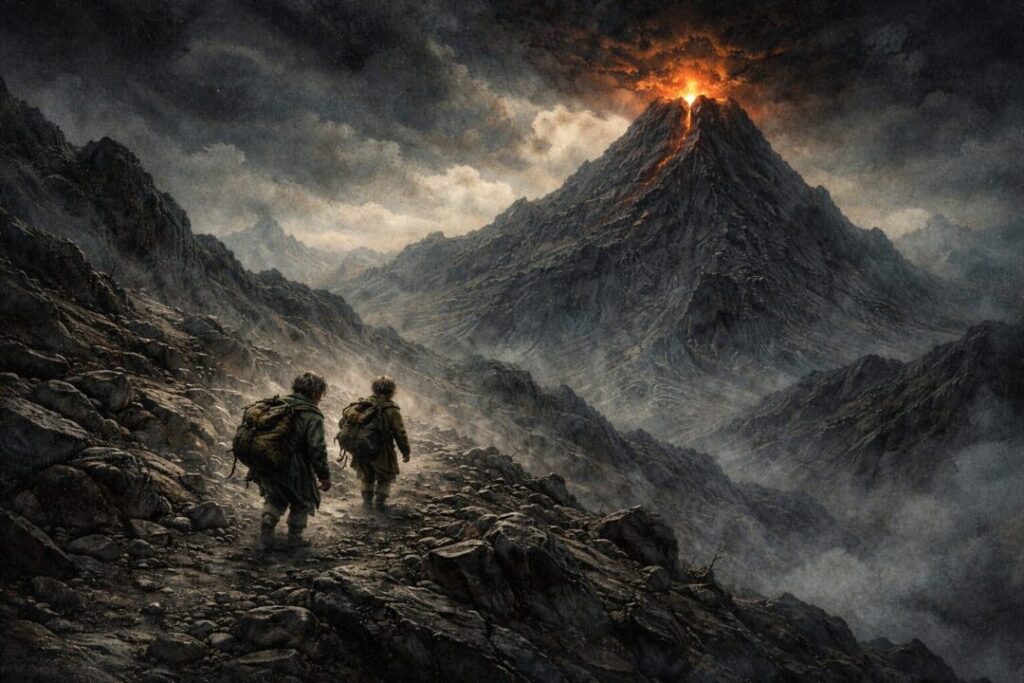
Frodo, Sam, and the Weapon Sauron Cannot See
Frodo Baggins and Samwise Gamgee succeed not because they are strong, clever, or immune to temptation.
They succeed because they embody a form of resistance Sauron cannot perceive.
They do not seek mastery.
They do not seek glory.
They do not even fully understand the scale of what they are doing.
Their strength lies in endurance, loyalty, and a willingness to carry a burden without expecting reward.
To Sauron, such qualities are not threatening.
They barely register as meaningful at all.
Tolkien’s Deeper Theme: Evil Is Self-Blinding
This absence of guards at Mount Doom is not a plot hole.
It is a moral statement.
Throughout Tolkien’s world, evil is shown to be intelligent, strategic, and adaptive—but also deeply limited. Evil cannot imagine goodness as strength. It cannot conceive of renunciation as victory.
This is why evil repeatedly defeats itself.
Not because it lacks intelligence.
Not because it lacks power.
But because it cannot see beyond its own hunger for domination.
Sauron does not fail because he underestimates Hobbits.
He fails because he underestimates humility itself.
Why Mount Doom Remained Unguarded
Mount Doom stands unguarded not because Sauron forgot.
It stands unguarded because guarding it would require him to acknowledge a truth he cannot face: that the greatest threat to absolute power is the willingness to let power go.
To accept that truth would already be a kind of defeat.
And so the mountain waits.
The fire burns.
And the Dark Lord watches the wrong horizon until the very end.