
Throughout the history of Middle-earth, Sauron is defined by conquest. His rise is marked by the fall of kingdoms, the corruption of peoples, and the slow tightening of his grip on the world. Where he turns his attention fully, lands are broken, cities are ruined, and resistance is eventually crushed beneath overwhelming force.
From the drowning of Númenor to the long wars against Gondor, Sauron reshapes the map of Middle-earth through domination, siege, and terror. He does not hesitate to strike at centers of power when it suits his purpose.
And yet, one place stands out for what never happens.
Rivendell, the hidden valley ruled by Elrond, sits at the crossroads of the War of the Ring. It shelters the heir of Isildur. It houses ancient knowledge. It hosts the Council that decides the fate of the One Ring.
And still, Sauron never sends an army against it.
No siege is laid.
No host marches up the Bruinen.
No great assault is launched to wipe it from the map.
This absence is not an oversight in the story. It is a deliberate and revealing choice—one that exposes the limits of Sauron’s understanding of power.
Rivendell Is Not Invisible
Rivendell is often described as “hidden,” but this word can be misleading.
Hidden does not mean unknown.
Rivendell lies along ancient roads that once connected Arnor to the rest of the North. Rangers pass near it. Elves travel to and from it. Its name is spoken openly among the Wise, the Dúnedain, and the free peoples of the West.
Even Sauron’s servants come close.
During the hunt for the Ring, the Nazgûl ride openly through Eriador. They cross the Shire. They reach Weathertop. They pursue the Ring-bearer to the Ford of Bruinen itself—mere days from Rivendell’s heart.
If Sauron wished to locate Rivendell, he could.
If he wished to test its defenses, he could attempt it.
The fact that he does not tells us something important: Rivendell’s safety is not based on secrecy alone. It rests on something deeper.
Rivendell is not merely a military target. It is a spiritual stronghold.
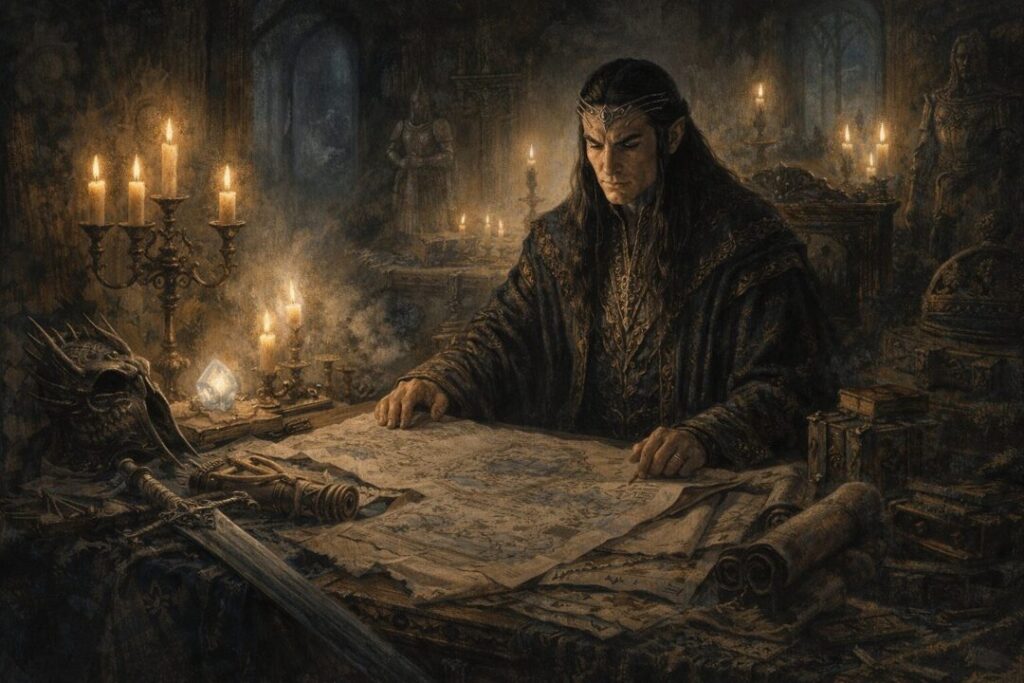
Elrond and the Weight of the Elder Days
To understand why Rivendell is different, we must understand who rules it.
Elrond is not simply an Elven lord guarding a peaceful refuge. He is a survivor of the First Age—born into the wars against Morgoth, shaped by the fall of Beleriand, and bound by blood to both Elves and Men.
Through him flow lineages that Sauron remembers all too well.
Elrond is descended from those who defied Morgoth at the height of his power. He bears the memory of battles fought when Sauron himself was only a lieutenant. His authority is not derived from armies or territory, but from history, wisdom, and continuity.
Rivendell reflects this nature.
It is sustained by arts older than Sauron’s dominion in Middle-earth—arts of preservation rather than conquest, healing rather than domination. Its power does not seek to expand. It seeks to endure.
This makes Rivendell difficult to confront directly.
An assault on Rivendell would not be swift.
It would not be quiet.
And it would not be cheap.
Such an attack would draw attention across the North, forcing Sauron to commit forces far from the centers of his power. Worse still, it could awaken responses from other ancient figures who prefer to remain in watchful restraint rather than open war.
Sauron understands these risks.
And he avoids them.
Sauron’s True Strategy: Control, Not Cost
One of the most misunderstood aspects of Sauron is the nature of his ambition.
Sauron does not seek symbolic victories. He does not wage war for glory, revenge, or spectacle. He seeks certainty.
Every conflict he initiates is meant to end decisively, with absolute domination and minimal long-term resistance. He prefers expansion to attrition, corruption to confrontation.
Rivendell offers him none of what he values most.
It does not control vital trade routes.
It does not command armies.
It does not rule over vast populations.
It does not possess industrial or military resources essential to victory.
Destroying Rivendell would be emotionally satisfying—but strategically inefficient.
More importantly, attacking it risks exposing a fundamental weakness in Sauron’s power: his inability to endure prolonged resistance without loss.
A costly siege in the far west would drain resources needed elsewhere—resources required to break Gondor, secure Mordor, and maintain pressure across multiple fronts.
Sauron avoids unnecessary risks. Rivendell is precisely that.
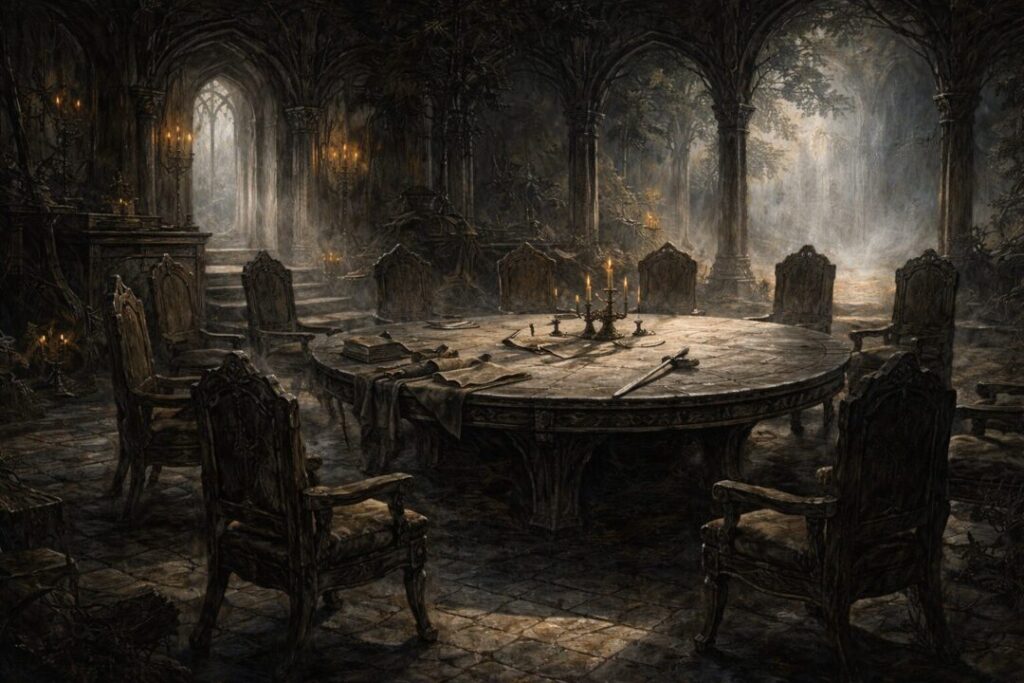
Rivendell’s Quiet Defiance
Rivendell does not challenge Mordor openly.
It does not raise banners.
It does not march hosts to war.
It does not proclaim defiance.
Instead, it waits.
Within its valley, knowledge is preserved that Sauron would rather see forgotten. Lineages are protected that threaten his long-term plans. Counsel is given freely, allowing the free peoples to act with clarity rather than despair.
This is Rivendell’s true danger.
Sauron’s greatest weapon is not the Orc or the Nazgûl. It is hopelessness. He wins by convincing his enemies that resistance is futile, that decline is inevitable, that the past is dead and cannot be reclaimed.
Rivendell quietly refutes this narrative.
It stands as living proof that memory endures, that ancient bonds still matter, and that wisdom can shape events without ever wielding a sword.
By ignoring Rivendell, Sauron believes he contains it.
In reality, he allows it to operate exactly as intended.
A Place of Counsel, Not Conquest
It is no accident that the most important decision of the Third Age is made in Rivendell—not Minas Tirith, not Lothlórien, not any seat of worldly power.
The Council of Elrond is not a war council. It is a council of restraint.
There, the greatest temptation—using the Ring as a weapon—is rejected. There, the idea of domination is refused. There, the fate of the world is placed in the hands of the small and overlooked.
This outcome would have horrified Sauron.
And yet, because Rivendell does not look like a threat, he allows it to exist.
This is his mistake.

A War Lost Without a Battle
When the One Ring is destroyed, Rivendell has not fired a single arrow at Mordor.
No army rides east from its valley.
No great deed of arms is recorded in its name.
And yet Sauron loses everything.
This is the ultimate irony of his strategy.
He avoids Rivendell because it cannot be conquered cheaply.
But by leaving it untouched, he allows it to become the place where his defeat is set in motion.
Sauron never attacked Rivendell directly—not because he was blind to its importance, but because he misunderstood the nature of the power that truly ends wars.
Power that preserves.
Power that advises.
Power that waits.
In a world where domination seems unstoppable, Rivendell proves that endurance, memory, and humility can still shape the fate of all things.
And that is precisely why it survives.