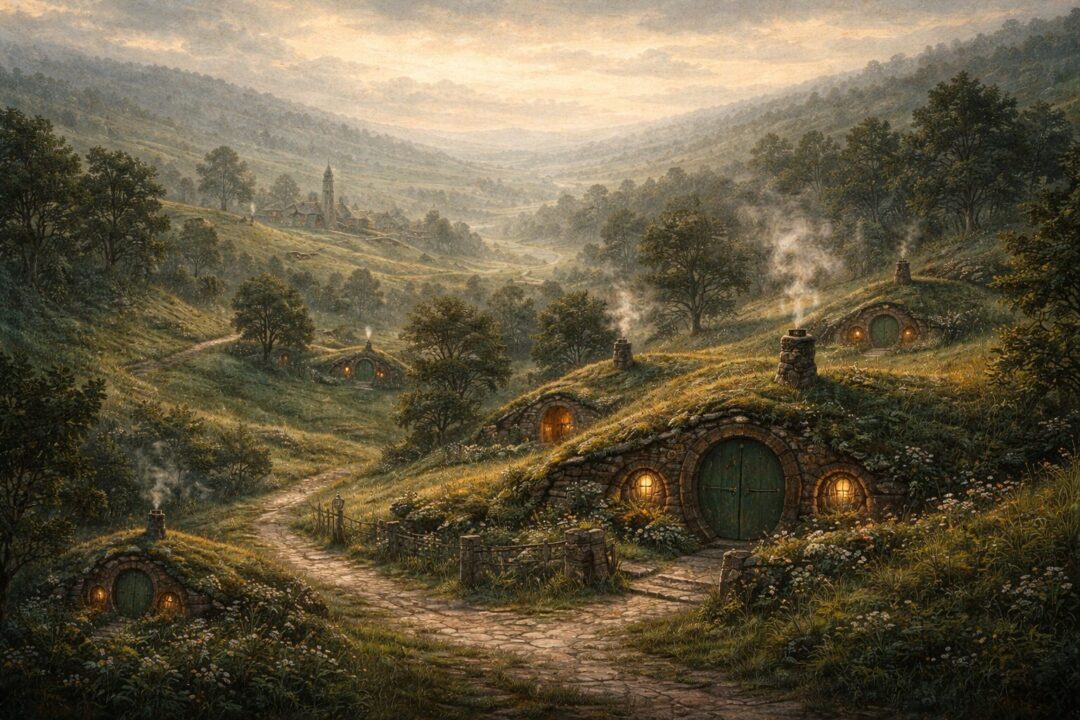
By the time the War of the Ring truly begins, Sauron’s shadow lies over nearly all of Middle-earth.
His armies march openly from Mordor. His allies stir in the East and South. His servants move without restraint across roads that were once safe. Long before the first great battles are fought, the Free Peoples already feel the pressure of his will—like a tightening grip, invisible but impossible to ignore.
And yet one place remains largely untouched.
The Shire.
To modern readers, this feels strange. The Shire is unfortified, lightly populated, and politically irrelevant. It has no standing army and no alliances worth mentioning. It produces no great warriors, no powerful lords, no weapons of renown. If Sauron wished to break the will of the West—or force the One Ring into the open—destroying the Shire outright would seem an obvious move.
But Sauron never does this.
Not because he cannot.
But because he does not think to.
That distinction matters.
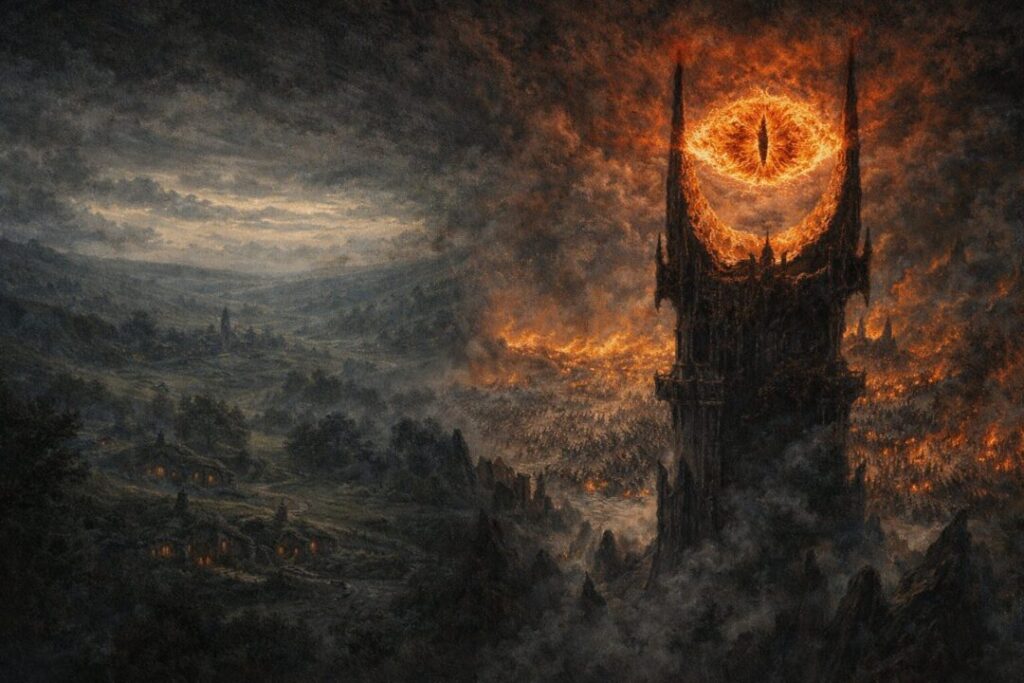
What Sauron Actually Knows
A common assumption is that Sauron simply did not know where the Ring was until it was too late. This is only partially true.
By the late Third Age, Sauron has learned two crucial facts through long searching and brutal interrogation:
- The Ring was taken by someone named Baggins
- That person comes from a land called the Shire
This knowledge is significant. It is enough to send the Nazgûl north in secrecy. It is enough to place Bree under suspicion. It is enough that the Dúnedain Rangers quietly increase their watch over the borders of the Shire, sensing that something dark is moving nearby.
But it is not enough to convince Sauron that the Shire itself is strategically important.
Why?
Because Sauron does not understand why the Ring would be there—or why it would stay there.
Sauron’s Fatal Assumption About Power
Sauron’s greatest weakness is not arrogance in the simple sense. It is projection.
He assumes that others desire power in the same way he does.
To Sauron, the One Ring exists to be used.
Not destroyed.
Not hidden indefinitely.
Used.
And not by just anyone—but by someone capable of wielding it.
This assumption governs every major decision he makes during the War of the Ring.
He expects the Ring to surface in Gondor, where desperation and pride might drive a ruler to challenge him. He fears that a powerful lord—perhaps a steward, a king, or even a Wizard—might claim the Ring and turn it against him.
He does not expect the Ring to remain with Hobbits.
To Sauron, Hobbits are beneath serious consideration. They have no history of conquest, no tradition of dominion, no interest in shaping the world beyond their own borders. Their culture is built on comfort, routine, food, gardens, and local concerns—precisely the opposite of what the Ring feeds upon.
In Sauron’s worldview, power flows downward from strength, authority, and fear.
The Shire has none of these.
So he looks past it.

Why Destroying the Shire Would Have Backfired
Even if Sauron had suspected the Shire more strongly, outright destruction would have worked against his goals.
The success of the Ring-quest depends entirely on secrecy—on movement without drawing attention, on the enemy not knowing where to look or when to strike. Sauron understands this principle instinctively, which is why he acts through shadows, servants, and indirect pressure rather than overwhelming force in the early stages.
A full assault on the Shire would have shattered that balance.
It would have alerted Rivendell immediately.
It would have drawn the attention of the Wise far earlier than Sauron wished.
It would have forced the Ring-bearer to flee in panic—perhaps westward, perhaps beyond Sauron’s reach entirely.
Worst of all, it would have confirmed that the Shire mattered.
The Nazgûl are used carefully for this reason. They search, intimidate, and probe—but they do not conquer. They ask questions. They spread fear. They gather information. Sauron wants the Ring delivered to him, not lost in chaos or destroyed in despair.
Open devastation risks losing control of the situation.
And Sauron values control above all else.
The Shire as a Blind Spot
More than any tactical reason, the Shire survives because it represents something Sauron fundamentally cannot comprehend.
A society content without domination.
A people uninterested in rule.
Lives lived without ambition for power or legacy.
To Sauron, this kind of existence is not merely unimpressive—it is meaningless.
He cannot imagine that such a place could produce the one thing capable of undoing him: resistance without force. A willingness to carry a burden without seeking mastery. The strength to endure without desiring control.
This is why Hobbits succeed where armies fail.
Not because they are stronger.
But because they are invisible to a mind obsessed with dominance.
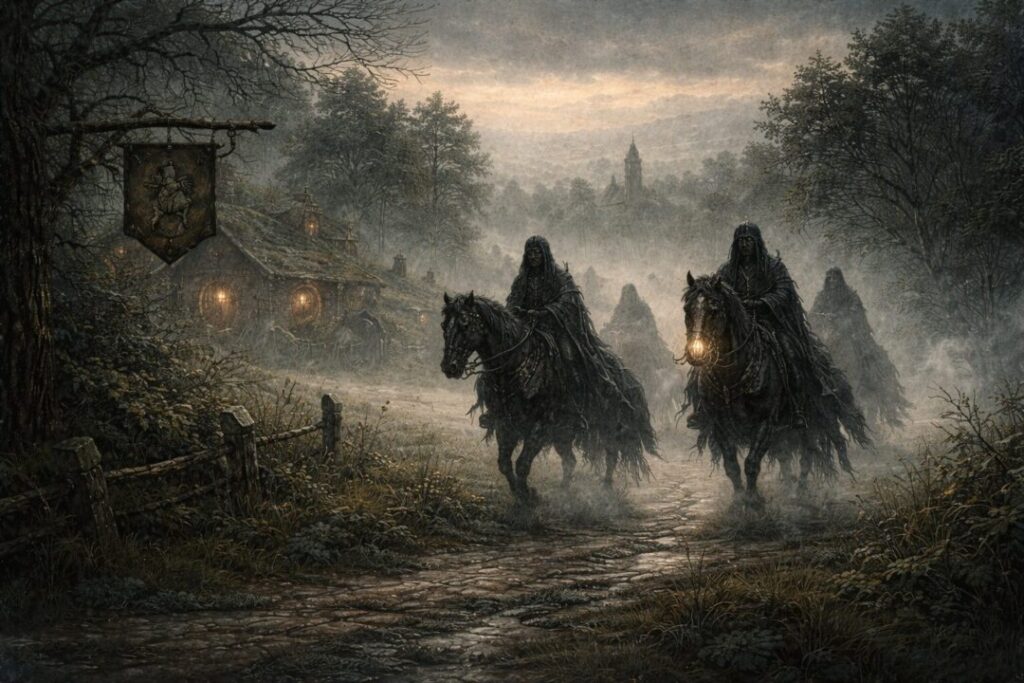
The Irony at the Heart of the War
Sauron is not defeated by a rival Dark Lord.
Not by a great warrior.
Not by superior military strategy.
He is defeated because he misunderstands the nature of his opposite.
He assumes goodness must be loud to matter.
That power must announce itself.
That threats always come from above—not below.
The Shire is spared not by protection, but by contempt.
And in the end, that contempt costs him everything.
A Dark Mirror: Saruman and the Scouring of the Shire
There is a bitter irony in the fate of the Shire after Sauron’s fall.
Sauron never destroys it—but Saruman nearly does.
Unlike Sauron, Saruman has lived among the Free Peoples. He understands Hobbits just enough to exploit them. When he turns his attention to the Shire, he does not attack it with armies—but with bureaucracy, fear, and quiet corruption.
And this reveals something crucial.
Sauron ignores the Shire because he cannot imagine its importance.
Saruman targets it because he understands its vulnerability.
Yet even then, the Shire survives—not because outside powers save it, but because Hobbits rise to defend themselves when they must.
This final act reinforces the same truth Sauron never learned.
Power does not always look like power.
Why This Choice Matters
Sauron’s decision not to destroy the Shire is not a narrative oversight or a convenient omission. It is a thematic cornerstone of the story.
Middle-earth does not rise or fall based on who commands the largest army. It turns on who is willing to carry responsibility without seeking domination—and who is capable of resisting power rather than claiming it.
Sauron never destroys the Shire because doing so would require him to see value where he believes none exists.
And that blindness—not strength, not armies, not cruelty—is what finally destroys him.