
At first glance, it seems obvious what Sauron should have done.
When the One Ring was found, his entire war effort pivoted around its recovery. The Nazgûl were sent out immediately. Armies were mobilized. Mordor stirred in full force. The Dark Lord’s attention, which had long been divided between many threats, narrowed to a single point.
So why, when Frodo Baggins carried the Ring across Middle-earth, did Sauron never issue a clear command to take him alive?
The short answer is unsettling:
Sauron did not believe Frodo mattered.
And the longer answer reveals one of the most important psychological limits in all of The Lord of the Rings—a limit that ultimately decides the fate of the world.
Sauron’s Objective Was the Ring—Not the Ring-Bearer
Throughout The Lord of the Rings, Sauron’s actions consistently show that his focus is singular.
He wants the Ring.
Not information.
Not prisoners.
Not negotiation.
This distinction matters, because it explains the behavior of his servants at every stage of the hunt.
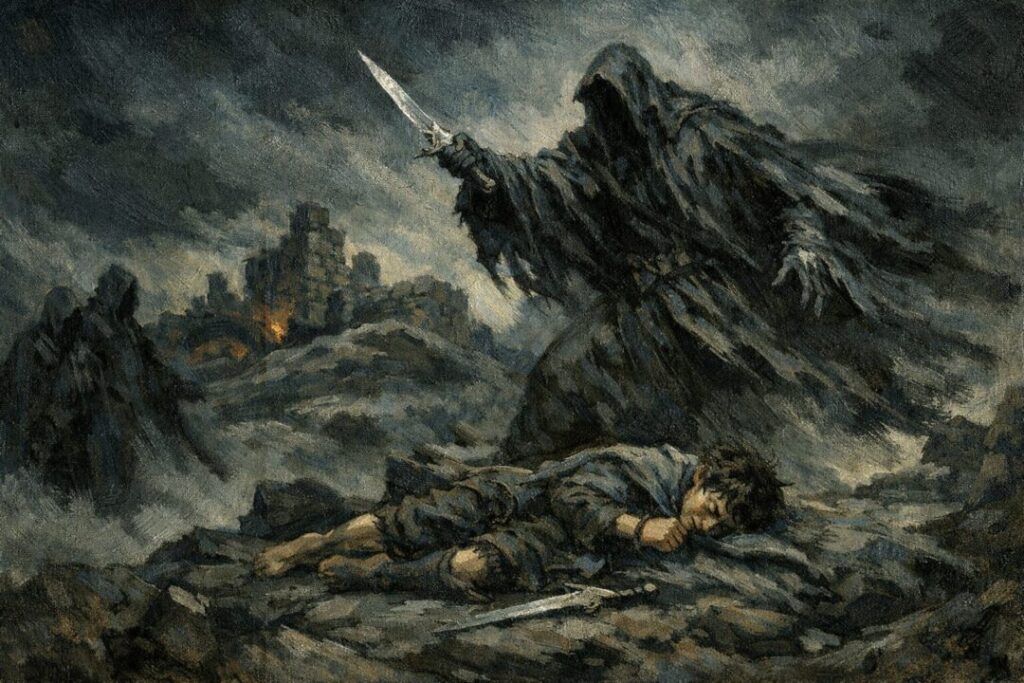
When the Nazgûl search the Shire, they threaten, bribe, and intimidate the Hobbits they encounter—but when violence becomes expedient, they do not hesitate. There is no attempt at careful capture. At Weathertop, the Witch-king does not seek to take Frodo alive. He stabs him outright with a Morgul blade, an act that would have condemned Frodo to a wraith-like existence had Elrond not intervened.
Nothing in the text suggests this was a mistake.
Later, during the breaking of the Fellowship at Amon Hen, Orcs attempt to kill the Ring-bearer amid the confusion of battle. Their orders focus on capturing Hobbits for Saruman—but Frodo, invisible and isolated, is nearly slain rather than secured.
At Cirith Ungol, Frodo survives only by accident. Shelob’s sting leaves him paralyzed, and the Orcs who find him assume he is dead. Even then, Frodo’s life is preserved not because it is valued, but because the Ring itself must be accounted for.
At no point does the narrative indicate a standing command to preserve Frodo’s life.
This absence is not an oversight in the story. It is a reflection of how Sauron understands the world.
The Assumption Sauron Never Questions
Sauron cannot conceive of anyone seeking to destroy the Ring.
This is not speculation. It is directly implied—and repeatedly reinforced—by Gandalf’s explanations throughout the story. Again and again, the Wise state that Sauron believes his enemies will attempt to use the Ring against him.
That belief governs every strategic decision he makes.
When Aragorn reveals himself through the palantír, Sauron immediately assumes that Aragorn possesses the Ring and intends to wield it. The idea that Aragorn might deliberately reveal himself without the Ring never enters Sauron’s calculations.
When armies march from the West toward the Black Gate, Sauron assumes it is a diversion—an attempt to draw his attention away while the Ring is used elsewhere. He responds exactly as Gandalf predicts, emptying Mordor to meet the challenge.
When the Ring disappears from sight entirely, Sauron assumes it is being hidden—temporarily—until its bearer is ready to strike.
What Sauron never imagines is refusal.
The Ring is an extension of his own will. To him, power exists to be exercised. Domination is its natural and inevitable end. The idea that someone would bear the Ring only to unmake it does not register as a meaningful possibility.
This is not merely arrogance.
It is a profound moral blindness.
Why a Dead Ring-Bearer Still Serves Sauron
From Sauron’s perspective, Frodo’s death is not a failure.
If Frodo dies, the Ring does not. It remains in Middle-earth, bound by its nature to endure. Someone will eventually find it. Someone will be tempted. And when the Ring is used—even briefly—Sauron will know.
Time favors him.
Sauron is immortal. His patience stretches across centuries. A lost Ring is an inconvenience; a destroyed Ring is unthinkable. As long as the Ring exists, Sauron believes his victory is inevitable.
This is why preserving the Ring-bearer’s life holds no strategic value.
A living Ring-bearer who refuses to use the Ring, avoids attention, and moves without ambition is vastly more dangerous—but only if one believes such a person could exist.
Sauron does not.
Thus, killing Frodo is acceptable. Losing track of him is acceptable. Even allowing the Ring to pass temporarily beyond reach is acceptable.
Only one outcome is intolerable.
And that outcome never truly enters Sauron’s mind.
Frodo’s Power Is His Insignificance
One of the most consistent themes in The Lord of the Rings is that evil is often defeated not by strength, but by limitation.
Sauron’s vast intelligence, ancient experience, and strategic brilliance all fail him at a single point: empathy. He cannot imagine choosing weakness. He cannot imagine surrendering power. He cannot imagine humility as a weapon.
Frodo is dangerous precisely because he is small.
Not physically small—but spiritually unassuming.
He does not seek conquest. He does not desire mastery. He does not even fully understand the forces at work around him. He seeks only to carry out a task placed upon him, despite fear, pain, and uncertainty.
That kind of obedience does not register as power in Sauron’s worldview.
And so Frodo becomes invisible.
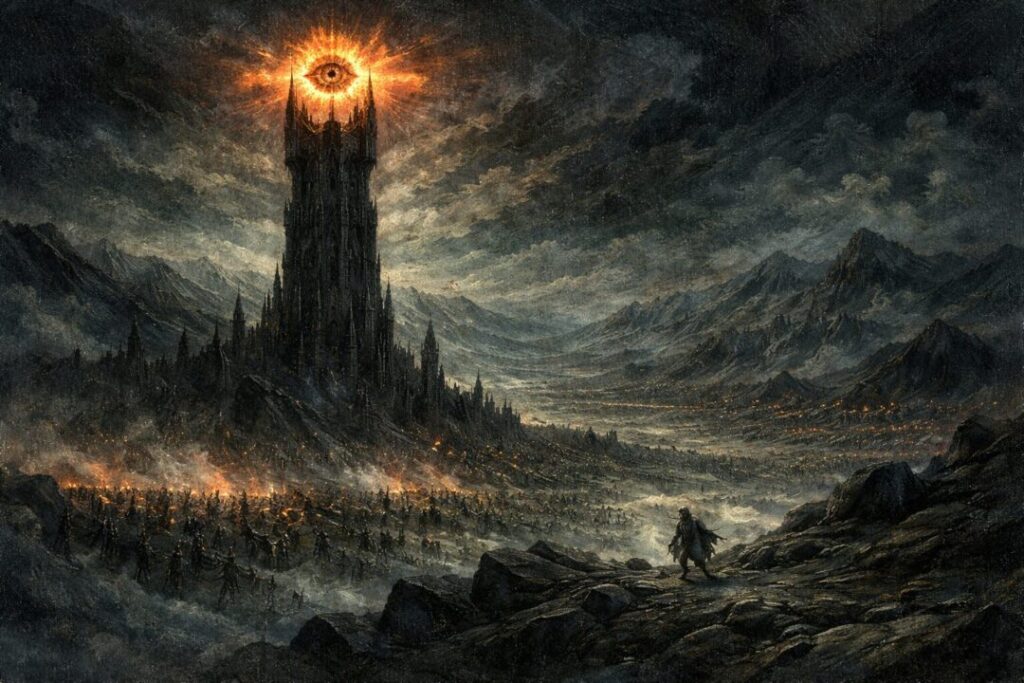
This is why Sauron watches kings and captains while ignoring Hobbits. This is why his Eye searches battlefields and palaces, not dusty roads and forgotten paths. This is why Mount Doom itself is left unguarded—not because Sauron is careless, but because he cannot imagine an enemy approaching it without the intent to claim the Ring.

Not a Tactical Error—but a Philosophical One
It is tempting to frame Sauron’s defeat as a series of mistakes.
Why didn’t he order Frodo captured?
Why didn’t he guard Mount Doom?
Why didn’t he imagine the obvious?
But these are modern questions applied to a character written with remarkable internal consistency.
Sauron does not lose because he is foolish.
He does not lose because he underestimates military strength.
He does not lose because of poor intelligence.
He loses because he is incapable of imagining goodness without domination.
In Sauron’s mind, power must always seek expression. Authority must always enforce itself. Victory must always be visible and overwhelming.
Anything else is meaningless.
That is the flaw at the heart of his being—and it cannot be corrected by strategy.
The Quiet Triumph of the Ring-Bearer
Frodo does not defeat Sauron by strength.
He does not outwit him in strategy.
He does not confront him at all.
He simply does something Sauron cannot understand.
He carries the Ring without claiming it.
He resists domination without seeking power.
He endures without expecting victory.
In the end, Sauron is not overthrown by a rival lord or a greater force.
He is undone by a possibility he never allowed himself to imagine.
And in Middle-earth, that is enough.