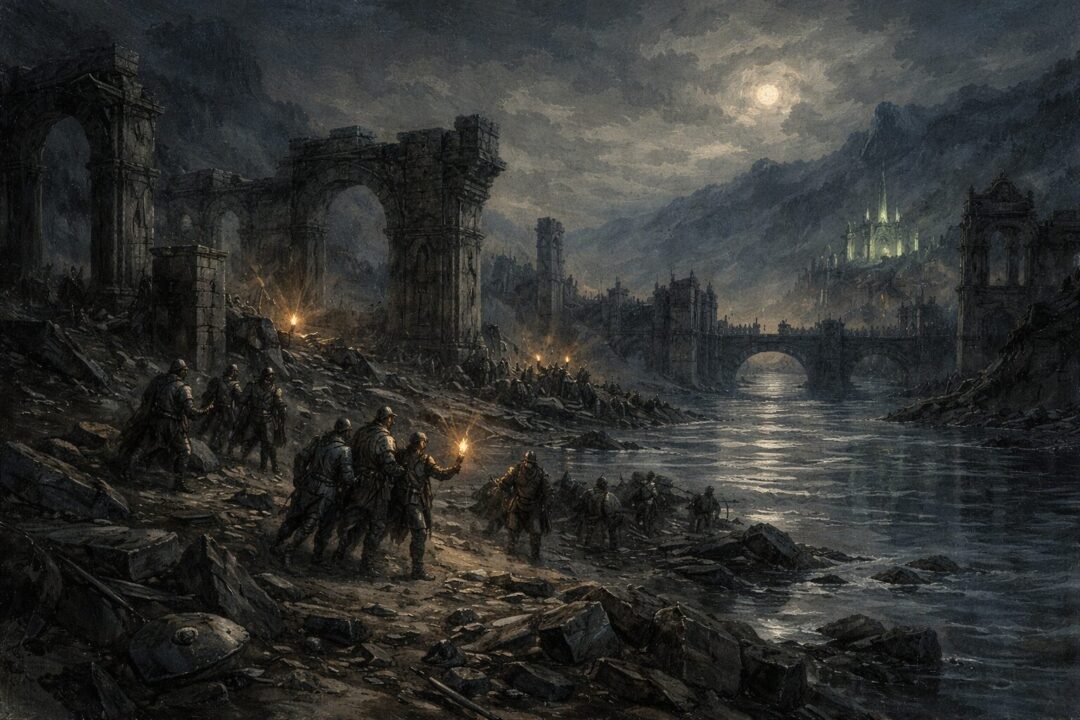
In the War of the Ring, not every land in Middle-earth holds the same strategic meaning.
Some places are political centers. Some are strongholds. Some are hidden enough, or distant enough, to escape the first shock of war. But other lands stand in a more dangerous position. They lie between a great power and its true objective. Those places become the ground that must be crossed, softened, raided, or broken before the deeper heartlands can be reached.
That is what a buffer zone looks like in the War of the Ring.
The term itself is modern, but the pattern is there in the text. Certain lands function as exposed march-lands: they absorb pressure, delay invasion, and protect something behind them. They are important not because they are peaceful, but because they are never fully allowed to be.
Buffer zones in Middle-earth are created by geography first
The War of the Ring is shaped by geography as much as by armies.
Rivers matter because they restrict movement. Gaps matter because they offer one of the few practical routes through mountain barriers. Open plains matter because they favor riders and also expose them. Ruined cities matter because even in decline they still control crossings and roads. The lands that become buffers are usually the lands where geography forces a decision.
The Anduin is the clearest large-scale example. It is not simply a river on the map. It is a frontier. Yet frontiers are only useful when they are difficult to cross, and Tolkien’s world repeatedly pays attention to the places where crossing is possible. The Undeeps matter because armies can pass there. Osgiliath matters because it sits on the river line between Minas Morgul and Minas Tirith. Cair Andros matters because it helps guard the northern approach into Gondor. Once an enemy secures such points, the defense behind them begins to contract.
So a buffer land is not just “near danger.” It is a land whose position turns it into an early battleground.
Rohan becomes a buffer because it shields Gondor’s flank
Rohan is often remembered for cavalry, for Théoden, or for the Ride to the Pelennor. But in strategic terms, Rohan is one of the most important buffer realms in the war.
It stands on Gondor’s northern border and is Gondor’s chief ally. That alone already gives it enormous weight. If Rohan remains intact, Gondor is not isolated. If Rohan is crippled, Gondor loses not only help in battle but security on a major flank.
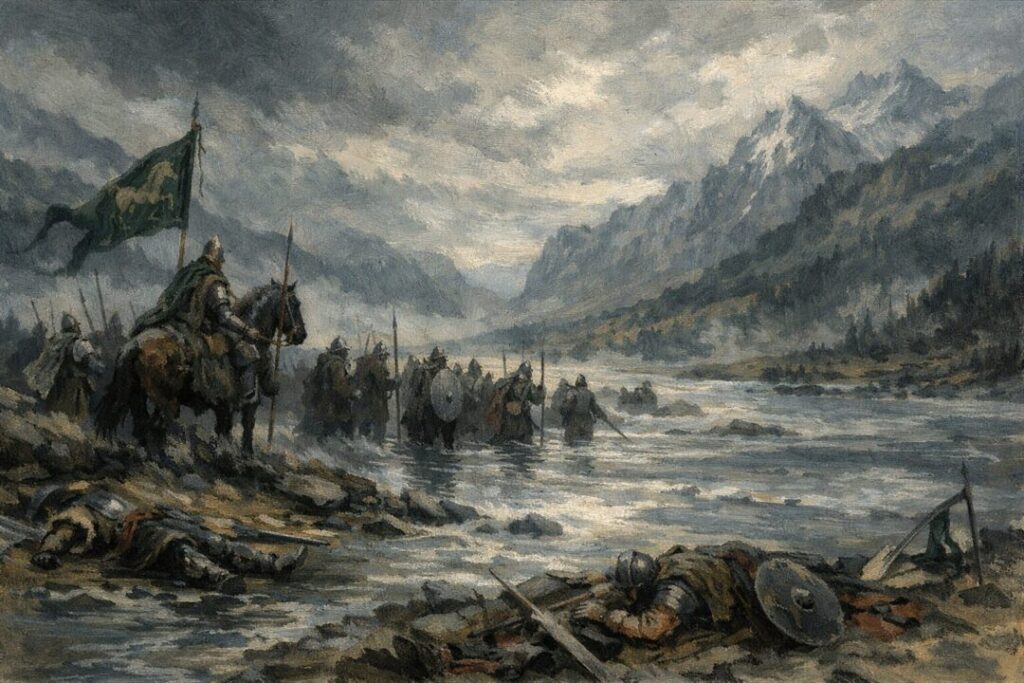
This is why Saruman’s war against Rohan matters so much. He does not need to storm Minas Tirith himself. He needs to neutralize the kingdom that could come to Minas Tirith’s aid and that blocks hostile control of the Gap of Rohan. The Fords of Isen, the main entrance into Rohan from the west and the only major crossing south of Isengard for large forces, become crucial for exactly that reason. They are not merely local terrain features. They are the point where the outer shield can be pierced.
Once the Westfold burns and the line at the Isen fails, the danger is immediate. Rohan is no longer just a kingdom under attack. It is becoming a broken buffer, and Gondor’s situation darkens even before the siege reaches full force.
The Gap of Rohan turns open land into strategic land
One reason buffer zones emerge is that Middle-earth is not open in every direction.
Mountains channel movement. Rivers narrow choice. Long detours cost time. The Gap of Rohan is one of the great openings between major mountain systems, and that makes the surrounding country strategically larger than it first appears.
This is why Isengard is so dangerous in Saruman’s hands. Its location places a hostile power near one of the natural corridors of the West. From there pressure can be directed into Rohan, and through Rohan the wider balance between north and south can be disrupted.
That same logic appears late in the war when the Mouth of Sauron offers terms at the Black Gate. The proposed arrangement imagines the lands west of the Anduin, as far as the Misty Mountains and the Gap of Rohan, reduced to tributary status. Whether or not one treats those terms as sincere, they reveal how Sauron’s side thinks spatially. This whole belt is not treated like an irrelevant fringe. It is treated like a zone that must be subdued and controlled if the West is to be broken permanently.
That is the language of buffer space.
Gondor’s eastern defense shows how a buffer can collapse inward
If Rohan is a living outer shield, Gondor shows another pattern: a buffer system that has already shrunk.
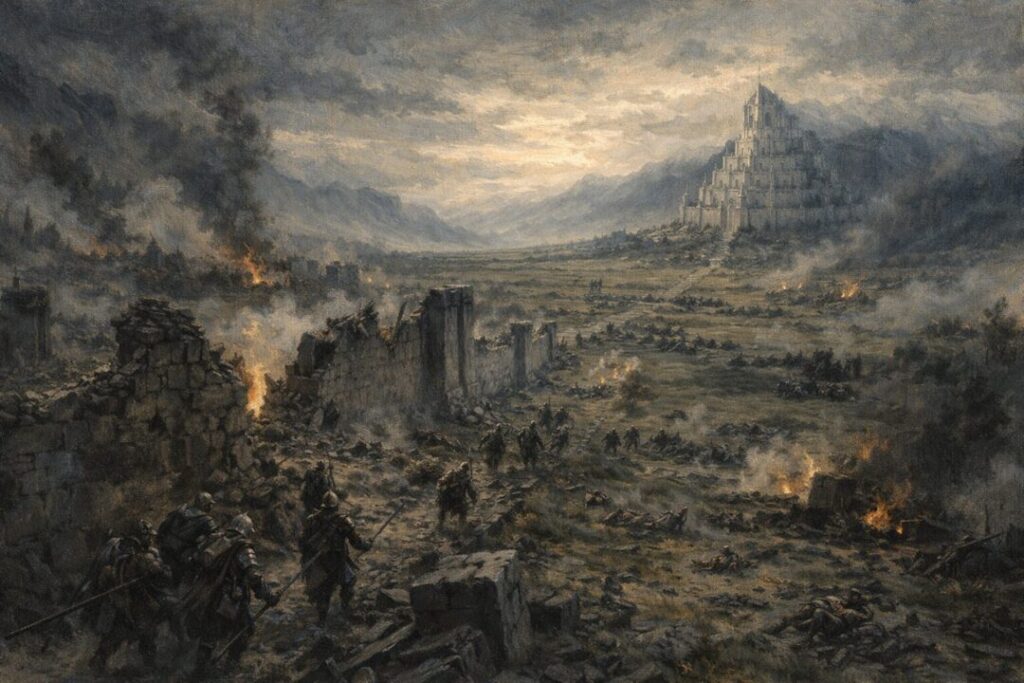
Long before the main siege, Gondor’s eastern line had been pushed back. Ithilien, once inhabited and defensible, falls under the Shadow after Sauron’s return to Mordor. The population flees west over the Anduin. That matters enormously, because once Ithilien is effectively lost, Gondor’s defense no longer begins far east of Minas Tirith. It begins much closer to home.
Osgiliath then becomes vital, not because it is whole, but because even as a ruin it still lies on the enemy’s route. It is a delaying ground. Faramir’s defense there is not about final victory. It is about time. The same is true of the Rammas Echor, the outer wall around the Pelennor. It exists because the older forward security is gone and the fields around Minas Tirith must now be defended much nearer the city.
This is how a buffer collapses in Tolkien’s war-writing. The fighting line does not simply disappear; it retreats from one zone to another.
First Ithilien is lost.
Then Osgiliath must be contested.
Then the Rammas is manned.
Then the Pelennor itself is overrun.
Only after all that does the battle reach Minas Tirith proper.
The capital is mighty, but it survives only because other lands are forced to fail before it.
Anórien and Cair Andros show that “behind the front” can still be exposed
One of the subtler points in the War of the Ring is that even lands behind a major city are not automatically secure.
Cair Andros helps guard the northern approach into Anórien, and when it falls, enemy forces can cross and interfere with the Rohirrim’s road to Minas Tirith. This matters because it shows that Gondor’s defense is not a single straight line facing east. It is a network of approaches, crossings, and roads. A buffer zone can exist on the flank or rear of a greater defense just as much as in front of it.
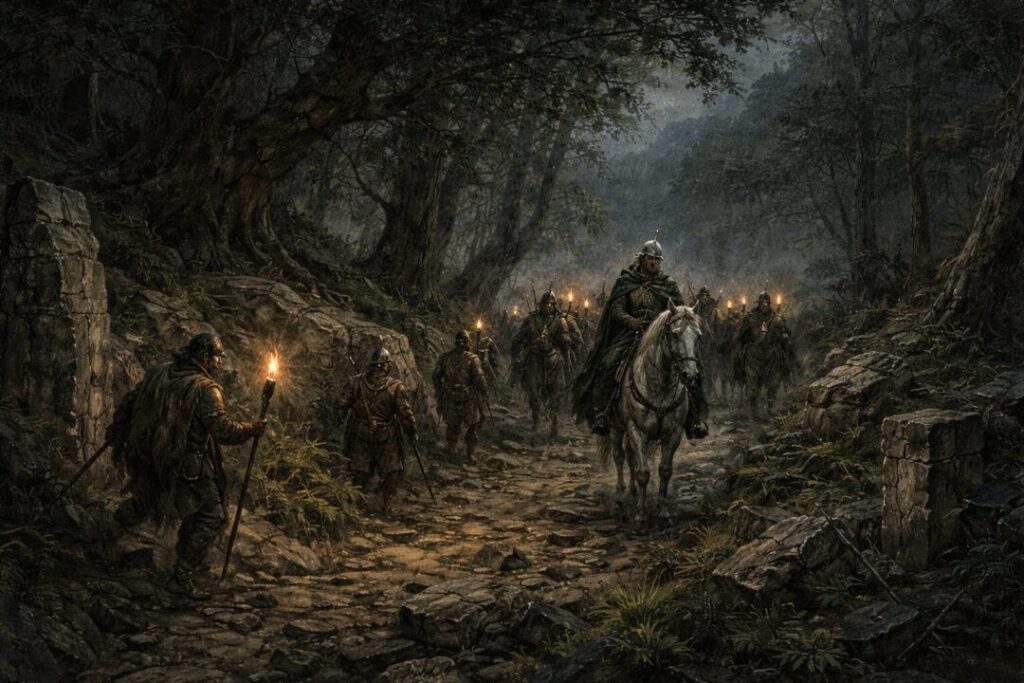
That is also why the road through the Drúadan Forest becomes so important. Théoden cannot simply ride forward on the obvious way once the enemy blocks it. He needs another route through threatened ground. The war is full of such moments. A land becomes strategically decisive not because it is beautiful, famous, or politically central, but because an army must pass through it at the right hour.
Not every threatened land is a buffer zone
It is worth being careful here.
A land under danger is not automatically a buffer zone. The Shire, for instance, is endangered by the end of the story, and Elrond even foresees peril there. But the Shire is not functioning as a military shield between two great war powers in the same way Rohan or Osgiliath does. It is vulnerable, but not a march-land in the same strategic sense.
Likewise, some hidden realms avoid this role precisely because they are hard to reach or are not on the main invasion corridors. Rivendell and Lórien are threatened in the wider war, but they are not described as simple buffer states standing in open country that must absorb the first direct blow for Gondor.
So the distinction matters. A buffer zone is not just any endangered place. It is an exposed intermediate place.
Why buffer zones matter so much in the War of the Ring
The deeper reason these lands matter is that the War of the Ring is a war of delay.
The West does not win by overwhelming strength. It wins by holding long enough for the Ring-bearer to finish the quest. That means every defensive layer, every crossing, every road, every outer wall, every horse-plain bought time even when it could not guarantee safety.
Seen this way, buffer lands are where time is purchased.
Rohan buys time for Gondor.
Osgiliath buys time for Minas Tirith.
The Rammas buys time for the city.
Cair Andros and the roads of Anórien affect whether aid can arrive in time at all.
Even the final march on the Black Gate works by the same logic. Aragorn and Gandalf deliberately make themselves the visible target so Sauron will commit attention and strength elsewhere. It is the largest buffer action in the story: an army standing forward so another movement, hidden and fragile, may still succeed.
The map of the war changes when you notice this
Once you begin to read the War of the Ring through buffer lands, the map looks different.
The great capitals remain important, of course. Minas Tirith still matters. Barad-dûr still matters. But the real drama of the war often begins earlier, in lands that are easier to overlook: the fords, the ruined city, the open plain, the wall before the wall, the crossing before the capital, the kingdom that must not fall because another realm is depending on it.
These are the places that are too close to the danger to rest and too important to abandon.
And in Middle-earth, those lands often decide the shape of the whole war before the final battle is even joined.