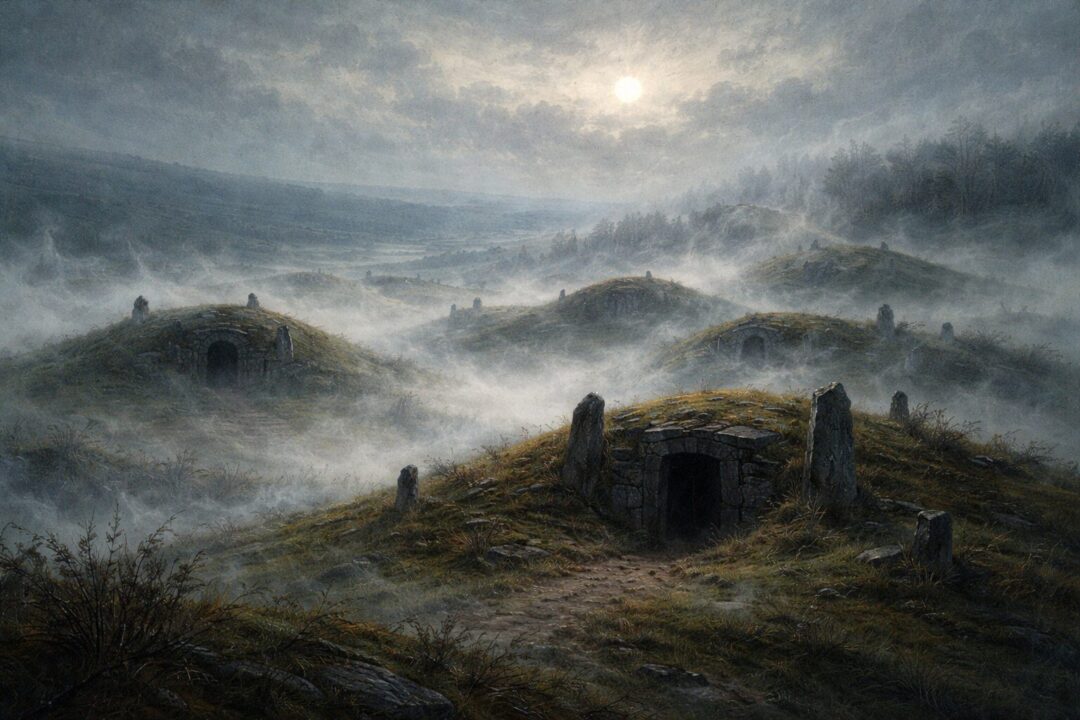
The Barrow-downs feel like an early warning in The Lord of the Rings—a place the story brushes past on the way to larger dangers.
But the horror there is not random.
It is rooted in history.
The mounds of Tyrn Gorthad are not described as “cursed hills” from the beginning. They are described as old and significant: ancient graves raised in the days of the “old world,” and later honored by the Dúnedain when they returned to the North.
That detail matters, because it tells you the Barrow-downs were once something like a landmark of memory—visible proof that the North had kings, lords, and inheritance.
Then the Barrow-downs become the opposite: a place that erases the living.
So the real question isn’t why are they haunted?
The texts answer that.
The real question is: why were they left haunted for so long, within reach of Bree-land and the Shire, without anyone cleansing them?
To understand that, you have to look at what the Barrow-downs represented—and what happened to the people who were meant to guard that representation.
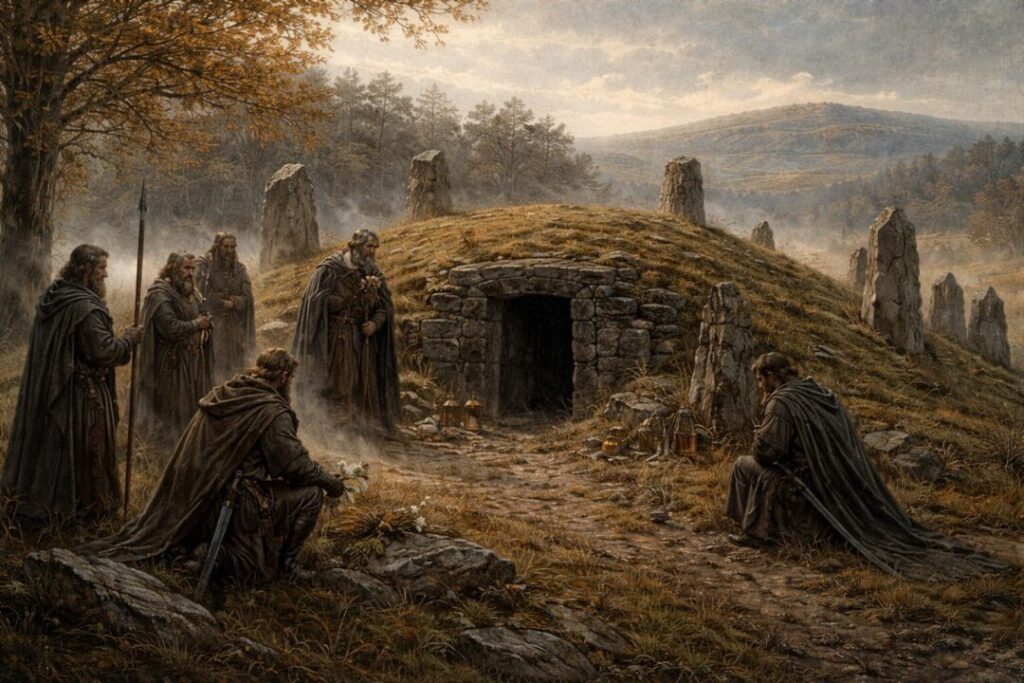
A sacred place that belonged to a kingdom that stopped existing
The Barrow-downs are tied, explicitly, to the northern Dúnedain realms.
In the long decline of Arnor, the North breaks into separate kingdoms—Arthedain, Cardolan, and Rhudaur—and the story becomes one of erosion: fewer people, less unity, and borders that cannot hold.
This is where Angmar enters the picture.
The Witch-king’s war in the North is not only military. It is aimed at destroying the Dúnedain’s ability to endure. The Appendices even state his purpose plainly: to break Arnor while Gondor is strong, taking advantage of disunion.
Cardolan is ravaged in that struggle. A remnant holds out for a time in Tyrn Gorthad itself—already a signal that the Barrow-downs are being used as a last refuge as much as a burial ground.
But the decisive turning point is not a battle.
It is plague.
In the days of Argeleb II, the Great Plague comes into Eriador from the southeast, and the Appendices say that most of the people of Cardolan perished. And then comes the sentence that explains the haunting:
At that time, an end came of the Dúnedain of Cardolan, and evil spirits out of Angmar and Rhudaur entered into the deserted mounds and dwelt there.
Notice what that implies.
The Barrow-downs become haunted precisely when the people who claimed and revered them are no longer able to stand there in strength.
The mounds are described as “deserted.”
That word does almost all the work.
No guards. No caretakers. No king in Cardolan who can say: this is our dead; this is our ground; this will not be taken.
Once the living withdraw, the dead become vulnerable.
And the evil that moves in is not framed as a natural haunting. It is an intrusion—spirits entering and dwelling.
This is not just a scary local legend.
It is a political act.
Why send wights at all?
The Barrow-wights are more than monsters in a hill.
They are strategic.
You can infer their purpose from where they are placed: in the tombs of the northern Dúnedain, in sight of the roads, close enough to Bree-land that fear can travel.
The Barrow-downs sit near what used to be Cardolan’s heartlands.
And if you want to keep a kingdom from ever returning, you don’t only burn its towers.
You make its most meaningful places uninhabitable.
A haunted burial ground does two things at once:
- It turns reverence into dread.
- It turns memory into taboo.
Even after Angmar is later defeated, the social effect remains: people avoid the Downs because they are known to be deadly.
And that avoidance becomes self-sustaining.
A place that is avoided cannot be reclaimed.
A place that is not reclaimed cannot be cleansed by ordinary governance.
So the Barrow-downs persist as a wound because they continue to perform the same function long after the hand that made the wound is cut off.
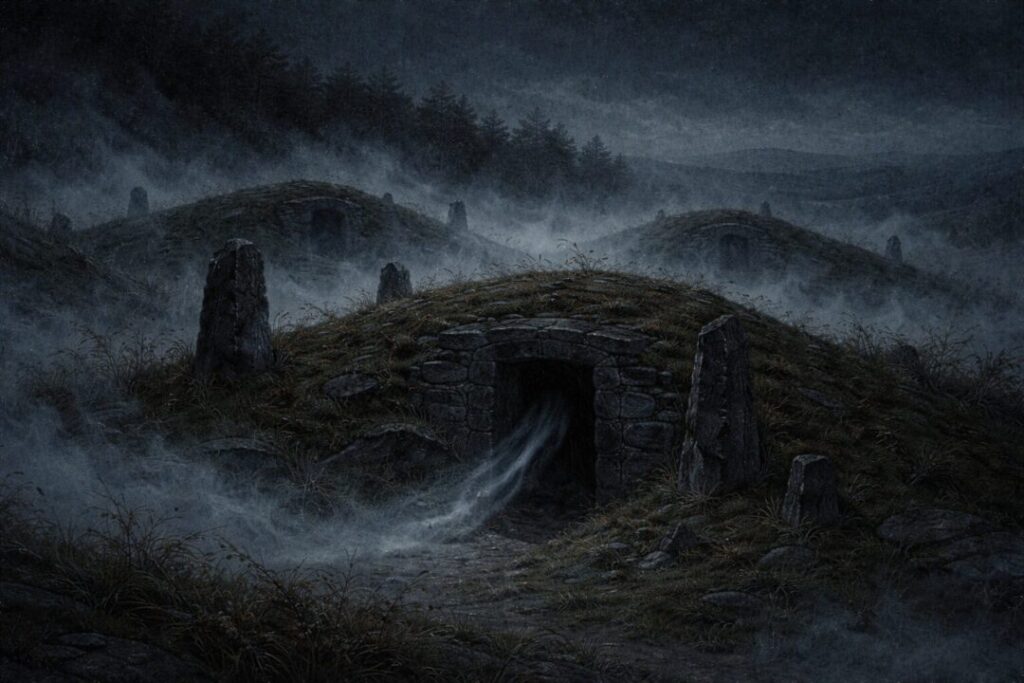
“Who failed to cleanse them?” starts with: who was able?
It’s tempting to look for a single negligent figure—some Ranger captain who should have marched in, some Elf-lord who should have sung a cleansing, some wizard who should have dealt with it “off-screen.”
But the texts don’t present a neat assignment of responsibility.
What they present is a world where the North is thinning out, and where power is distributed unevenly.
Start with the most obvious candidate: the kings of the North.
After Cardolan ends, Arthedain continues—barely—until it too falls. Fornost is taken. The last king, Arvedui, flees and dies, and the North-kingdom ends.
After that, the Dúnedain do not vanish—but they become Chieftains and Rangers: fewer, secretive, wandering, with their deeds seldom recorded.
In other words: the people most invested in cleansing a Dúnedain grave-field are reduced to a hidden remnant whose primary task is survival and watchfulness, not reclaiming haunted hills.
Even if they wanted to cleanse Tyrn Gorthad, “wanting” is not the same as “being able.”
Because cleansing isn’t only about courage. It is about holding ground afterward.
What happens if you drive a wight out of one mound, but you cannot station guards, rebuild a settlement, and restore a living presence?
The mounds simply become deserted again.
And the text has already shown you what happens to deserted mounds.
The Elves were not the North’s caretakers
Then there are the Elves.
It’s true that Elven power remains in Rivendell and Lindon, and Elves do intervene at key moments in the North. The war against Angmar includes aid coming from Elven realms, and the Witch-king is ultimately checked by forces beyond the Dúnedain alone.
But the Barrow-downs are not presented as an Elven responsibility.
They are a Mannish burial place—revered by Dúnedain tradition, connected to the history of the Edain, and bound up in the political collapse of Arnor.
Elves can help in war.
That doesn’t mean they become permanent wardens of every haunted landmark in Eriador.
And in the late Third Age, Elven realms are also in “the long defeat,” guarding their own borders, their own people, and what little remains against shadows that are rising again elsewhere.
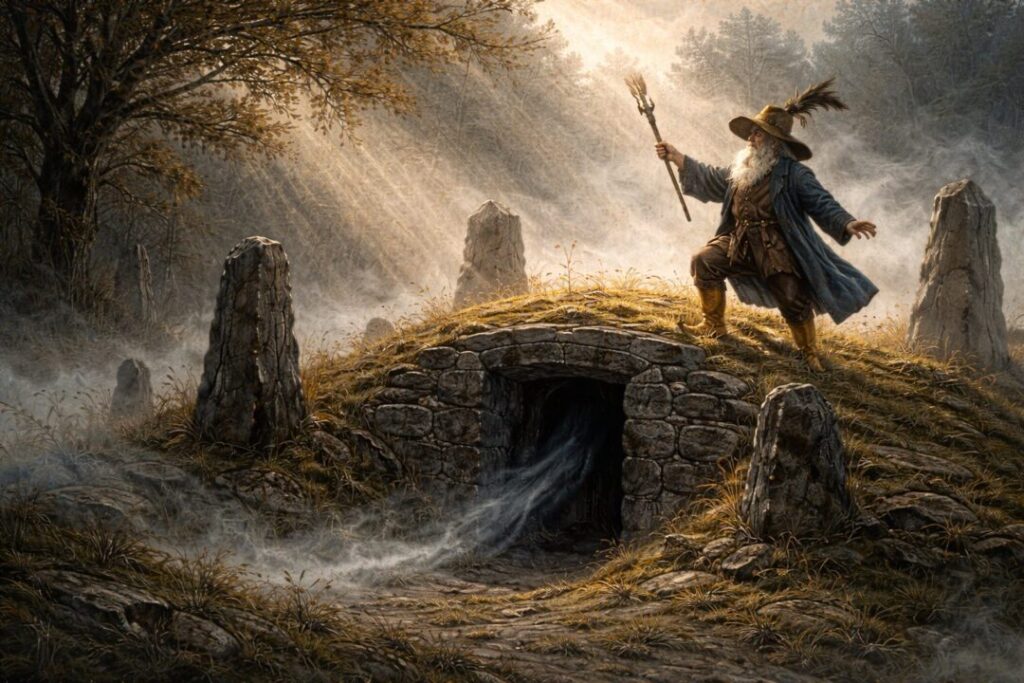
Tom Bombadil complicates the question instead of answering it
Then you arrive at the detail that makes everything feel even stranger:
Tom Bombadil.
In “Fog on the Barrow-downs,” Tom breaks the wight’s hold and drives it out with a song. He treats the creature like an intruder in his country—something that can be dismissed.
So why doesn’t that mean the Barrow-downs are safe afterward?
Because the text only shows Tom dealing with one barrow in one event.
It does not say he scoured every mound.
It does not say the Downs were wholly cleansed and made harmless for all travelers.
In fact, the way the Hobbits speak afterward, and the way the region is treated, reinforces the opposite: the Downs remain dangerous enough that ordinary folk still avoid them.
Tom is not a replacement for governance.
He is a power that can intervene, but does not appear to rule in the political sense—does not rebuild, resettle, patrol, or restore a kingdom’s authority over its dead.
His rescue is bright and immediate.
But it does not undo centuries of abandonment.
And that brings you back to the unromantic answer.
The haunting lasted because the North never truly healed
The Barrow-downs were left haunted for so long because the conditions that allowed the haunting never fully disappeared.
A kingdom ended.
The land emptied.
The Dúnedain faded into secrecy.
Eriador became a place of scattered pockets—Bree-land, the Shire, wandering Rangers—rather than a unified realm that could restore ancient sacred sites.
And the wights, once placed, did not need constant reinforcement to keep doing their work.
They made the Barrow-downs function as a boundary of fear.
So who “failed”?
Not one person.
A whole structure failed.
Cardolan failed—because it was destroyed by war, plague, and long decline.
Arnor failed—because it could not remain united.
And after that, there was no North-kingdom left whose basic duty would have included reclaiming and safeguarding the tombs of its lords.
The Barrow-downs remained haunted because they were the grave-marker of a realm that could not rise again.
Until, at last, the story introduces a king who can restore what was broken.
And once you remember that, the Barrow-downs stop being a spooky detour near Bree.
They become a quiet symbol of what the War of the Ring is actually deciding:
Not only whether Sauron is defeated—
But whether the North will ever become a land where the dead can rest untroubled again.