
When readers think about the War of the Ring, their minds naturally turn to Frodo climbing Mount Doom, Aragorn leading the Host of the West, or Gandalf standing against despair. Yet one of Middle-earth's greatest mysteries lies far beyond Gondor, beyond Mordor, and even beyond the maps included in The Lord of the Rings.
What was happening in the East while the West fought for survival?
It is an overlooked question, but one with enormous consequences. Sauron's strength did not come from Orcs alone. His greatest military advantage was the loyalty—or fear-induced obedience—of countless peoples from Rhûn, Harad, and other eastern and southern lands. If every one of those nations had marched west under his command, Gondor and its allies would almost certainly have faced impossible odds.
Late writings present a remarkable possibility. Rather than disappearing into irrelevance, the mysterious Blue Wizards may have spent centuries quietly preventing exactly that outcome. If this interpretation is accepted, they did not defeat Sauron directly. Instead, they helped ensure that he never reached the overwhelming strength he otherwise might have possessed.
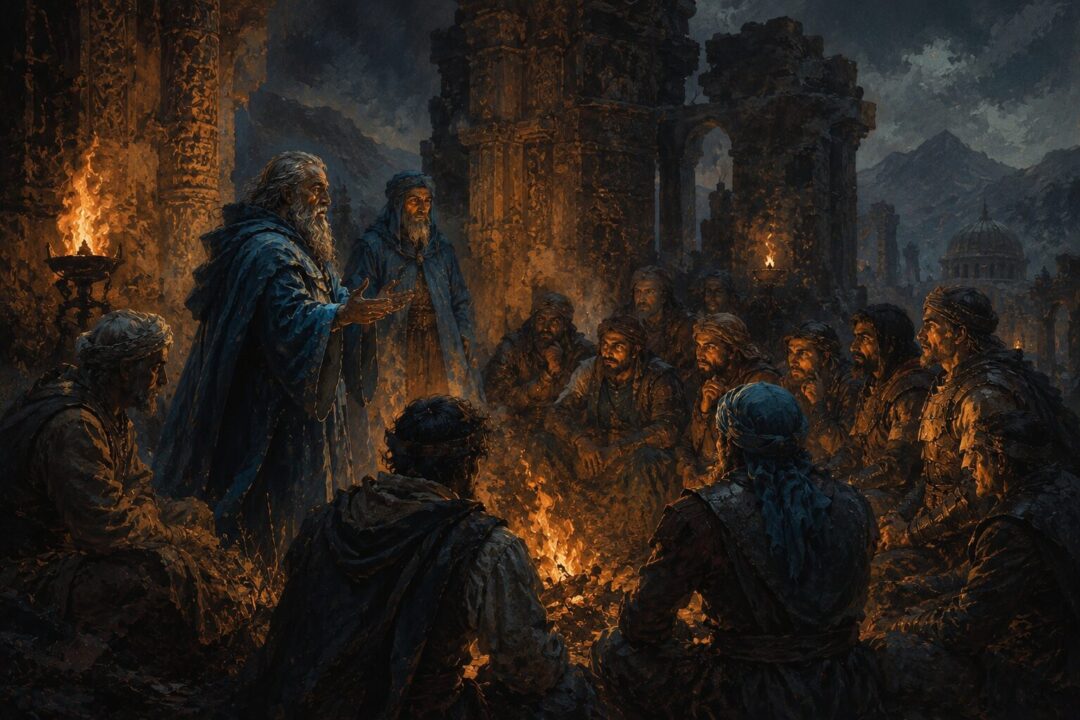
The Great Mystery of the Blue Wizards
Unlike Gandalf, Saruman, and Radagast, the two Blue Wizards never appear as characters within The Lord of the Rings. The published narrative only indirectly confirms the existence of five Wizards when Saruman refers to "the rods of the Five Wizards."
The fuller story comes from later writings.
In Unfinished Tales, the Blue Wizards are identified as Alatar and Pallando. There they accompany Saruman into the East and are never heard from again. The text deliberately leaves their fate uncertain, suggesting several possibilities without choosing among them.
One tradition held that they failed.
Another possibility was that they perished.
Still another was that they were ensnared by Sauron.
None of these possibilities is presented as certain, and the mystery remained unresolved.
That uncertainty would become even more intriguing in later writings.
A Dramatic Change in the Later Tradition
Among Tolkien's final notes, preserved in The Peoples of Middle-earth, the Blue Wizards receive a remarkably different treatment.
Instead of arriving around the year 1000 of the Third Age alongside the other Istari, these writings place them much earlier, around the forging of the One Ring during the Second Age. Their names are also given as Morinehtar ("Darkness-slayer") and Rómestámo ("East-helper"), though it is not explicitly stated whether these replace or supplement the earlier names Alatar and Pallando.
Most importantly, their mission is described far more clearly.
Rather than simply wandering into unknown lands, they were sent to aid those peoples of the East and South who resisted Sauron's domination. Their task included encouraging rebellion, creating dissension among Sauron's allies, searching for the Dark Lord after his temporary downfall at the end of the Second Age, and continually weakening his influence wherever possible.
These notes go even further.
They state that the Blue Wizards "must have had very great influence" in weakening and throwing into disarray the peoples of the East who otherwise would have greatly outnumbered the West.
That single statement reshapes how one may understand the military balance of the entire Third Age.

Sauron's Greatest Strength Was Not Mordor Alone
Modern adaptations often emphasize Mordor itself: endless Orcs, Nazgûl, siege engines, and black fortresses.
The books paint a broader picture.
Again and again, armies from outside Mordor arrive to reinforce Sauron's campaigns. Easterlings invade Gondor repeatedly across history. Haradrim march beneath scarlet banners with mûmakil. Men from Khand also fight beside Sauron's hosts.
This pattern stretches across centuries.
Sauron's influence reached far beyond the borders visible on the familiar maps of Middle-earth.
Indeed, one of the major themes of The Lord of the Rings is that evil spreads politically as well as militarily. The Dark Lord builds coalitions, secures loyalties, exploits fear, and gathers peoples into his service.
His empire is never merely an Orc kingdom.
It is an expanding network of subject peoples.
The West Was Always Outnumbered
The kingdoms opposing Sauron were impressive, but they were not vast.
By the end of the Third Age, Arnor had long since fallen.
Gondor had declined dramatically from its earlier greatness.
Rohan was comparatively young and sparsely populated.
The Elves were departing Middle-earth.
The Dwarven kingdoms had suffered repeated disasters.
Even before the War of the Ring began, the Free Peoples represented only a fraction of Middle-earth's total population.
This makes the Blue Wizards' reported mission especially significant.
If Sauron had achieved complete political and military unity throughout the East and South, the imbalance could have become overwhelming.
The late writings explicitly suggest precisely this possibility by stating that the eastern peoples might otherwise have outnumbered the West.
Importantly, this is not speculation by later commentators. It is the implication of Tolkien's final conception of their mission.
Victory Without Becoming Famous
One striking feature of the Blue Wizards' possible success is its invisibility.
Gandalf becomes known throughout the West.
Aragorn is crowned king.
Frodo becomes the Ring-bearer whose sacrifice saves Middle-earth.
The Blue Wizards, by contrast, would have succeeded in places that almost none of the main characters ever saw.
If they persuaded one tribe to resist Sauron…
If they delayed an invasion…
If they encouraged rivalries among Sauron's allies…
If they prevented distant kingdoms from uniting under one banner…
None of those victories would necessarily appear in the chronicles of Gondor.
Yet every one of them might have reduced the number of soldiers arriving before Minas Tirith or marching to the Morannon.
Their work, if successful, would have remained almost entirely hidden.

Why Their Mission Fits the Nature of the Istari
The Istari were never sent to conquer Sauron through displays of overwhelming supernatural power.
Their purpose was to advise, encourage, inspire, and strengthen the resistance of the Free Peoples.
Gandalf embodies this throughout The Lord of the Rings. He rarely solves problems through force alone. Instead, he rekindles hope, counsels rulers, and helps others find courage.
The later description of the Blue Wizards follows the same pattern.
They are not portrayed as destroying vast armies through magical combat.
Instead, they influence peoples.
They encourage resistance.
They create disorder within Sauron's sphere of influence.
Their struggle becomes political, spiritual, and cultural rather than simply military.
That approach is entirely consistent with how the Istari were intended to oppose evil.
Did They Completely Succeed?
The answer is almost certainly no.
Even under the later conception, Sauron still commands enormous eastern armies during the War of the Ring.
Haradrim fight in Ithilien.
Easterlings battle before Minas Tirith.
Other eastern forces attack Dale and Erebor at the same time.
The Blue Wizards did not eliminate Sauron's influence.
Instead, the texts suggest something more modest—but perhaps equally important.
They weakened it.
The difference matters.
A campaign does not need to end in total victory to change history.
If enough kingdoms remained independent…
If enough rebellions distracted Sauron's attention…
If enough armies never reached Mordor…
Then the military balance during the War of the Ring would have been fundamentally altered.
The Earlier Tradition Has Not Disappeared
Readers should also remember that Tolkien never produced one final, fully harmonized account.
The earlier tradition preserved in Unfinished Tales remains valuable.
There, the Blue Wizards' fate is unknown, and Tolkien even expressed concern elsewhere that they may have failed, perhaps becoming founders of secret cults and magical traditions that survived after Sauron's fall.
These two conceptions sit in tension.
One presents probable failure.
The later writings suggest meaningful, though largely unseen, success.
Neither version appears within the finished narrative of The Lord of the Rings itself.
For that reason, any conclusion should remain appropriately cautious.
The later conception represents Tolkien's final known thoughts on the subject, but it does not erase the existence of earlier ideas.

Why This Possibility Changes the War of the Ring
The War of the Ring often appears to hinge on a handful of visible heroes.
Yet Middle-earth repeatedly emphasizes that history is shaped by countless acts of courage beyond the famous battlefields.
The Fellowship succeeds because many separate struggles occur simultaneously.
The Dwarves defend Erebor.
The Elves protect their own realms.
The Ents overthrow Isengard.
Faramir delays enemies in Ithilien.
Countless unnamed soldiers hold walls and river crossings.
The Blue Wizards, under the later conception, fit naturally into this pattern.
They become guardians of an entire unseen front.
Rather than winning glorious victories remembered in song, they may have spent thousands of years ensuring that Sauron's empire never achieved complete unity across the East.
If so, the armies that attacked Gondor represented not Sauron's full potential but only the forces he was actually able to gather.
That possibility offers one of the most compelling explanations for a question hidden beneath the larger story: why did the Dark Lord, whose influence stretched across so much of Middle-earth, never bring the full weight of the East crashing down upon the West?
The answer may not lie in a forgotten battle or a lost kingdom.
It may lie with two mysterious Wizards whose greatest victories were the ones almost nobody in the West ever knew had happened.
Sources & Notes
- Tolkien Gateway, “Blue Wizards” — summarizes Tolkien’s two traditions for Alatar and Pallando / Morinehtar and Rómestámo, including the late note that their work weakened and disarrayed Sauron’s eastern forces. https://tolkiengateway.net/wiki/Blue_Wizards
- Tolkien Gateway, “Istari” — gives context for the Wizards’ order, the five Istari, their mission against Sauron, and the different accounts of the Blue Wizards’ arrival. https://tolkiengateway.net/wiki/Istari
- Encyclopedia of Arda, “Blue Wizards” — independently explains the Ithryn Luin, their journey into the East, and Tolkien’s later suggestion that they helped resist Sauron there. https://encyclopedia-of-arda.com/b/bluewizards.php
- Tolkien Gateway, “Easterlings” — background on the eastern peoples repeatedly allied with or dominated by Sauron, supporting the article’s argument about the military importance of Rhûn and the East. https://tolkiengateway.net/wiki/Easterlings
- Encyclopedia of Arda, “Istari” — overview of the Wizards as emissaries sent to oppose Sauron and encourage resistance rather than rule by force. https://encyclopedia-of-arda.com/i/istari.php
Sources document Tolkien’s late Blue Wizards tradition, the Istari mission, and the eastern peoples whose partial disruption matters to the article’s Sauron strategy argument.