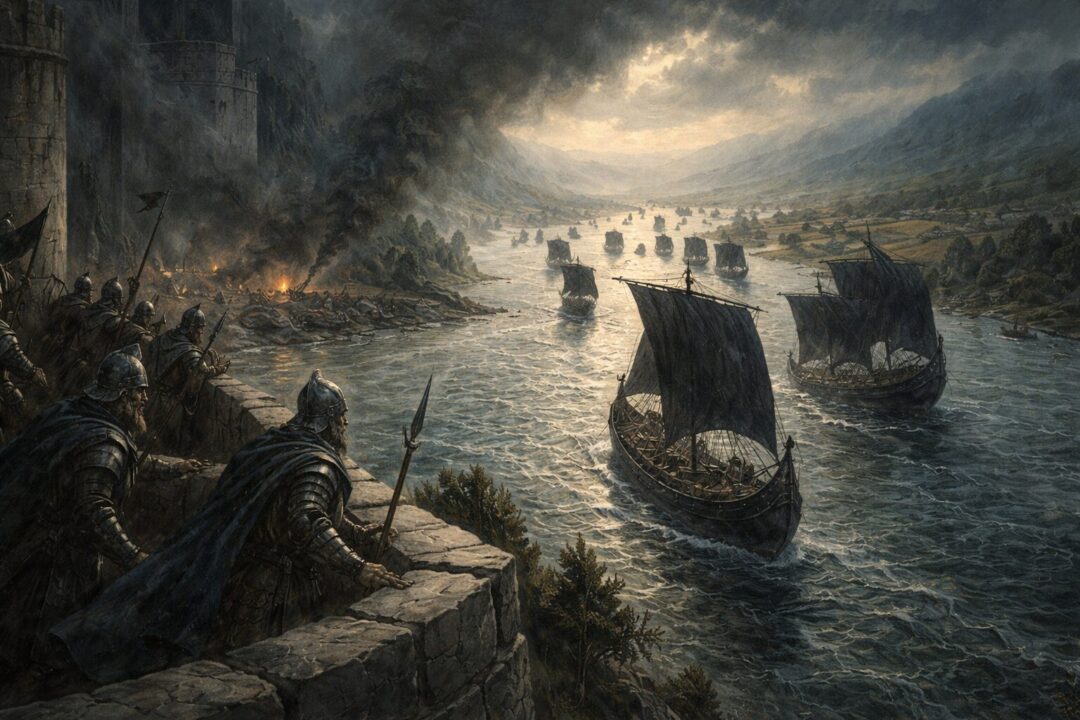
The Corsairs of Umbar are one of those Middle-earth dangers that can look smaller than they are.
They arrive late in most readers’ memory.
They do not have the scale of Mordor, the horror of the Nazgûl, or the symbolic weight of the Black Gate.
They seem, at first glance, like an extra problem attached to the main one.
But the texts do not treat them that way.
Again and again, when Gondor’s southern weakness is mentioned, Umbar is there. When old decline is explained, Umbar is there. When the Pelennor reaches its moment of deepest fear, black-sailed ships come up the Anduin and men cry out not merely that enemies are coming, but that Belfalas is taken, the Ethir lost, and Lebennin gone.
That is not the language of a side-show.
It is the language of encirclement.
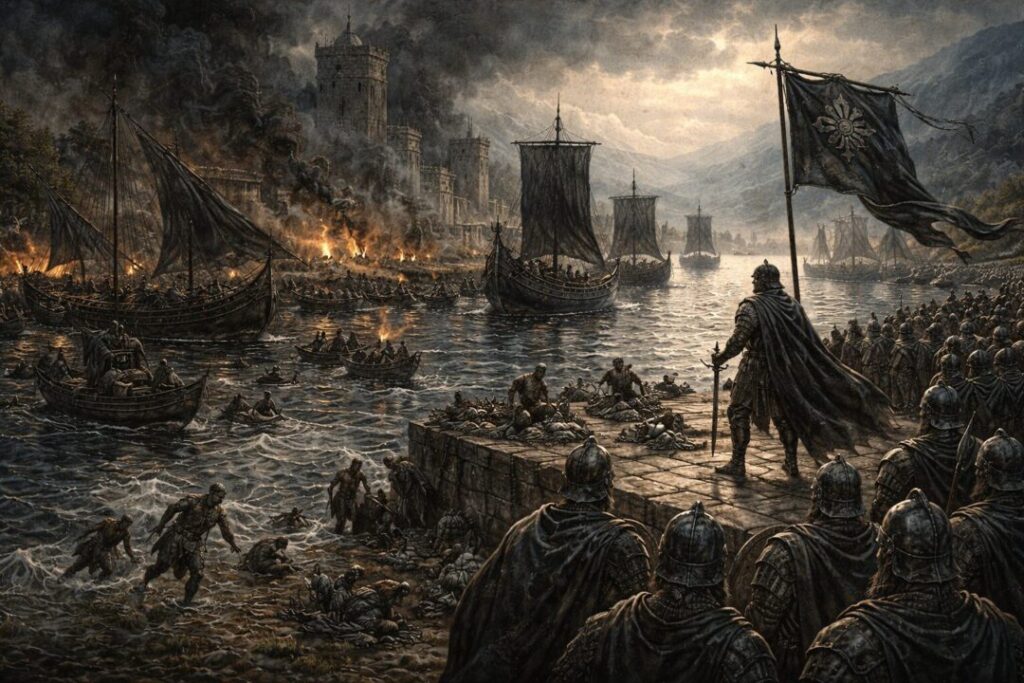
And that is the first thing to see clearly: the Corsairs matter because they widen the war.
Sauron’s greatest military strength comes from Mordor, of course. The siege of Minas Tirith is real, central, and overwhelming. But Gondor is not simply a walled city under attack from the east. It is a kingdom of coastlands, river towns, fiefs, and long communications. A threat from Umbar is not just another enemy to count on a battlefield. It is a second pressure on the body of the realm.
The older history explains why.
The Corsairs are not introduced as random sea-raiders with no deep connection to Gondor. Their enduring enmity is tied to the Kin-strife. After Eldacar regained the throne, the sons of Castamir escaped and fled to Umbar, which became a refuge for all enemies of the king. From there an independent power endured, hostile to Gondor for generations.
That detail matters more than it first appears.
Umbar is not merely outside Gondor.
It is, in part, a wound made from Gondor’s own history.
The rebels who survive do not simply disappear into exile. They become the seed of a lasting maritime enemy. The texts then connect Umbar with repeated southern pressure: alliance with Harad, attacks on Gondor’s coasts, loss of control, and a constant threat to sea-traffic and the shorelands.
So when the War of the Ring comes, the Corsairs are not new.
They are an old strategic fact.
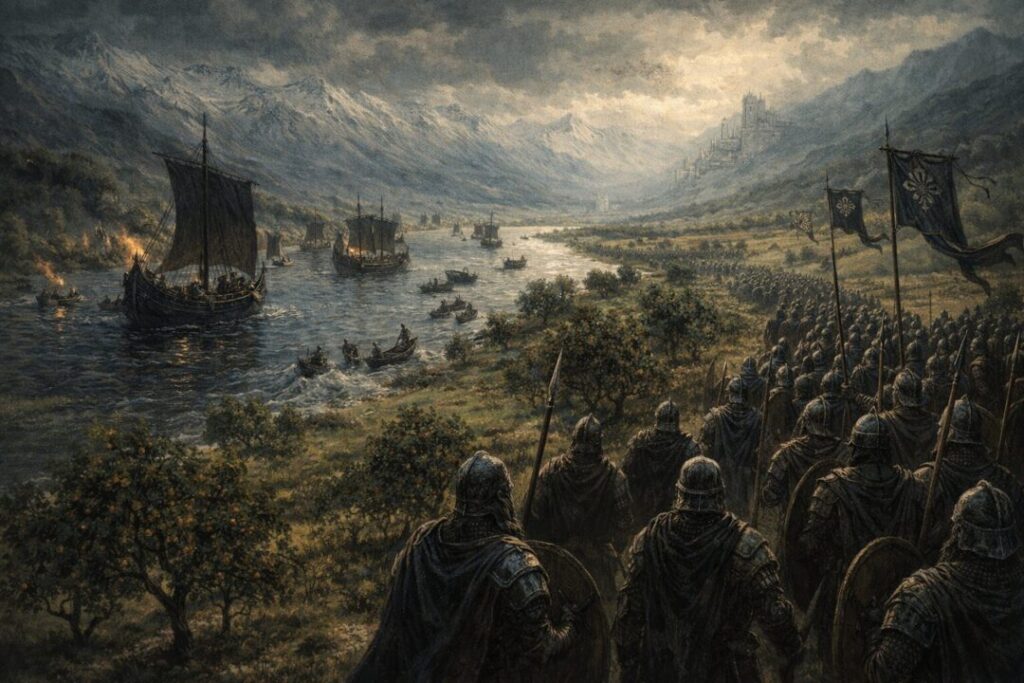
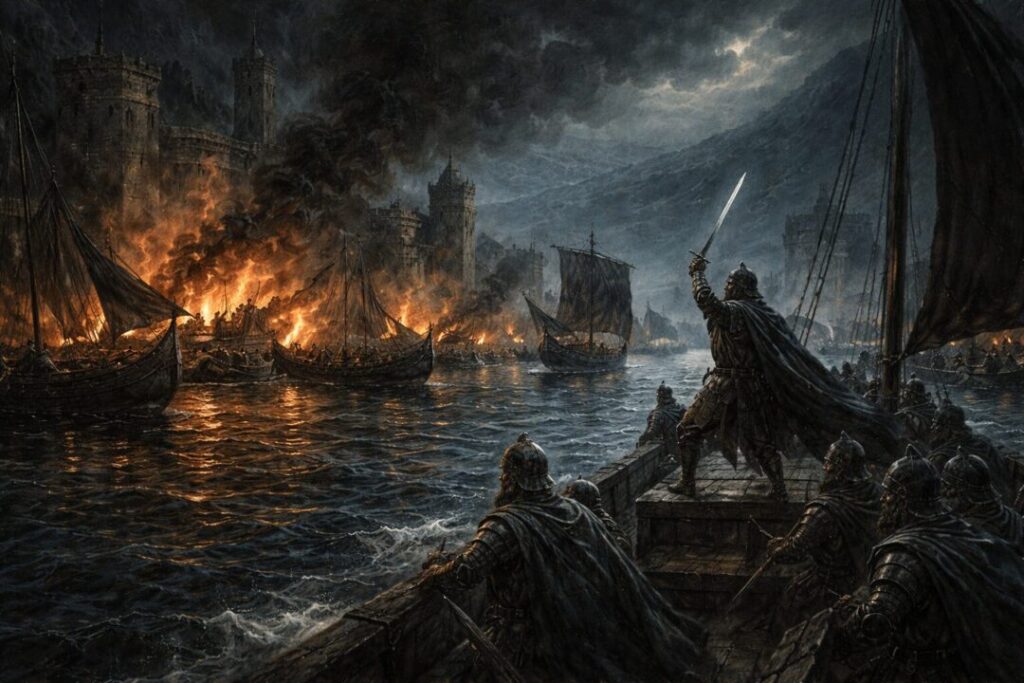
That is why Aragorn’s earlier life as Thorongil is so revealing. In the days of Steward Ecthelion, he repeatedly warned that the strength of the rebels in Umbar was a great peril to Gondor and a threat to the southern fiefs if Sauron moved to open war. Then he persuaded the Steward to let him strike first: he took a small fleet, came by night, burned a great part of the Corsair ships, slew the Captain of the Haven on the quays, and withdrew with small loss.
That episode is easy to read simply as one more proof that Aragorn is bold.
It is that.
But it is also a clue.
It tells you that a leader with long sight judged Umbar to be dangerous before the great war even fully broke over Gondor. Not a nuisance. Not a pirate inconvenience. A peril. And specifically a peril to the south, which means to the parts of Gondor that would need to send strength north in an hour of supreme need.
This is where the Pelennor begins to look different.
Readers naturally focus on whether Rohan will come in time.
The text quietly asks another question beside it: can Gondor’s own south come in time?
The answer, at first, is no.
When Aragorn later speaks in “The Last Debate,” he says plainly that new strength is on the way from the southern fiefs now that the coasts have been rid. He had already sent four thousand marching from Pelargir through Lossarnach, and more were coming by river in whatever craft they could gather.
That sentence is one of the most important on the subject.
It means the coast-threat was not theoretical.
It had materially constrained Gondor’s ability to gather force.
The southern fiefs had men. But those men were not fully disposable while the Corsairs were active. If the coast is endangered, the coast must be held. If Pelargir and the river approaches are threatened, troops cannot simply be stripped away and sent to Minas Tirith. The realm must defend more than one gate.
And then comes the black-sailed moment itself.
At the Pelennor, after the Rohirrim have already come and after battle has turned savage and unstable, the watchers on the walls see ships drawing up from the bend at the Harlond: dromunds and vessels of deep draught, with black sails bellying in the wind. Men cry out that the Corsairs of Umbar are coming, and with that cry comes a chain of conclusions: Belfalas is taken. The Ethir is lost. Lebennin is gone. “It is the last stroke of doom.”
That is an extraordinary passage.
Not because the Corsairs are the largest force in the war.
But because their appearance means something larger than themselves.
They signify collapse elsewhere.
They mean the south has failed.
They mean help will not come.
They mean Sauron’s enemies are not merely besieged but surrounded.
That is why the panic is so sharp. The black fleet is military, yes, but also psychological. It tells Gondor a story: not only is Minas Tirith under assault, but the kingdom beyond it is already breaking.
This is also why Aragorn’s arrival matters so much more than spectacle.
When the standard of the King breaks upon the foremost ship, the reversal is not just visual. The meaning of the fleet changes in an instant. What had signified doom now signifies relief. What looked like the closing of the trap becomes the reopening of Gondor’s strength. And the men who disembark are not phantoms alone in a tale of fear; they are the Dúnedain and “a great valour of the folk of Lebennin and Lamedon and the fiefs of the South.”
That line matters.
The southern fiefs are back in the war.
Not abstractly. Not eventually. Here.
So the Corsairs were dangerous in at least three distinct ways.
First, they were an old and persistent enemy with deep roots in Gondor’s history, not an incidental ally improvised at the last hour.
Second, they restricted Gondor’s freedom to move men. Aragorn’s own words show that aid from the southern fiefs could fully come only once the coasts had been cleared.
Third, they carried the power of visible despair. Their black sails at the Harlond appear to confirm that the south has fallen and the final ring around Gondor is closing.
None of this requires us to exaggerate them beyond the text.
The Corsairs are not greater than Mordor.
They are not secretly the true main enemy.
The canon does not say that Sauron relied on them above all other forces, and it would go too far to claim that the whole war hinged on Umbar alone.
But the texts do support something narrower and stronger.
They show that the Corsairs were a major secondary threat whose importance is easy to underrate because readers remember the siege more vividly than the coast. They helped divide Gondor’s attention, delay southern reinforcement, and deepen the sense that the kingdom was being attacked from every side at once.
And that is why Aragorn’s black ships are such a perfect turning point.
He does not merely bring more swords.
He breaks a pattern.
He removes the southern pressure, restores Gondor’s lost connection to its own fiefs, and transforms a sign of defeat into a sign of kingship.
The Corsairs had been dangerous precisely because they made Gondor smaller than it was.
Aragorn’s arrival makes it whole again—just long enough to survive.