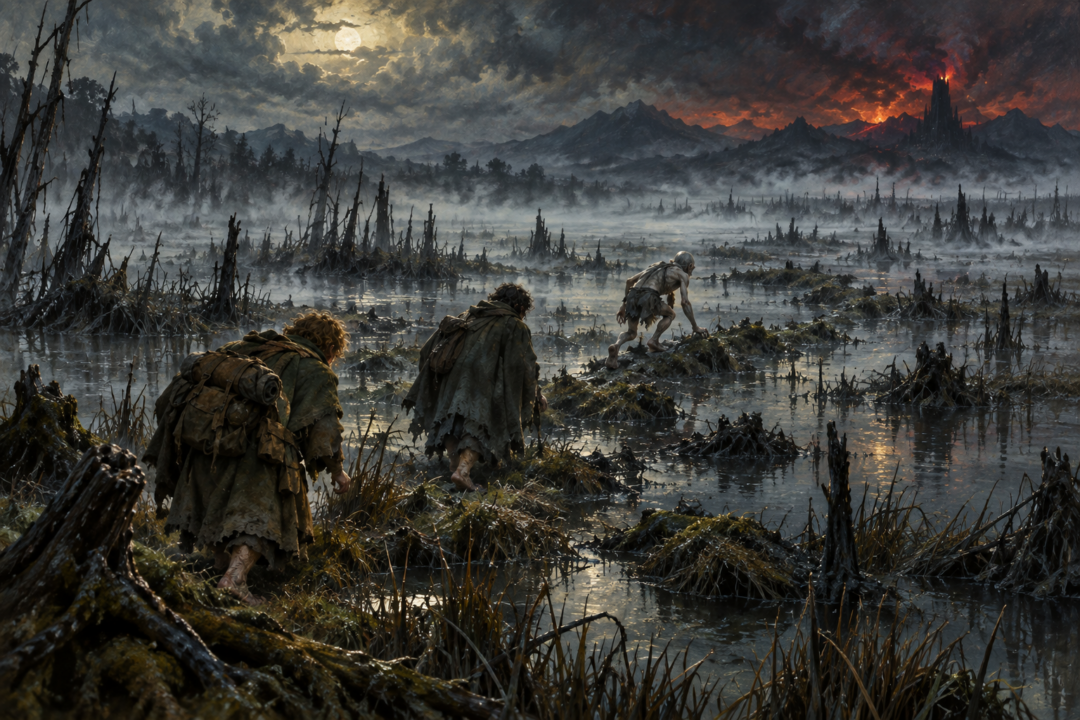
The Dead Marshes contain one of the strangest reversals in Frodo and Sam’s journey. By the time they reach them, Gollum is the person they have the greatest reason to distrust — yet he is also the one person whose movements they cannot safely ignore.
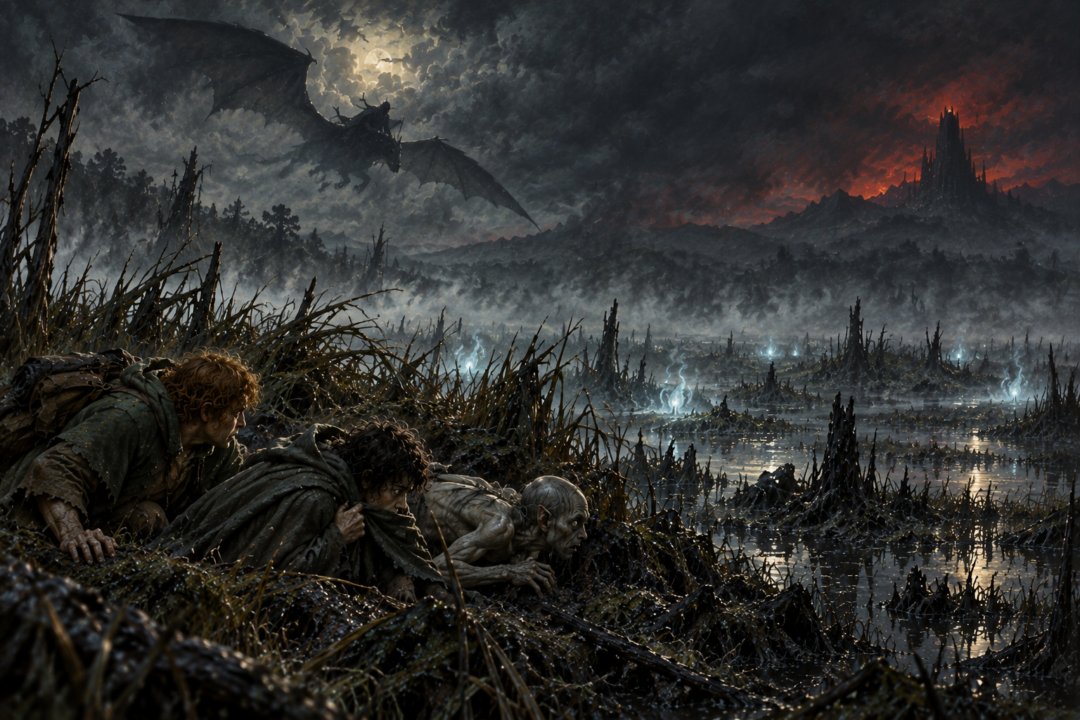
There is no welcoming road through the marshes. There are pools, channels, mud, mist, foul vegetation, uncertain ground, and lights that seem to invite travelers away from safety. Somewhere beyond them lies Mordor. Somewhere beneath their waters appear the faces of warriors killed thousands of years before.
And through all of it goes Gollum.
The text does not literally say that Frodo and Sam must place every foot precisely inside Gollum’s footprints. But the underlying reality is even more unsettling: they must follow his chosen course closely because he possesses knowledge of a route they cannot independently read.
For perhaps the first time in the Quest, survival depends on trusting the experience of someone who may eventually betray them.
The Dead Marshes Are Not Simply a Swamp
When Gollum leads the hobbits down from the Emyn Muil, he takes them into a landscape that seems almost designed to erase certainty.
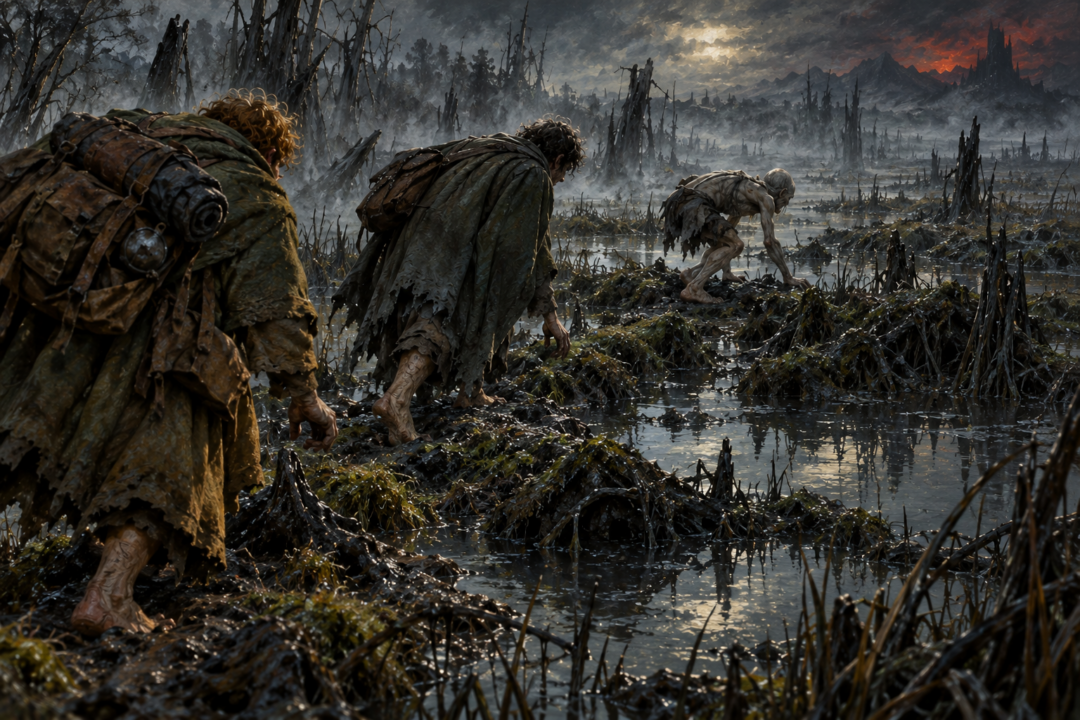
The marshes are described as a miserable country of stagnant waters, mud, reeds, mist, and deceptive pools. Their surfaces are covered in sickly vegetation rather than healthy greenery. Movement is slow and exhausting. The travelers have to negotiate watercourses and patches of uncertain ground while Gollum searches out the way.
That distinction matters.
Gollum is not following a maintained path. He is navigating a landscape in which the safe route is difficult for Frodo and Sam to distinguish from the dangerous terrain around it.
This is why his local knowledge suddenly becomes extraordinarily valuable.
Gollum has been in this region before. Earlier in his long wanderings, he had approached Mordor and learned enough of the country around it to guide the hobbits toward the Black Gate. Frodo and Sam, by contrast, have never seen the Dead Marshes.
If they lose Gollum’s route, they cannot simply consult a signpost and recover it.
They are following knowledge stored in a living guide.
Why Gollum Knows What the Hobbits Do Not
Gollum’s usefulness is easy to underestimate because he rarely resembles a conventional guide.
He crawls, sniffs, mutters, disappears briefly into the darkness, and seems almost animal-like in his familiarity with unpleasant places. Yet those same characteristics make him exceptionally suited to this stage of the journey.
For centuries, Gollum survived by secrecy. After losing the Ring, his search eventually carried him far from the Misty Mountains and toward Mordor. He knows something of the approaches to the Black Land and, crucially, understands dangers that Frodo and Sam cannot immediately recognize.
In the marshes, experience matters more than courage.
Sam can be loyal, practical, and suspicious. Frodo can possess remarkable endurance. Neither quality tells them whether the patch of earth ahead will hold their weight.
Gollum sometimes has to investigate the way carefully. The crossing is not effortless even for him. This suggests that his knowledge should not be imagined as a perfectly memorized trail of permanent stepping-stones. The marsh is difficult terrain, and he must actively find his passage through it.
So “following Gollum’s footsteps” is best understood as following his decisions: where he advances, where he hesitates, what he avoids, and which direction he chooses through a landscape that offers few reliable visual clues.
The Marshes Have Been Moving for Thousands of Years
The horror of the Dead Marshes begins long before Frodo enters them.
Nearby lies Dagorlad, the Battle Plain before Mordor. At the end of the Second Age, the Last Alliance of Elves and Men fought Sauron’s forces there before advancing into Mordor.
Many died.
Gollum explains that the marshes have spread since those ancient days and swallowed the graves. This is why the landscape carries the memory of the battle even though the fighting occurred more than three thousand years before Frodo’s journey.
That detail transforms the geography.
The Dead Marshes are not merely dangerous wilderness beside an old battlefield. The wilderness has encroached upon the battlefield itself. Water and mud have consumed places where the slain were buried.
Yet what Frodo sees beneath the water cannot be explained simply as preserved corpses.
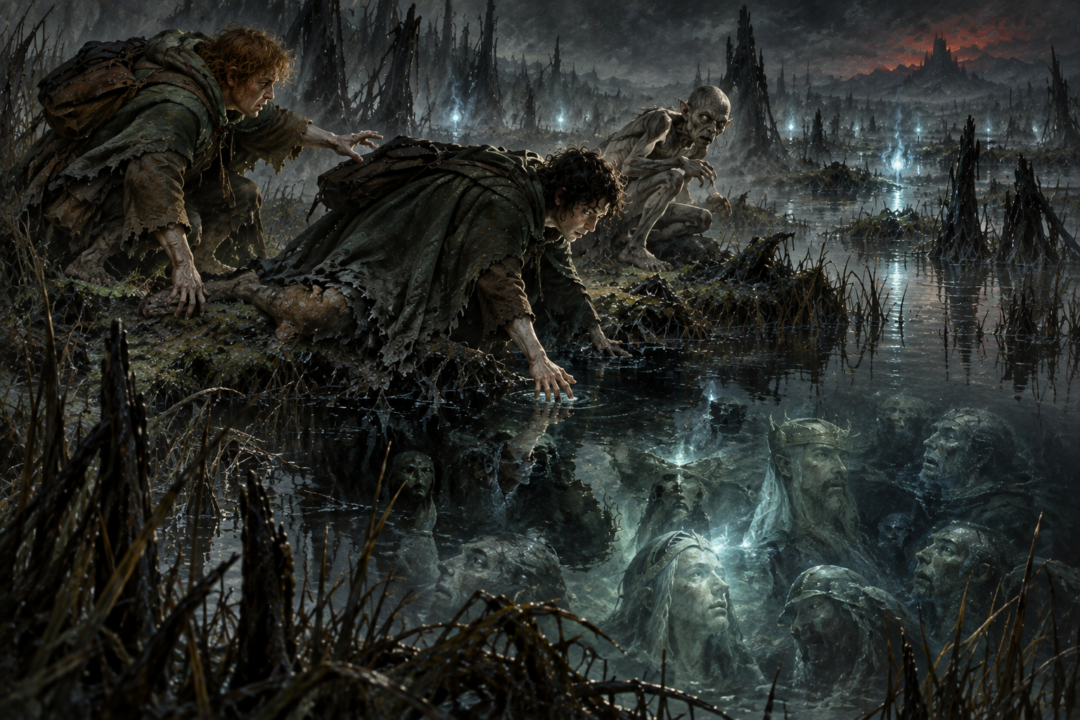
There appear to be faces — Men, Elves, and Orcs — illuminated beneath the pools. Sam questions how bodies could remain after so vast an interval. Gollum himself says, in effect, that what can be seen cannot truly be touched.
The narrative deliberately leaves the phenomenon mysterious.
It is therefore safest not to treat the faces as ordinary physical corpses or to claim a definite supernatural mechanism for them. The text gives us the apparition without fully explaining its cause.
And that uncertainty makes the marshes more dangerous, not less.
The Lights Make Leaving Gollum’s Route Even More Dangerous
Physical terrain is only half the problem.
Lights appear in the marshes.
Gollum calls them corpse-candles and reacts to them with fear born from experience. Frodo becomes fascinated by them and by the faces beneath the water. Sam has to call him back from his strange absorption.
This creates a second reason to remain close to the guide.
A traveler can become lost because he chooses the wrong patch of ground. But in the Dead Marshes, he can also become lost because something draws his attention away from the route.
The distinction is important because the danger is psychological as well as geographical.
Frodo does not need to make a rational decision to abandon Gollum. He only needs to become sufficiently captivated by what he sees.
Gollum understands that danger because he apparently tried to reach the faces himself in the past. His remarks imply personal experience: he knows that the visible shapes cannot simply be reached and touched.
Here, bizarrely, Gollum becomes the voice of restraint.
The creature consumed for centuries by desire for the Ring is the one warning Frodo not to reach for something beautiful and terrible that lies beyond the safe path.
Following Gollum Is Also a Form of Concealment
There is another reason the route matters.
Frodo and Sam cannot approach Mordor like an army.
Their entire mission depends upon secrecy. They are carrying the One Ring toward the place where Sauron would least want it taken, and they have no strength capable of forcing a passage through his defenses.
Gollum’s route through the marshes serves that larger strategy.
It leads them through country that is hideous, difficult, and obscure rather than along an obvious approach. That does not make them safe. During the passage, a Nazgûl passes overhead, and its presence terrifies Gollum. Frodo also feels the oppressive proximity of the Enemy more strongly as they move eastward.
But the central logic of the Quest remains intact: places unsuitable for armies may still be usable by three small travelers.
This is one of the great ironies of Frodo’s road.
The more impossible the landscape looks, the more useful it can become to people whose survival depends on avoiding ordinary roads and ordinary expectations.
Sam Understands the Other Danger: Gollum Himself
Of course, there is a problem with depending on Gollum.
Sam does not trust him.
His suspicion is not irrational. Gollum remains divided by conflicting desires. His attachment to Frodo, his oath concerning the Ring, his fear, and his longing for the Precious pull him in different directions.
The marsh crossing therefore produces an unusual kind of tension.
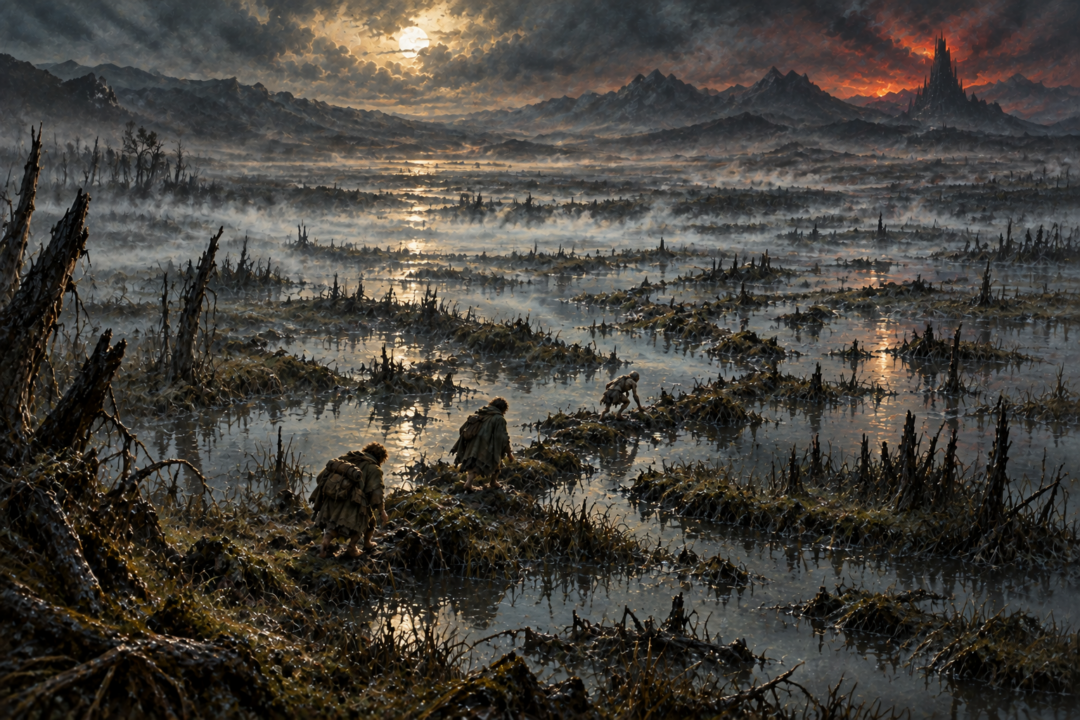
Sam must distrust Gollum without refusing his guidance.
He can watch him. He can question him. He can remain ready for betrayal. What he cannot sensibly do is stride away across the marsh and choose his own route merely to prove independence.
That would exchange a possible future betrayal for an immediate environmental danger.
Frodo understands something else as well: Gollum is not merely useful. He is a ruined being whose fate is bound up with the same Ring Frodo carries.
That relationship gives the journey through the marshes a deeper moral dimension. Frodo follows someone who represents one possible end of prolonged possession of the Ring. The guide ahead of him is both necessary companion and warning.
Gollum’s Knowledge Has Limits
The marshes also prevent us from romanticizing Gollum as an infallible wilderness guide.
He can get them through the Dead Marshes, but he cannot solve the larger problem of entering Mordor at the Black Gate.
When they eventually reach the Morannon, Frodo sees that attempting to enter there is effectively hopeless. The Gate is guarded, watched, and prepared for war.
Gollum then reveals that he knows another way.
That second route will ultimately lead toward Cirith Ungol — and toward his planned betrayal involving Shelob.
This changes how we should read his earlier usefulness.
Gollum can genuinely save Frodo from one danger while later leading him toward another.
Both things can be true.
His knowledge of the Dead Marshes is real. His warnings there are valuable. His later treachery does not retroactively make every piece of guidance false.
That ambiguity is precisely what makes following him so uncomfortable.
The Real Trap of the Dead Marshes
The deepest danger in the Dead Marshes is not simply that the ground may swallow Frodo and Sam.
It is that the landscape removes their independence.
In the Shire, Sam understands the earth beneath his feet. On the road, Aragorn can read tracks and terrain. In Moria, Gandalf possesses memories and knowledge that help choose the way.
Here, those familiar sources of confidence are gone.
The hobbits are reduced to watching Gollum.
When he goes forward, they follow. When he avoids something, they should avoid it. When the corpse-lights beckon away from the route, his experience tells them not to heed them.
The text never establishes a magical rule that only Gollum’s literal footprints are safe. The reality is subtler and more convincing: the Dead Marshes are a shifting, confusing, supernatural-haunted wilderness, and Gollum knows how to navigate them better than his companions.
That creates one of the Quest’s cruelest contradictions.
Frodo and Sam are trying to save Middle-earth from the consequences of the Ring, yet for a crucial stretch of the road they survive because they follow the creature the Ring has already destroyed.
In the Dead Marshes, the safest place for the Ring-bearer is directly behind Gollum.
And that is exactly what makes the path so frightening.
Sources & Notes
This article is based on close reading and interpretation of Tolkien's published works and related source material where relevant.