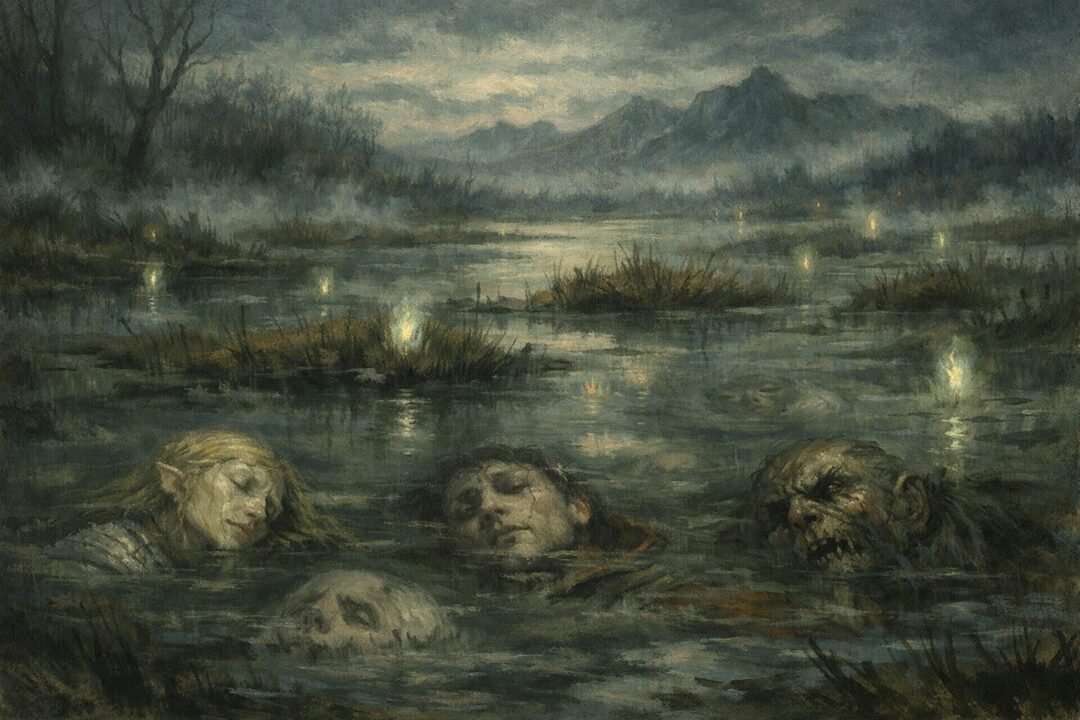
Few places in The Lord of the Rings feel as quietly wrong as the Dead Marshes.
They are not dramatic.
There is no fortress rising from the earth.
No throne.
No ruling enemy casting orders from above.
The land itself seems almost passive—flat, waterlogged, and silent. Reeds sway. Pools reflect the sky. The ground offers no clear boundary between solid footing and collapse.
And yet, travelers die there.
Not in battle.
Not in glory.
Often without anyone striking a blow.
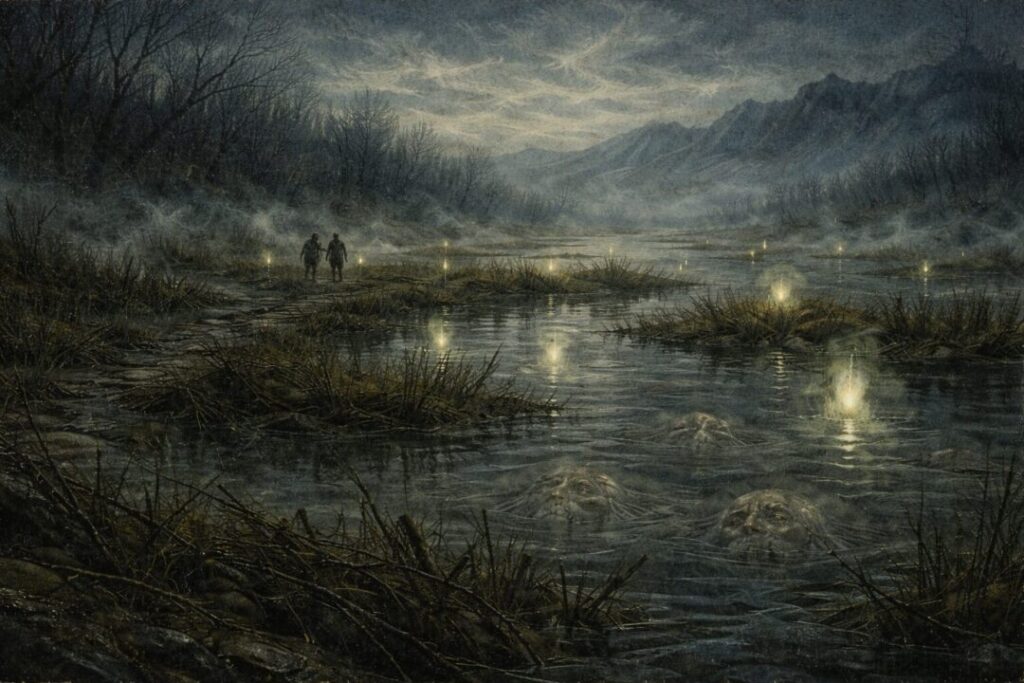
When Frodo, Sam, and Gollum pass through the Dead Marshes in The Two Towers, Tolkien presents something unusual. The danger is constant, but vague. The threat is everywhere, but never clearly defined. Frodo is drawn to the water. Sam feels dread without fully understanding why. Gollum is terrified—not of attack, but of attention.
The marshes don’t do anything.
They simply are.
And that is precisely why they are so dangerous.
A Battlefield That Never Ended
The Dead Marshes lie north of Mordor, formed after the Battle of Dagorlad at the end of the Second Age—a cataclysmic conflict where Elves and Men fought Sauron’s forces for years before the final siege of Barad-dûr.
This was not a single clash, but a grinding war of attrition. Armies marched, retreated, returned. Bodies fell by the thousands. The land was trampled, flooded, and soaked with blood.
When the war finally ended, victory did not bring closure.
The dead were countless.
And many were never buried.
Tolkien describes their faces as clearly visible beneath the water: pale lights revealing eyes, hair, and expressions frozen at the moment of death. Elves, Men, and Orcs lie together, indistinguishable now except by shape and sorrow.
This matters.
In Middle-earth, burial and remembrance are not merely cultural practices—they are acts of order. Tombs, mounds, songs, and names give the dead their place within the world’s moral structure. Even enemies are often granted some form of acknowledgment, a recognition that death has meaning and finality.
When death is denied that dignity, it does not simply disappear.
It lingers.
The Dead Marshes are not merely wet ground over corpses. They are a place where death was never resolved—where history stalled instead of concluding.
Not Ghosts—Something Worse
A common mistake is to think of the Dead Marshes as haunted in the usual sense.
But the dead do not rise.
They do not speak.
They do not pursue the living.
There is no army of spirits waiting beneath the water. No revenge-driven wraiths clawing upward.
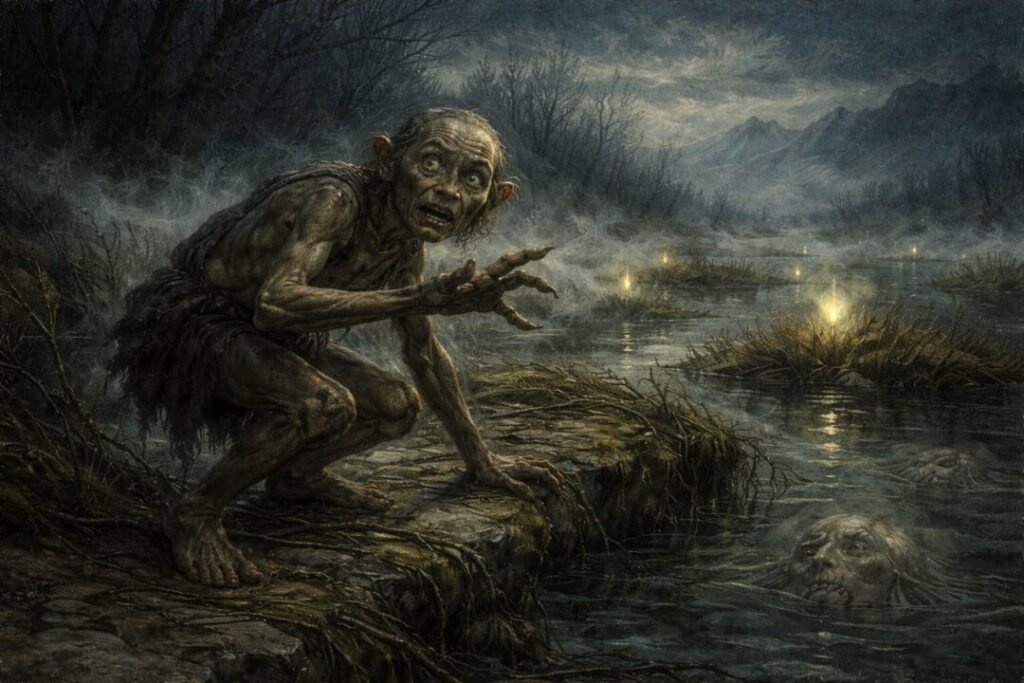
Gollum’s warning is revealing: “Don’t follow the lights.”
The danger is not aggression—it is attraction.
The corpse-lights do not threaten. They invite. The faces beneath the water stir pity, horror, curiosity. They feel close. Familiar. Almost reachable.
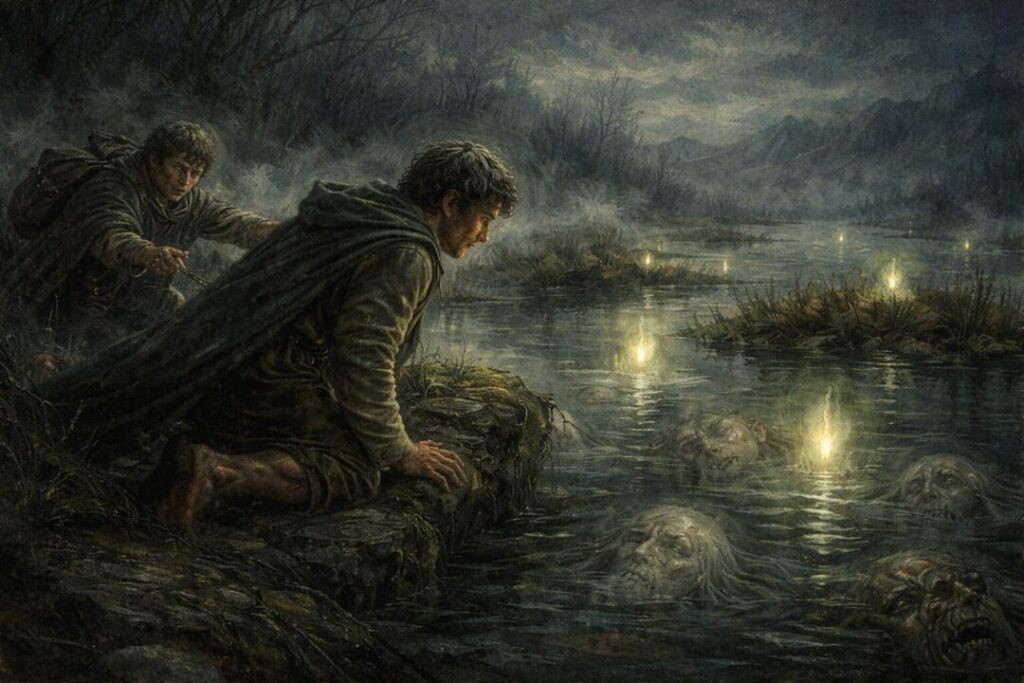
Frodo, especially sensitive to unseen forces, feels compelled to look longer than he should. He wants to understand what he is seeing. He wants to make sense of it. He leans closer, as though meaning itself might be found just beneath the surface.
This is how the marshes kill.
Not by force, but by delay.
A step too far.
A pause too long.
A moment of fascination in a land where footing is never secure.
The marshes reward attention with death.
The Pull of Memory and the Weight of Witness
What makes the Dead Marshes especially dangerous is that they do not simply trap the body—they trap the mind.
The faces beneath the water do not accuse, but they witness. They testify silently to a past that refuses to fade. To look at them is to be pulled backward into an age of slaughter and despair.
In Tolkien’s world, memory has power.
Songs preserve history. Names carry meaning. The past is never truly gone—it presses forward, shaping the present. The Dead Marshes weaponize this principle. They force the living to confront death without context, resolution, or meaning.
There are no songs here.
No burial mounds.
No names spoken aloud.
Only faces, stripped of story.
To linger among them is to risk becoming part of the same unfinished memory.
Corruption That Outlives Its Master
One of Tolkien’s recurring ideas is that evil leaves scars even after it is defeated.
Sauron was overthrown at the end of the Second Age.
His armies were broken.
His physical form was destroyed.
But the Dead Marshes remain.
They are proof that some corruption does not vanish when the tyrant falls. It seeps into land, memory, and history itself. Evil reshapes the world in ways that cannot simply be undone by victory.
The marshes are not actively malevolent. They do not choose to kill.
They are tainted—saturated with the spiritual residue of mass death, terror, and despair. The land itself has absorbed the trauma of what occurred there.
This is why they still kill centuries later.
Not because anyone wills it.
But because no one healed it.
Frodo, the Ring, and the Invitation to Look Back
Frodo’s reaction to the Dead Marshes is not accidental.
As Ring-bearer, he is especially vulnerable to places where the boundary between seen and unseen grows thin. The Ring heightens perception, but it offers no protection. It draws Frodo toward suffering, history, and doom—not through command, but through fascination.
In this way, the Dead Marshes mirror the Ring itself.
They do not order.
They entice.
They suggest that understanding lies just a little closer, that looking a little longer might yield meaning, closure, or truth.
But once invited, the burden grows heavier.
Sam’s role becomes crucial here—not as a warrior, but as an anchor to the present. He pulls Frodo’s attention away. He refuses to look at the faces. He insists on movement, on forward motion, on now.
Survival requires not looking back.
Why the Marshes Were Never Cleansed
A natural question arises: why were the Dead Marshes never purified, drained, or reclaimed?
The answer lies in Tolkien’s understanding of history.
Middle-earth is not a world where every wound is healed. Some scars remain as warnings. Others remain because the time for healing has passed. The marshes sit too close to Mordor, too saturated with death, too bound to a past that cannot be undone.
They are not simply neglected.
They are beyond restoration.
This is not failure—it is realism. Victory does not erase cost. Peace does not undo damage. Some lands remain broken because what was done there cannot be balanced by later good.
The Dead Marshes stand as a permanent reminder:
Of what war costs.
Of what victory does not undo.
Of how long violence echoes.
A Quiet, Enduring Danger
The Dead Marshes do not belong to the present war of the Ring.
They belong to an older failure.
They kill because they were never meant to be crossed again—only remembered from a distance. When the living step into them, they step into unfinished history, into a space where time stalled under the weight of death.
And Middle-earth, like our own world, is not always kind to those who linger too long among unresolved ruins.
That is why the Dead Marshes still kill.
Not because they are angry.
Not because they seek vengeance.
But because they were never allowed to rest.
And some places, once made that way, never truly will.