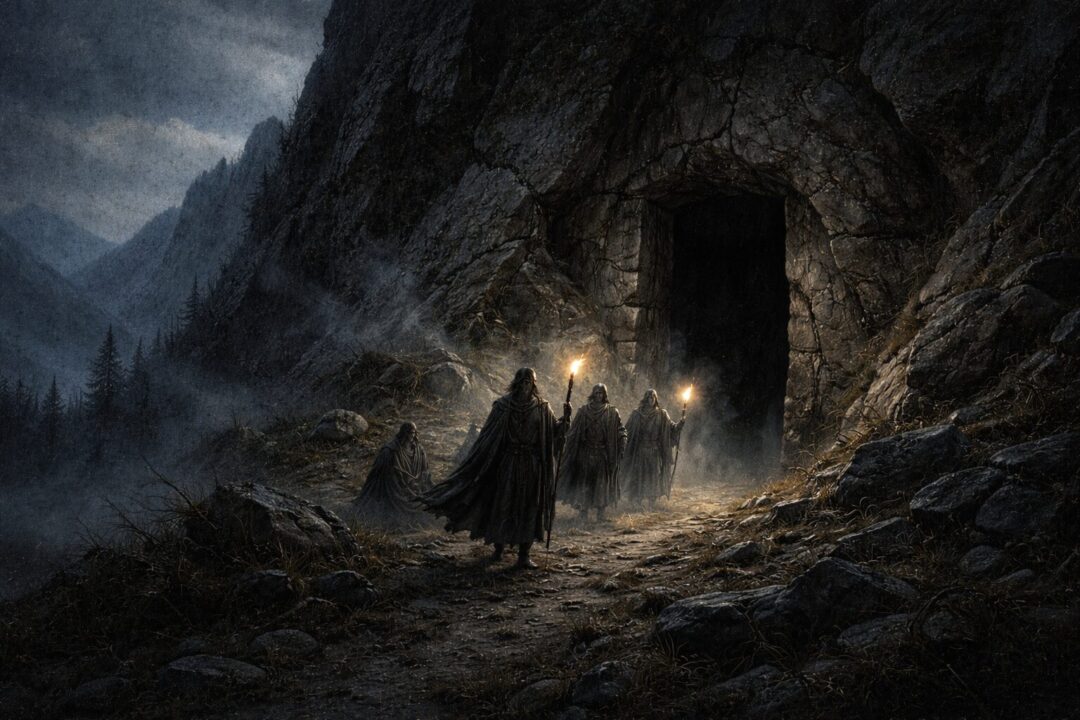
The Dead Men of Dunharrow are usually remembered as a force.
A grey host. A sudden advantage. A terror that turns the tide.
But the texts frame them as something else first.
They are not introduced as an army.
They are introduced as a consequence.
Because the core of their story is not warfare. It is a promise made at a stone, and a refusal that echoes for “years uncounted.”
And what follows is not merely punishment. It is a specific kind of dread: to be unable to finish.
An oath that reaches into the world
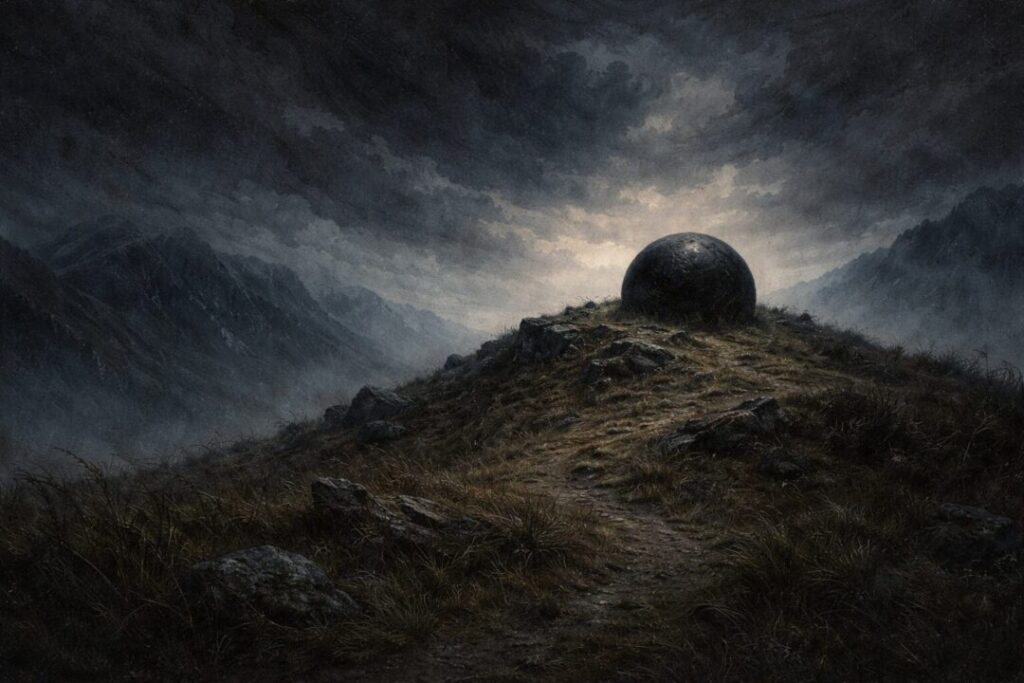
The oath begins in the early days of Gondor, when Isildur establishes a covenant with the Men of the Mountains at Erech. The texts present it as a formal act, tied to a physical witness: a great black stone set upon a hill.
That detail matters, because it quietly tells you how Middle-earth treats oaths.
An oath is not only an inward intention. It is not only a social contract.
It is something made public to the world—fastened to a place, spoken under a witness, and therefore capable of having a reality beyond reputation.
So when war returns and Isildur summons them, their refusal is not framed as a change of policy.
It is a breach.
And the text gives a reason that is chilling in its simplicity: they would not come, “for they had worshipped Sauron in the Dark Years.”
They are not portrayed as men who openly ride to the Enemy.
They are portrayed as men who choose the third option.
They hide.
They try to pass beneath notice, as if silence could erase the sound of a spoken promise.
The curse is not “death.” It is “no rest.”
The heart of the matter is the wording of Isildur’s condemnation.
He does not say they will die.
He says they will “rest never until your oath is fulfilled.”
That is a different kind of sentence.
It implies that death—ordinary death—is itself a kind of rest, a release that should have been available to them. And it implies that their true punishment is not violence, but the denial of departure.
The text then underlines the psychological effect on the living world:
“The terror of the Sleepless Dead lies about the Hill of Erech and all places where that people lingered.”
Notice what spreads.
Not a rumor of massacre.
Not a memory of battle.
A terror attached to places, because the Dead become geographically rooted, unable to go where Men are meant to go when life ends.
This is why the fear surrounding them is different from ordinary fear. It is not simply fear of being harmed.
It is fear of being trapped in an unfinished state.
Why this is worse than death (in Middle-earth terms)
If you want the metaphysical weight of the Oathbreakers, you don’t need extra inventions.
You only need to take the text seriously on its own terms.
Middle-earth treats Men as mortal by nature. Mortality is not just fragility—it is a boundary. And boundaries define meaning.
A life that ends has shape.
A death that concludes has finality.
But the Oathbreakers are denied conclusion. They become a “forgotten people” called out of “grey twilight.”
Grey twilight is not fire and brimstone.
It is the dull, suspended hour where nothing properly begins and nothing properly ends.
So the dread is not the suffering of dying.
It is the horror of not being able to be done.
That is why breaking the oath becomes more fearful than death itself: because it turns death into something that does not complete.
The cultural dread: shame that becomes a landscape
The story also hints at another layer: what their choice did to their identity as a people.
After the curse, the Men of the Mountains “hid themselves in secret places… had no dealings with other men, but slowly dwindled in the barren hills.”
This is not the description of an active faction with banners and councils.
It is the description of a people collapsing into isolation.
Their oath-breaking does not merely stain their honor; it reshapes their way of living. They do not rejoin the world. They recede from it, as if contact itself would force the broken promise back into speech.
In that sense, the curse doesn’t simply punish them after death.
It begins working on them while they are still alive, because it makes their entire existence a kind of hiding.
And when they die, the hiding continues—only now it is metaphysical, locked into the mountains.
So the dread that later cultures feel around Dunharrow and Erech is not irrational superstition. It is a memory written into geography: a people who tried to escape accountability by vanishing, and discovered you cannot vanish from a spoken oath.
The heir returns, and the past becomes present
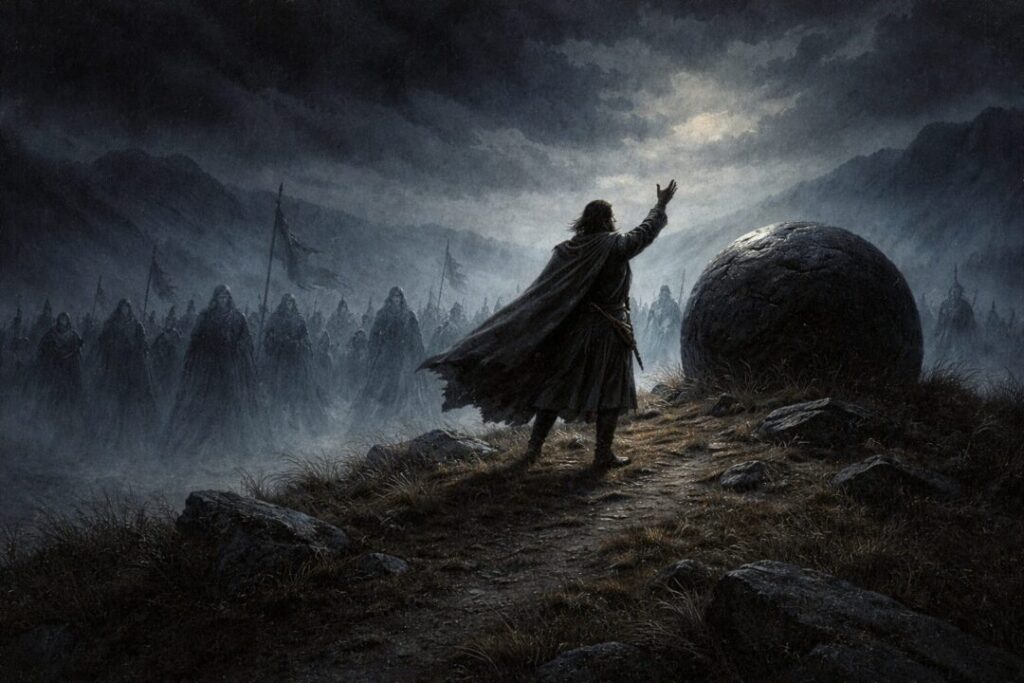
The “legendary song” Aragorn recites is explicit about the logic of the return.
The Dead will stand again at the Stone of Erech.
They will hear a horn in the hills.
They will be called by “The heir of him to whom the oath they swore.”
That is why Aragorn’s journey feels less like clever strategy and more like appointment.
He even says so in plain language: he goes “on a path appointed,” not gladly, but because need drives him.
This is important for understanding the Dead Men’s fear.
Their oath is not a private matter between themselves and a long-dead king.
It is structured to return.
It is built to come due.
So their dread is not only that they did wrong.
It is that they cannot prevent the moment when the world forces the wrong back into the open.
What the Dead actually want
When the Dead finally speak in the story, their desire is stark.
Not conquest.
Not vengeance.
Peace.
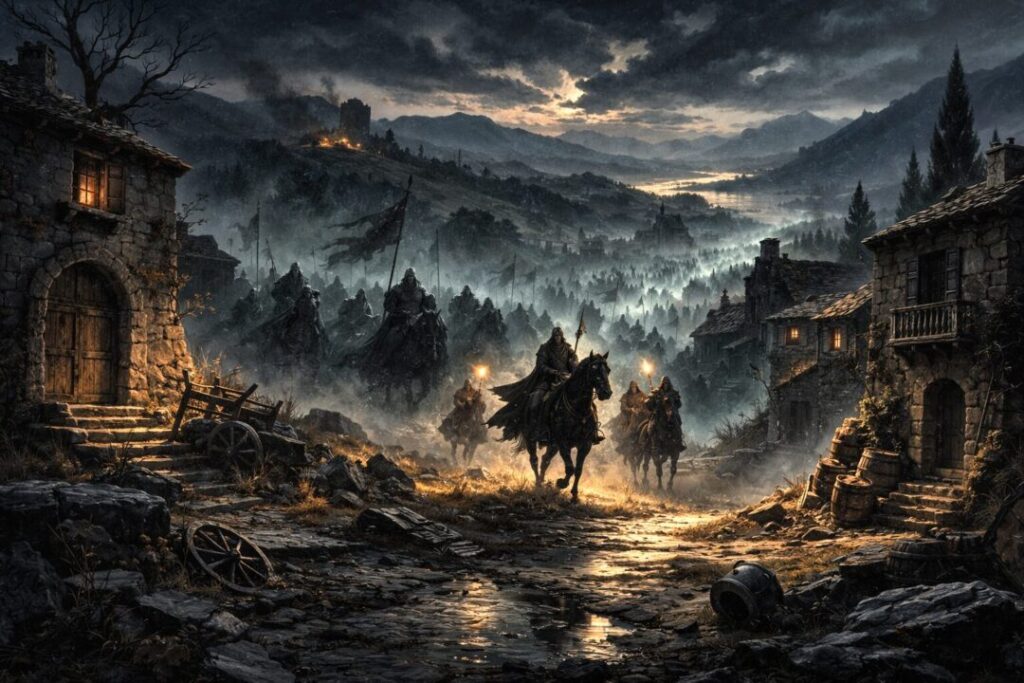
Even the living shout “The King of the Dead is come upon us!” as Aragorn rides, because what approaches is not merely a man—it is the returning weight of a broken oath, made visible again.
And the Dead follow because they are not seeking war as a preference.
They are seeking release as a necessity.
This is where the angle turns: the Oathbreakers did not become terrifying because they were turned into monsters who enjoy haunting.
They became terrifying because they are a picture of what it looks like when a promise outlasts your life—and still demands completion.
They feared breaking oaths more than death because, in their case, death did not end anything.
Death only sealed the refusal into the world.
A conservative conclusion (what we can and can’t claim)
The texts do not explain the full mechanics of the curse in philosophical terms. They do not give a technical map of the afterlife.
What they do give—clearly—is the moral and metaphysical shape:
- An oath is treated as binding enough to define fate.
- Their punishment is specifically “no rest,” implying the loss of a proper ending.
- The result is an enduring “terror” attached to places where they linger.
Everything else—exactly how their spirits are held, and by what ultimate authority—is interpretation beyond what’s directly stated.
But you don’t need more than the text gives to see the dread.
Middle-earth does not treat oath-breaking as a mere social flaw.
It treats it as a wound in the order of things—one that can keep you from rest, keep you from departure, and keep your death from becoming what death is meant to be.
And when the heir finally comes to the Stone, the Dead do not march because they love him.
They march because, at last, the world offers them the one gift they forfeited when they hid:
An ending.