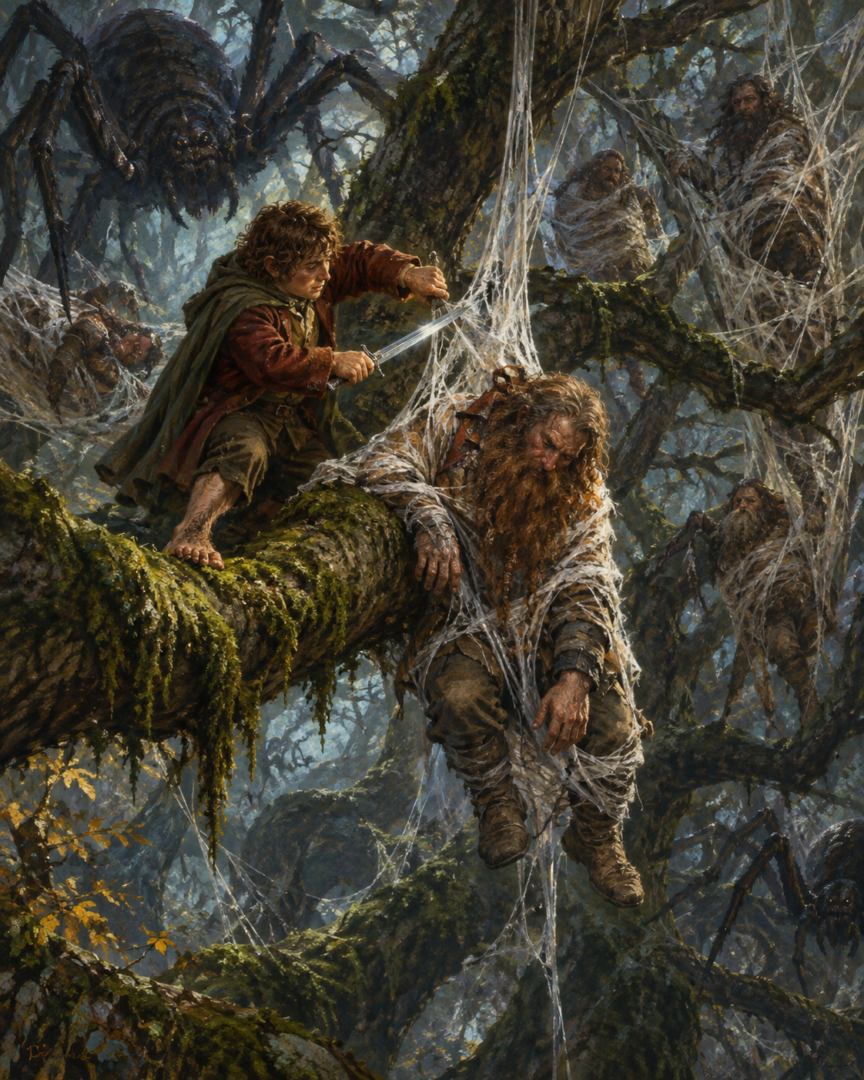
Bilbo Baggins has done what seems almost impossible. Deep in Mirkwood, he has found his captured companions, driven away enormous spiders, and begun cutting the Dwarves out of their silken prisons.
Yet the rescue immediately reveals another problem.
The Dwarves are no longer securely bound, but they cannot simply gather themselves into an effective fighting party and march away. Some can barely stand. Others are confused and weakened. The spiders are returning, and every moment spent struggling to recover gives the creatures another opportunity to surround them.
This is one of the most revealing details in Chapter 8 of The Hobbit, "Flies and Spiders." The danger does not end when Bilbo cuts the webs. In some respects, the hardest part of the escape begins afterward.
The distinction matters because the Dwarves have not suddenly become cowards or forgotten how to fight. Their bodies are exhausted, their senses are unreliable, and the circumstances make coordinated action extraordinarily difficult.
Bilbo must do more than free them. He must somehow turn a group of injured, bewildered survivors into companions capable of escaping together.
The Dwarves Were Already Exhausted Before Their Capture
The spiders do not attack a healthy, well-rested company.
By the time Bilbo discovers his companions hanging in the webs, their journey through Mirkwood has already stripped away much of their strength.
Food has become desperately scarce. The company has struggled through days of oppressive darkness, uncertainty, and discouragement. Their attempts to find relief have repeatedly ended in disappointment.
Bombur's fall into the Enchanted River has made matters worse. His unnatural sleep forces the others to carry him, increasing the burden on companions who are themselves growing weaker.
When the travelers abandon the forest path in pursuit of the Wood-elves' lights, they are acting under the pressure of hunger and desperation.
Their separation follows the mysterious disappearance of the elven feast. The Dwarves eventually fall into the spiders' power, while Bilbo awakens separately and escapes his own attacker.
This sequence is essential to understanding the rescue.
The Dwarves are not beginning their struggle against the spiders with full reserves of strength. They have been worn down before the creatures ever bind them.
Their captivity adds another crisis to an already dangerous physical condition.
Cutting the Webs Does Not Remove the Spider-Poison
The spiders' silk is the most visible obstacle, but it is not the only one.
When Bilbo begins releasing his companions, he discovers that they have been badly affected by their captivity. The chapter explicitly describes the Dwarves as suffering from the spiders' poison.
This explains why severing the threads does not immediately restore their ability to move or defend themselves.
A prisoner may be freed from physical restraints while remaining too weak to escape. That is precisely the difficulty Bilbo encounters.
The text does not provide a detailed medical explanation of the spiders' venom. It does not establish exact doses, lasting neurological effects, or a particular mechanism of paralysis.
What it does establish is enough: the Dwarves are sick, exhausted, and unsteady.
Their weakened condition is visible in their movements and in their difficulty maintaining resistance against the spiders.
The distinction between being unbound and being recovered is central to the scene.
Bilbo can cut silk with his sword. He cannot cut away the effects of hunger, captivity, and poison.
Bombur Shows How Uneven Their Recovery Really Is
Bombur's condition makes the problem especially clear.
During the rescue, he is particularly helpless. After Bilbo begins cutting the Dwarves loose, Bombur falls from the web rather than recovering his footing and joining the others.
The spiders continue to threaten him, and his companions must prevent him from being captured again.
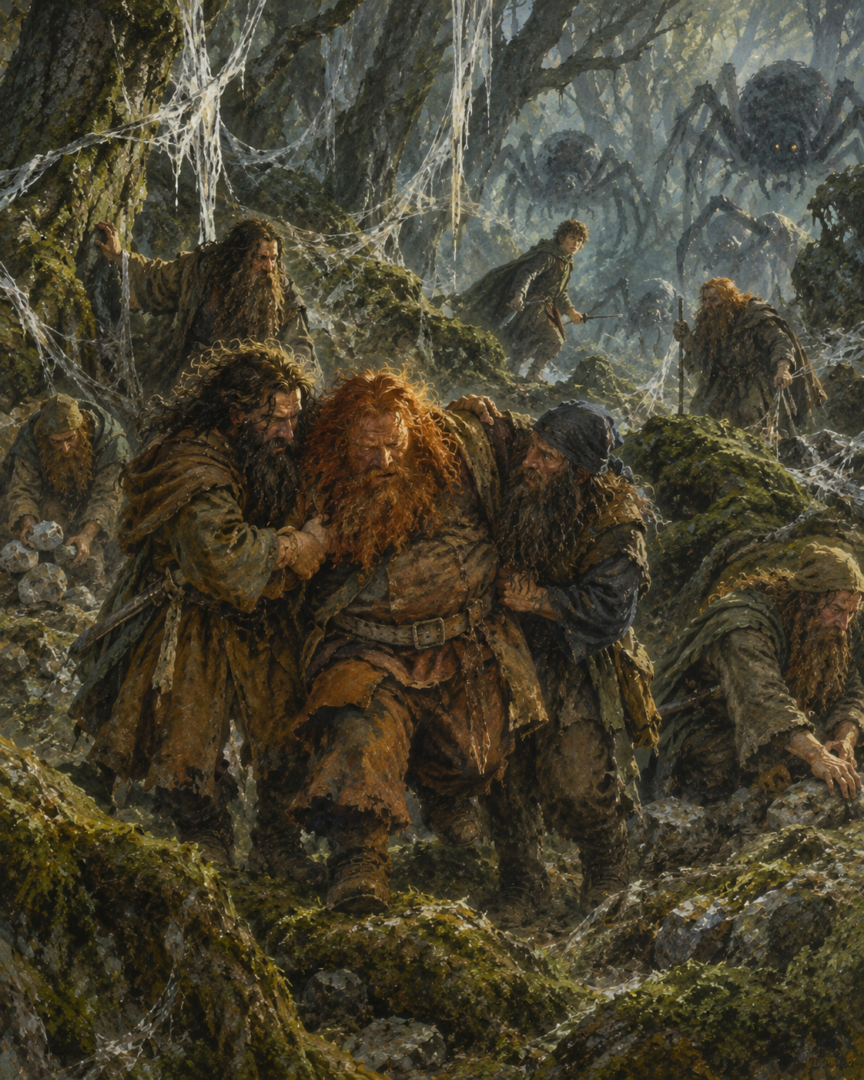
Later, when the company gathers to resist the surrounding creatures, Bombur requires physical support from Bifur and Bofur.
This detail is important because it shows that the Dwarves are not all functioning at the same level.
Some can fight. Some can move only with difficulty. Bombur needs help simply to remain with the group.
His earlier experience in the Enchanted River also belongs to the wider story of the company's exhaustion, although the text does not establish that the river's enchantment is still directly affecting him during the spider battle.
The immediate evidence is his weakness after captivity.
And Bombur is not the only one struggling.
At one point in the fighting, only four Dwarves are able to stand firmly. The others are still participating in the struggle as best they can, but the company cannot sustain a prolonged defense.
This is not a situation in which twelve equally capable warriors can simply form an orderly fighting group.
It is a desperate attempt to keep weakened companions alive while enemies attack from several directions.
The Rescue Happens While the Spiders Are Still Attacking
Another reason the Dwarves cannot coordinate immediately is that Bilbo has no opportunity to complete the rescue in safety.
His initial strategy depends on distraction.
Using his invisibility and his voice, he draws many of the spiders away from their captives. He then returns to the webs and begins cutting the Dwarves loose.
But the diversion cannot keep every spider away indefinitely.
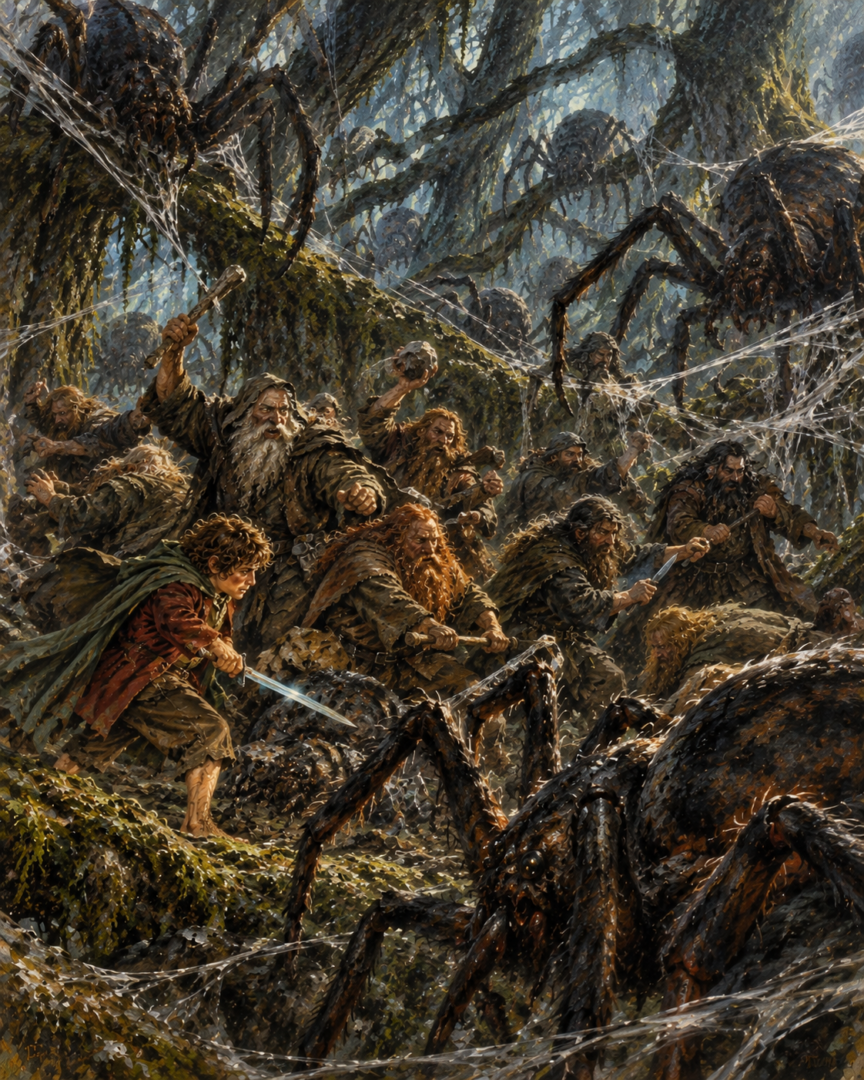
The creatures return before the company has recovered, and Bilbo must shift between freeing his companions and fighting their attackers.
The Dwarves are therefore trying to regain their footing in the middle of an ongoing battle.
They cannot calmly assess their injuries, distribute weapons, or decide upon a route.
Every movement takes place under immediate threat.
The spiders can also use the surrounding forest against them. Their webs stretch between trees, and they begin attempting to enclose the company again.
Escape requires more than overcoming individual enemies. The travelers must break out of a dangerous area before the spiders can trap them a second time.
That makes hesitation especially costly.
Even a Dwarf strong enough to strike an attacker may not be strong enough to fight, move through the forest, and assist a weaker companion for long.
Why Fighting Back Is Not the Same as Escaping
The Dwarves are not entirely helpless after Bilbo frees them.
This is an important distinction.
They use whatever weapons are available, including knives, sticks, and stones. They fight repeatedly and kill or drive off a number of spiders.
Their resistance demonstrates that they retain courage and some capacity for action.
But the fighting does not solve their predicament.
The spiders are numerous, the Dwarves are exhausted, and the creatures continue closing in.
A defensive struggle might delay capture without creating a way out.
The company needs to stop thinking only about the enemies directly in front of them and begin moving toward an escape route.
That requires a shared plan.
The difficulty is that the Dwarves are dizzy, surrounded by noise, and occupied with defending themselves. Even understanding instructions becomes a challenge.
In the confusion, each immediate threat demands attention.
A spider descending nearby, a companion falling, or a fresh strand of webbing can interrupt the movement of the whole group.
The chapter therefore presents two different problems: surviving the attack and escaping the battlefield.
The Dwarves can contribute to the first. They still need Bilbo's plan to accomplish the second.
Bilbo's Instructions Are Hard to Follow for a Reason
As the spiders tighten their encirclement, Bilbo decides that he must reveal the secret of his invisibility to the Dwarves.
His plan is straightforward.
He will disappear, draw the spiders away, and give his companions a chance to move together in the opposite direction.
He directs them toward the area where they last saw the elven fires.
But communicating this plan is unexpectedly difficult.
The Dwarves are dizzy, and the sounds of fighting interfere with their ability to understand him. Sticks are striking, stones are flying, and the spiders are still advancing.
Bilbo cannot wait until everyone is comfortable with the instructions.
He has to act before the circle closes.
This is the precise point at which physical weakness becomes a problem of coordination.
The Dwarves do not merely need strength. They need to recognize the same opportunity, move in the same direction, and avoid becoming separated again.
Bilbo supplies the plan, but the others must still understand and carry it out.
His role is not that of a commander directing a trained military formation. It is that of a companion improvising an escape for people who are struggling to think and move clearly.
The difference makes the scene more convincing.
Their confusion is not a failure of loyalty or courage. It follows naturally from what they have endured.
Why Balin's Understanding Changes the Situation
Balin plays a crucial part in turning Bilbo's idea into action.
When Bilbo vanishes and begins calling to the spiders from another direction, some of the creatures are distracted by his voice.
Balin understands the plan better than the others.
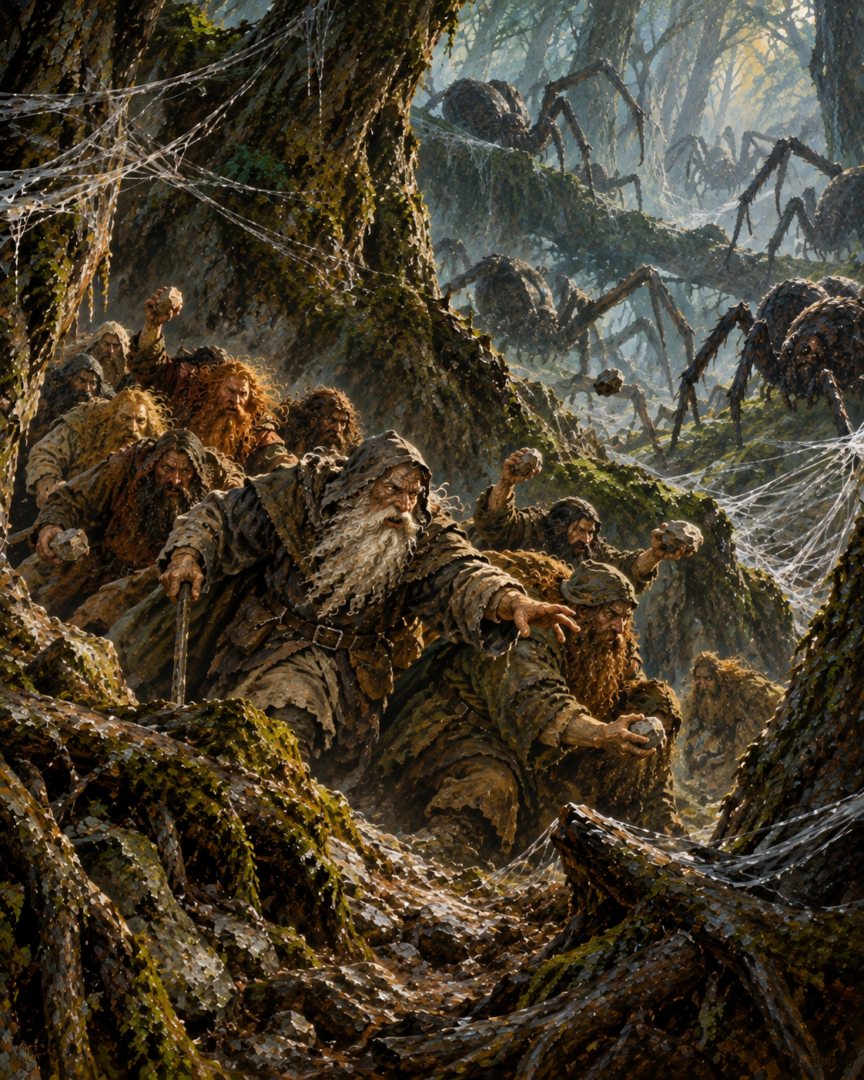
He leads the Dwarves in an attack toward the left, where the company has an opportunity to break through.
The Dwarves gather together and use a shower of stones to force their way past the spiders.
This is the moment when their scattered resistance becomes a coordinated escape.
It does not happen because their strength has suddenly returned.
It happens because Bilbo creates a diversion and Balin helps the others exploit it.
The distinction also prevents the scene from becoming a story in which Bilbo does everything alone.
The Dwarves still have to fight their way out. Balin makes an important decision, and the others act together.
Bilbo's contribution is to create the opportunity that their exhausted bodies could not have secured through continued fighting.
Balin's contribution is to turn that opportunity into collective movement.
Neither action would be enough without the other.
Even Breaking Through Does Not Mean They Are Safe
The Dwarves succeed in escaping the immediate encirclement, but their weakness continues to shape what happens next.
They cannot run quickly.
Their movement is slow and painful, and the spiders continue pursuing them through the trees.
The company has escaped the first trap without escaping the larger danger.
Bilbo must return to the struggle, using Sting to cut webs and attack spiders that threaten his companions.
He is also becoming exhausted.
The escape is therefore not a clean victory followed by an easy march to safety. It is a prolonged retreat in which the travelers repeatedly come close to being overwhelmed.
Eventually the spiders abandon the pursuit as the company approaches the area associated with the Wood-elves' fires. The creatures also fear Bilbo's blade.
Only then can the travelers stop and recover.
The sequence confirms the significance of their earlier weakness.
Their inability to move quickly is not confined to the first moments after the webs are cut. It remains a serious danger throughout the retreat.
Freedom has been achieved in stages: first from the bindings, then from the surrounding spiders, and finally from the pursuit.
The Missing Thorin Reveals Another Limit of Their Coordination
After the survivors finally find a place to rest, they make a disturbing discovery.
Thorin is missing.
He has not been fighting alongside them or following their escape.
The reader later learns that he was captured by the Wood-elves after the disappearance of the feast and taken before their king.
His absence is not caused by the spiders' poison, and he was not among the Dwarves Bilbo released from the webs.
Nevertheless, the delayed discovery is revealing.
During the rescue and retreat, the company has been so occupied with immediate survival that it has not successfully accounted for everyone.
Their normal leader is absent, and the remaining travelers have been forced to act without knowing his fate.
This adds another dimension to the chapter's portrayal of confusion.
Even after the immediate danger passes, the company must confront how little control it has had over events.
Bilbo has saved the Dwarves from the spiders, but the expedition is still incomplete and vulnerable.
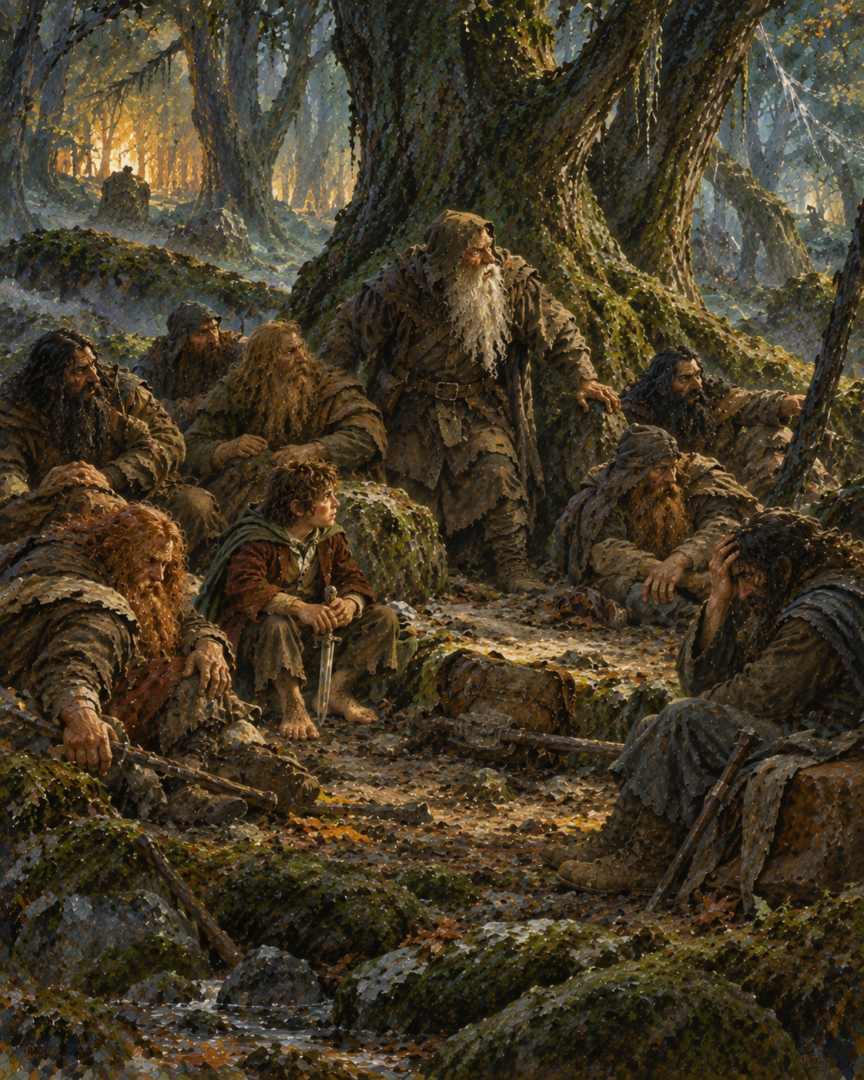
The Real Meaning of the Dwarves' Difficult Escape
The spider episode is often remembered for Bilbo's courage, his sword, and his clever use of invisibility.
Yet its most revealing feature may be the distance between being rescued and being able to escape.
The Dwarves are experienced travelers and determined companions, but neither experience nor determination can instantly reverse physical exhaustion.
Their weakness is not presented as a moral defect.
They fight when they can. They help one another. They follow the escape plan once it becomes clear enough to act upon.
What they cannot do is recover immediately from everything Mirkwood has inflicted upon them.
Bilbo's achievement is therefore more complicated than simply cutting twelve captives out of spider-webs.
He recognizes that releasing them is only the beginning. They still need time, direction, protection, and an opportunity to move together.
Balin's intervention shows that coordination can return even before full physical recovery, provided the group has a workable plan.
And the continuing pursuit shows how fragile that recovery remains.
In the end, the episode reveals a harsh truth about survival in Middle-earth: escaping a trap is not the same as regaining the strength to face what comes next.
Bilbo cuts the webs, but the company survives because its members gradually recover enough unity to move beyond them.
Sources & Notes
- Tolkien Gateway — Flies and Spiders. https://tolkiengateway.net/wiki/Flies_and_Spiders
- Tolkien Gateway — Spiders. https://tolkiengateway.net/wiki/Spiders
- Tolkien Gateway — Bombur. https://tolkiengateway.net/wiki/Bombur
Primary text: The Hobbit, “Flies and Spiders.” These references cover the rescue, attackers, and Bombur’s condition. Physical weakness and poison explain the difficulty; specific medical mechanisms or lasting neurological effects are not established.