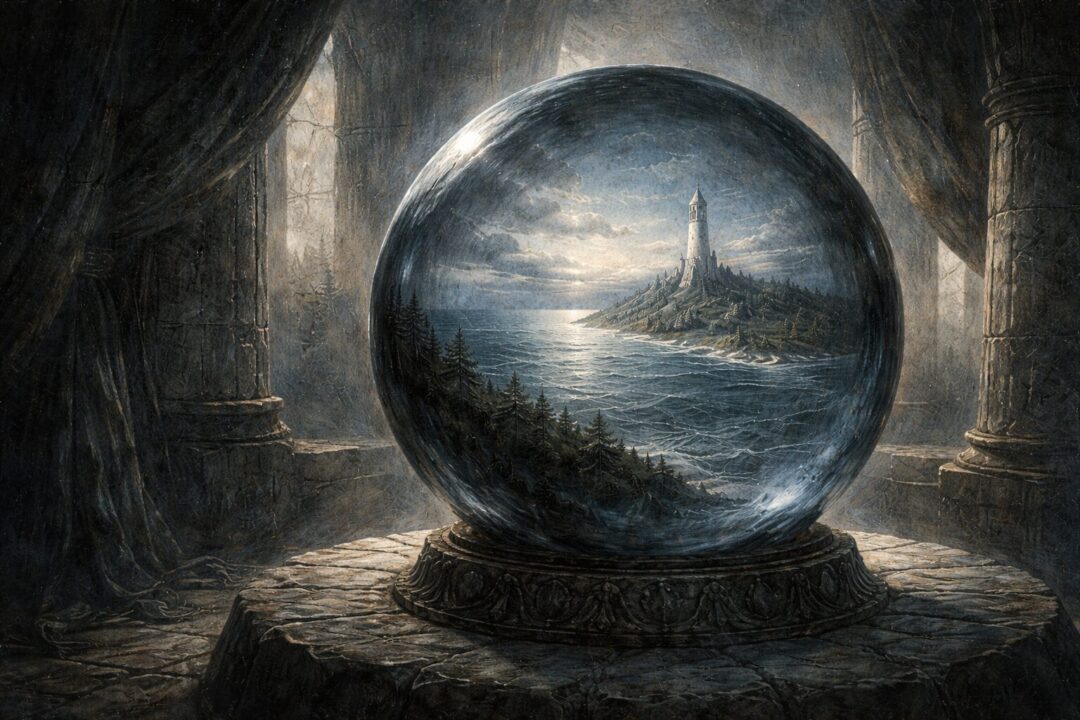
The palantíri feel, at first glance, like the most practical “magic” in Middle-earth.
They are not rings. They do not corrupt by mere touch. They do not demand worship or sacrifice. They are tools—seeing-stones—made for looking and for thought. In the great days of Númenor, they served kings and stewards the way maps and messengers serve later ages: as instruments of awareness and command.
That is why the Elostirion palantír is so unsettling.
Because there was one stone that refused the entire point.
It could not be used like the others.
It did not communicate with the palantíri of Gondor or Arnor. It did not “range” across Middle-earth to show distant places. The texts describe it as a special case—set apart—“unique” in its use. It looked only West, over the Sea, toward Tol Eressëa and the Tower of Avallónë where the Master-stone was kept.
A palantír that only looks one way is not a convenience.
It is a statement.
And once you understand what that statement is, you begin to see why it matters that this tower stood within sight of the Shire, and why the last movements of the Elves and Ring-bearers feel the way they do.
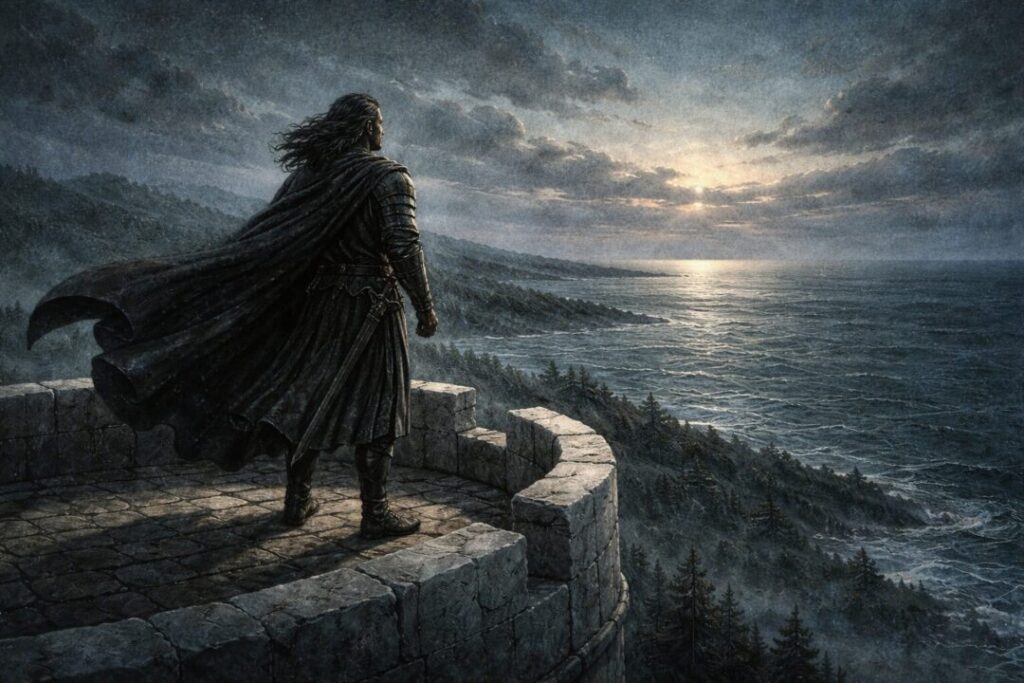
The tower that holds the wrong kind of seeing-stone
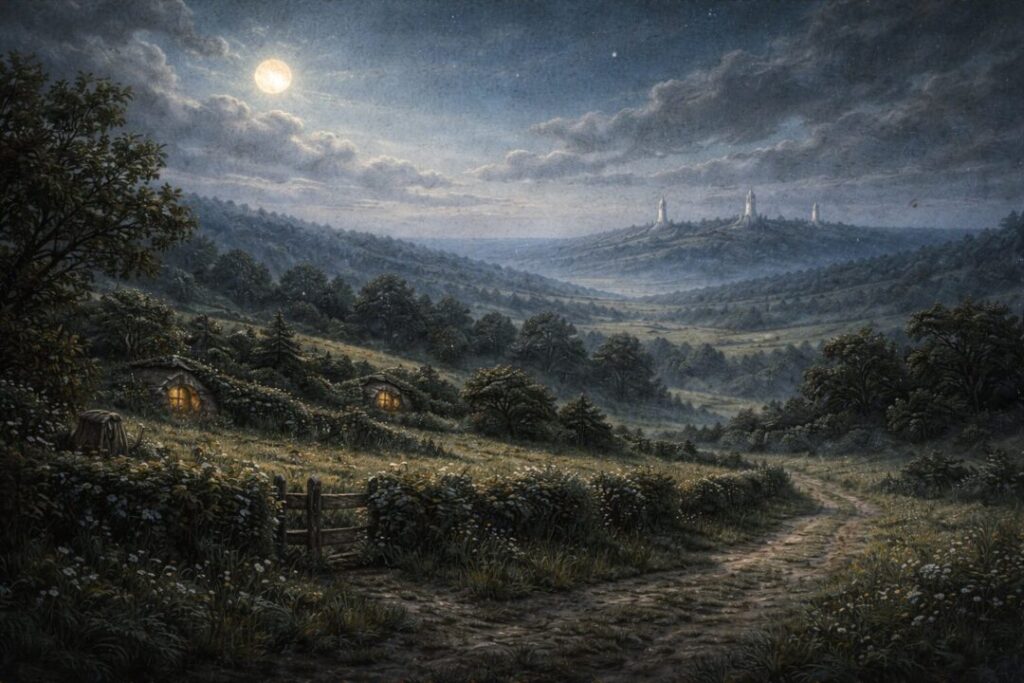
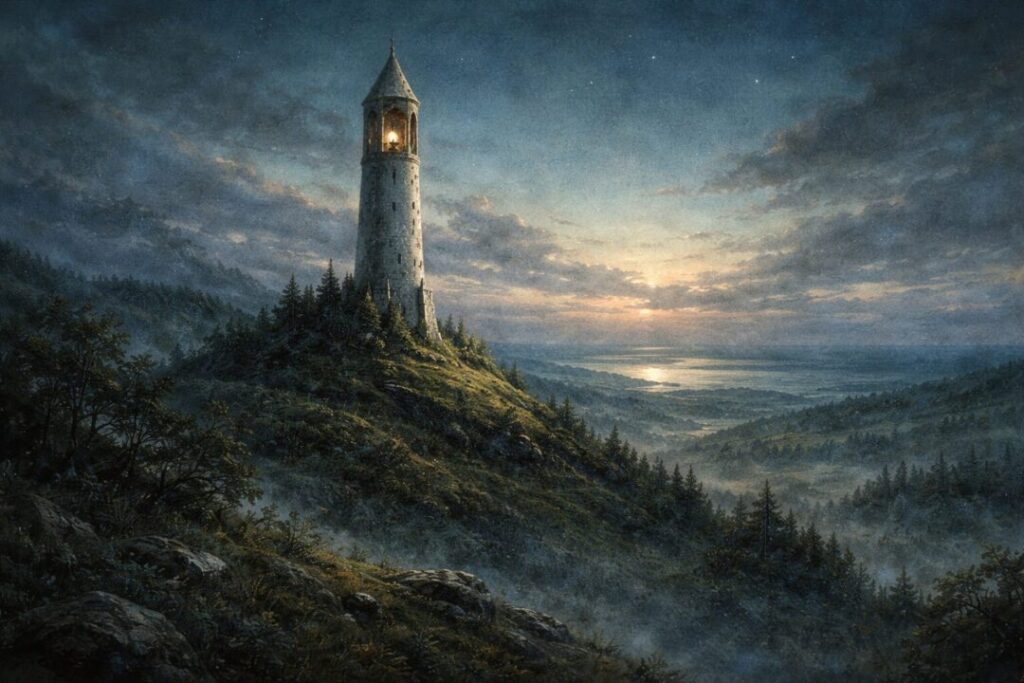
Elostirion was the westernmost and tallest of the White Towers on the Tower Hills (Emyn Beraid), raised by Gil-galad and associated with Elendil. From the Shire, hobbits could see those towers shining far off in the moonlight—distant, clean, and almost unreal.
That distance is part of the point.
The Elostirion-stone does not sit in Minas Tirith or Orthanc, where politics and power circle around it. It sits on the edge—near the Grey Havens, under Elvish guard, close to the road that ends in ships and salt.
It is placed where endings gather.
The stone itself is called the Elendil-stone in later discussion, and the tradition is clear: it was set there so that Elendil could look West. Not to dominate. Not to rule. To look.
Already, that should slow you down.
Because Elendil is a man of immense authority—High King in Exile, founder of Arnor and Gondor—yet the one palantír most associated with him is not an instrument of governance.
It is an instrument of grief.
“In accord” with the Master-stone
Most palantíri belong to a system. They can “answer” one another, and their greatest use is in relationship: one mind reaching another across leagues of land.
But the Elostirion-stone is described as being “in accord” only with the Master-stone on Tol Eressëa.
That phrase matters. It tells you the stone is not simply limited by damage, neglect, or loss of skill. It is aligned—tuned—by design. Its truest counterpart is not in Middle-earth at all, but in the West that mortals cannot reach by ordinary sailing.
Even before you add any philosophy, you can see the shape of the thing:
- A seeing-stone in Middle-earth
- that does not connect to Middle-earth
- but points beyond it, toward the West.
So why would anyone do that?
Because the world changed.
The bent world and the Straight Road
After the Downfall of Númenor, the world is altered. The West is removed from the circles of the world, and the path to Aman becomes something other than ordinary geography. The Elves can still sail the Straight Road. Men cannot.
That is the theological and metaphysical boundary-line of the later ages: not merely “far away,” but set apart.
And this is where Elostirion becomes more than a curiosity.
A palantír that can only look West is not merely looking “over the ocean.” It is looking toward something that has been intentionally withheld from the ordinary reach of mortal life. In other words, it is a device that keeps the West visible but unreachable.
That is exactly what exile feels like.
Elendil’s story begins in catastrophe: Númenor is lost, the world he knew is drowned, and he arrives in Middle-earth not as an explorer but as a refugee. The titles come later. The grief is first.
So the Elostirion-stone becomes a kind of counter-image to the stones of Gondor.
Those stones serve continuity—how to preserve a realm, how to coordinate, how to hold things together.
This stone serves memory—how to survive the fact that something is gone.
It is not for “spying,” and that is the point
Readers sometimes import the Orthanc-stone experience into every palantír: risk, temptation, domination. And it’s true that palantíri can be dangerous in the wrong hands, especially when a stronger will asserts itself through them.
But the Elostirion-stone is almost the opposite problem.
If it cannot be used to look into Middle-earth, it cannot be used to gather intelligence about Middle-earth. If it does not communicate with the other stones, it cannot be used as a node in the political struggle of the Third Age.
It has no strategic value to Saruman or Sauron—because it is not aimed at their world.
That is why it can remain, quietly, under Elvish care.
And that quietness is the clue: this is not a weapon. It is a window that faces the wrong direction.
The Elves who went to look
One of the most telling notes preserved about this stone is that Elves sometimes came to gaze into it, and were sometimes rewarded with a vision—clear but remote—connected with Varda (Elbereth), who dwells in the West.
Even if you never follow every footnote, the narrative effect is powerful: a pilgrimage not for power, but for sight. A journey not to acquire, but to behold.
That fits the emotional geography of late Third Age Elvendom.
The Elves are fading from Middle-earth not because they are weak, but because their time in this land is passing. Their westward longing is not a mood; it is the direction of their destiny.
So Elostirion becomes, in miniature, what the Grey Havens are in full: a place where you stand on the edge of the world and admit what you cannot keep.
Why it matters that this is near the Shire
The Shire is not a coastal realm. Hobbits are not a sea-people. Their stories begin in fields, not harbors.
And yet Tolkien places within their horizon—literally within their landscape—a set of white towers connected to a one-way window to the West.
From early in The Fellowship of the Ring, we are reminded that the Shire is not sealed off from the great movements of the Age. Elves wander near its borders. The Road runs through it. The long defeat of the Elder Days casts a shadow even here.
The Tower Hills are part of that reminder.
Because Elostirion is not simply “an Elvish monument.” It is a physical sign that the West is real, present, shining—and not for you.
That creates a particular kind of sorrow, the kind that makes the ending of the story land the way it does.
When the time comes for Frodo to depart, the West is not introduced as a new idea. It has been there all along, bright on the far hills, half-seen and half-understood.
Elostirion is the West as rumor.
The Grey Havens are the West as choice.
Why would the stone be taken away?
By the end of the Third Age, the Elostirion-stone is removed from Middle-earth and taken over the Sea with the Ring-bearers and the Keepers of the Three.
That move is easy to treat as housekeeping: the Elves are leaving, so they take their treasures.
But the symbolic logic is sharper than that.
If the stone is a window to the West, leaving it behind would mean leaving behind a functioning “view” into something mortals are not meant to pursue. It is not that the stone would suddenly let someone sail the Straight Road—but it could feed the oldest human sickness in Tolkien’s legendarium: the desire to seize what is not given.
Númenor fell by that desire. The longing for the West, when twisted, becomes catastrophe.
So removing the stone fits the moral architecture of the story: certain doors are shut not because they are unreal, but because they are too real to be handled without ruin.
What the Elostirion palantír really is
The Elostirion palantír is not a broken tool.
It is a purposeful limitation.
It embodies the post-Downfall world: the West is not erased, only removed. It can be remembered. It can be seen—sometimes. But it cannot be entered by will or by force.
That is why this palantír matters.
It tells you that Middle-earth is not only losing power as the Ages pass.
It is losing access.
The greatest “magic” in the late Third Age is not the ability to see farther.
It is the discipline to accept what you can no longer reach.
And in that light, Elendil climbing the Tower Hills becomes more than a historical detail. It becomes a portrait of exile: a king who can found realms, fight wars, and establish lines of rule—yet still must climb a green hill to look West, because the one thing he truly wants cannot be regained.
A stone that only looks West is not about information.
It is about the shape of an ending.
And once you notice that, you start seeing the Third Age’s final truth everywhere: the West does not “win” the story by conquest.
It wins by departure.
The last great movement is not a battle.
It is a turning of the eyes—and then a letting go.