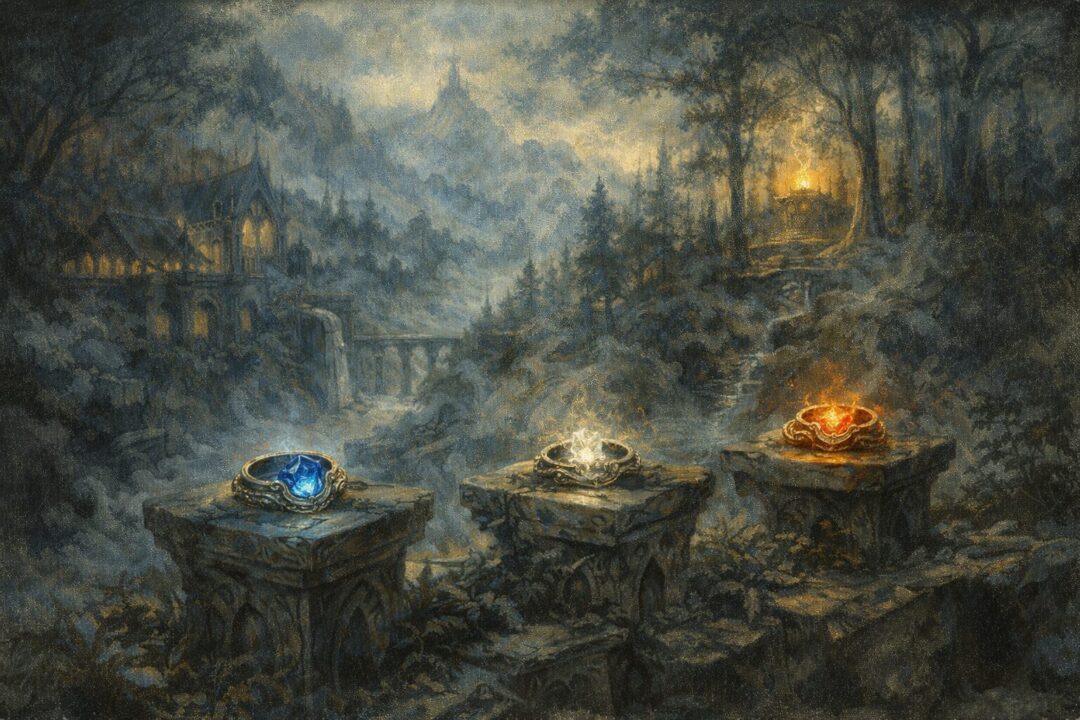
The forging of the Rings of Power stands as one of the greatest achievements—and greatest mistakes—in the history of Middle-earth.
In an age when the world was still young but already beginning to fade, the Elves sought a way to preserve what they loved. Under the guidance of Celebrimbor, the master-smiths of Eregion crafted objects of extraordinary subtlety: Rings that could preserve beauty, slow decay, and hold back the weariness of time.
For a time, it seemed they had succeeded.
The Elven realms flourished. Memory remained vivid. The slow diminishment that haunted the Firstborn appeared, at last, to be delayed. The Rings were not forged as weapons, nor as tools of conquest, but as acts of resistance against loss itself.
Then the One Ring was forged.
And everything changed.
When Sauron revealed himself and claimed mastery over the Rings, the Elves immediately perceived the truth: the knowledge they had relied upon was never fully their own. Ring-craft itself—however fair its intentions—had been shaped by an external will. Not openly. Not crudely. But patiently, quietly, and with devastating foresight.
This realization explains a decision that often goes unquestioned: after Sauron’s betrayal, the Elves never attempted to forge new Rings of Power.
This was not because they lacked the skill.
It was because they understood the cost.
Ring-Lore Was No Longer Safe
The Rings of Power were never independent artifacts. They were components of a single system, designed to function in harmony—and, ultimately, under control.
Even the Three Rings, forged without Sauron’s direct involvement, were bound to the One. Their power flowed through the same unseen structure. When the One Ring was worn, the Three were revealed, laid bare to domination, and rendered unsafe to use.
This was not a flaw that could be corrected with better craftsmanship.
It was fundamental.
Creating more Rings would not have freed the Elves from this danger. It would have multiplied it. Each new Ring would deepen their reliance on a craft whose foundations were already compromised—whose governing principles were no longer fully understood, and no longer fully theirs.
The Elves grasped something crucial: you cannot escape a poisoned system by expanding it.
Ring-lore had become inherently vulnerable to Sauron’s will. Whether he possessed the One Ring or not, the very conceptof Rings of Power was now suspect. To continue forging them would mean accepting a future permanently entangled with the Dark Lord’s designs—whether he ruled openly or remained hidden.
The Elves were not deceived twice.
The Lesson of Eregion
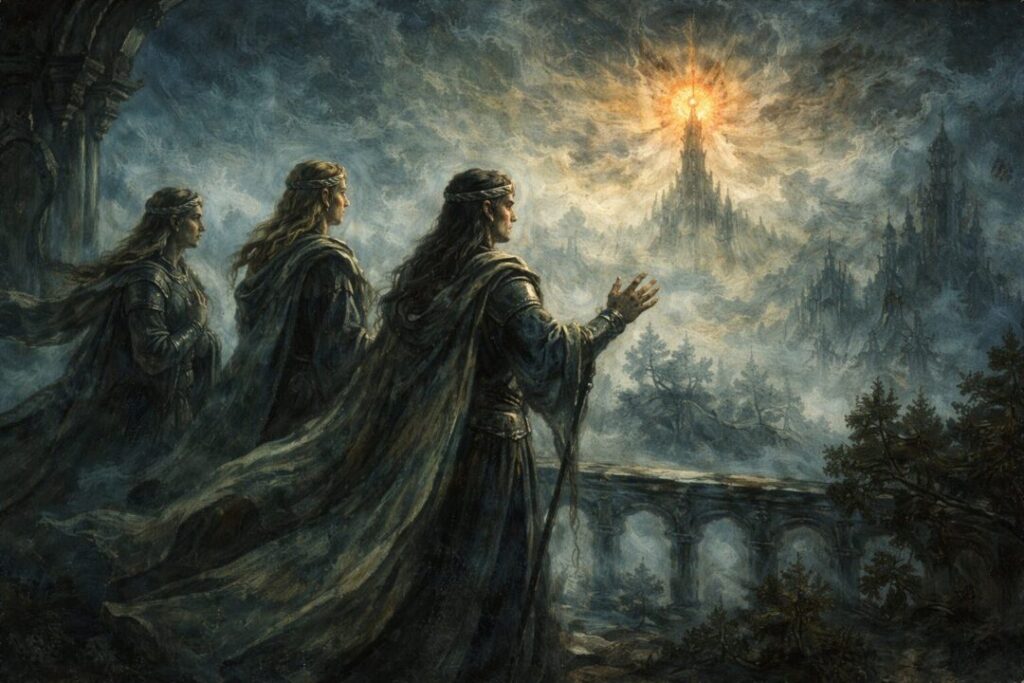
The fall of Eregion was not merely a military catastrophe. It was a philosophical reckoning.
When Sauron came in open war, Eregion was destroyed. Celebrimbor was slain. The great experiment of Ring-craft ended in fire and ruin. But what was lost went deeper than a realm or a master-smith.
The Elves learned that preservation through domination—even subtle domination—was a dead end.
The Rings allowed them to resist time, but at a terrible price: dependence. By attempting to arrest change, they had bound their fate to forces beyond their control. In seeking to preserve Middle-earth as they remembered it, they had invited a power that sought to reshape it entirely.
After Eregion’s destruction, the surviving Elves chose a different path.
They would preserve, not expand.
They would guard, not create.
They would endure, not dominate.
This choice marks a fundamental shift in Elvish behavior during the Second and Third Ages. No new Rings are forged. No attempt is made to recover or replace the lost art. Instead, the Elves turn inward, becoming stewards of memory rather than architects of the future.
Why the Three Rings Were the Last
The continued existence of the Three Rings can make this decision seem contradictory. If Ring-craft was compromised, why were the Three preserved at all?
The answer lies in restraint.
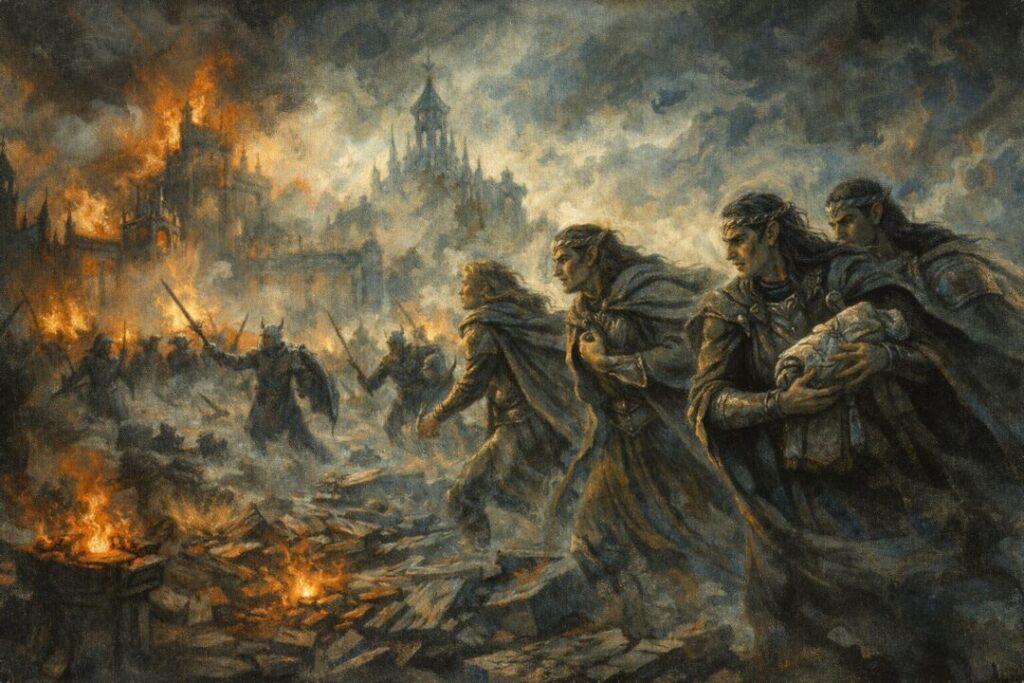
The Three Rings—held by Galadriel, Elrond, and Gandalf—were never tools of command. They did not seek to rule others, nor to impose will. Their power was inward-facing: preservation, healing, protection against decay.
Even so, they were used sparingly.
Their bearers understood that these Rings were not a solution, only a reprieve. They could hold back the tide for a time, but they could not change its direction. And once the One Ring resurfaced, even that reprieve became dangerous.
The Elves knew then that their time was nearly over.
To forge more Rings at that point would have been an act of denial—an attempt to prolong a struggle already decided by the nature of the world itself. The fate of the Rings was bound to the fate of the One. And when the One fell, the power of all the Rings would fade with it.
The Elves accepted this outcome long before it came to pass.
The Elves Chose Restraint Over Power
This decision represents one of the most understated but profound moral choices in Middle-earth.
The Elves did not attempt to “fix” their mistake by creating greater artifacts. They did not escalate. They did not seek dominance to counter dominance.
Instead, they accepted limits.
They accepted loss.
They accepted diminishment.
They accepted the end of their central role in the world’s story.
Where others—Men, Wizards, and Sauron himself—reach for control, the Elves step back. They recognize that not all evils can be undone through craft, and not all wounds can be healed through power.
Their refusal to forge new Rings is not weakness.
It is wisdom.
Why This Matters to the Story of the Third Age
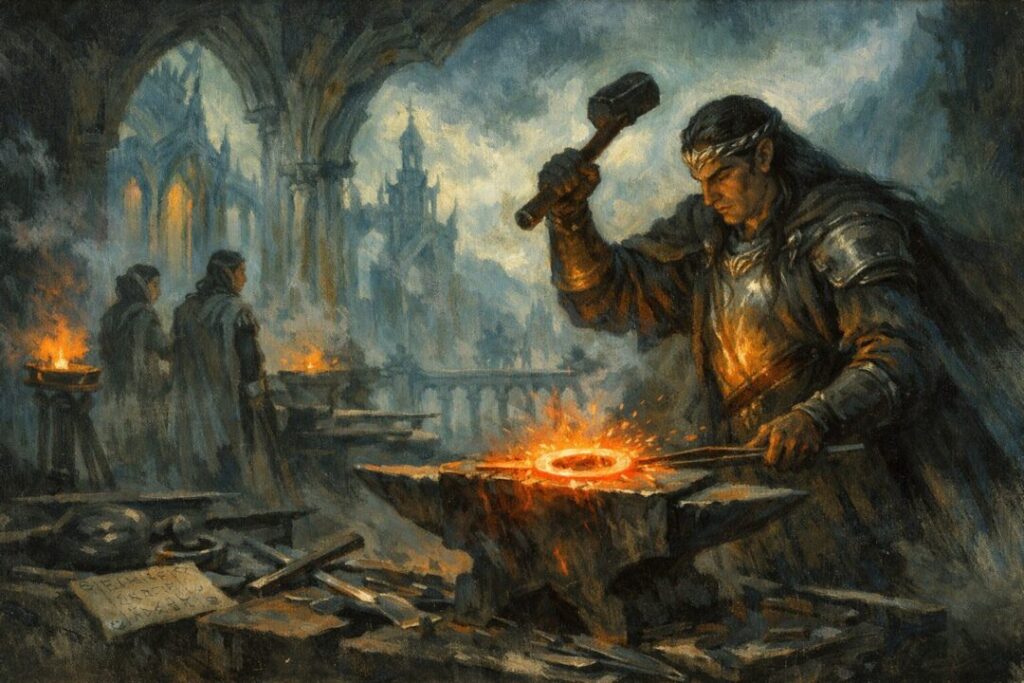
By the time of The Lord of the Rings, the Elves are no longer trying to shape the future. They are preparing to leave it.
Their Rings are fading.
Their realms are quiet.
Their greatest works lie behind them.
Rivendell and Lothlórien are not centers of expansion, but sanctuaries—places held together by memory, care, and restraint. The Elves do not march to conquer Mordor. They do not seek to remake the world in their image.
And that is exactly why the fate of Middle-earth passes to smaller hands.
To Hobbits, whose strength lies in endurance rather than mastery.
To Men, whose time has come to rise without Elvish guidance.
To a future shaped not by preservation, but by change.
The Elves understood something vital: not every problem is meant to be solved by creation. Some are meant to be endured—and then released.
That understanding is why the Rings were never remade.
And it is why, when the One Ring is finally destroyed, the Elves do not mourn the loss of their power.
They depart in peace.