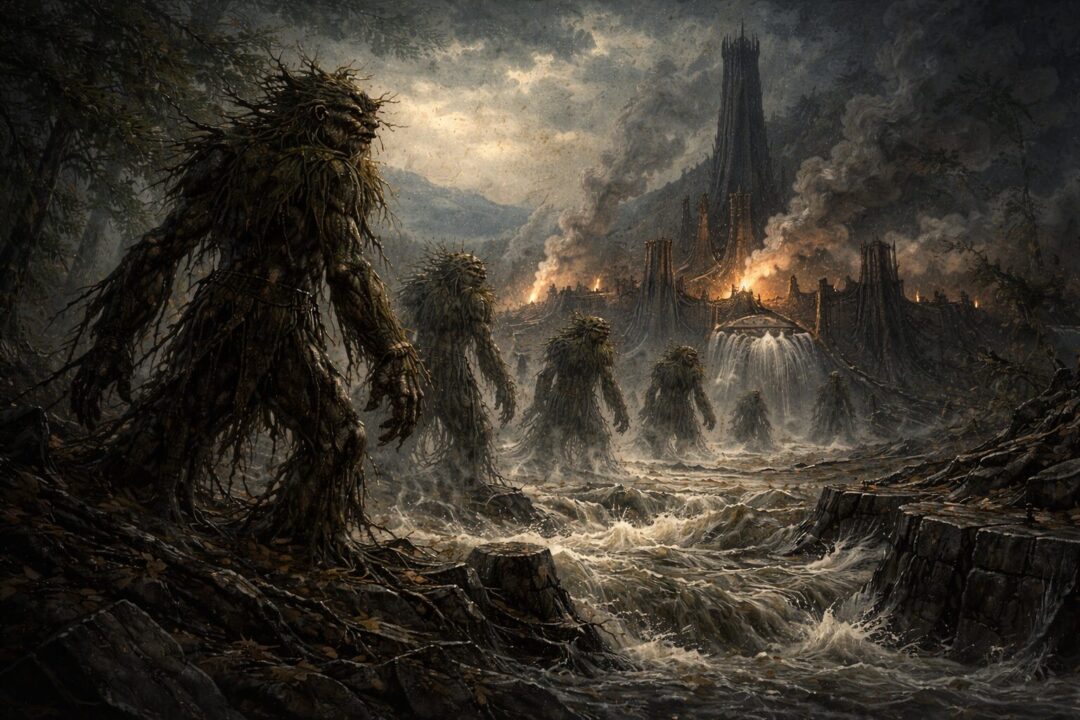
When the Ents finally march on Isengard, it feels sudden—overwhelming, unstoppable. Stone breaks beneath their hands. Water rises and floods the pits. The engines of war are torn apart by living wood and ancient strength.
It feels like a force of nature finally unleashed.
But by the time this happens, the damage has already been done.
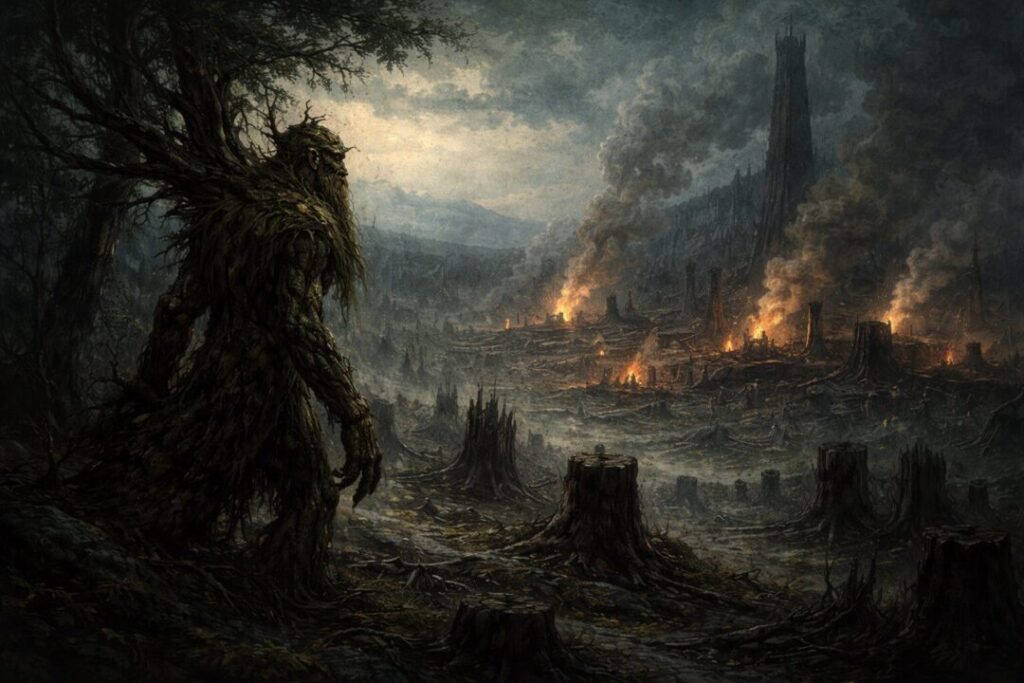
Trees have been felled and burned. Ancient groves have been reduced to fuel. The forest that once bordered Isengard has been gnawed away and fed into furnaces, smoke rising where green once stood.
And all of this happened within sight of Fangorn Forest—the oldest living woodland in Middle-earth.
So why didn’t the Ents intervene sooner?
Why did the shepherds of the trees allow such destruction to continue until it reached the point of no return?
The answer lies not in carelessness or weakness, but in the very nature of the Ents themselves—and in the slow, deliberate way evil works in Middle-earth.
The Ents Were Never Wardens in the Human Sense
The Ents are often described as guardians of the forest, but this image can be misleading.
They are not soldiers.
They are not rangers.
They do not patrol borders or enforce laws.
Ents are shepherds in the most ancient sense of the word. Their task is not to rule the forest, but to tend it—to encourage growth, to remember names, to listen, and to speak when speech is needed.
They live within the forest, not above it.
Treebeard himself makes this clear. Ents do not hurry. They do not assume malice quickly. They do not leap to conclusions or intervene unless the harm is unmistakable and enduring.
For long ages, this way of being worked.
Fangorn was feared. Few dared enter it, and fewer still dared harm it openly. Those who did often vanished or fled, and word spread quickly enough among those who mattered.
But the Third Age was different.
The world had grown crowded, loud, and impatient—while the Ents had grown slower, more inward, more rooted in memory than in vigilance.
And Saruman understood this perfectly.
Saruman Did Not Begin With Open Destruction
Saruman’s genius—if it can be called that—was not in raw power, but in timing.
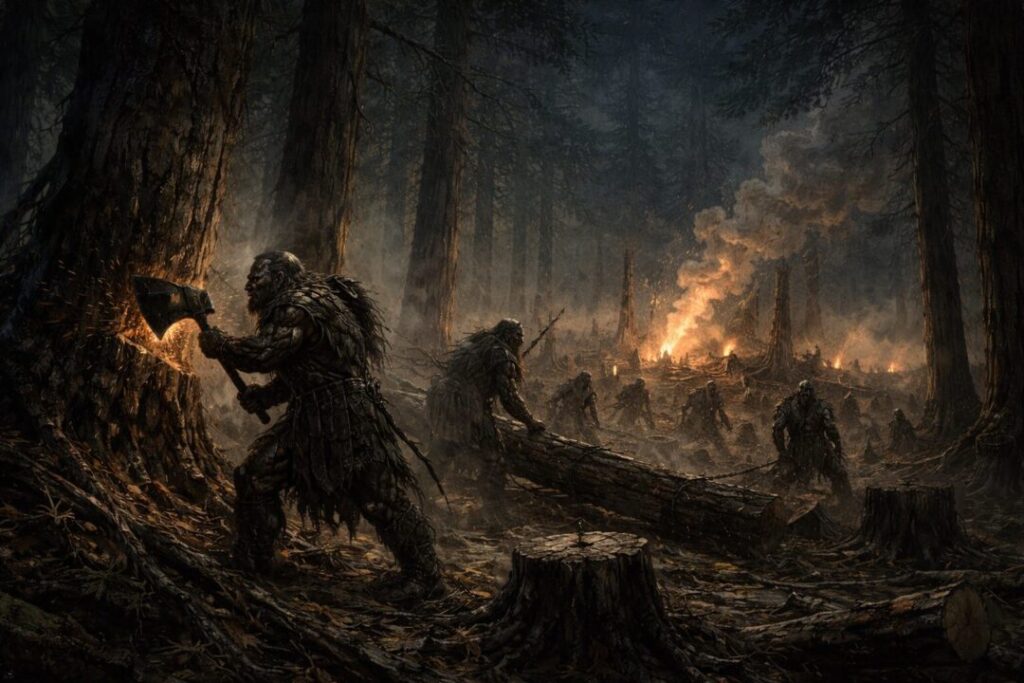
When he first turned Isengard into an industrial stronghold, he did not begin by attacking Fangorn directly. He did not announce himself as an enemy of the forest.
Instead, he worked gradually.
He cut trees at the edges.
He harvested from places already disturbed.
He used Orcs and Men—creatures the Ents had long learned to avoid rather than confront.
He relied on fire, noise, and smoke to keep distance between himself and the forest.
To the Ents, this did not look like a war.
It looked like disturbance.
And disturbances, over long ages, often fade. Storms pass. Fires burn out. Men move on. Ents are patient precisely because history has taught them that most harms are temporary.
Saruman exploited that patience.
By the time the scale of destruction became undeniable, it was no longer a question of prevention—it was a question of response.
The Forest Itself Was Falling Silent
By the late Third Age, Fangorn Forest was no longer what it had once been.
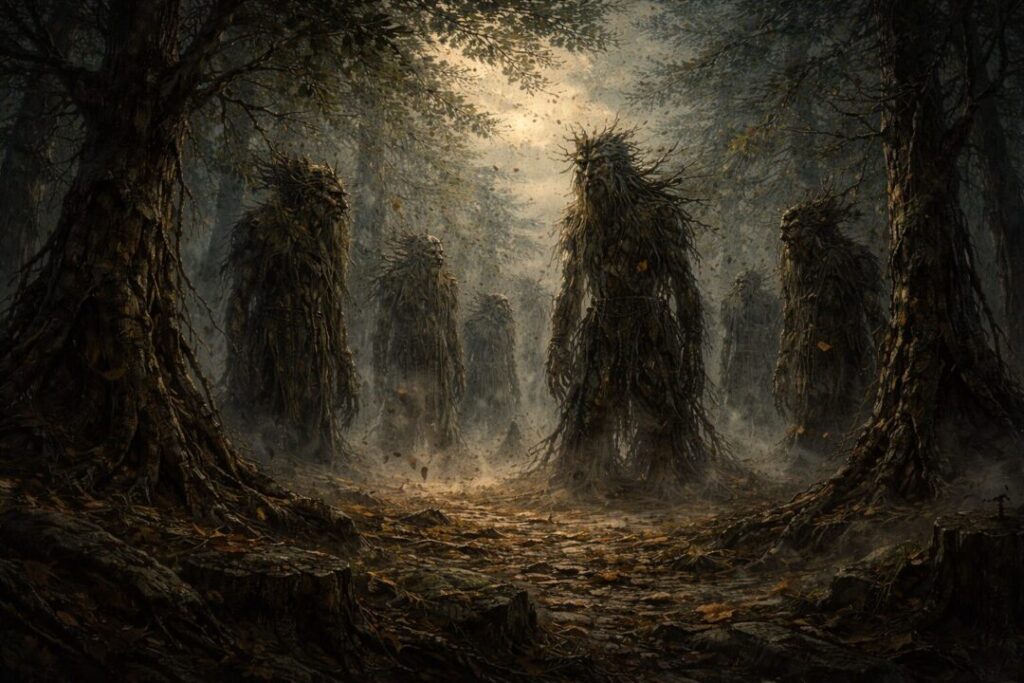
Many Ents had grown “tree-ish”—a state Treebeard describes with quiet sorrow. They had slowed, rooted themselves, and begun to lose the distinction between Ent and tree. This was not death, but it was a kind of withdrawal from the world.
Communication among Ents weakened.
The long Entish songs that once carried news across valleys and centuries had faded. Messages took longer to travel. Warnings dulled into murmurs.
And worse still, the Entwives were gone.
Their disappearance did more than break the hearts of the Ents. It shattered the balance of their society. The Entwives were movers, shapers, planners—those who loved gardens, fields, and change. Without them, Entish life became static, contemplative, and inward-facing.
Fangorn remained ancient and powerful—but it was no longer alert.
So when trees were cut, the pain did not echo as it once had.
The forest felt it.
But it whispered.
Why Treebeard’s Walk Changes Everything
The turning point does not come through rumor or distant unease.
It comes through movement.
When Treebeard walks toward Isengard with Meriadoc Brandybuck and Peregrin Took, he does something Ents rarely do: he leaves the deep forest and looks directly at the world beyond it.
What he sees is not theoretical harm.
He sees burned stumps.
He sees slaughtered trees.
He sees waste piled where life once grew.
This is no longer a question of balance or patience.
It is murder.
And once Treebeard understands this fully, he does what Ents almost never do: he calls an Entmoot.
The Entmoot: Slowness as Moral Weight
The Entmoot is famously slow. Days pass. Discussions circle. Decisions are delayed.
This is often treated as humor—but it is something far heavier.
Each Ent must feel the truth for themselves. Each must reconcile centuries of restraint with undeniable loss. This is not a tactical council—it is a moral reckoning.
The Ents are not deciding whether they can act.
They are deciding whether the world has changed so much that they must.
When the decision finally comes, it is unanimous.
And it is irreversible.
The March on Isengard Is Not Rage—It Is Awakening
Contrary to popular imagination, the Ents are not consumed by sudden anger.
They are consumed by clarity.
Saruman did not cross the line by cutting trees alone. Trees have been cut before. What he did was worse.
He reduced living things to fuel.
He treated the forest as a resource, not a community.
He assumed that ancient beings would remain passive forever.
He mistook patience for weakness.
He was wrong.
The Ents do not rush to war—but once they move, they are unstoppable. Not because they are violent, but because they are done waiting.
A Quiet Warning Embedded in the Story
This episode carries one of the most understated warnings in The Lord of the Rings.
Great evils rarely begin loudly.
They advance slowly.
They hide within routine.
They rely on good beings waiting for certainty.
By the time certainty arrives, something irreplaceable has already been lost.
The Ents win at Isengard—but they cannot restore what was burned. Fangorn endures, but it bears scars that will never fully heal.
Their victory is real.
But it is not clean.
Why This Still Matters
The Ents did not fail because they were weak.
They failed because they were ancient, careful, and slow to assume betrayal.
Middle-earth survives not because its guardians are perfect—but because, eventually, they choose to act.
Even if it is late.
Even if the cost is permanent.
Even if the world they protect has already changed.
And perhaps that is the most Entish truth of all.
The forest does not forget.
But it remembers too slowly.