Most battles in Middle-earth end with something you can point to.
A king falls. A gate breaks. A banner rises. A body is found.
Helm’s Deep does not.
Helm’s Deep ends with a forest.
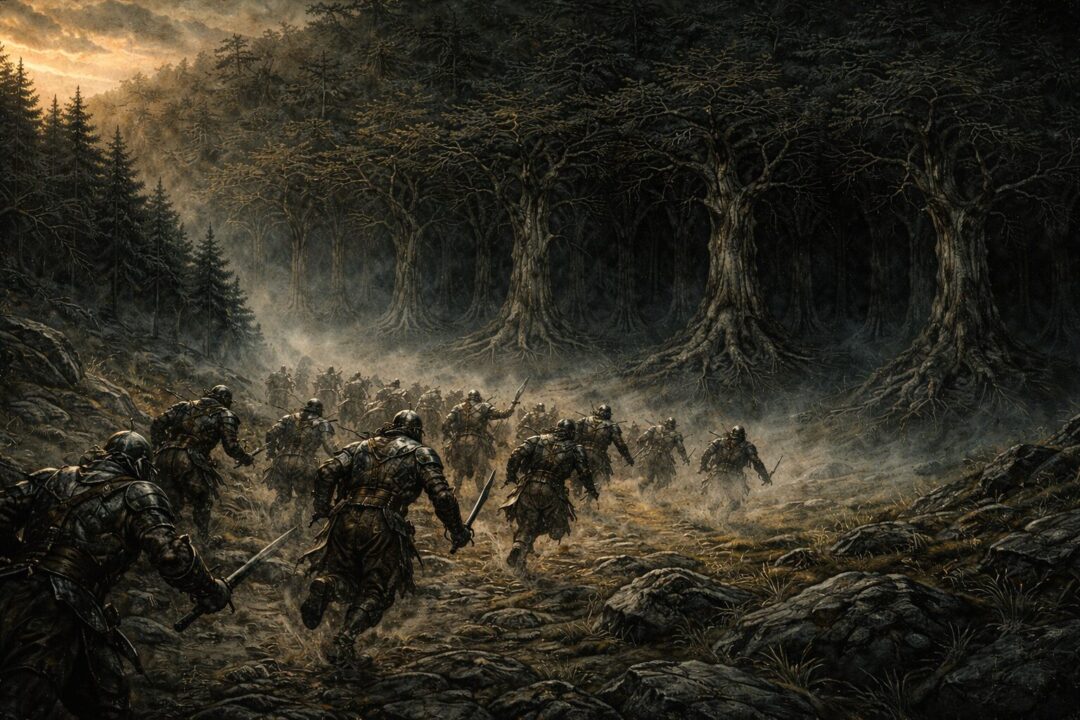
That alone should feel strange. The entire night has been a siege: fire on the walls, shouting in the dark, the slow exhaustion of defenders who are meant to fail by numbers alone. Then the sun comes—and suddenly the story stops behaving like a war story and starts behaving like a warning.
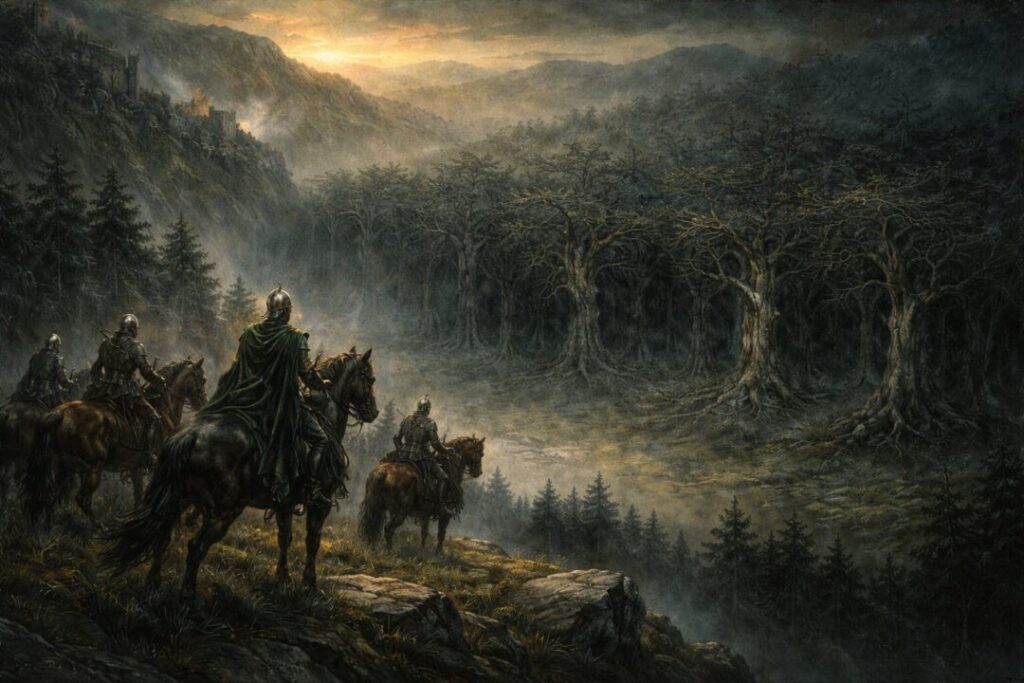
Théoden and his company ride out at dawn. They drive the enemy back. And when they look down into the Deeping-coomb, the valley has changed.
“Where before the green dale had lain… there now a forest loomed. Great trees, bare and silent, stood, rank on rank… Darkness was under them.”
The text does not pause to explain how this happened. It simply presents the forest as a fact, like weather—only it isn’t weather. It is deliberate. It is waiting.
And then comes the most chilling sentence in the entire sequence:
“Wailing they passed under the waiting shadow of the trees; and from that shadow none ever came again.”
That is not a normal battlefield outcome. It isn’t even described like one.
It’s disappearance.
The victory you’re not invited to watch
If Helm’s Deep were only about tactics, the story would show you the moment of destruction: the last clash, the final rout, the counting of slain.
Instead, the story draws a line at the forest’s edge.
The wild men throw themselves down before the White Rider. The Orcs panic. They run. And then the narrative lets them cross into shadow and refuses to follow.
This is one reason the Huorns feel like horror: they are a force that ends the battle off-screen—not because it’s unimportant, but because it is the kind of thing the characters themselves cannot safely witness.
The Rohirrim can face spears. They can face ladders. They can face death in the open.
But they do not want to enter that wood.
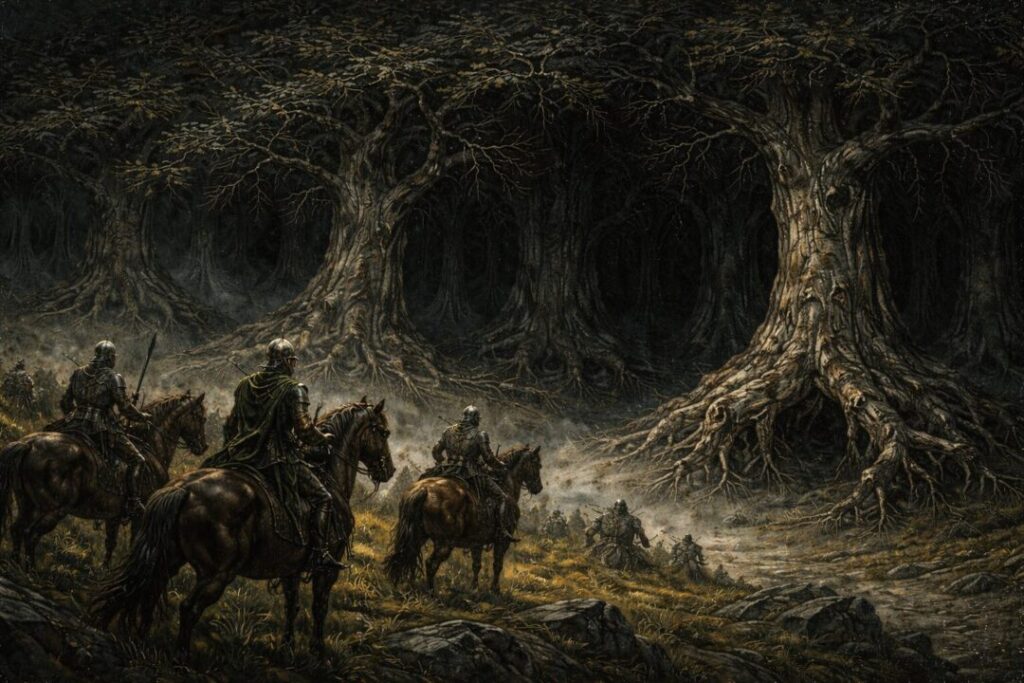
When the Riders approach later, the description turns from military to monstrous:
“The trees were grey and menacing, and a shadow or a mist was about them. The ends of their long sweeping boughs hung down like searching fingers, their roots stood up from the ground like the limbs of strange monsters, and dark caverns opened beneath them.”
It’s not just “trees that moved.” The imagery is actively predatory: fingers, limbs, caverns. The wood is made to feel like a mouth.
And crucially: Gandalf warns them against harming the trees at their peril.
That warning doesn’t read like “respect the forest.” It reads like “do not provoke what you don’t understand.”
What are Huorns, according to the text?
The story does eventually give you a name—though it delays it.
When Merry explains what happened at Isengard, he admits that Treebeard won’t say much about them. But Merry offers the clearest description we get:
“It was the Huorns… Treebeard won’t say much about them, but I think they are Ents that have become almost like trees…”
That “I think” matters. It’s not a formal definition. It’s a close observer trying to put words on something that resists tidy categories.
Then the passage becomes even more unsettling:
“There is a great power in them, and they seem able to wrap themselves in shadow… They can move very quickly, if they are angry… then suddenly you find that you are in the middle of a wood with great groping trees all around you.”
And the key detail:
“They still have voices, and can speak with the Ents… but they have become queer and wild. Dangerous.”
So, as far as the primary text allows us to say with confidence:
- Huorns are tree-like beings associated with Fangorn.
- They can move (sometimes quickly), and they can “wrap themselves in shadow,” making movement hard to perceive.
- They have voices and can speak with Ents, but they are “queer and wild” and dangerous.
- Even Merry and Pippin, who are unusually close to the Ents, do not treat them as friendly.
That is already enough to explain the horror tone. Huorns are not simply “good” creatures doing a good deed. They are a peril that happens, in this case, to fall on the Enemy.
Why were they at Helm’s Deep at all?
The text gives an answer—but in the same sideways manner.
After the fall of Isengard begins, Merry describes a night filled with “rustlings, creakings, and a murmur like voices passing.” He believes “hundreds more of the Huorns” were moving past “to help in the battle.”
And immediately before that, Treebeard says only this:
“Huorns will help.”
That’s the entire decision, reduced to four words.
There is no council shown. No marching orders. No triumphant announcement. The Huorns simply go—moving under cover of darkness, arriving like a living trap.
By the time the Orcs break and flee, the forest is already in place.
What happened to the Orcs?
This is where the “barely explains” feeling becomes real, because the text refuses to satisfy the most obvious question.
The Orcs run into the wood.
None come out.
Later, the aftermath is described in two different layers: what people see, and what people believe.
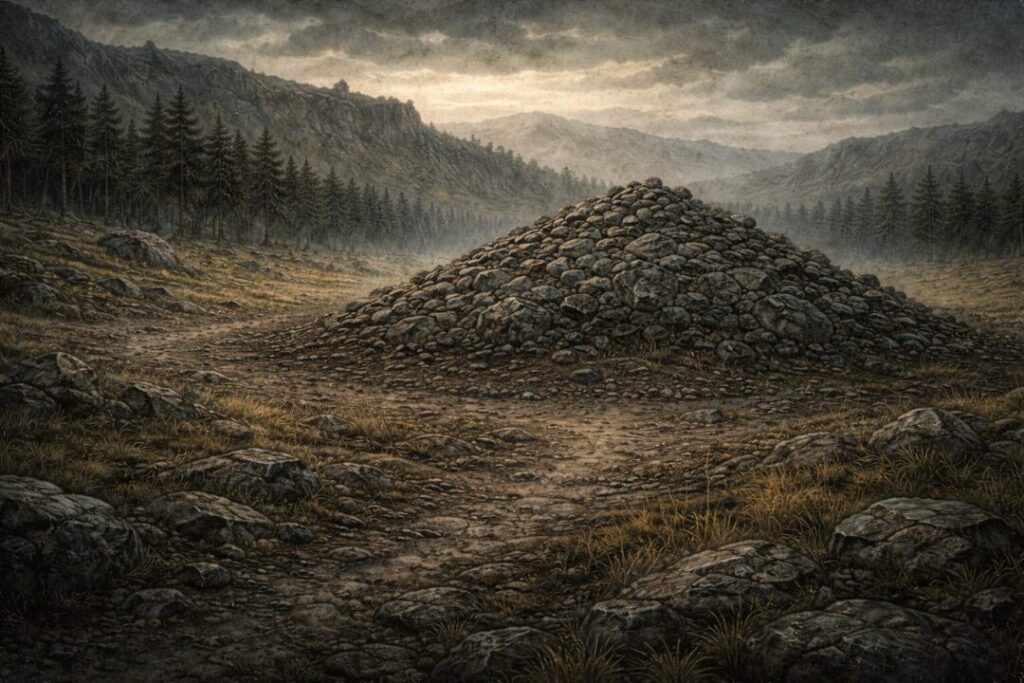
A pit is delved and covered with stones, “and over it stones were piled into a hill.” Men believed the Orcs they had slain were buried there—but whether those who fled into the wood were among them, “none could say,” because no one dared set foot on that hill.
The hill is named the Death Down, and “no grass would grow there.”
That’s not an explanation. It’s a boundary.
Even the language “men believed” matters. The text does not confirm the fate of every Orc. It gives you a haunted place, a dead patch of earth, and the social fact that people will not go near it.
If you are tempted to fill the gap with something more concrete—dragged under roots, crushed, strangled, buried alive—the important point is this: the canon does not tell you the method. Any graphic certainty would be invention.
What the canon does tell you is that the Huorns are dangerous, shadow-wrapped, and angry—and that the Enemy’s survivors vanish into them as into a final night.
Why does it read like horror?
Because it is written like horror.
Notice what the text emphasizes:
- Shadows that move with purpose. (“wrap themselves in shadow”)
- A trap you don’t see closing until you’re inside it. (“suddenly you find that you are in the middle of a wood”)
- An unnatural stillness. (“bare and silent… Darkness was under them.”)
- A refusal to describe the killing directly. (“none ever came again”)
- A contaminated landmark afterward. (“Death Down… no grass would grow there”)
And—most importantly—the characters behave the way characters behave around something that is not meant to be approached.
They hesitate. They fear. They do not take axes to the trees. They do not enter casually.
In other words: the story treats the Huorns like a power with rules you don’t know.
The unsettling implication the text does support
The Huorns are associated with the Ents, but they are not simply “Ents in another outfit.” They are described as something that has become “queer and wild,” still capable of speech, yet not safely approachable.
That means the world contains living things on a spectrum: from ordinary trees, to Huorns, to Ents—beings that can think, move, watch, and become wrathful.
And when that wrath arrives at Helm’s Deep, it does not arrive as a hero.
It arrives as a forest that makes an army disappear.
This is why the Huorns change the emotional shape of the battle. Helm’s Deep is not only “men held the wall until dawn.” It is also “something ancient and half-unnamed chose to intervene—and no one wanted to look too closely at the cost.”
Even the ending underlines this. The strange trees “were never seen in Deeping-coomb again; they had returned…”
Returned where?
The text does not linger. It lets them go back into the story’s deeper wood, where they belong—where they can be felt as presence, not explained as mechanism.
And that is the final horror-story move: the monster doesn’t die. It doesn’t get unmasked.
It simply leaves.