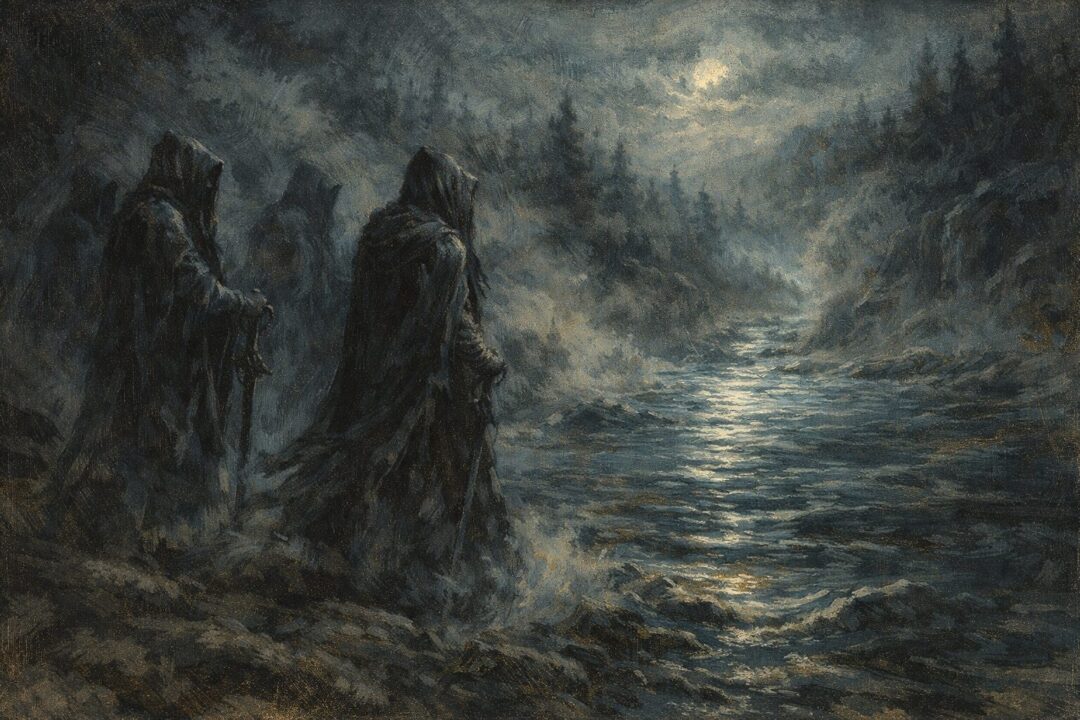
Few scenes in The Lord of the Rings undermine the Nazgûl as completely—and as quietly—as the crossing at the Ford of Bruinen.
Until that moment, they appear nearly unstoppable.
They track Frodo across the Shire with relentless patience. They move through borders and settlements without hesitation. They inspire terror without needing to strike, and even seasoned figures like Aragorn treat them as enemies to be avoided rather than confronted.
The Nazgûl do not need speed.
They do not need numbers.
They do not need spectacle.
Their power lies in inevitability.
And then they reach the river.
Instead of charging forward, they hesitate. Instead of overwhelming their prey, they wait. And when the waters rise, they are swept away—not slain in battle, not undone by courage or steel, but removed by something as ancient and ordinary as a river.
The scene raises an unsettling question that the text never answers outright:
Why does water matter to the Nazgûl at all?
They do not breathe.
They do not drown.
They do not live in bodies that function like those of ordinary Men.
So what, exactly, are they afraid of?
The answer lies not in physical danger, but in what the Nazgûl are—and what water represents in Middle-earth.
The Nazgûl Are Not Creatures of the Physical World
The Nazgûl are often described loosely as undead, but this is misleading.
They are not ghosts.
They are not corpses animated by sorcery.
They are not spirits severed from the world.
They are Men who have faded.
The Rings of Power they accepted did not kill them. Instead, those Rings stretched their lives far beyond their natural limits, drawing them slowly out of the visible world and into the unseen. Over time, their bodies passed almost entirely into that other realm, leaving behind figures that exist primarily as will, fear, and domination.
What remains of them is sustained by Sauron’s power and anchored to the One Ring.
This makes the Nazgûl uniquely dangerous—but also uniquely constrained.
They are not most vulnerable to weapons.
They are not most vulnerable to strength.
They are vulnerable to forces that resist domination.
Fire can harm them.
Light unsettles them.
And water—quietly, persistently—interrupts them.
Water as a Boundary, Not a Weapon
In Tolkien’s legendarium, water is rarely just a physical obstacle.
Rivers and seas consistently function as boundaries.
They separate realms.
They mark transitions.
They define where one authority ends and another begins.
Crossing water often signals a change in moral, spiritual, or historical state: from safety into danger, from one age into another, from one kind of power into a different kind altogether.
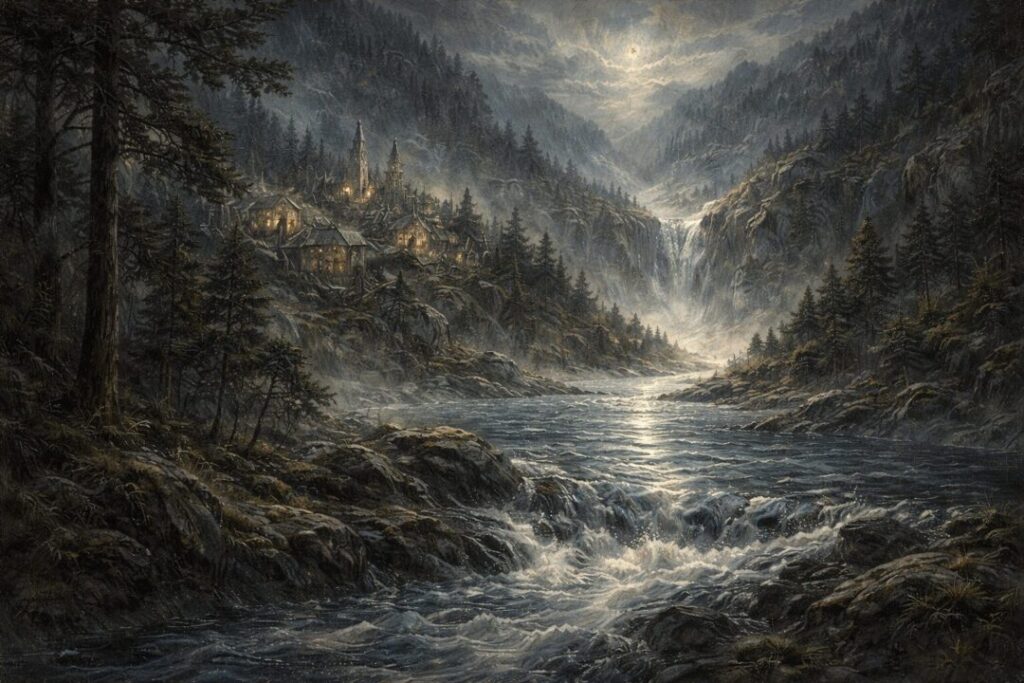
The Bruinen is not merely a river flowing through a landscape.
It flows from Rivendell, a hidden valley shaped by preservation rather than conquest, by memory rather than domination. It is a place sustained by older powers, largely untouched by Sauron’s reach.
The river is an extension of that protection.
It does not need to be wielded like a weapon.
It already stands where it stands.
And the Nazgûl sense this.
They are beings designed for intrusion. Their purpose is to cross borders, infiltrate strongholds, and corrupt what lies beyond the Shadow’s reach. They exist to erase distinctions—to make every land equally subject to Sauron’s will.
Water resists that function.
It cannot be owned.
It cannot be permanently shaped.
It cannot be held still.
This is why the Nazgûl hesitate even before the flood is unleashed.
They recognize a boundary they are not meant to cross.
The Memory of What They Once Were
There is another, quieter layer to their fear.
The Nazgûl were once kings of Men—rulers who lived in a world governed by natural law. They knew seasons. They ruled lands defined by rivers and coasts. They existed within limits that shaped their identity and authority.
Their transformation severed them from that world.
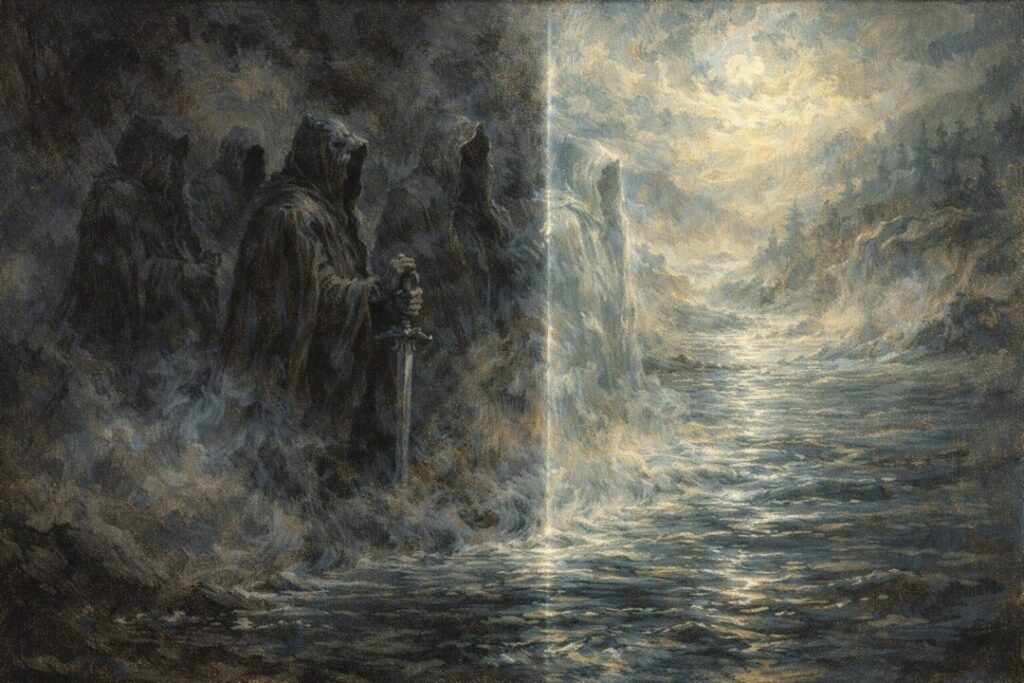
They no longer belong to the living order of things. They do not age, do not change, and do not truly inhabit the lands they traverse. They pass through Middle-earth as shadows imposed upon it, not as beings rooted within it.
Water represents everything they have lost:
– Natural limits
– Mortality
– Independence
– Belonging
It is not that water can destroy them.
It is that water reminds them they no longer fully exist in the world it shapes.
Why Sauron Cannot Fully Control Water
Sauron’s power is fundamentally about domination.
He binds wills.
He reshapes matter.
He imposes order through force and fear.
But domination requires rigidity.
Water is not rigid.
It flows.
It adapts.
It erodes.
Even Morgoth, whose corruption of the world ran far deeper than Sauron’s, struggled to taint water completely. While lands could be scarred and creatures twisted, the great rivers and seas of Middle-earth remain among the least corrupted elements of creation.
They align more closely with preservation than control.
When Elrond commands the Bruinen, he does not invent power. He releases what is already present—an ancient resistance to domination that predates the Rings themselves.
The Nazgûl are swept away not because they are weak.
They are swept away because they are out of place.
Why the Nazgûl Fear, But Do Not Flee, Water Elsewhere
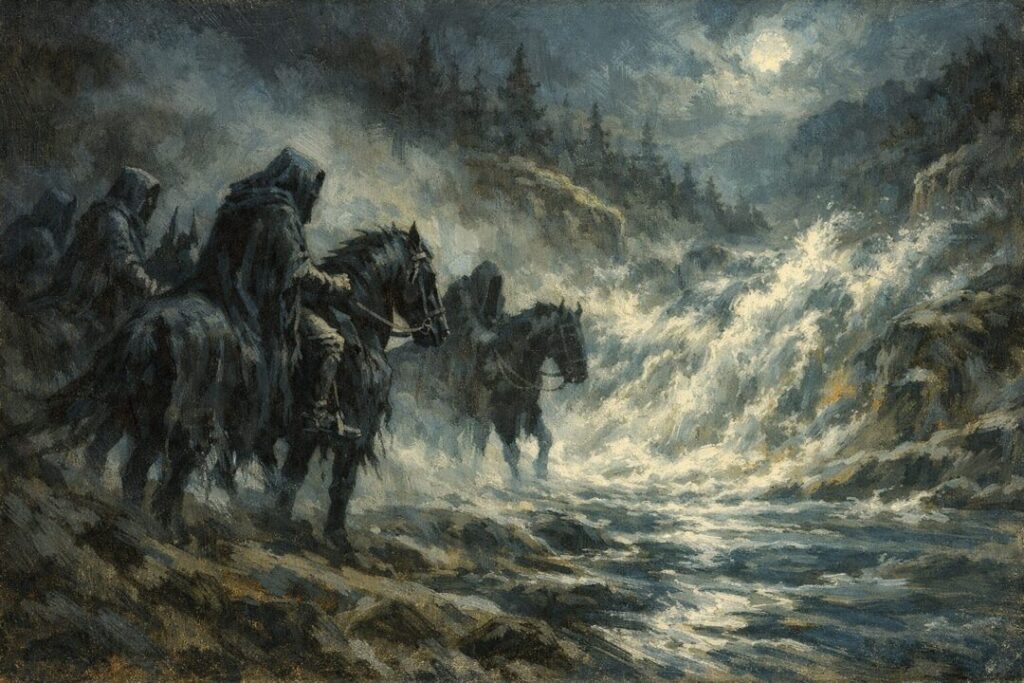
Importantly, the Nazgûl are not paralyzed by every stream or river they encounter.
They cross water when necessary.
They linger rather than retreat.
They test boundaries cautiously.
This reveals that their fear is not panic—it is awareness.
They understand that certain places are governed by powers they cannot fully contest. When they hesitate, it is because they sense resistance rather than vulnerability. They wait for advantage, for permission, or for overwhelming force.
At the Ford of Bruinen, none of those conditions are met.
The river belongs to Rivendell.
The power behind it is older.
And the Nazgûl arrive not as conquerors, but as trespassers.
Why Tolkien Never Explains This Directly
Tolkien almost never explains metaphysical rules inside the narrative itself.
He does not interrupt scenes to clarify symbolism.
He does not annotate spiritual mechanics.
He allows meaning to emerge through restraint.
The Nazgûl never speak of their fear.
No character explains why they hesitate.
The text simply shows them stopping.
And that silence is deliberate.
The story is largely filtered through the perspective of Hobbits—creatures who sense danger without fully understanding its nature. They see effects long before causes. They experience power without knowing its source.
From that perspective, the Nazgûl’s hesitation is not a puzzle to be solved, but a warning to be felt.
A Subtle Limit to Absolute Evil
This moment serves a larger thematic purpose.
It shows that Sauron’s power is not total.
There are things he cannot command.
There are boundaries he cannot erase.
There are elements of the world that remember a deeper order.
The Nazgûl fear water not because it is strong—but because it is free.
It moves according to its own nature.
It answers to no master.
It carries memory older than domination.
And in a world increasingly shaped by shadow, that quiet resistance matters.
The river does not defeat evil through force.
It simply refuses to yield.
And for creatures like the Nazgûl, that refusal is terrifying.