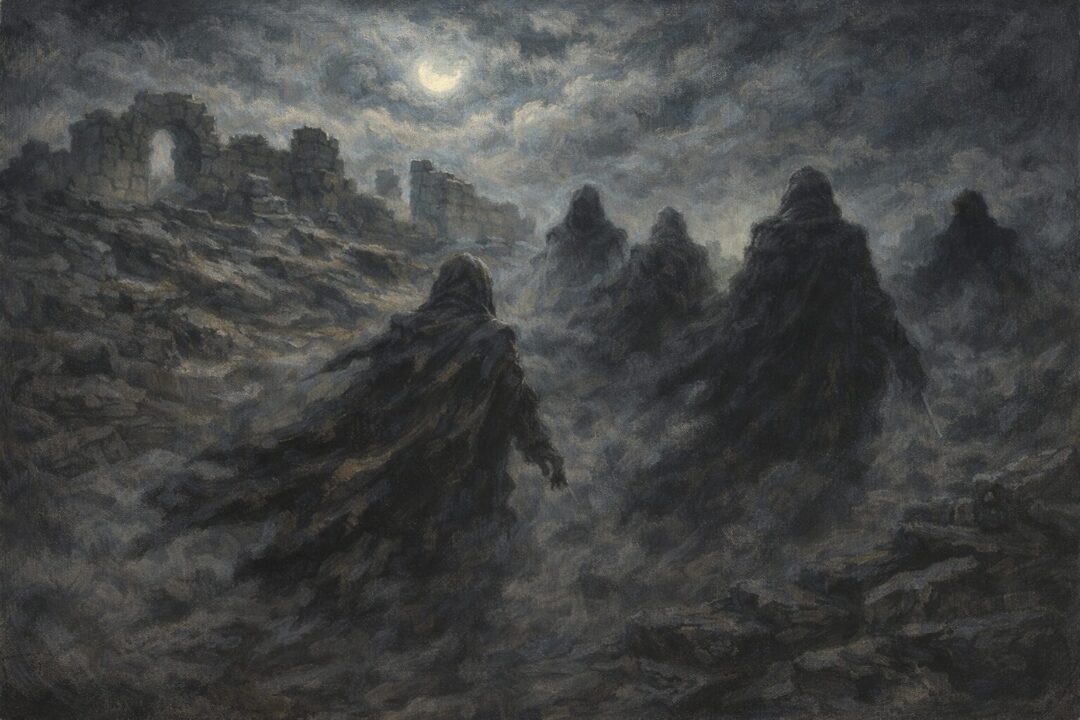
The confrontation at Weathertop is one of the most misunderstood moments in The Lord of the Rings.
Five Nazgûl finally corner the Ring-bearer. The night favors them. Fear presses in from all sides. And when Frodo Baggins is stabbed by a Morgul blade, the attack seems decisive—fatal, even.
From a purely military perspective, this should have been the end.
The Ring-bearer is wounded by a weapon of sorcery. His companions are few, exhausted, and outmatched. The Nazgûl possess overwhelming supernatural advantage. There is no reason, at least on the surface, for them not to press forward, seize the Ring, and disappear into the night victorious.
And yet they retreat.
They withdraw into darkness and allow the wounded hobbits to escape.
This moment has often been explained away as fear of fire, or as a setback inflicted by Aragorn. But neither explanation holds up under close reading of the text or the broader logic of Middle-earth.
The Nazgûl did not retreat because they were defeated.
They retreated because they believed the mission was already complete.
The Nazgûl Were Not Hunters — They Were Instruments
One of the most important things to understand about the Nazgûl is that they are not independent agents.
They do not operate according to personal judgment, improvisation, or battlefield instinct. They do not seek glory, combat, or conquest for its own sake. Every action they take is constrained by the will of Sauron, whose power sustains them and whose intent directs them.
At this stage of the War of the Ring, Sauron’s primary objective was not destruction.
It was recovery.
The Ring was not meant to be shattered in open conflict. Sauron did not yet expect or fear that outcome. His strategy relied on inevitability—on the assumption that all resistance would eventually fail, and that the Ring, like all things bound to him, would return.
That distinction shapes everything the Nazgûl do.
A violent seizure of the Ring at Weathertop would have carried risks. It could have drawn immediate attention from powerful forces: Rivendell, the Wise, and potentially even remnants of the White Council. Open confrontation was not yet desirable.
Subtlety still mattered.
What the Morgul Blade Was Designed to Do
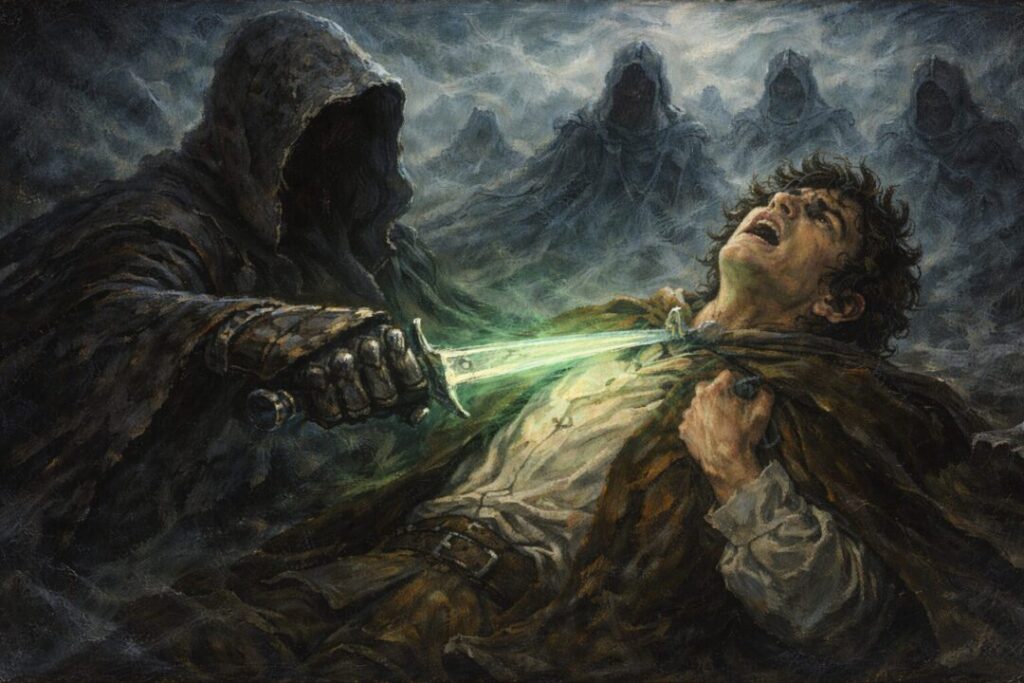
The wound Frodo receives is not meant to kill him quickly.
The Morgul blade is not a battlefield weapon in the ordinary sense. It is a tool of spiritual corruption, designed to operate slowly and invisibly. Its true purpose is not physical death, but transformation.
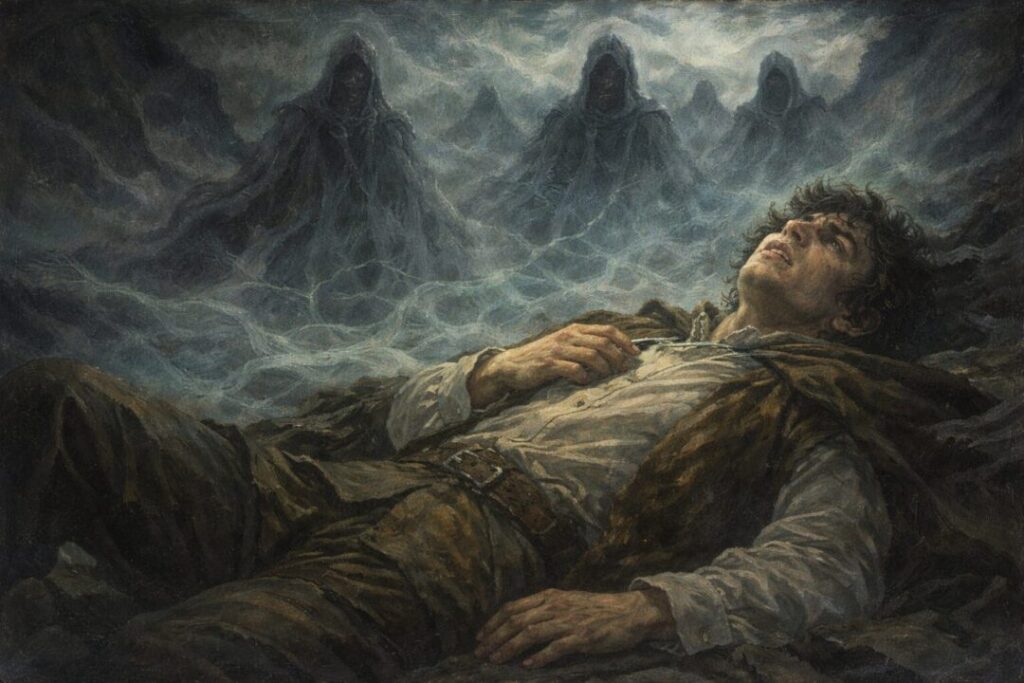
The splinter left behind by the blade works its way inward, drawing the victim gradually into the unseen world. As the process continues, the wounded person becomes increasingly detached from the physical realm and increasingly visible to the Nazgûl.
Had the process been completed, Frodo would not simply have died.
He would have become a wraith.
A being stripped of autonomy, bound to the will that commands the Nazgûl themselves.
From their perspective, the blade had already done its work.
They expected Frodo to:
- Fade within days
- Lose clarity and resistance
- Become visible and controllable in the wraith-world
Once that transformation occurred, the Ring would no longer need to be seized by force.
It would come to them naturally.
No battle required.
No pursuit necessary.
No risk of exposure.
The retreat was not caution—it was confidence.
Why They Didn’t Expect Aragorn to Change the Outcome
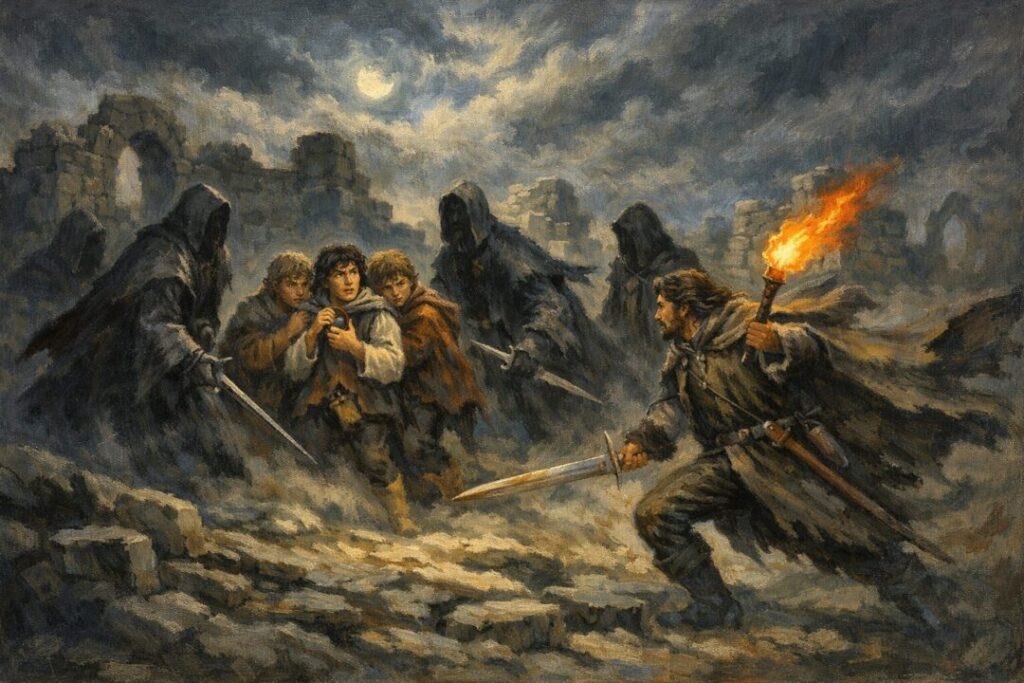
Aragorn’s intervention is dramatic, but it is not what truly disrupts the Nazgûl’s plan.
They had faced Númenórean bloodlines before.
They had faced Elves wielding ancient power.
They had faced kings, captains, and champions across centuries.
Aragorn was dangerous—but not unprecedented.
What they failed to account for was speed.
The Nazgûl assumed the wound would complete its work before meaningful help could be reached. They did not expect the Ring-bearer to be carried across leagues of wilderness in a race against time. Nor did they anticipate the urgency with which Aragorn would push toward Rivendell, knowing precisely what kind of wound had been dealt.
The Nazgûl withdrew because they believed time favored them.
They were not fleeing defeat.
They were allowing the poison to finish the task.
Why Weathertop Was Not a Failure — From Their Perspective
Seen through the Nazgûl’s understanding of the world, Weathertop was a success.
The Ring-bearer had been marked.
The wound was incurable by ordinary means.
The slow pull of the unseen world had begun.
They had no reason to risk further exposure by continuing a loud, visible pursuit that could draw unwanted attention. The strategy relied on patience and inevitability, not aggression.
Their error was not tactical.
It was theological.
They underestimated the preservation of healing power in Rivendell—power that had been diminished across the ages but not extinguished. They failed to account for mercy, care, and the remnants of ancient grace still active in the world.
In other words, they misunderstood the nature of resistance.
Why Rivendell Changed Everything
Rivendell represents something the Nazgûl no longer fully grasp.
It is not merely a refuge. It is a place where the seen and unseen worlds still intersect in harmony rather than domination. The same qualities that make it difficult for evil to penetrate also make it uniquely capable of healing wounds that exist on both physical and spiritual levels.
The Morgul blade was designed to function in a world where such sanctuaries no longer mattered.
The Nazgûl assumed that age had passed.
They were wrong.
Why This Moment Matters
Weathertop reveals something essential about the nature of evil in Middle-earth.
Evil relies on inevitability.
On decay.
On the belief that resistance will collapse given enough time.
The Nazgûl retreated because they believed the future was already written.
They did not account for endurance.
They did not account for compassion.
They did not account for small acts of courage accumulating into something greater.
Their failure at Weathertop is not a failure of strength.
It is a failure of understanding.
And that same misunderstanding follows them all the way to the final destruction of the Ring—where power once again assumes victory is inevitable, only to be undone by resilience it never learned to recognize.
The Nazgûl did not lose at Weathertop because they were weak.
They lost because they believed time itself belonged to them.
And in Middle-earth, that belief is always fatal.