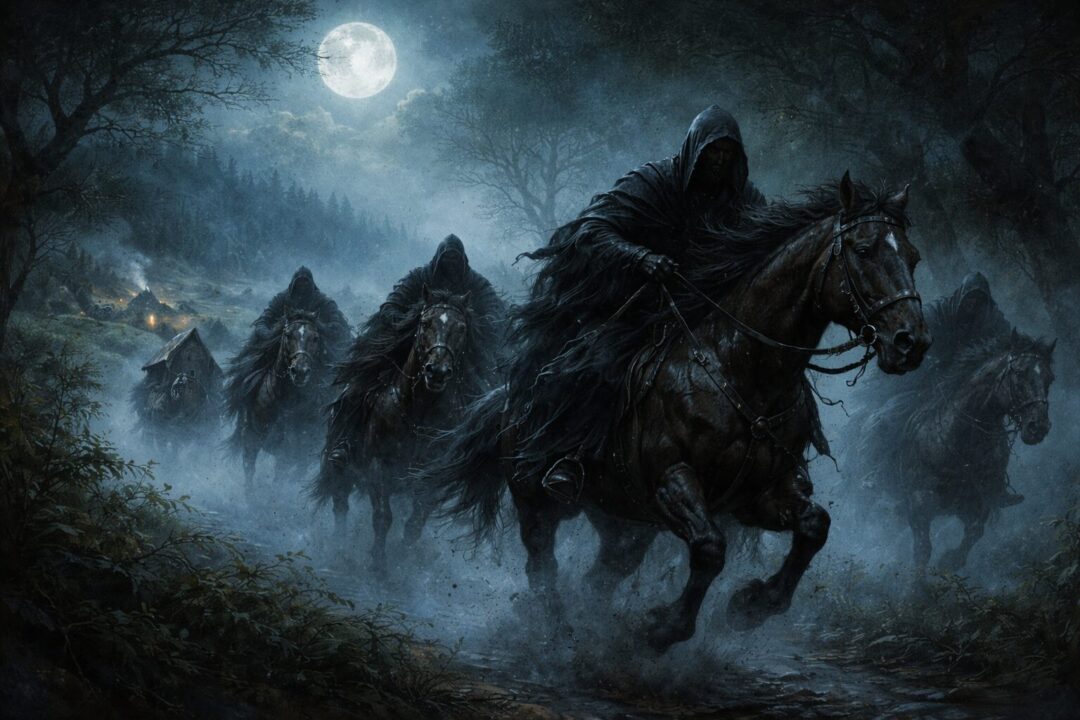
When readers picture the Nazgûl, the image is usually fixed: faceless riders cloaked in black, silent and relentless, embodiments of fear itself.
They are often imagined as creatures who exist apart from the world—immune to fatigue, unmoved by terrain, untouched by ordinary limits. Shadows on horseback, pursuing the Ring with mechanical certainty.
But that image is incomplete.
Because that is not how the Nazgûl first appear.
In The Fellowship of the Ring, the Ringwraiths ride living horses—breathing, panicking animals that react visibly to the terror they are forced to carry. Their mounts stumble, shy, scream, and resist. They are not extensions of the Riders’ will. They are creatures under strain.
This detail is easy to gloss over, especially when the Nazgûl themselves are so frightening. Yet Tolkien lingers on the horses in quiet, deliberate ways.
Because those horses tell us something crucial about the Nazgûl themselves.
The Nazgûl Are Not Fully Physical Beings
By the Third Age, the Ringwraiths exist in a profoundly unstable state. They are neither alive nor dead in any ordinary sense. Their bodies have faded, leaving them bound to the unseen world and sustained only by the power of the Rings they bear and the will of their master.
They have presence—but not solidity.
They have intention—but limited means.
They can terrify, dominate, and command, but their ability to interact with the physical world is diminished. Doors must be forced open. Weapons are wielded awkwardly. Sunlight weakens them. Flowing water repels them.
This creates a problem.
The Nazgûl cannot easily move through the world on their own.
Horses solve that problem—temporarily.
When the Nazgûl ride, they borrow substance. Speed. Weight. Momentum. The horses anchor them to the material realm in a way their own forms no longer can. The sound of hooves, the rhythm of motion, the physical impact of pursuit—all of this depends on living bodies beneath them.
But this arrangement comes at a cost.
The Horses Bear the Burden of Terror
Tolkien repeatedly shows the horses reacting before the Riders do.
They shy away from Elvish spaces, where the unseen world presses more strongly against the seen.
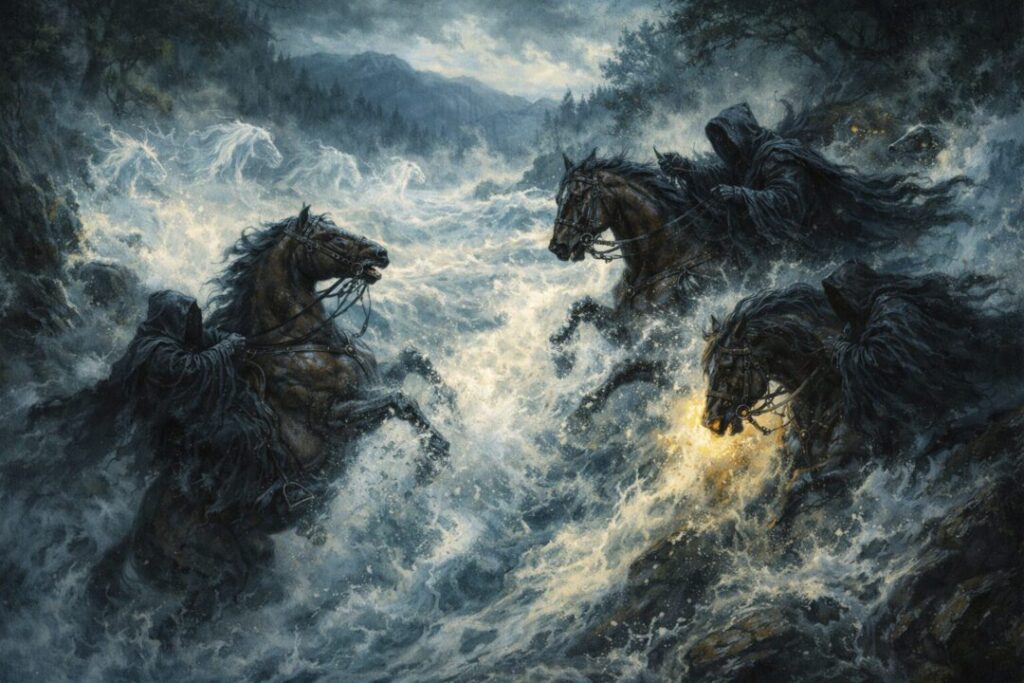
They resist crossing running water, long before the Riders themselves are driven back.
They panic in the presence of Glorfindel, whose spiritual presence blazes in both worlds at once.
And they are the first to fail at the Ford of Bruinen.
This pattern is not incidental.
Living animals experience the Nazgûl’s aura directly. Fear is not abstract or symbolic for them—it is physical. It manifests as confusion, pain, and instinctive resistance. The horses do not understand why they are afraid. They only know that something profoundly wrong sits upon their backs.
Prolonged exposure breaks them.
The horses are not evil. They are not corrupted in the way Orcs are corrupted. They are not willing servants.
They are victims.
And Tolkien makes sure we see that.
The Nazgûl dominate men through fear and the Rings of Power. But animals cannot be bound in the same way. They cannot be reasoned with, threatened with promises, or enslaved by ambition.
They can only endure—until they cannot.
The Ford of Bruinen Is a Breaking Point
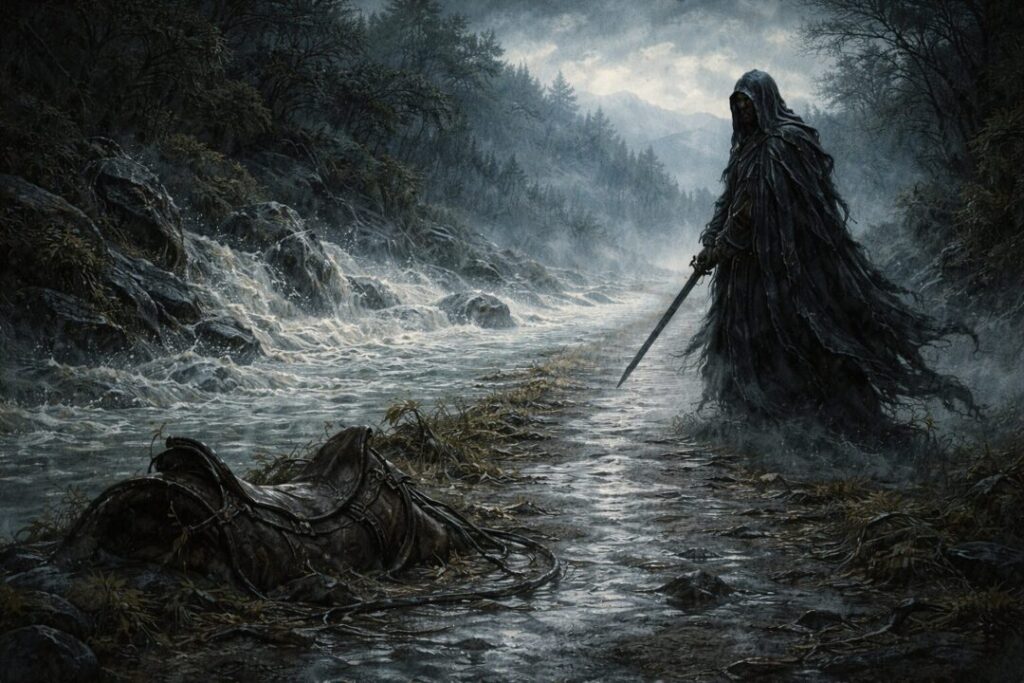
When Elrond commands the flood at the Ford of Bruinen, it does more than wash away the Black Riders.
It severs the Nazgûl from their last stable connection to the physical world.
The water does not simply knock them down. It overwhelms the horses—living creatures already stretched to their limits. The panic, the force of the flood, and the presence of Elvish power combine into a moment the animals cannot survive.
The Nazgûl endure.
The horses do not.
This distinction matters.
From this point on, the Ringwraiths are never again shown riding ordinary horses in the same way. Their pursuit changes. Their presence becomes quieter, colder, and less tangible.
They do not gallop through the countryside anymore.
They drift.
They wait.
They haunt.
The loss of the horses does not destroy the Nazgûl—but it pushes them further away from life.
After the Ford: A Change in How the Nazgûl Exist
Before the Ford, the Nazgûl are loud in their terror. Hooves thunder. Doors are battered. Cries echo in the night.
After the Ford, they become something else.
More distant.
More patient.
Less bound by roads and borders.
Their fear becomes purer, but also more abstract. It no longer relies on physical pursuit alone. Instead, it spreads like a pressure in the air—felt rather than seen.
This is not an increase in strength.
It is a retreat.
They are withdrawing further into the unseen world, where they are safest, but also most removed from life.
Why the Witch-king Rides Something Else
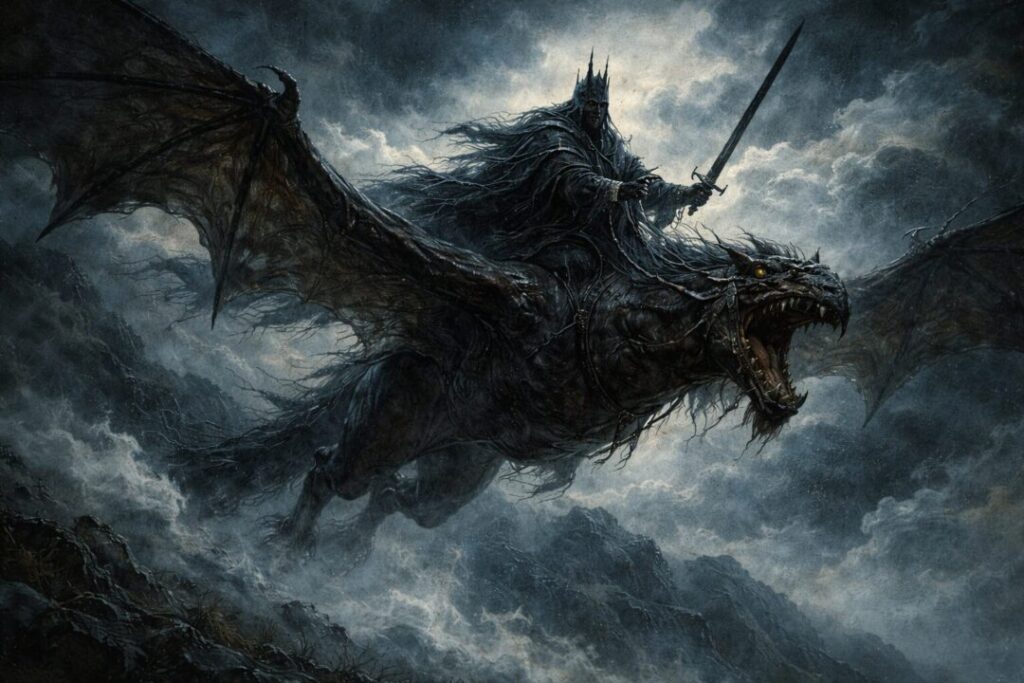
Later in the story, the Witch-king mounts a fell beast—not a horse.
This is not a cosmetic change. It is a narrative and metaphysical one.
The fell beast is no ordinary animal. It is described as ancient, unnatural, and almost nameless—something closer to a living extension of shadow than a creature of the natural world. It does not shy away. It does not panic. It does not resist.
It is shaped—or bred—to endure the presence of a Ringwraith.
Where horses recoil from domination, the fell beast exists in harmony with it.
This reflects a deeper transformation in the Nazgûl themselves.
They are no longer attempting to move within the living world.
They are imposing themselves upon it.
Horses belong to life: to instinct, vulnerability, fear, and resistance. The fell beasts do not. They occupy a threshold space, much like the Nazgûl themselves.
The Witch-king’s mount is not a replacement.
It is an admission.
Tolkien’s View of Domination
Throughout Tolkien’s legendarium, domination is never portrayed as stable or clean.
Power that seeks to control others corrodes everything it touches—including its wielder.
The Nazgûl enslaved kings of Men.
The Rings enslaved the Nazgûl.
And Sauron himself is diminished by the act of domination he pursues.
Even animals cannot endure proximity to this chain of corruption.
The horses break because domination always extracts a price.
This is a pattern repeated across Middle-earth:
- Lands under tyranny become barren.
- Peoples under domination wither.
- Tools of control eventually fail.
The Nazgûl’s horses are simply one of the clearest, quietest examples of this truth.
Why This Detail Matters
Tolkien could have ignored the horses entirely.
He could have treated them as disposable objects—mere transport for villains who mattered more.
Instead, he shows us their fear.
Their suffering.
Their failure.
Because Middle-earth is not a world where evil passes without consequence.
Even the ground feels it.
Even the water resists it.
Even animals recoil from it.
The Nazgûl did not lose their horses by chance.
They lost them because the living world could no longer bear them.
And after that loss, the Ringwraiths become something colder, quieter, and far more removed from life than before.
Not stronger.
But further gone.