Most people think the answer is simple.
Isildur kept the Ring when he should have destroyed it, and so the Ring turned on him.
That is true as far as it goes. But it is not the deepest answer the texts give.
Because the striking thing about Isildur’s death is not only that he made a catastrophic choice.
It is that the Ring seems to act.
Not metaphorically. Not only as a symbol of corruption. But in the narrative itself, as something with a will bent toward its own purpose. Gandalf later says exactly this: the Ring was trying to get back to its master. That line matters enormously when we return to Isildur at the Gladden Fields.
Isildur’s First Mistake Was Real
There is no need to soften what Isildur does after Sauron’s defeat.
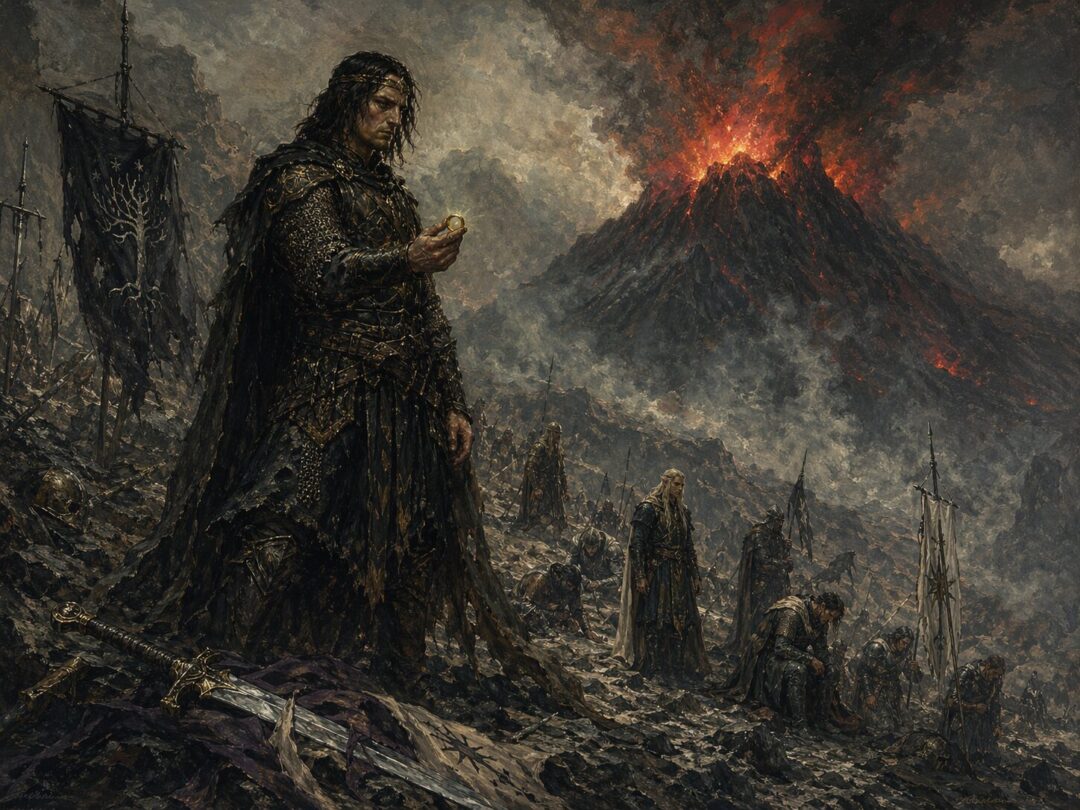
After Sauron is overthrown at the end of the Last Alliance, Elrond and Círdan urge Isildur to cast the Ring into Orodruin. He refuses. He claims it as a weregild for the deaths of Elendil and Anárion, and as an heirloom for his own house. That refusal is one of the great turning points of the age.
But the texts do not present Isildur as already reduced to a wraithlike servant the moment he takes it.
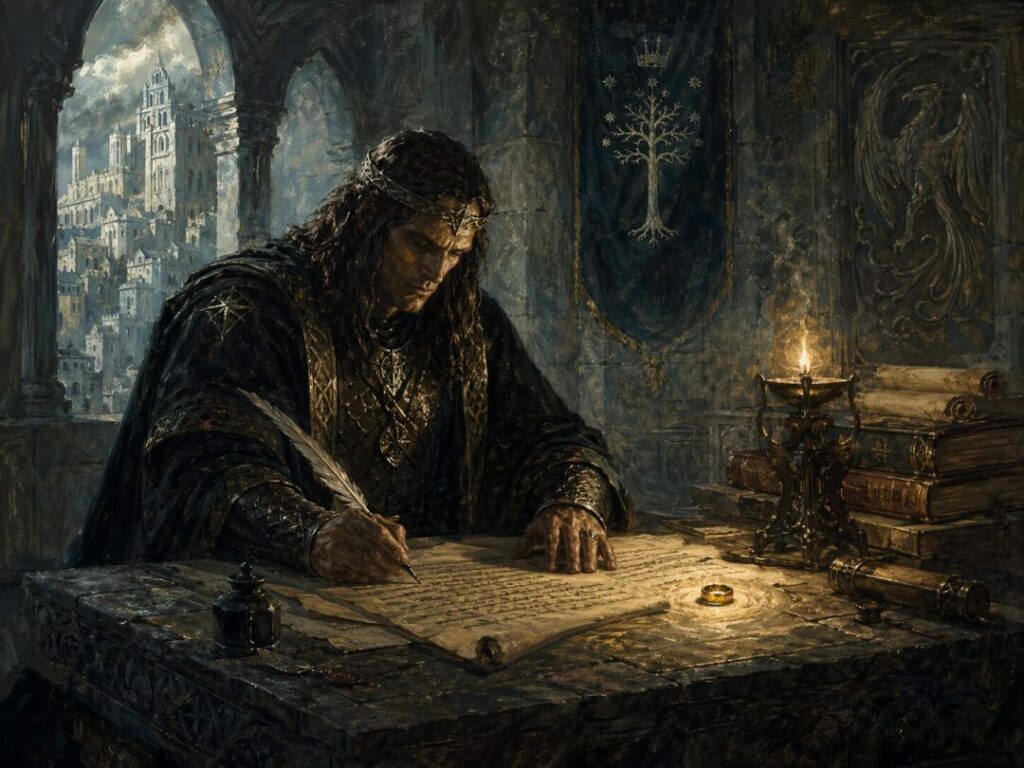
In the surviving traditions, he is still recognizably himself. He restores order in Gondor, prepares to return north, and writes the account later called the Scroll of Isildur. Yet even there, the danger has already begun to work on his thought. He calls the Ring “precious” and says he will risk no hurt to it, though he bought it “with great pain.”
That is important.
Isildur is not yet Gollum. He is not enslaved in the way later bearers become enslaved. But he is already beginning to think about the Ring in the Ring’s own language of possession and preservation.
The Ring Is Not Treated as a Passive Object
This is where the discussion usually becomes too flat.
People often talk as if the Ring only corrupts inwardly, by magnifying desire or pride. It certainly does that. But the story also treats it as something with a kind of directed will, bound to Sauron and to the purpose for which it was made. Gandalf tells Frodo that the Ring was trying to get back to its master. He also says that a Ring of Power can “look after itself.”
That line is not a small detail.
It means the Ring is not merely dangerous because people want it.
It is dangerous because it is, in some limited but real sense, active. It can leave one bearer for another. Gandalf says it abandoned Gollum once Gollum had become of no further use and once Sauron’s dark thought was stirring again. The Ring had no final loyalty to Gollum, only use for him.
And once that pattern is clear, Isildur’s end reads differently.
What Happened at the Gladden Fields
The fuller account in Unfinished Tales is especially revealing.
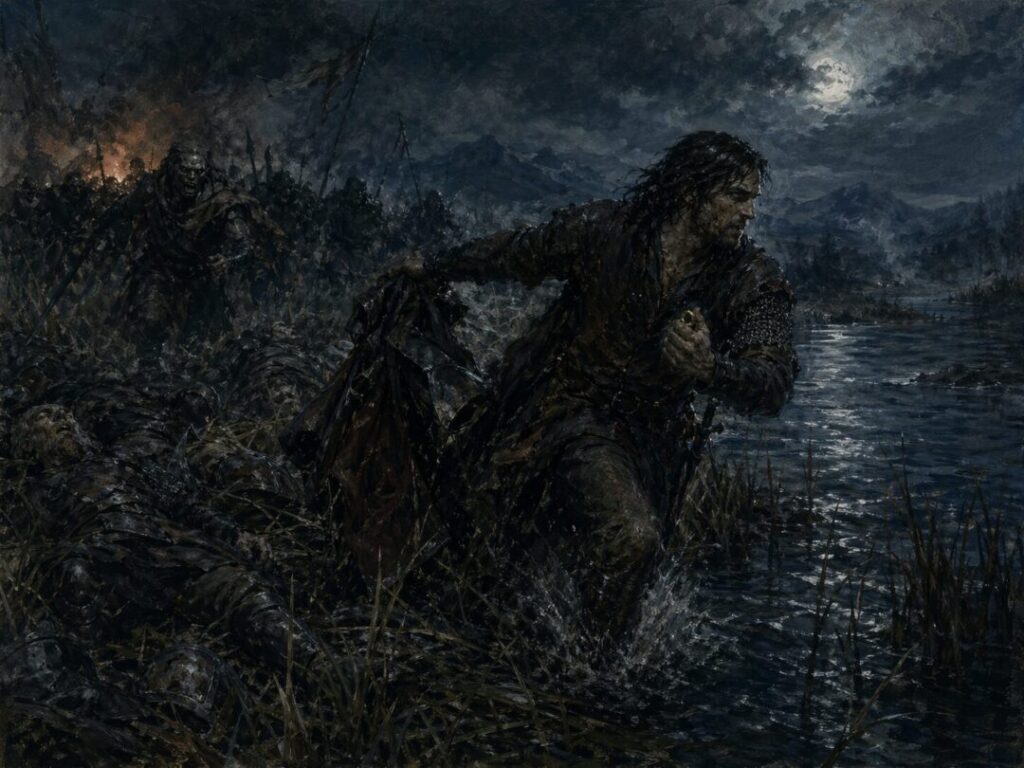
Isildur is traveling north from Gondor when his company is ambushed near the Gladden Fields. The attack is disastrous. At last he puts on the Ring and escapes as an unseen man. That much works. The Ring gives him the invisibility that lets him break out from the slaughter around him.
He reaches the Anduin, strips off his armor, and plunges into the river.
Then comes the crucial moment.
As he swims, the current bears him toward the tangles of the Gladden Fields, and there the text says the Ring betrayed him. It slips from him. A sudden despair comes upon him, so deep that for a moment he would have drowned himself. Then the mood passes, “as if a great burden had been taken away.” He reaches the bank, but now he is visible. Orcs see him as he rises from the water and shoot him down.
The wording matters.
The account does not say Isildur fumbled the Ring.
It does not say the river simply tore it away.
It says the Ring betrayed him.
Why Did It Choose That Moment?
The strongest textual answer is also the simplest one.
Because the Ring was trying to return to Sauron.
That does not mean the Ring possessed full foresight. In fact, the irony of the entire history is that it abandoned Isildur and then failed to get back to Sauron at all, lying lost in the river for long years. So whatever will the Ring has, it is not the same as perfect knowledge. It is purpose without omniscience.
Still, the direction of its will is clear.
The Ring is made by Sauron, filled with much of his power, and ordered toward his domination. If it can preserve itself, if it can work subtly on bearers, and if it can abandon a bearer once he no longer serves its path, then its action at the Gladden Fields fits the pattern exactly. Isildur at that moment is not its master. He is only its temporary keeper.
This is what makes the scene darker than a simple moral lesson.
The Ring does not “betray” Isildur because it has suddenly judged him unworthy.
It betrays him because betrayal is built into its nature. It serves power alone, and only in the end the power from which it came.

Was Isildur Already Under Its Full Control?
The texts do not support saying that.
They do support saying that he had already fallen into its hold in a serious way. He kept it when warned not to. He prized it. He concealed it. And in the ambush, Elendur’s plea to him is telling: “Take your burden” and bring it to the Keepers. Even in this late hour, the Ring is spoken of as a burden, not a rightful prize.
But there is also a tragic restraint in the account.
When the Ring leaves him, Isildur feels the burden lift. That suggests not mastery regained, but the sudden removal of a pressure he had already been carrying. He dies almost immediately after, and so the text never shows us what repentance or recovery might have looked like in full.
That is why it is safer to say this:
Isildur had already been ensnared by the Ring, but the sources do not justify claiming he had become nothing more than its puppet. The tragedy is sharper than that. He is still a great man, and still capable of ruin.
The Ring’s “Betrayal” Is Part of a Larger Pattern
Once Isildur is set beside Gollum, the pattern becomes hard to miss.
Gandalf says the Ring abandoned Gollum because Gollum had become useless to it. That statement is not about accident. It is about intention, as far as one can speak of intention in the Ring at all.
The same logic illuminates Isildur.
The Ring serves a bearer for a time, but never faithfully.
It does not belong to Isildur because he seized it.
It does not belong to Gollum because he hid with it.
It does not even truly belong to Frodo, who carries it with greater mercy than either of them.
The Ring remains ordered toward Sauron, and everyone else is only a stage in its passage.
That is why calling it a betrayal is so exact.
A betrayal assumes trust where no trust should ever have existed.
Isildur treated the Ring as heirloom, treasure, compensation, possession. But the Ring was never his. The moment his use to it ended, it revealed the truth.
Why This Moment Matters So Much
Isildur’s death is often remembered as the first great warning of the Third Age.
It is that.
But it is also one of the clearest revelations of what the Ring actually is.
Not only a symbol of evil.
Not only a test of character.
Not only a device that tempts.
It is a thing made for domination, carrying the imprint of a master it seeks in its own dark way. And because of that, it cannot be kept safely even by the man who took it in victory.
So why did the One Ring betray Isildur?
Because Isildur made the fatal mistake of thinking he possessed it.
The deeper truth is that no one ever really does.
And once the Ring can no longer use the hand that wears it, the hand is left empty. Sometimes that emptiness comes with relief.
And sometimes, as it did for Isildur beside the Anduin, it comes one heartbeat before death.
Sources & Notes
- J.R.R. Tolkien, The Lord of the Rings, Book I, Chapter 2, “The Shadow of the Past” — has Gandalf explain that the Ring was trying to get back to its master and could “look after itself.”
- J.R.R. Tolkien, The Lord of the Rings, Book II, Chapter 2, “The Council of Elrond” — recounts Isildur refusing Elrond and Círdan’s counsel to destroy the Ring after Sauron’s defeat.
- J.R.R. Tolkien, The Lord of the Rings, Book I, Chapter 2, “The Shadow of the Past” — preserves Isildur’s scroll, including his “precious” wording and his desire to risk no hurt to the Ring.
- J.R.R. Tolkien, Unfinished Tales, “The Disaster of the Gladden Fields” — gives the fuller account of Isildur’s ambush, his escape with the Ring, and the Ring betraying him in the Anduin.
- J.R.R. Tolkien, The Silmarillion, “Of the Rings of Power and the Third Age” — frames the One Ring as Sauron’s ruling instrument, made with his power and directed toward domination.