The One Ring is never harmless.
That is the first thing to keep in view.
Wherever it goes, it works to possess, deceive, isolate, and bend the will of its bearer. It does not need a battlefield, a fortress, or a dark tower to begin its work. Bilbo feels its hold in the Shire. Gollum is consumed by it in the roots of the Misty Mountains. Frodo bears it through woods, roads, and peaceful lands, and it remains what it always is: Sauron’s ruling instrument, carrying within it a portion of his own will.
And yet the story also suggests something more exact.
The Ring does not feel equally dangerous in every place.
There are moments in The Lord of the Rings when its pull becomes sharper, its temptation more urgent, or its effect more exposed. These moments are not scattered at random. They cluster around certain kinds of places: places bound to Sauron, places haunted by the Nazgûl, places of unusual perception, and above all the place where the Ring itself was made.
That does not mean the text gives us a neat system.
It does not.
There is no passage laying out a rulebook that says the Ring gains tenfold force here, or works by a different law there. But the pattern is still there, and the pattern matters. The deeper logic seems to be that the Ring becomes more dangerous where its own nature is more directly answered by the place around it.
The Ring Is Not Just Evil — It Is Connected
The Ring is not merely a cursed object lying in the world like poison in a cup.
It is bound to Sauron.
The text repeatedly treats it as something carrying his power and acting in line with his will. It betrays Isildur in the Gladden fields. It slips away from Gollum when a new path back toward its master becomes possible. It works on each bearer by promising possession and power, not by brute force alone.
This is important because it means place matters.
If the Ring contains part of Sauron’s native force, then places shaped by Sauron, watched by his servants, or tied to the making of the Ring are not neutral surroundings. They are environments where the Ring’s own alignment with the Dark Lord becomes more immediate. That does not require the Ring to “wake up” in a literal new way. It is enough that the bearer stands where the pressure around the Ring matches the pressure within it.
In other words, the Ring is most dangerous where Middle-earth itself begins to answer it.
Weathertop Shows the Pattern Early
The first clear sign of this comes long before Frodo reaches Mordor.
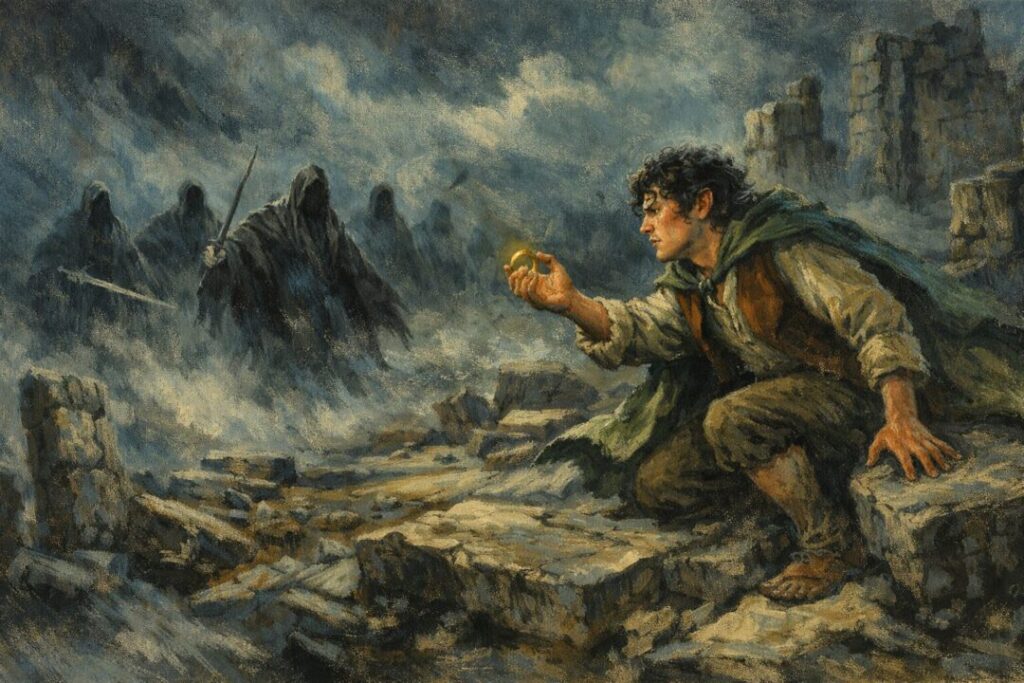
At Weathertop, Frodo is not in Sauron’s land. But he is under direct pursuit by the Nazgûl, who exist in a relation to the Ring unlike that of ordinary enemies. In that moment, their presence fills him with an irresistible temptation to put the Ring on. When he does, he sees the Ringwraiths as they appear in their own realm, and the act makes him more vulnerable, not less.
That scene matters because it reveals something easy to miss.
The Ring does not merely help Frodo hide. In the wrong place, before the wrong beings, putting it on draws him closer to their mode of existence. The Nazgûl become clearer to him, and he in turn becomes more exposed to them. So even outside Mordor, the Ring becomes more perilous when the bearer stands close to powers already half within the wraith-world.
The place itself is not evil in the same sense as Minas Morgul or Mount Doom.
But the conditions are right.
And that is enough.
Amon Hen Makes the Ring Dangerous in a Different Way
Amon Hen is one of the most revealing places in the whole journey.
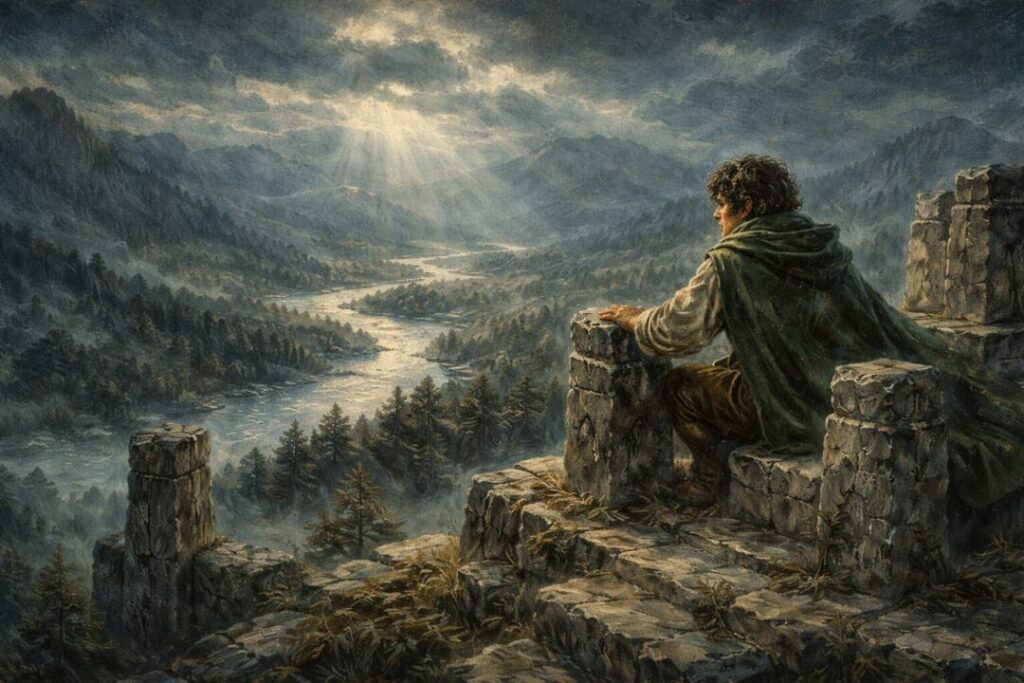
It is not a place of darkness in the ordinary sense. It is an ancient Gondorian hill of sight, crowned with the Seat of Seeing. Its significance lies not in corruption but in perception. Frodo goes there wearing the Ring, sits in that high place, and suddenly becomes the focus of immense reaching powers. He becomes aware of the Eye searching, and of a Voice commanding him to remove the Ring.
The text never gives a technical explanation.
So any exact mechanism here must remain interpretation.
But the implication is strong: the Ring becomes more dangerous in places where vision, will, and remote power are already concentrated. Amon Hen is a place built for heightened seeing. Frodo arrives there already burdened by the Ring. Once he sits in the Seat, what is latent becomes immediate. He is no longer merely carrying a perilous object. He is exposed through it.
That distinction matters.
At Weathertop, the danger came from fear and the Nazgûl’s proximity. At Amon Hen, the danger comes through revelation. The Ring is perilous there because it makes Frodo findable.
The Morgul Vale Combines Place, Wound, and Enemy Power
By the time Frodo enters the Morgul Vale, the burden has become far heavier.
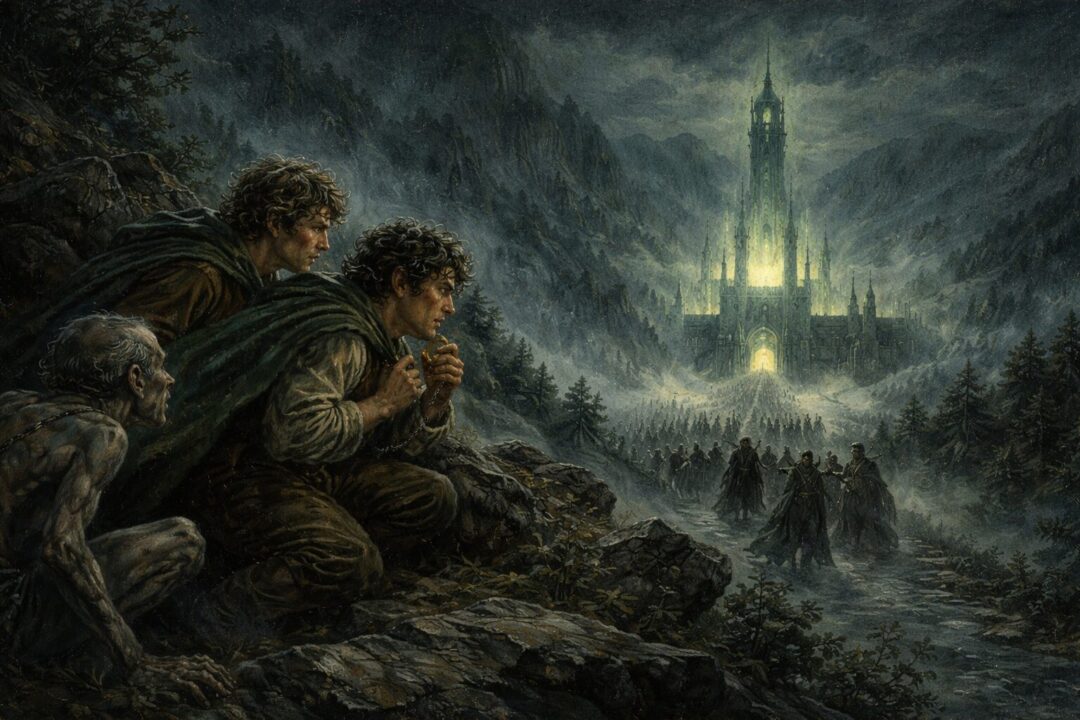
Now he is not only Ring-bearer. He is also carrying the long consequences of the Morgul wound from Weathertop, a wound explicitly tied to the dark enchantments of the Nazgûl and one that threatened to draw him toward wraithhood. When he sees the Witch-king leading an army out from Minas Morgul, he has to resist putting on the Ring yet again.
This is one of the clearest cases where place seems to matter.
Minas Morgul is not just another fortress. It is the Tower of Sorcery, long held by Sauron’s chief servant. Frodo is moving under its shadow, in sight of the Lord of the Nazgûl, while still marked by the wound given him on Weathertop. The story does not say, in so many words, that Minas Morgul amplifies the Ring as Mount Doom does. But it does show that in such a place the pressure to put it on becomes acute again.
So here the Ring’s danger is not only about location.
It is about convergence.
The Ring, the wound, the Witch-king, and the place all point in the same direction.
Mount Doom Is the Place of Maximum Danger
Then the story reaches the point where interpretation gives way to something firmer.
Mount Doom is not merely one more dark place.
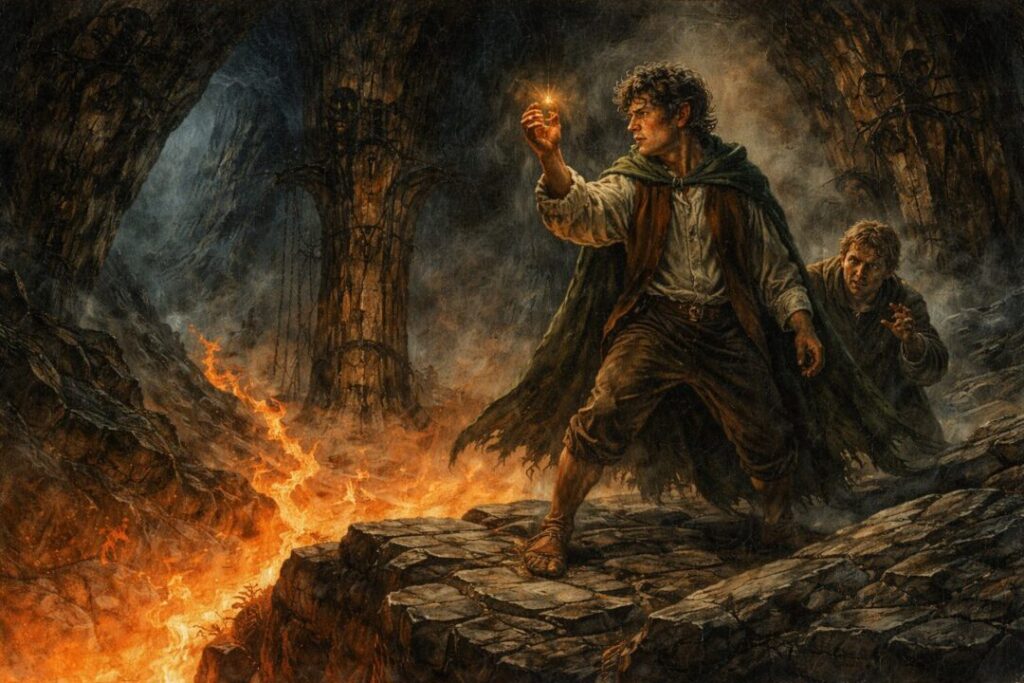
It is the place where Sauron forged the One Ring, and the only place where it can be destroyed. The Cracks of Doom lie within the Sammath Naur, and Barad-dûr itself was strengthened with the Ring’s power. This is the place of the Ring’s making, the physical heart of the bond between the Ring and its maker.
That alone would already make it unique.
But there is more.
In a letter explaining Frodo’s failure, Tolkien says it was impossible for Frodo to surrender the Ring at its point of maximum power. That line is crucial. It confirms that the Ring’s danger at Mount Doom is not just dramatic timing or simple exhaustion. Something about reaching the Fire where it was wrought brings the Ring’s hold to its highest intensity.
That does not mean Frodo becomes weaker in any merely moral sense.
Quite the opposite.
The point of the letter is that no ordinary incarnate creature could be expected to destroy the Ring there by bare will alone. Frodo’s failure is not presented as cheap collapse. It is the moment when the burden reaches its most impossible pressure.
And this fits the geography of the story perfectly.
The Ring is most dangerous where it is nearest both to its own source and to Sauron’s realm.
So Why Certain Places?
The best conservative answer is this:
The Ring grows more dangerous near certain places because some places answer its nature more directly than others.
Near the Nazgûl, it draws the bearer toward the wraith-world and exposure. At Amon Hen, a place of far-seeing, it becomes a channel of perception and discoverability. In the Morgul Vale, under the shadow of the Witch-king and with a Morgul wound still working in Frodo, its temptation sharpens again. At Mount Doom, where it was forged and where Sauron’s realm is strongest, its power reaches its height.
What the text does not support is a loose claim that every ancient or magical place makes the Ring stronger.
That is too broad.
Rivendell and Lórien do not function that way. They are places of preservation and resistance, not places where the Ring simply grows in strength. The pattern is narrower than that. The most dangerous places are those where the Ring meets either Sauron’s will, the machinery of domination he has built, or conditions that make its hidden effects more immediate.
The Ring Comes Closer to Home
That may be the clearest way to say it.
The Ring does not become a different object in these places.
It comes closer to home.
Near certain places, the bearer is no longer struggling against temptation in the abstract. He is standing where the world itself has been shaped to the Ring’s logic: mastery, surveillance, fear, domination, exposure, and the long reach of Sauron’s will. That is why Frodo’s burden changes as the road darkens. The closer he comes to places where the Ring belongs, the less the struggle feels like carrying something alien.
And the more it feels like the Ring is being welcomed back.