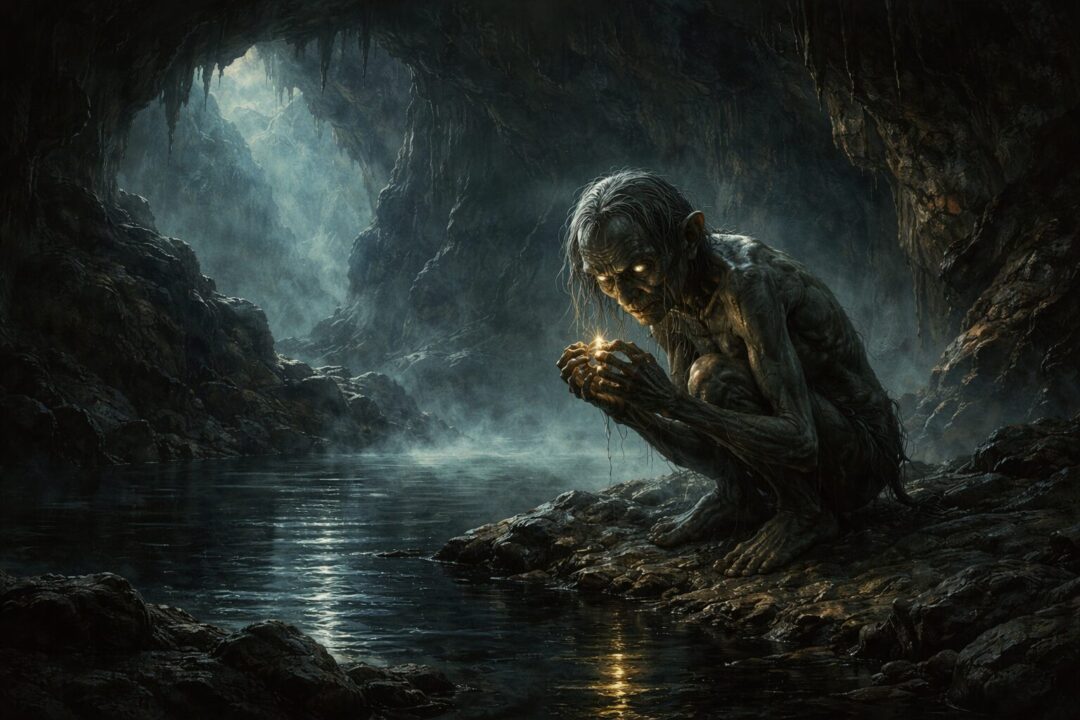
One of the quiet but essential truths of The Lord of the Rings is that the One Ring is not merely an object. It is not passive. It does not simply corrupt and wait.
The Ring acts.
It chooses.
And above all—it waits.
Nowhere is this more clearly revealed than in its long, twisted relationship with Gollum.
Gollum possesses the Ring longer than almost anyone else in recorded history—nearly five centuries. Longer than Isildur. Longer than Frodo. Longer than Bilbo, even when their years are combined.
And yet, despite that extraordinary span of time, the Ring does not leave Gollum until the precise moment the wider story of Middle-earth begins to move again.
This is not coincidence.
And it is not accident.
The Ring Does Not Reward Loyalty
A common misunderstanding is that the Ring “favored” Gollum because of his devotion.
After all, no one clings to the Ring more obsessively. No one loves it more completely, or suffers more deeply for it. Gollum speaks to it, dreams of it, and structures his entire existence around it.
But the Ring does not value love.
It does not value loyalty.
It values usefulness.
The Ring’s primary drive is singular and unwavering: return to its maker, Sauron.
Everything else—temptation, corruption, domination—is only a means to that end.
Gollum serves this purpose for a long time, though not in the way he believes. His obsessive attachment keeps the Ring hidden but also preserved. He does not destroy it. He does not trade it. He does not hand it over to powers that might lock it away or unmake it.
In that sense, Gollum is the Ring’s perfect container.
But containers are not carriers.
And eventually, containment becomes a problem.
Why the Ring Stayed With Gollum for So Long
When Gollum first acquires the Ring, the world is quiet in a dangerous way.
Sauron is diminished, though not destroyed.
The Nazgûl are dormant, shadows without direction.
The Wise are vigilant, but restrained.
There is no active search. No open war. No clear path by which the Ring might return to Mordor.
In such an age, movement would be reckless.
If the Ring abandoned Gollum too early, it would risk falling into hands far more dangerous to its long-term survival: the Elves, who might hide it beyond reach; the Dwarves, who could lock it away; or even Men, who might destroy themselves with it in ways that stall its return entirely.
Lost in a river, buried in a hoard, sealed in a vault—any of these outcomes could delay the Ring’s purpose for ages.
Gollum, miserable and isolated as he is, provides stability.
He hides.
He guards.
He clings.
The Ring waits.
Gollum’s Isolation Becomes a Liability
As centuries pass, however, the world begins to change.
By the late Third Age, Sauron has risen again in Dol Guldur. His shadow spreads quietly but deliberately. The Nazgûl stir. Rumors, movements, and fears ripple outward.
The world is no longer static.
But Gollum is.
He has withdrawn completely from the affairs of Middle-earth. He avoids settlements, avoids roads, avoids power. He hides so deeply that even the Enemy struggles to locate him.
This is a crucial shift.
What once made Gollum a perfect hiding place now makes him useless.
The Ring cannot influence the world through him. It cannot draw attention. It cannot shape events. It cannot move closer to Mordor.
Gollum is no longer protection.
He is confinement.
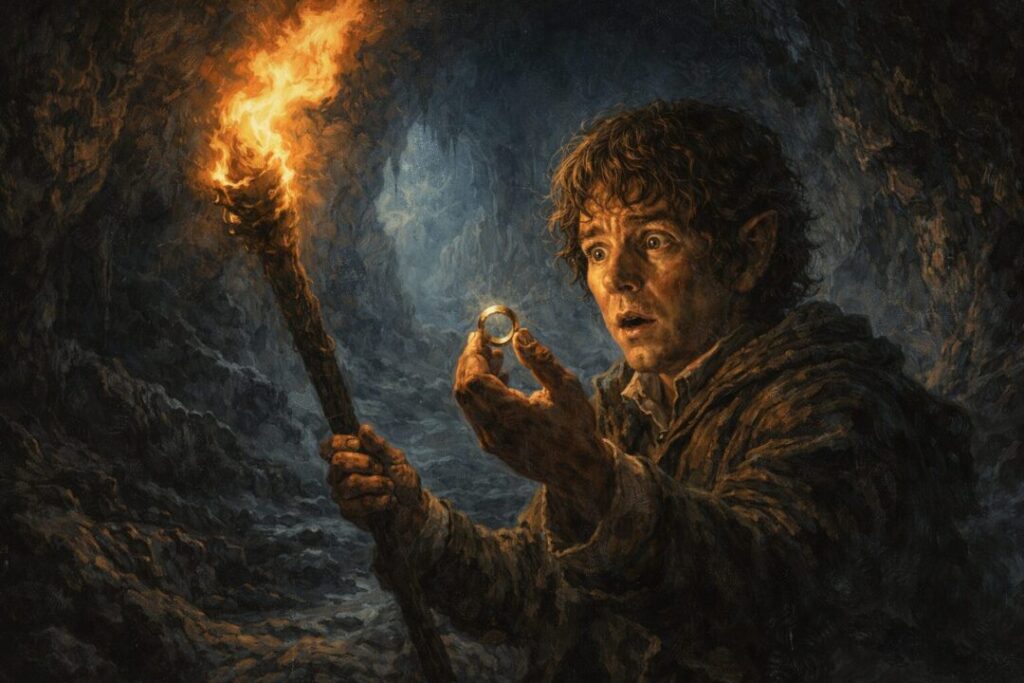
What Changed Beneath the Misty Mountains
By the time Bilbo Baggins enters the tunnels beneath the Misty Mountains, everything has aligned.
Sauron is active again.
The Nazgûl will soon ride.
Paths once quiet are stirring.
The Ring does not suddenly awaken—it has always been awake. But now, for the first time in centuries, it has options.
And Gollum cannot provide them.
The Ring’s Most Subtle Act of Will
When the Ring slips from Gollum’s finger, it does not leap into Bilbo’s hand. It does not glow. It does not call out.
It lies in darkness.
This moment is often overlooked, but it is one of the Ring’s most important acts of will. The Ring does not choose Bilbo as a person. It chooses possibility.
Bilbo is moving.
Bilbo is curious.
Bilbo is connected—however faintly—to the wider world.
And just as importantly, Bilbo is small.
Too small to alarm the great powers.
Too insignificant to draw immediate notice.
Yet mobile enough to travel, to wander, to carry the Ring out of its prison.
The Ring does not need a conqueror. It needs a bearer.
And Gollum will never carry it anywhere again.
Why the Ring Did Not Abandon Gollum Earlier
The answer is simple, and chilling.
Earlier abandonment would have achieved nothing.
Before this moment:
- The world was unready
- Sauron was too weak to reclaim the Ring
- A new bearer might lose it, hide it, or destroy its chances entirely
The Ring is patient. It measures time in centuries, not years. It can wait while the world ripens.
But once movement becomes possible—once roads open, enemies search, and shadows lengthen—the Ring acts.
Quietly.
Carefully.
And without mercy.
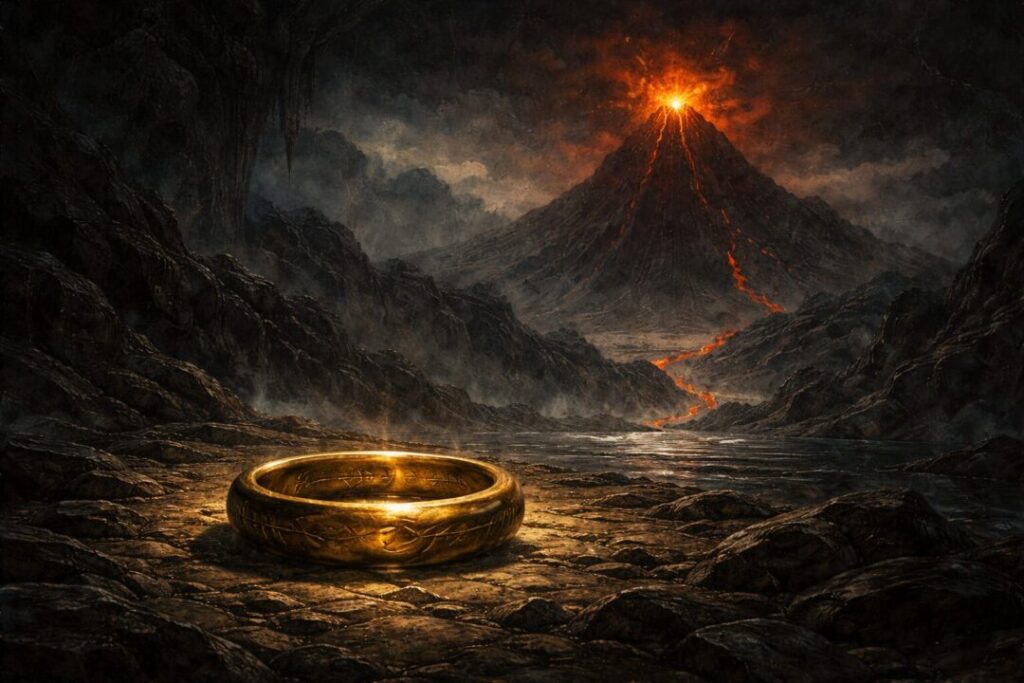
The Tragedy of Gollum
Gollum believes the Ring betrayed him.
From his perspective, this is true. The Ring abandons him at the moment he needs it most, plunging him into loss, rage, and obsession.
But the deeper truth is more devastating.
The Ring never belonged to him at all.
It does not punish Gollum for weakness. It discards him for irrelevance. And in doing so, it sets in motion the chain of events that will ultimately lead to its own destruction.
Because by abandoning Gollum, the Ring ensures that he will follow it.
Broken.
Enslaved.
Driven by need.
All the way to Mount Doom.
The Ring’s Greatest Failure
The Ring chooses efficiency.
Fate chooses irony.
By acting in its own best interest—by abandoning a stagnant bearer in favor of movement—the Ring unknowingly creates the conditions of its own undoing.
Gollum’s suffering does not end when the Ring leaves him. It intensifies. And that suffering binds him to the Ring more tightly than possession ever did.
In the end, it is not strength that destroys the Ring.
Not wisdom.
Not even deliberate sacrifice.
It is the long shadow of a choice the Ring made centuries earlier.
Middle-earth is shaped not only by battles and heroes, but by moments of quiet decision—moments when something ancient chooses to move… and cannot foresee the cost.